VLSI Korea
AWS from Inferentia to Trainium3: The Evolution of an AI ASIC with a Price Tag
From Inferentia1 to Trainium3, how AWS Neuron expanded from a chip into a 144-chip UltraServer and token-economics platform.


🆓 Free article · Anyone can read this article for free
This article is for readers comparing cloud AI accelerator architecture and system economics for purchasing, investment and supply-chain decisions. It separates peak specifications from model-level TCO and identifies the evidence that should validate the next generation.
Data cutoff: August 2, 2026
TL;DR
AWS did not begin with a frontier-training chip. It used Inferentia1 to reduce the cost of high-volume inference, extended the same Neuron software stack into Trainium1, and let Inferentia2 and Trainium1 share the NeuronCore-v2 architecture. Trainium2 moved the product boundary from chip to rack with eight third-generation NeuronCores, 96 GiB of HBM at 2.9 TB/s and a 64-chip UltraServer. Trainium3 advances to 3 nm, 144 GB of HBM3e at 4.9 TB/s, MXFP8 and MXFP4, and a 144-chip all-to-all domain built around NeuronSwitch.
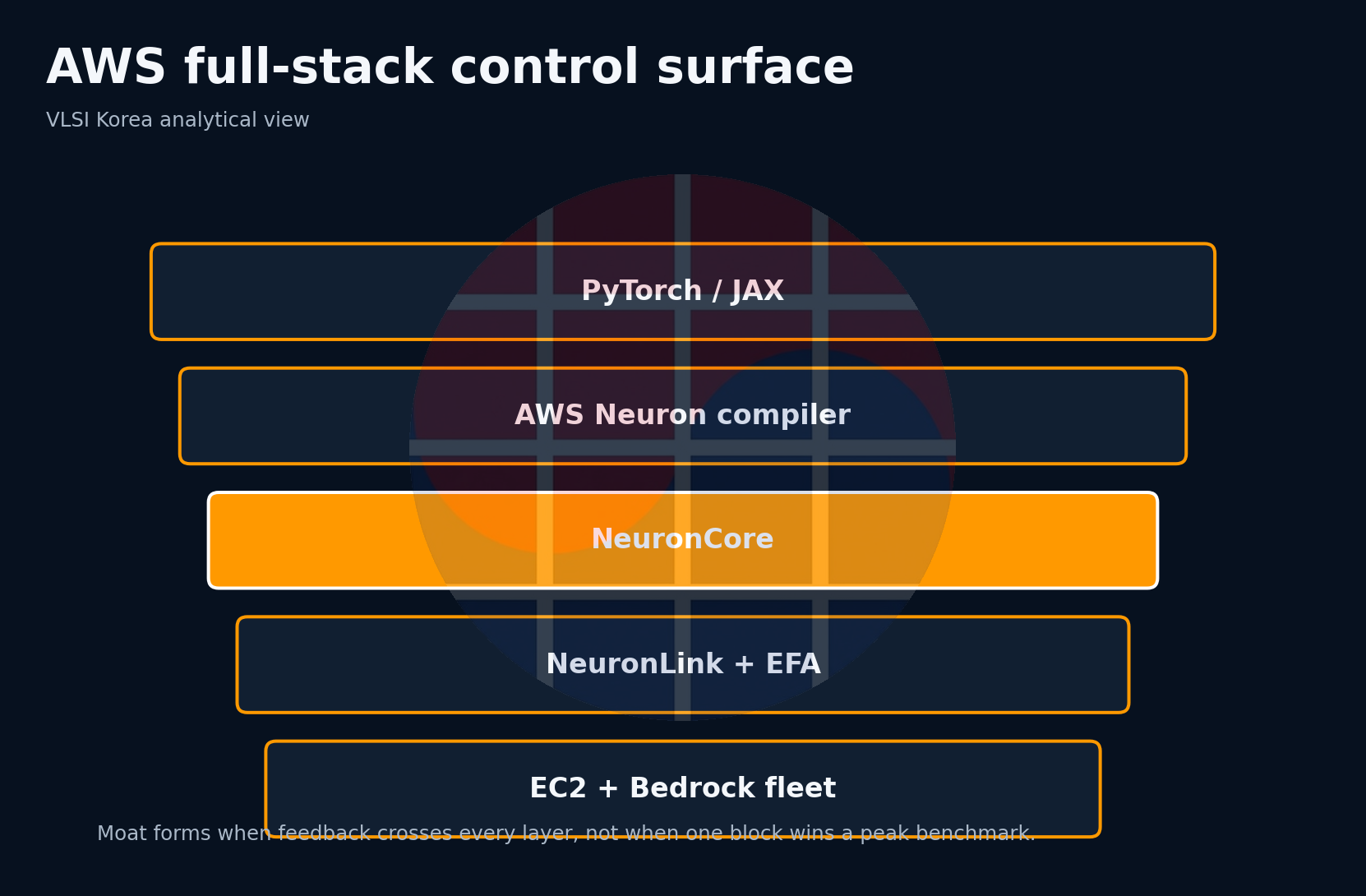
AWS's advantage is that the accelerator arrives as an EC2 instance, SageMaker job or Bedrock token with a visible price. Its weaknesses are operator coverage, compilation and debugging friction versus CUDA, and a runtime that does not leave AWS. Trainium's outcome depends less on peak PFLOPS than on whether anchor workloads such as Anthropic and Bedrock keep the fleet busy enough to pay down Neuron's software debt.
Generation map
| Generation | Primary role | Compute per chip | Memory per chip | Scale boundary |
|---|---|---|---|---|
| Inferentia1 | Inference | 128 INT8 TOPS / 64 FP16 TFLOPS | 8 GB DRAM, 50 GB/s | Up to 16 chips per Inf1 instance |
| Trainium1 | Training | About 190 FP16/BF16 TFLOPS | 32 GB HBM, about 0.61 TB/s | 16 chips per Trn1, up to 30,000-chip cluster |
| Inferentia2 | Distributed inference | 380 INT8 TOPS / 190 FP16/BF16 TFLOPS | 32 GB HBM, about 0.82 TB/s | 12 chips per Inf2 instance |
| Trainium2 | Training and inference | 1.3 dense FP8 PFLOPS | 96 GiB HBM, 2.9 TB/s | 64-chip UltraServer |
| Trainium3 | Training and inference | 2.52 FP8 PFLOPS | 144 GB HBM3e, 4.9 TB/s | 144-chip UltraServer |
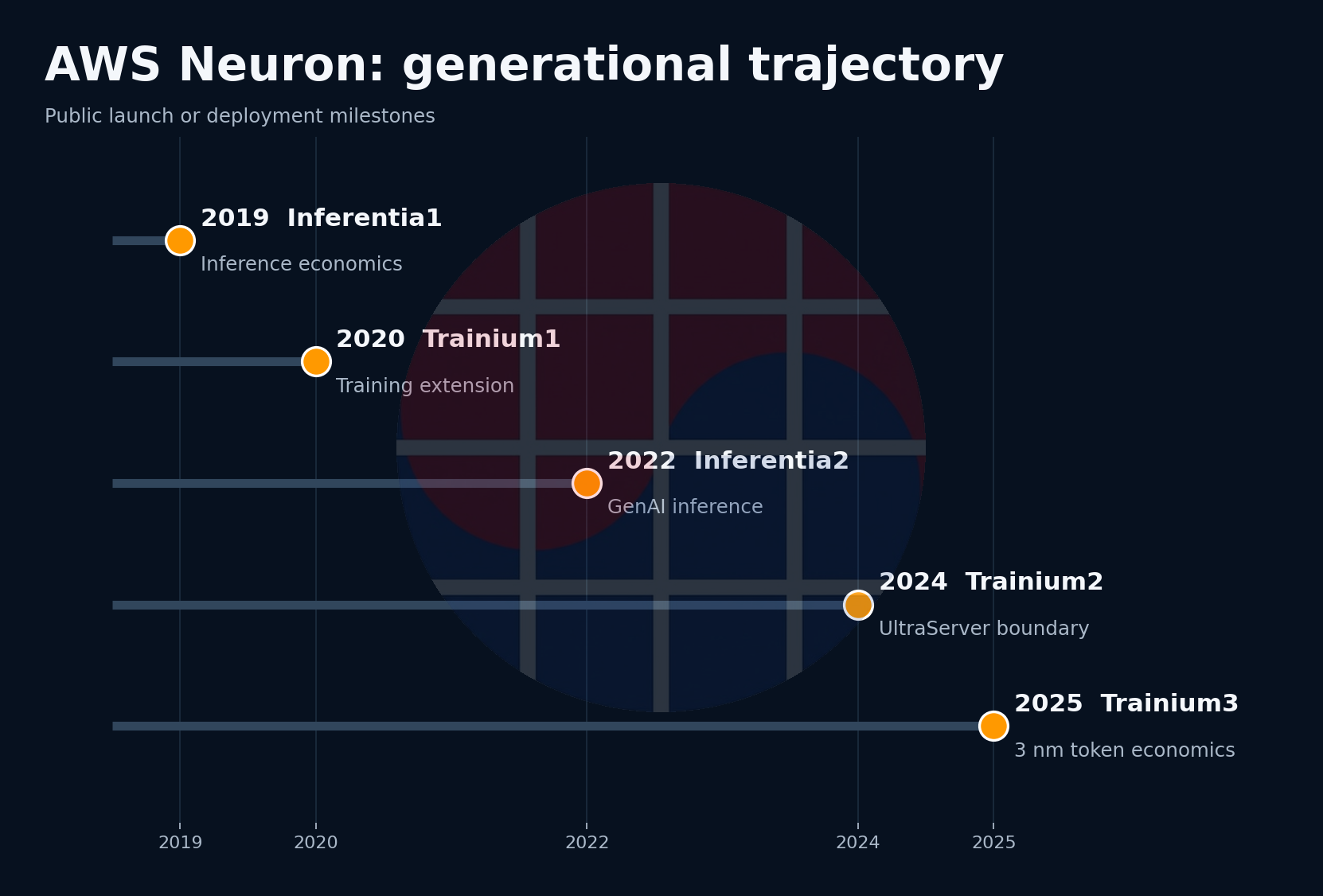
Trainium1's per-chip figure is derived from AWS's published 16-chip Trn1 aggregate and rounded. Trainium2's sparse 5.2 PFLOPS and Trainium3 UltraServer's 362 MXFP8 PFLOPS use different sparsity and format assumptions from dense FP8.
Inferentia1: the pragmatic place to start
Inferentia1 launched in 2019 with four NeuronCore-v1 units, 128 INT8 TOPS or 64 FP16/BF16 TFLOPS per chip, and 8 GB of DRAM at 50 GB/s. The specifications are small today, but the target was rational: image, recommendation, speech and NLP inference ran at much greater volume than training, had latency SLOs that constrained batching, and incurred a visible GPU bill.
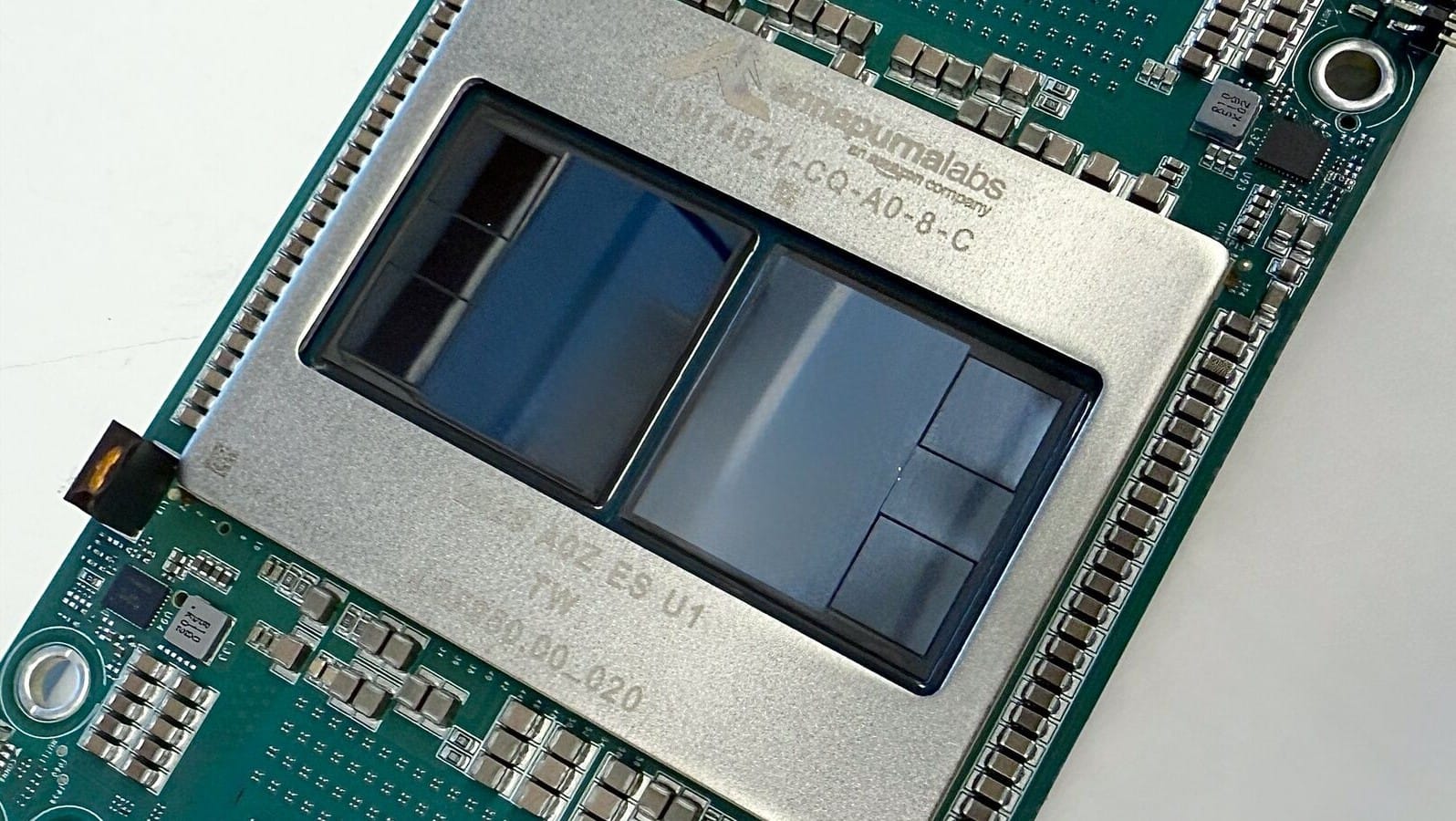
Four cores could host different production models or shards of one model. The 8 GB capacity and low bandwidth were not sufficient for large generative-model weights and KV cache, while chip-to-chip scaling was limited. AWS's lasting asset was therefore the Neuron compiler and runtime: a path from TensorFlow or PyTorch graphs to NEFF executables, drivers, deployment and monitoring. First-generation cost was dominated by unsupported operators, graph assumptions, compilation and immature profiling rather than silicon alone.
Trainium1: extending Neuron into training
Trainium1 used two NeuronCore-v2 units and 32 GB of HBM. A Trn1.32xlarge combined 16 chips, 512 GB of HBM, 9.8 TB/s of aggregate memory bandwidth and roughly 3 PFLOPS at FP16 or BF16. Intra-instance NeuronLink reached 768 GB/s; EFAv2 provided 800 Gbps between nodes and Trn1n doubled that figure. AWS described UltraClusters scaling to 30,000 chips and 6 EFLOPS.
Scalar, vector and tensor engines are all necessary because a Transformer is not a continuous stream of GEMMs. Normalization, activations, indexing, optimizer updates and control flow need programmable execution. GPSIMD, custom C++ operators, dynamic shapes, stochastic rounding and configurable FP8 softened the rigidity of an ASIC.
The system lesson was that EFA belongs in the chip roadmap. NeuronLink handles collectives inside a server and Nitro/EFA handles scale-out. Tensor, pipeline and data parallelism must respect the bandwidth boundary. A nominal 30,000-chip cluster is useful only when placement, compiler artifacts and topology-aware sharding make it productive.
Inferentia2: generative AI redesigns inference
Inferentia2 reduced the core count from four to two but made each core much larger. A chip delivered 380 INT8 TOPS, 190 FP16/BF16/cFP8/TF32 TFLOPS, 47.5 FP32 TFLOPS and 32 GB of HBM. Against Inferentia1, capacity rose four times and bandwidth 16.4 times. Inf2.48xlarge combined 12 chips, 384 GB of HBM and 2.3 PFLOPS, with NeuronLink moving model shards without a CPU round trip.
The conclusion was that inference also needs scale-up. A 175-billion-parameter model consumes roughly 350 GB for BF16 weights before KV cache and buffers. Twelve chips can contain it within one instance; smaller models can be replicated for throughput. AWS's claims of up to four times throughput and ten times lower latency are workload maxima. Autoregressive decode is governed by HBM bandwidth, collective latency, sequence length, batching, quantization and compiler version more than by peak arithmetic.
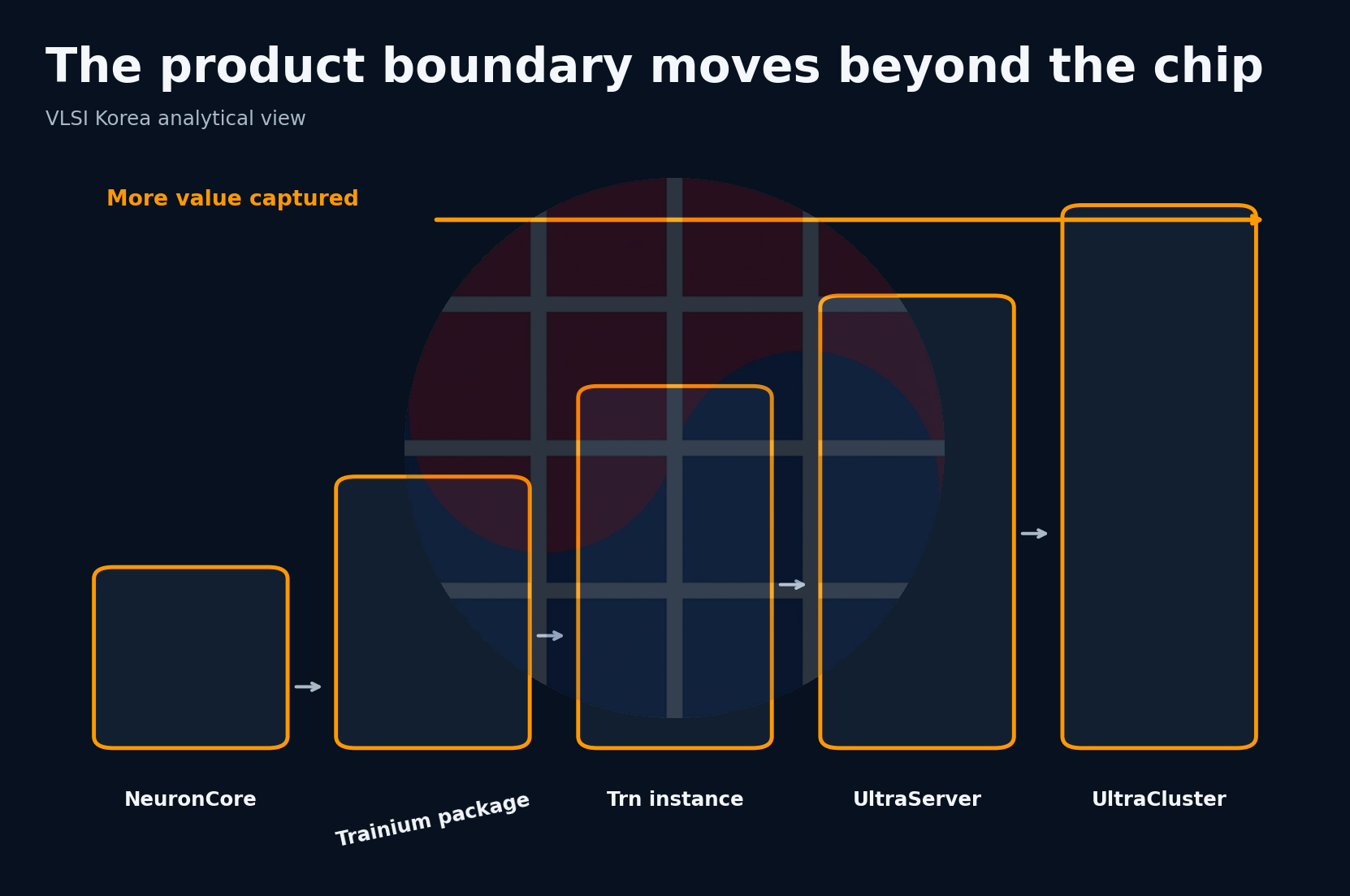
Trainium2: moving the boundary to an UltraServer
Trainium2 contains eight third-generation NeuronCores, 96 GiB of HBM at 2.9 TB/s, and 1.3 PFLOPS of dense FP8 peak compute. Structured sparsity raises the quoted peak to 5.2 PFLOPS. A Trn2 instance contains 16 chips and an UltraServer joins 64 through NeuronLink. AWS says automated HBM queue reordering can drive memory-bandwidth utilization to 95%.
A dedicated collective engine allows communication to overlap matrix work. This matters especially for MoE token dispatch and expert-result gathering. The 64-chip UltraServer places 6.144 TiB of HBM in one scale-up domain, potentially keeping model parallelism within a rack and reserving EFA scale-out for data parallelism. But connecting 64 chips is not the same as making them behave like one accelerator. Software must understand physical topology, contention, expert placement and failures.
Trainium3: 3 nm token economics
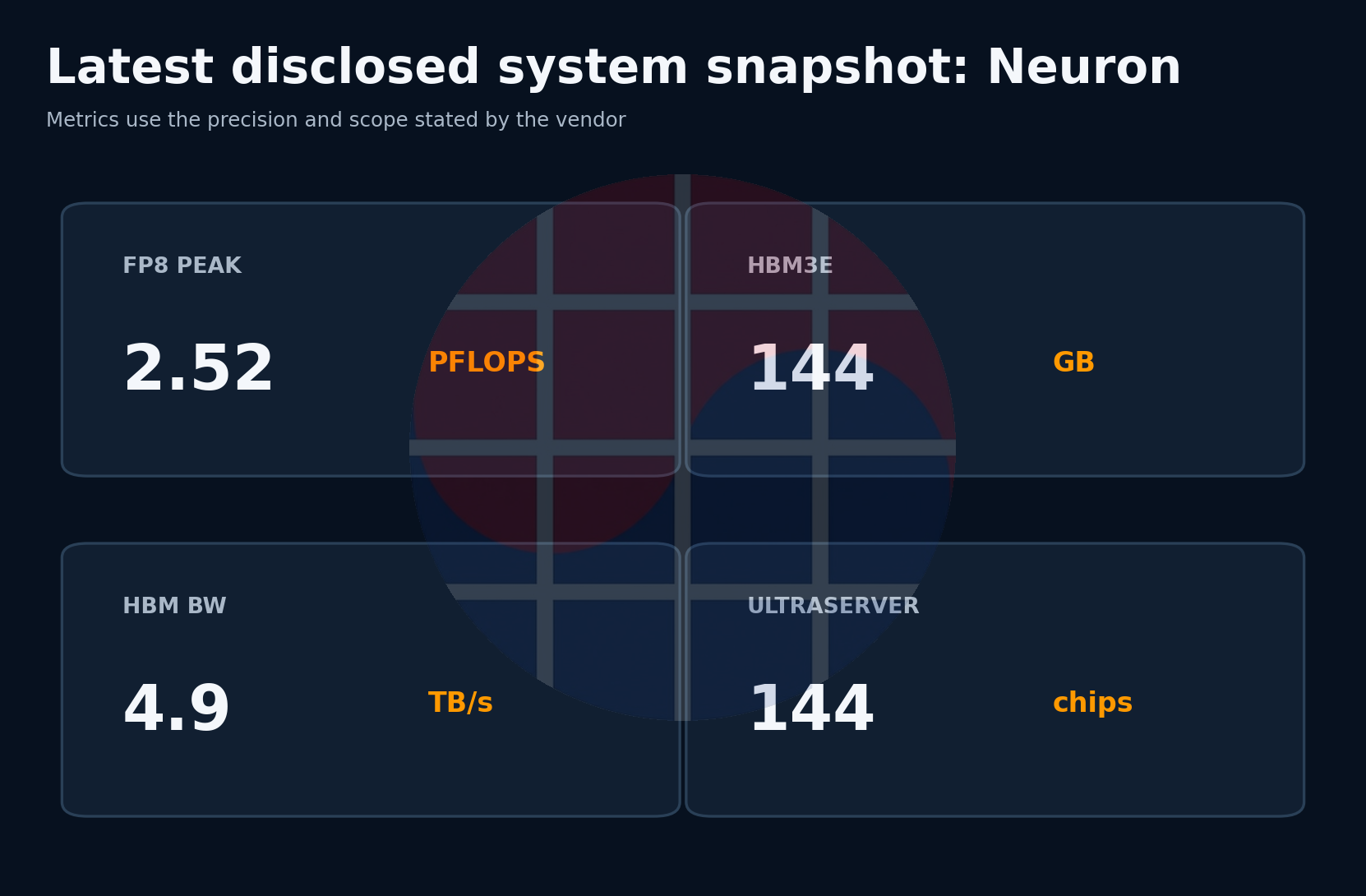
Trainium3 is AWS's first 3 nm AI chip. It provides 2.52 PFLOPS at FP8, 144 GB of HBM3e and 4.9 TB/s per chip, with support for FP32, BF16, MXFP8 and MXFP4. Compared with Trainium2, compute is roughly two times higher, capacity 1.5 times and bandwidth 1.7 times.
A Trn3 UltraServer contains as many as 144 chips, 20.7 TB of HBM3e, 706 TB/s of aggregate memory bandwidth and 362 MXFP8 PFLOPS. NeuronSwitch-v1 and NeuronLink-v4 provide a 2 TB/s per-chip all-to-all fabric; UltraCluster 3.0 targets hundreds of thousands of chips. AWS's claims of up to 4.4 times the performance, 3.9 times memory bandwidth and four times performance per watt versus a Trn2 UltraServer combine the chip transition with a rise from 64 to 144 chips and a different system topology.
Compute grows faster than memory bandwidth, so dense GEMM benefits more readily than decode and other memory-bound kernels. Larger memory and the bigger scale-up domain can nevertheless reduce model partitions and network hops. MXFP4 cuts weight traffic further, but accuracy recipes and conversion overhead determine whether that theoretical gain survives.
The stable release of the Neuron Kernel Interface is strategically important. NKI provides a Python-level escape hatch for ISA, tiles and schedules, enabling custom attention, quantization and fused optimizer kernels. Neuron releases in 2026 added Trainium3 scalar instructions, OCP FP8 and MXFP8, variable-length all-to-all and zero-copy host transfer. The software continues unlocking the silicon after launch.
AWS's economic model
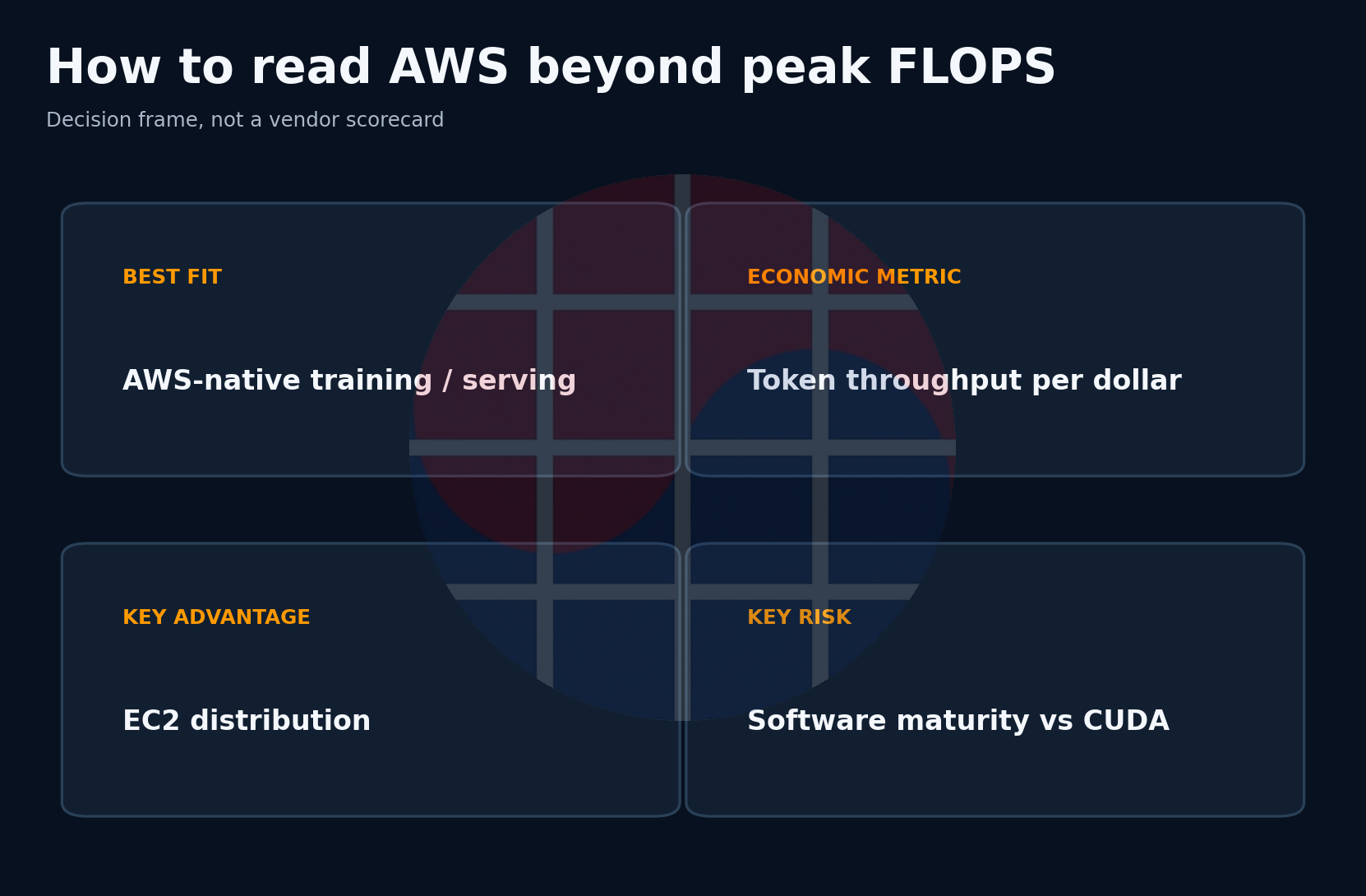
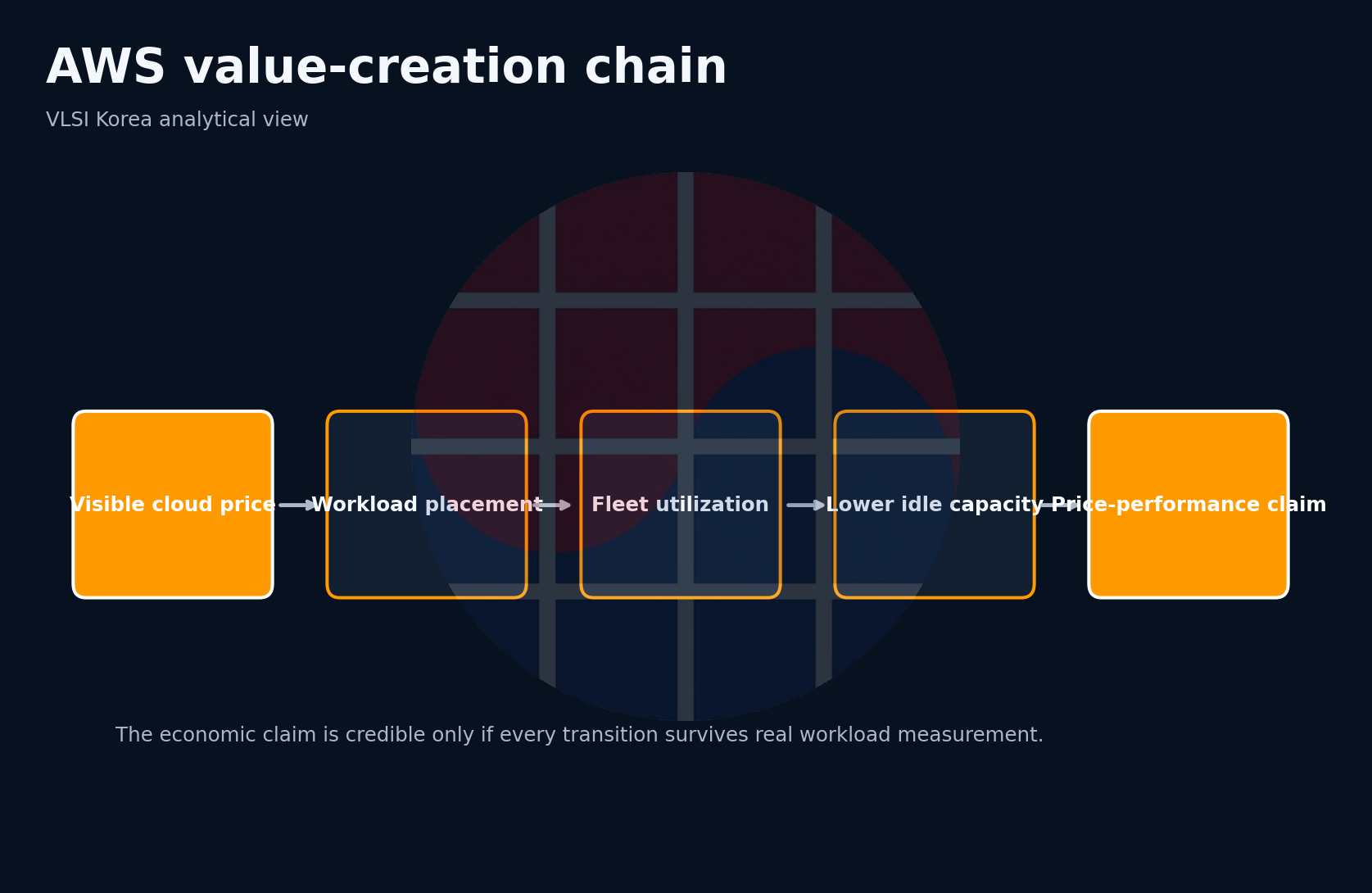
AWS sells EC2 time, SageMaker training and Bedrock tokens, not packaged chips. It can optimize fleet cost and service margin instead of die gross margin. Moving work from GPUs to Trainium reduces exposure to vendor margin and supply, while reservations, spot capacity and managed services improve utilization.
Using one Neuron stack for training and inference lowers some transition cost, but it does not create perfect binary portability. Training and serving differ in precision, parallelism and dynamic batching. Migration labor, compilation caches, validation and fallback capacity belong in the customer's true cost calculation.
Anchor tenants are therefore crucial. Repeated large workloads generate compiler feedback and absorb capacity. Bedrock can hide the hardware boundary altogether: a customer buying a token service does not need to program Neuron directly, and AWS can change the accelerator behind the endpoint.
Watch points
- Sustained HBM utilization and model FLOPS utilization across dense, MoE, long-context and video workloads.
- Failure isolation and collective tail latency in the 144-chip NeuronSwitch domain.
- Whether NKI and Neuron Explorer reduce CUDA porting, compilation and numerical-validation time.
- Whether Trainium absorbs the inference roadmap or a separate Inferentia3 restores an inference-specific balance.
- Whether Bedrock token prices and EC2 instance prices pass utilization and energy gains to customers.
Contrarian read
AWS distribution cannot hide weak developer economics forever. Neuron-specific kernels and sharding reduce portability for customers that must run across clouds or on premises. “No PyTorch code changes” often describes functional porting, not the work required to recover performance.
The opposite hypothesis may be more important: enterprise customers increasingly buy APIs and containers, not accelerator programming models. If Bedrock hides model, runtime and hardware behind an SLA and price, the relevant success metric is not developer affection but AWS's ability to deliver an equivalent token more cheaply.
Korean lens
For Korean NPU companies, AWS demonstrates that frontier training need not be the first market. Repetitive inference can finance the compiler and operating stack before training is added. It also shows why a chip sale alone cannot reproduce hyperscaler economics: instances, model services, anchor workloads and long-term capacity convert lower silicon cost into a service margin.
For component suppliers, the opportunity extends beyond HBM and advanced packaging. A 144-chip UltraServer multiplies switch silicon, connectors, optical modules, rack power and liquid-cooling requirements. Qualification bottlenecks distribute across the entire NeuronSwitch and EFA hierarchy.
Sources
- Inferentia1 and Inferentia2 architecture evolution
- EC2 Inf2 instances
- EC2 Trn1 instances
- Trainium1 GA
- Trainium2 and Trn2 UltraServers
- Trainium3 UltraServers
- AWS Neuron 2.29
- AWS Neuron 2.30
Disclosure
This article is for informational purposes only and does not constitute a recommendation to buy or sell any security. Figures and facts are based on publicly available corporate disclosures, media reports and market research, and errors may occur in the source material or writing process. The author may hold shares of companies mentioned. Readers are solely responsible for all investment decisions and outcomes.