VLSI Korea
Siemens to Acquire Precision Innovations: Not an OpenROAD Takeover
Siemens has not completed the acquisition. It signed an agreement on July 20, 2026 to acquire Precision Innovations Inc., with closing expected in calendar Q3 2026 subject to customary conditions.


🆓 Free article · Anyone can read this article for free
Core thesis: Siemens is not buying exclusive rights to OpenROAD. It is buying the commercial layer that can connect open code to enterprise design decisions and production tool flows.
1. Deal facts: Siemens has not completed the acquisition
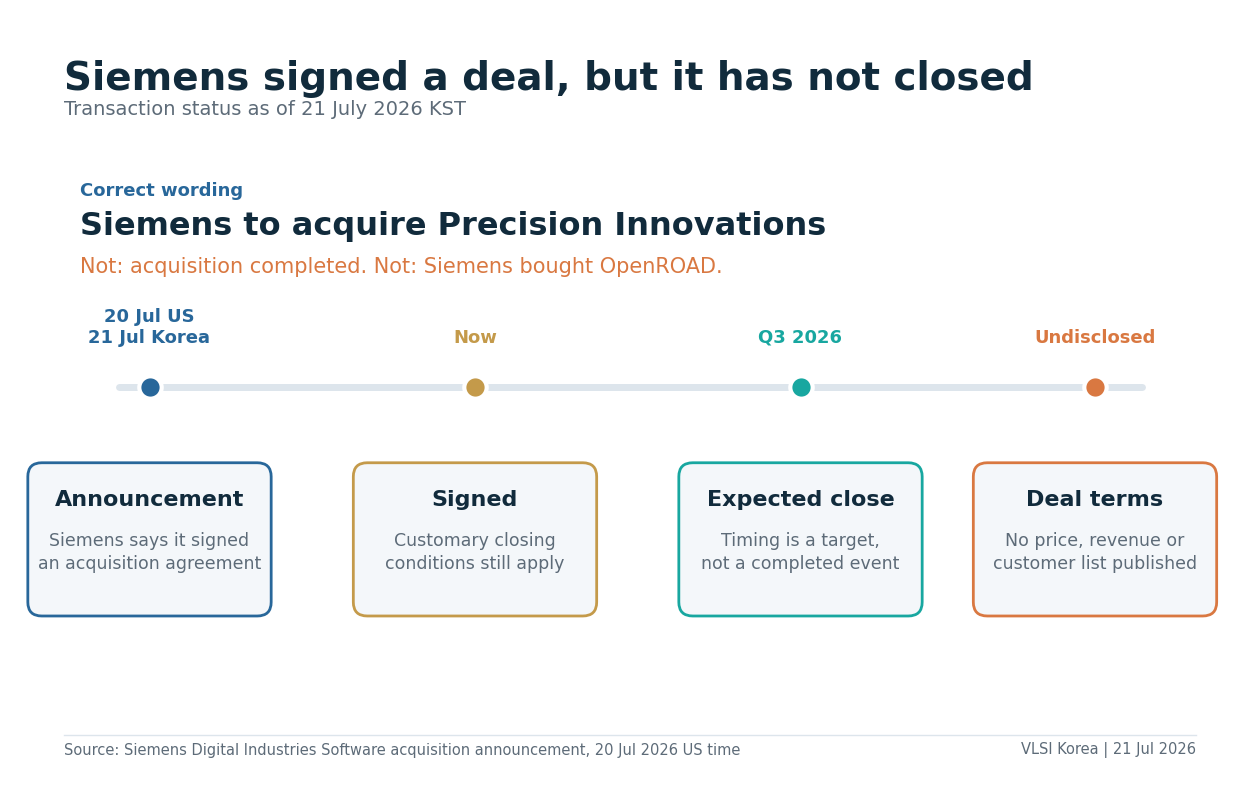
Interpretation: The accurate verb today is 'agreed to acquire,' not 'acquired.'
Siemens's official release says the company signed an agreement to acquire privately held Precision Innovations Inc. The US distribution was timestamped July 20, 2026, while Siemens's regional newsroom page is dated July 21.
Calling it a completed acquisition is one step too far. The release expects closing in calendar Q3 2026, subject to customary closing conditions, and does not disclose the price or other financial terms.
The identity of the target also needs precision. Discussion sometimes shortens the company to 'Precision EDA,' but the legal target is Precision Innovations Inc., founded in San Diego in 2019.
This is not a minor wording issue. Before closing, conditions can remain outstanding, retention and integration plans are not final, and the announcement alone cannot establish a change in OpenROAD governance.
Siemens says Precision Innovations solutions are used by leading semiconductor and technology companies. It does not name customers or disclose contract size, recurring revenue, process nodes, or production status, so the adoption statement remains a company claim.
The transaction's direct financial materiality cannot be calculated either. Siemens reported FY2025 revenue of EUR78.9 billion and net income of EUR10.4 billion in the same release, but Precision Innovations revenue and the purchase price are missing.
VLSI Korea inference: Precision Innovations described a team of 20 employees and contractors in a 2024 presentation. Relative to Siemens, the deal is more likely to matter first as a talent, technology-direction, and workflow-control transaction than as a near-term group earnings event, but that is a scale inference rather than a purpose stated by Siemens.
2. Siemens is not buying OpenROAD itself
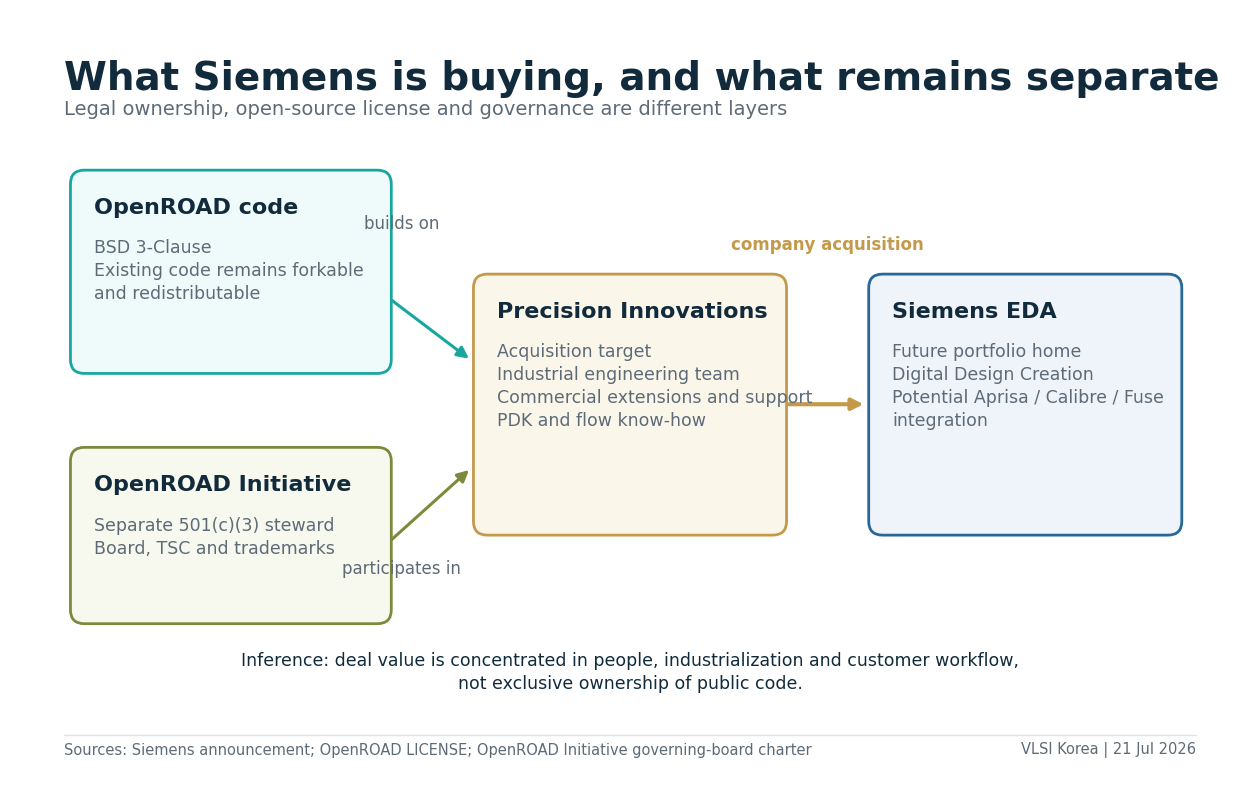
Interpretation: Open code and valuable commercial execution around that code can coexist without sharing the same ownership boundary.
The OpenROAD license is BSD 3-Clause. Anyone can use, modify, and redistribute the public code under its conditions, so acquiring Precision Innovations does not turn the published repository into a Siemens-exclusive asset.
The neutral legal steward is also separate. The OpenROAD Initiative describes itself as a 501(c)(3) nonprofit, and its published charters assign trademarks to the nonprofit and define open technical governance.
Precision Innovations is a commercial company operating around that structure. The company and its DAC 2024 materials describe PII as a principal industrial developer and integrator of OpenROAD and a provider of professional support.
According to PII, its commercial work includes secure regressions, custom features, foundry-technology support, and integrated RTL-to-GDS flows. Those services bridge the gap between downloading a public repository and buying reproducible support against an enterprise schedule.
That makes the acquired economic unit broader than source code. It can include maintainer expertise, application engineering for customer flows, regression infrastructure, release accountability, and commercial technology for architecture exploration.
VLSI Korea inference: When source access is nonexclusive, the moat moves toward update speed, correlation methods, PDK and macro integration, incident history, and enterprise support. The deal announcement does not reveal the scope or exclusivity of those assets, so their value cannot yet be quantified.
Saying 'Siemens bought OpenROAD' creates two false impressions. Readers may infer that the license is closing, while contributors may infer that nonprofit governance automatically moves under Siemens control.
The accurate statement is that Siemens agreed to acquire Precision Innovations, a commercial company built around OpenROAD. The openness of the code and the ownership change of PII must be tracked separately.
3. The technical asset is early decision feedback, not just faster RTL-to-GDS
Interpretation: The strategic unit is not one fast GDS file. It is the number of bad architectures a team can discard before production implementation.
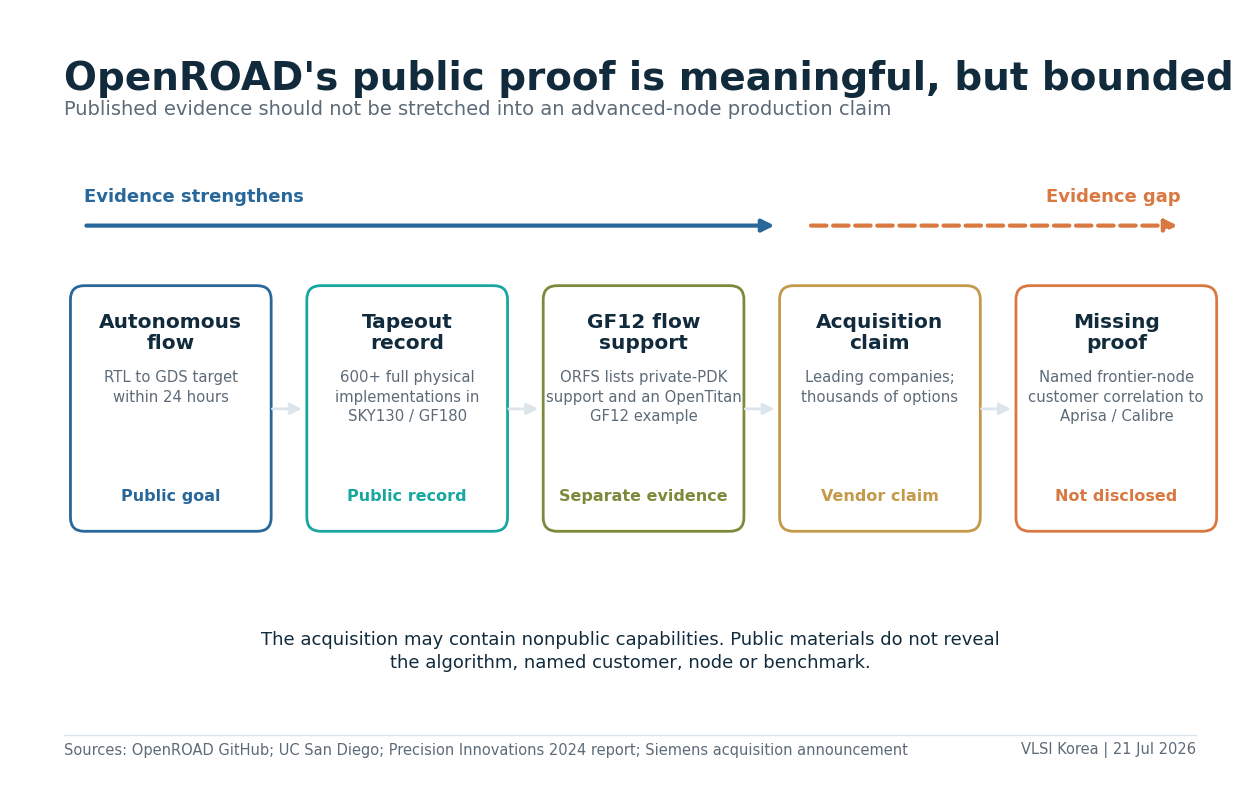
Precision Innovations promotes autonomous OpenROAD-based RTL-to-GDS in 24 hours with limited human intervention. That number is a target or vendor claim, not an independently verified service guarantee across every node and customer design.
The more useful interpretation is not producing one final layout faster. It is running many architecture and RTL variants through a cheap physical proxy, observing the direction of congestion, timing, area, and power, and discarding weak candidates before they consume production-tool capacity.
The OpenROAD Initiative's Ascenium example uses a predictive ASAP7 PDK and an integrated flow to return physical feedback during microarchitecture selection. The public example is about design-space exploration and feasibility rather than tapeout signoff.
The OpenROAD README reports more than 600 full physical implementations in SKY130 and GF180 MPW and ChipIgnite contexts. ORFS separately lists private GF12 support and an OpenTitan GF12 implementation example, but that does not mean the 600 tapeouts occurred at 12nm. Both are meaningful ecosystem evidence, yet neither is a single dataset exposing customer, node, signoff scope, and measured silicon for every design.
Precision Innovations said in 2024 that it supported commercial foundry technology from 180nm down to 12nm. Its broader language about fast estimation or feasibility on any node must remain a company claim and should not be converted into a public benchmark for production correlation below 7nm.
Fast proxies have structural error. Predictive or abstracted PDKs, incomplete macro and IP models, simplified clocks, power intent, and routing rules can change the ordering of PPA candidates when the design enters a real foundry kit and full signoff corners.
The most valuable post-acquisition evidence is therefore not a count of explored variants. It is a correlation table showing the absolute error and rank preservation when the same RTL and constraints move from the OpenROAD proxy to Aprisa production implementation and final signoff.
VLSI Korea inference: If Siemens can accumulate this correlation by node and design class, PII becomes an upstream decision engine rather than a paid wrapper around a free tool. If correlation is weak, faster exploration only allows teams to become confident in the wrong candidates more quickly.
4. The deal can fill the gap between Catapult and Aprisa, but overlap is real
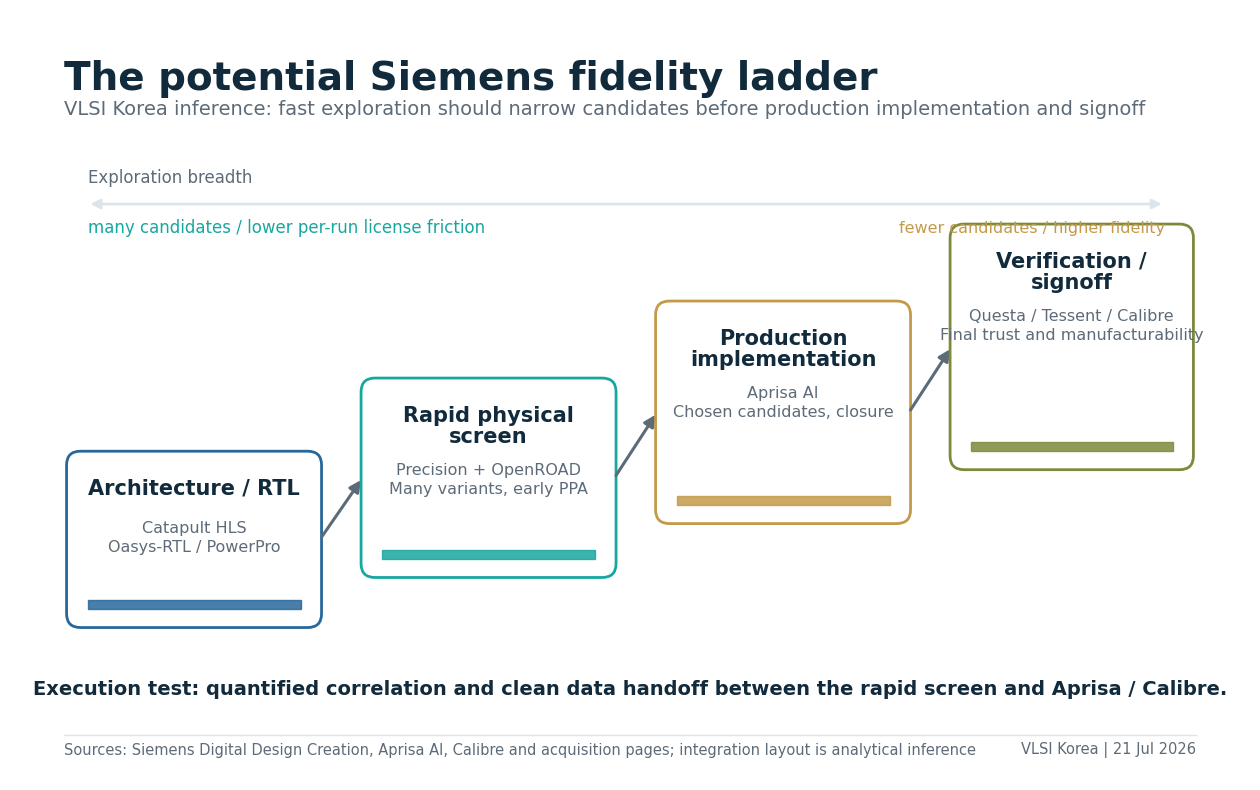
Interpretation: Portfolio synergy does not come from placing logos next to each other. It comes from moving the same constraints and evidence between stages without semantic loss.
Siemens's Digital Design Creation Platform includes Catapult HLS, PowerPro, mPower, Precision FPGA, Aprisa, and Tessent. Precision Innovations can fit into the fast physical-feedback layer between architecture or RTL creation and production P&R.
The potential loop is straightforward. Catapult generates architecture variants from C++ or SystemC, an OpenROAD-based proxy evaluates area, timing, and congestion quickly, and only surviving candidates move into Aprisa AI, verification, test, and signoff.
If that loop works, teams do not need to spend expensive production runs on every candidate. Architects receive feasibility feedback earlier, while backend engineers can reduce late returns of RTL that never had a realistic path to closure.
Siemens's 2026 Fuse EDA AI agent announcement describes orchestration from design through signoff and openness to third-party tools. Fuse could become the interface for this loop, but Siemens has not announced a concrete product architecture connecting Fuse and PII.
Overlap cannot be ignored. Aprisa AI already markets Design Explorer and AI-optimized production RTL-to-GDS, with claims of 10x productivity, 3x compute efficiency, and 10% better PPA.
Those are Siemens marketing claims, not an independent benchmark with a fully disclosed workload, baseline, node, and runtime definition. They also mean Siemens must redefine which objectives and design stages belong to PII if Aprisa already searches and optimizes design space.
The integration problem is semantic, not just a file-format issue. If SDC, UPF, macro abstractions, clocks, hierarchy, and routing constraints are interpreted differently by the proxy and production flow, upstream rankings will not survive downstream.
VLSI Korea inference: The strongest division of labor is a coarse-to-fine system in which PII searches broadly and cheaply while Aprisa performs narrow, high-fidelity production closure. The failure mode is two products repeating similar searches with different objectives and databases, increasing compute and support complexity.
5. Competitive advantage depends on public production proof, not AI feature count
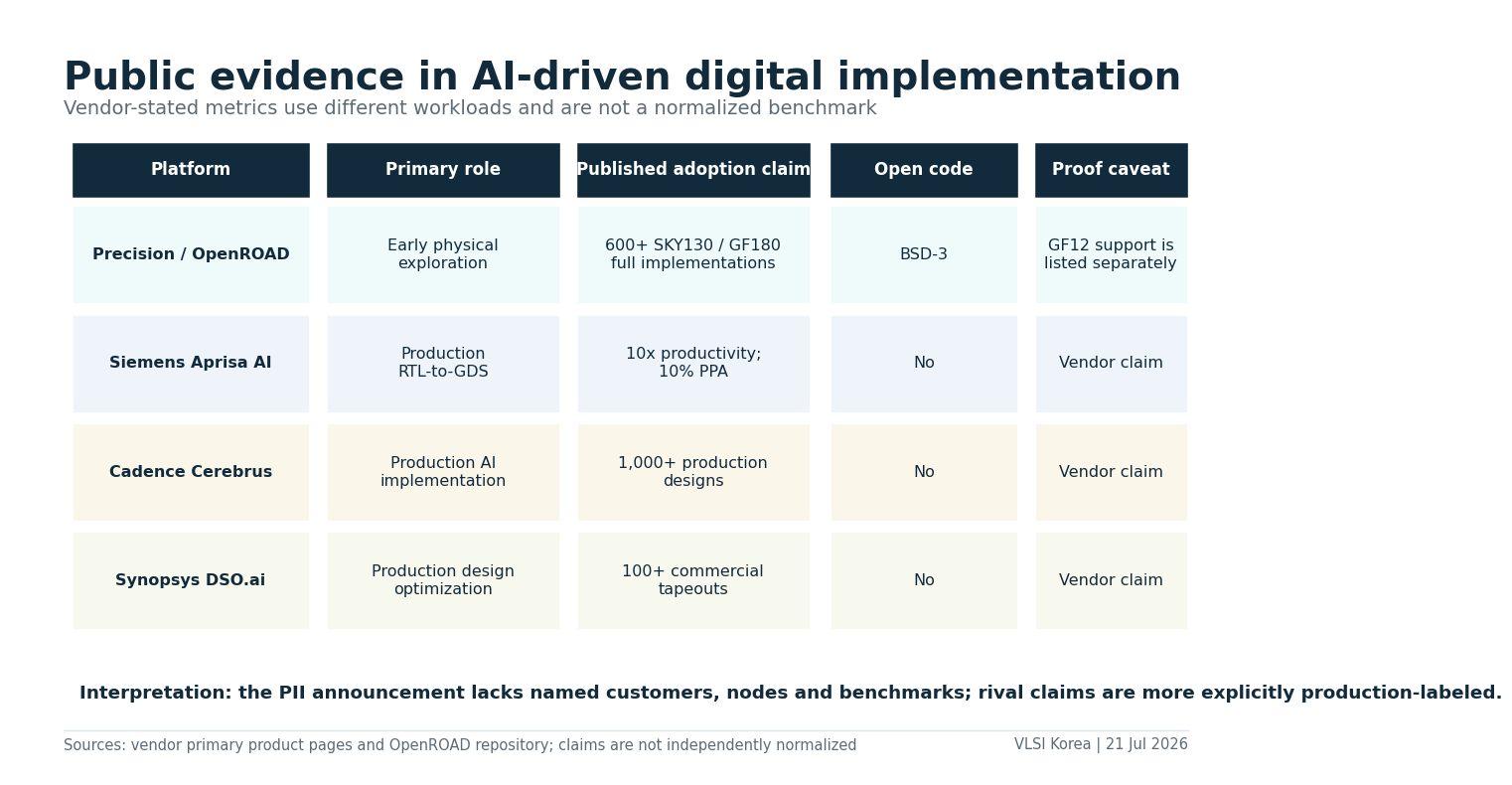
Interpretation: One thousand production designs, 100 commercial tapeouts, and 600-plus full physical implementations do not share a denominator and cannot be converted into market share by placing them on one chart.
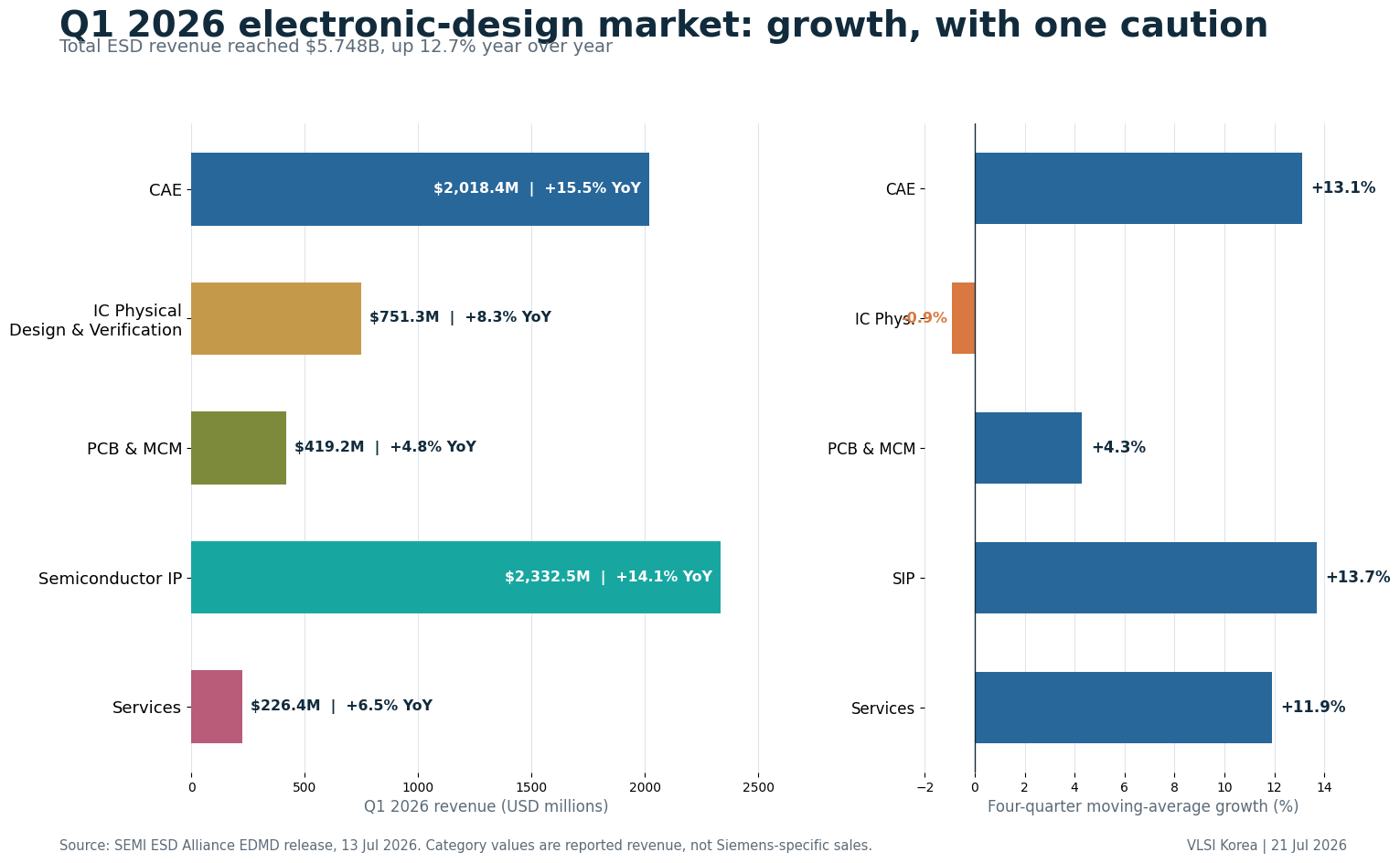
The SEMI ESD Alliance reported Q1 2026 electronic-system-design industry revenue of $5.7478 billion, up 12.7% year over year. CAE revenue was $2.0184 billion, up 15.5%; IC physical design and verification was $751.3 million, up 8.3%; and SIP was $2.3325 billion, up 14.1%.
These figures do not isolate AI EDA. They do show that software and IP spending is expanding at double-digit rates while architecture exploration and production optimization become new battlegrounds for wallet share.
Cadence says Cerebrus has been deployed on more than 1,000 production designs since its 2021 release. Cerebrus AI Studio promotes full-SoC, multi-block optimization and 5x to 10x delivery improvement, but public materials do not expose customer distribution or a common raw baseline.
Synopsys announced in 2023 that DSO.ai had reached 100 commercial tapeouts. This is a public claim from the author's employer and is used only as reported adoption evidence.
The OpenROAD project reports more than 600 full physical implementations in SKY130 and GF180 MPW and ChipIgnite contexts, while Aprisa AI presents productivity and PPA multipliers. Production design, commercial tapeout, full physical implementation, productivity, and PPA differ in unit and time period, so their chart heights cannot establish product quality or market share.
The asymmetry in public proof is still informative. Cadence and Synopsys emphasize cumulative production adoption, while the Siemens PII announcement refers to leading-company use and the exploration of thousands of options without naming customers, nodes, tapeouts, or baselines.
The fastest way for Siemens to narrow this gap is not to publish another multiplier. It is to show a customer-approved case study that follows the same design through early proxy correlation, Aprisa handoff, closure time, final PPA, and engineering hours.
License economics form a second competitive axis. OpenROAD can reduce seat friction when teams evaluate many early candidates, but if production signoff and enterprise support remain paid, total cost must include compute, integration, verification, and accountability rather than license price alone.
6. The business model is an open-source funnel with a correlation moat
Interpretation: Free OpenROAD does not remove the price tag from the product. It pushes paid value higher in the stack.
OpenROAD's BSD license lowers the friction of experimentation and education. Students, research teams, and startups can learn the flow with public PDKs, which means Precision Innovations and Siemens do not need to acquire every lead through a traditional license sale.
The funnel can monetize at three layers. The first is professional support and secure regression, the second is customer-flow and private-PDK integration, and the third is expansion into Aprisa and Siemens verification, test, and signoff products after a design survives exploration.
Design-space exploration requires many runs. When tool seats become the bottleneck in early search, teams reduce search breadth; OpenROAD can lower that license friction and allow more candidates to be evaluated.
An open-source funnel is not automatically a good business. If community code is sufficient, support attachment can stay low, and if PII results transfer easily to any production tool, Siemens may capture little downstream wallet.
The strongest moat could instead form in node- and design-class correlation methods, the structure of regression corpora, expert application engineering, and incident-resolution time. The acquisition announcement does not disclose the scope or exclusivity of any such assets.
VLSI Korea inference: Siemens can treat OpenROAD popularity as a distribution channel that enters customer workflows at the architecture stage, rather than only as a zero-price threat to paid tools. Under this interpretation, PII moves the start of the customer journey upstream and creates an option on later enterprise conversion.
The cost structure also changes. A community can share development of the open core, but enterprise qualification of PDKs, security, support, and long-term maintenance remains a corporate expense, so gross margin depends on the support mix.
Without transaction terms or PII financials, return on investment cannot be modeled. Observable 12-month signals include paid-support customers, public reference flows, Aprisa attachment, upstream contribution, and node-level correlation reports.
7. The largest risks are correlation, handoff, and trust, not immediate privatization
Interpretation: An open license guarantees the right to fork. It does not guarantee the speed of core development or enterprise trust.
The first risk is correlation. Listed GF12 flow support and an implementation example do not establish the same fidelity for private PDKs below 7nm, advanced routing rules, foundry signoff, large macros, multi-voltage designs, or complex clocking.
The proxy does not only need accurate absolute PPA. Candidate A must remain better than candidate B in the production flow, which requires measured rank correlation by node and block type.
The second risk is handoff. If PII and Aprisa use different databases, objectives, or constraint interpretation, the scripts and learning accumulated upstream will not be reusable downstream.
The integration team needs a reproducibility contract more than a unified interface. Versioned reports should define what remains consistent for the same RTL, libraries, SDC, UPF, and macros, and what differences are allowed.
The third risk is ecosystem trust. The OpenROAD Initiative board charter gives Principal Members representation and defines the board voting structure, while the TSC charter provides processes for committers and technical governance.
This structure prevents Siemens from automatically controlling the project by buying PII. However, if a large share of key maintainers works for one company, roadmap priority, review latency, and contribution velocity can still develop a bus-factor problem.
As of July 2026, the OpenROAD Initiative site lists Google and Precision Innovations as Principal Members. That can provide a counterweight to single-company participation, but there is no public evidence that Google's participation and the Siemens transaction were coordinated.
Maintaining trust requires upstream-first development, a public roadmap, neutral release authority, reproducible tests, and contributor diversity. Developers and customers also need a comprehensible boundary between proprietary extensions and the open core.
VLSI Korea assessment: Immediate privatization is not the primary risk under the current license and legal structure. The more plausible risk is a quiet divergence in which commercial products separate from upstream, correlation evidence stays closed, and the community loses confidence in maintenance priorities.
8. Korea should evaluate PDK-correlation contracts before broad OpenROAD adoption
Interpretation: Korea's bottleneck is not access to an open algorithm. It is proving that fast estimates preserve final signoff rankings on domestic process and IP contexts.
The educational value of OpenROAD is immediate for Korean universities and early fabless teams. Public PDKs and reproducible flows can teach the causal chain from synthesis through floorplanning, placement, CTS, and routing, with physical feedback rather than scripts alone.
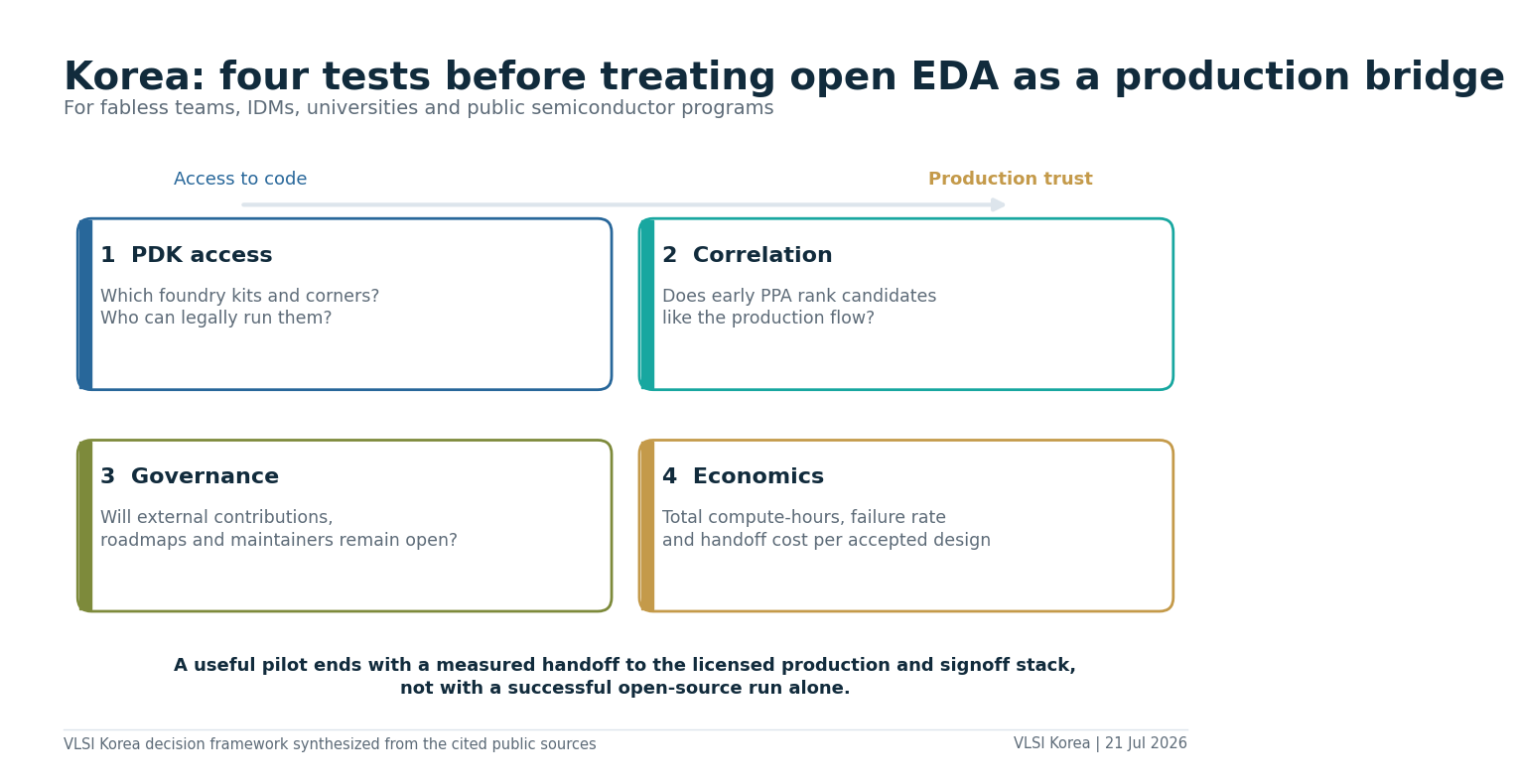
The first enterprise use case does not need to replace production P&R. Teams can contain a pilot to architecture variants, floorplan feasibility, macro placement, or congestion risk, using the open flow to reject weak candidates early while leaving signoff accountability in the existing system.
The next gate is the private PDK. Public ASAP7 or mature-node success becomes production value only when libraries, macros, routing rules, and voltage corners work in Korean foundry and memory or logic IP contexts, including Samsung Foundry where relevant.
A Samsung representative was quoted in Siemens's Fuse announcement, but that is not evidence that Samsung uses Precision Innovations or OpenROAD. The acquisition announcement names no Samsung Foundry PDK, joint customer, or Korean deployment.
A Korean buyer should require at least three outputs from a 90-day pilot: proxy and production baselines from identical RTL and constraints, preservation of candidate ordering, and explainable logs for every constraint or tool-stage divergence.
Security belongs in the same gate. Contracts should define where RTL, PDKs, macros, timing, and power reports are stored; whether air-gapped operation and audit logs are available; and who owns patch accountability across open dependencies and proprietary extensions.
Workforce development needs a bridge curriculum connecting the open flow to enterprise differences. Students should understand that an OpenROAD result is not final signoff and learn the evidence ladder through STA, DRC/LVS, DFT, and silicon validation.
Policy support should not stop at funding another general AI EDA model. A shared benchmark harness, anonymized failure taxonomy, and node-level correlation methodology for public domestic use would become infrastructure for universities, startups, and the foundry ecosystem.
The immediate decision for Korean organizations is not whether Siemens has won. It is whether early exploration saves time without increasing production-handoff rework, and whether upstream openness and vendor accountability can be secured at the same time.
For the wider market context, continue with VLSI Korea's analysis of AI EDA startups and the public proof gap.
Korean Lens: implications for Korea's semiconductor ecosystem
In Korea, public-PDK education, early architecture exploration, and production signoff should be treated as three separate contracts. The availability of OpenROAD does not establish Samsung Foundry private-PDK access or silicon correlation, and Siemens has not disclosed a Korean Precision Innovations customer.
The most defensible pilot does not immediately replace production tools. It runs the same RTL and constraints through a PII or OpenROAD proxy, the incumbent P&R baseline, and signoff; measures candidate ordering, absolute PPA error, engineering rework, and runtime; and expands only when failures are reproducible.
Recommended actions and experiments
- Until closing, use 'Siemens agreed to acquire Precision Innovations' and 'expected to close in Q3 2026' in documentation and avoid completed-acquisition language.
- Separate the OpenROAD codebase, the OpenROAD Initiative, and Precision Innovations commercial IP and support organization as distinct due-diligence assets.
- For architecture pilots, compare the same RTL and constraints across the OpenROAD proxy, Aprisa or incumbent production P&R, and signoff, recording absolute PPA error and variant rank correlation.
- Ask Siemens for explicit boundaries between PII and Aprisa AI, database handoff, version compatibility, private-PDK support, regressions, and support SLA.
- Use public-PDK OpenROAD flows in Korean universities and startups, but label the boundary as 'not foundry signoff' and teach STA, DRC/LVS, DFT, and silicon evidence as separate stages.
- Companies joining the OpenROAD ecosystem should contribute tests, fixes, benchmarks, and governance upstream instead of remaining code consumers, reducing single-vendor bus-factor risk.
Further questions
- Which Precision Innovations commercial components are proprietary and separate from BSD OpenROAD, and what are their licenses and customer-migration terms?
- What node-level absolute error and variant rank correlation does the PII early proxy achieve against Aprisa AI production implementation?
- How will the employment, upstream review authority, release cadence, and OpenROAD Initiative board roles of key maintainers change after closing?
- Will Siemens provide common constraints, databases, and audit trails across Catapult, PII, Aprisa, Questa, Tessent, and Calibre?
- Among the more than 600 OpenROAD full physical implementations reported in SKY130 and GF180 contexts, how many expose commercial-foundry scope, customer production, measured silicon PPA, and independent reproduction?
- Can Korean foundries and universities jointly build a publishable PDK-proxy and correlation benchmark?
Assumptions and limitations
- As of July 21, 2026, the transaction is a signed agreement, not a completed acquisition, and price and detailed terms are undisclosed.
- Precision Innovations revenue, customer count, ARR, customer nodes, private-PDK scope, and Aprisa integration roadmap are not public.
- OpenROAD's more than 600 full physical implementations in SKY130 and GF180 contexts, Precision Innovations' 24-hour flow, and Siemens and Cadence productivity or adoption figures are reported by the relevant company or project.
- Cadence production designs, Synopsys commercial tapeouts, and OpenROAD full physical implementations differ in definition and period and do not form a direct performance or market-share comparison.
- The open-source funnel interpretation and the view that PII moves Siemens upstream into the decision layer are VLSI Korea inferences from public portfolio materials.
- The author is a Synopsys Staff Engineer. This analysis uses no nonpublic employer information, customer information, product roadmap, or internal benchmark.
- This is technical and industry-structure research, not a valuation or securities recommendation.
What would break this thesis
- Siemens or transaction documents disclose that control of core OpenROAD code, trademarks, or the OpenROAD Initiative is part of the acquired perimeter, materially changing the current BSD and nonprofit governance boundary.
- Independent or customer-verified data repeatedly shows low error and high variant rank correlation between PII's proxy, private foundry flows below 7nm, and final signoff, while also reducing Aprisa handoff rework.
- Conversely, key maintainers depart, upstream commits and releases slow, and community forks or Principal Member exits weaken the strategic value of the open-source funnel and neutral governance.
Dated watch list
- 2026-07-26 to 2026-07-29: At DAC 2026, check whether Siemens publishes product boundaries, an integration demo, or correlation data across Precision Innovations, OpenROAD, Fuse, and Aprisa AI
- 2026-08-06: At Siemens FY2026 Q3 results, check for transaction progress, EDA portfolio priorities, acquisition costs, or workforce-integration detail
- 2026-09-30: By the end of the stated calendar Q3 2026 closing window, verify completion status, final organizational placement, and changes to maintainer roles or OpenROAD Initiative governance
Practical takeaway
Sources
- Siemens, agreement to acquire Precision Innovations (2026-07-21)
- Siemens press-wire copy via PR Newswire (2026-07-20)
- Precision Innovations official product site (2026-07-21)
- Precision Innovations company and team (2026-07-21)
- Precision Innovations, DAC 2024 OpenROAD presentation (2024-06-25)
- Precision Innovations, OpenROAD in 2024 review (2025-02-01)
- OpenROAD official GitHub repository (2026-07-21)
- OpenROAD repository license (2026-07-21)
- OpenROAD Initiative official site (2026-07-21)
- OpenROAD Initiative Governing Board Charter (2026-01-27)
- OpenROAD Initiative Technical Steering Committee Charter (2026-07-21)
- OpenROAD Initiative, energy-efficient design starts with architecture (2026-07-21)
- Siemens Digital Design Creation Platform (2026-07-21)
- Siemens Aprisa AI (2026-07-21)
- Siemens Fuse EDA AI agent announcement (2026-03-16)
- Siemens financial calendar (2026-07-21)
- Siemens acquisition of Avatar and Aprisa (2020-07-15)
- SEMI ESD Alliance Market Statistics Service, Q1 2026 (2026-07-13)
- Cadence Cerebrus AI Studio product page (2026-07-21)
- Cadence Cerebrus Intelligent Chip Explorer (2026-07-21)
- Synopsys DSO.ai product page (2026-07-21)
- Synopsys, DSO.ai reaches 100 commercial tapeouts (2023-02-07)
- Siemens at DAC 2026 (2026-07-21)
- VLSI Korea, AI EDA startups and the public proof gap (2026-07-17)