VLSI Korea
AI Chips: Peak-Out or Supercycle? The Data Behind Both Cases
Hyperscaler capex nears USD 700B vs USD 51B in direct AI revenue; power bottlenecks vs sold-out HBM. Both the peak-out and supercycle cases, verified with data, plus a clear verdict.


30-Second Summary
- As of October 2026, Wall Street is openly split on AI semiconductors. A fund-manager survey published a month ago found 45% of respondents expect an AI bubble to pop as early as next year — while 57% expect the current investment pace to continue into next year. Both camps can be right.
- The peak-out case rests on money and electricity. 2026 hyperscaler capex is approaching USD 700 billion against roughly USD 51 billion of direct AI revenue. And power is now the binding constraint: 315 data centers in the UK are queuing for grid connections, and a 1 GW AI data center in the Seoul metro area could wait 7–8 years for power delivery.
- The supercycle case rests on earnings and memory. Nvidia posted USD 59.7 billion in quarterly net income, HBM is sold out through 2026, and DRAM prices keep rising double-digits with shortages expected into 2027.
- This article's conclusion, stated up front: 2026–2027 is a supercycle on fundamentals, but the power bottleneck acts as a natural governor on its speed — and the real risk sits in the financing structure, not in technology demand. That is what makes 2028–2029 the period to watch.
Background: Why the "Peak-Out" Debate Is Hot Right Now
Until the first half of 2026, the AI semiconductor debate was about "how much higher." The mood shifted on two events. First, on June 5, 2026, more than USD 1 trillion in semiconductor market capitalization evaporated in a single-day sell-off. Second, in October 2026, the Broadcom CEO's remarks likening some investors' capital allocation in the sector to "gamblers in a casino" sent Asian chipmakers tumbling again.
The numbers behind the debate are stark. In Bank of America's October 2026 monthly Fund Managers Survey, the share of investors overweight AI-related equities hit 37% — the highest since the 2020 Covid rebound. Yet in the same survey, 45% said the AI sector could be headed for a bubble as early as next year, while 42% disagreed. The most crowded trade in the market remains long semiconductor positions. In other words, investors are buying while worrying about a blow-up. Notably, nearly 40% named AI capital spending as the "most likely source of a systemic credit event." AI is seen as both the engine of growth and a potential detonator for the financial system.
To sort this out, we need to lay both cases out against the data. Below, the peak-out case and the supercycle case are each broken into two to three axes and examined.
Peak-Out Case 1: The Money Logic — A 10-to-1 Spending-to-Revenue Gap
The sharpest weapon of the peak-out camp is accounting. The five largest hyperscalers (Amazon, Alphabet, Microsoft, Meta, Oracle) are estimated to deploy USD 660–690 billion in capex in 2026, while the direct AI revenue those investments generate is estimated at roughly USD 51 billion — a ratio of about 10 to 1. When cloud computing sat at a similar point on its adoption curve in 2011, that ratio was 2.4 to 1.
Layered on top is the controversial "depreciation trap" argument associated with investor Michael Burry: hyperscalers depreciate servers over five to six years, but the real economic life of an AI chip is two to three years. If he is right, the industry is understating depreciation by an estimated USD 176 billion between 2026 and 2028. The claim is contested, but the underlying point — AI server generations turn over faster than old general-purpose servers — is broadly accepted in the industry.
The financing structure also looks fragile. Free cash flow has turned negative at Alphabet and Amazon, and the gap is being filled with debt: AI-related bond issuance reached about USD 450 billion by early September 2026, more than double all of 2025. Data centers built on borrowed money are becoming the norm. There is also the "circular deal" problem — suppliers directly or indirectly funding their own customers' financing — which may inflate some demand figures.
How the market prices this logic showed up in stock prices early in 2026: Microsoft plunged 11% in a single day — its largest one-day drop since March 2020 — when slowing Azure growth and accelerated data-center spending plans were announced together. The market's warning was clear: "spending up, cloud growth down" is a combination investors punish.
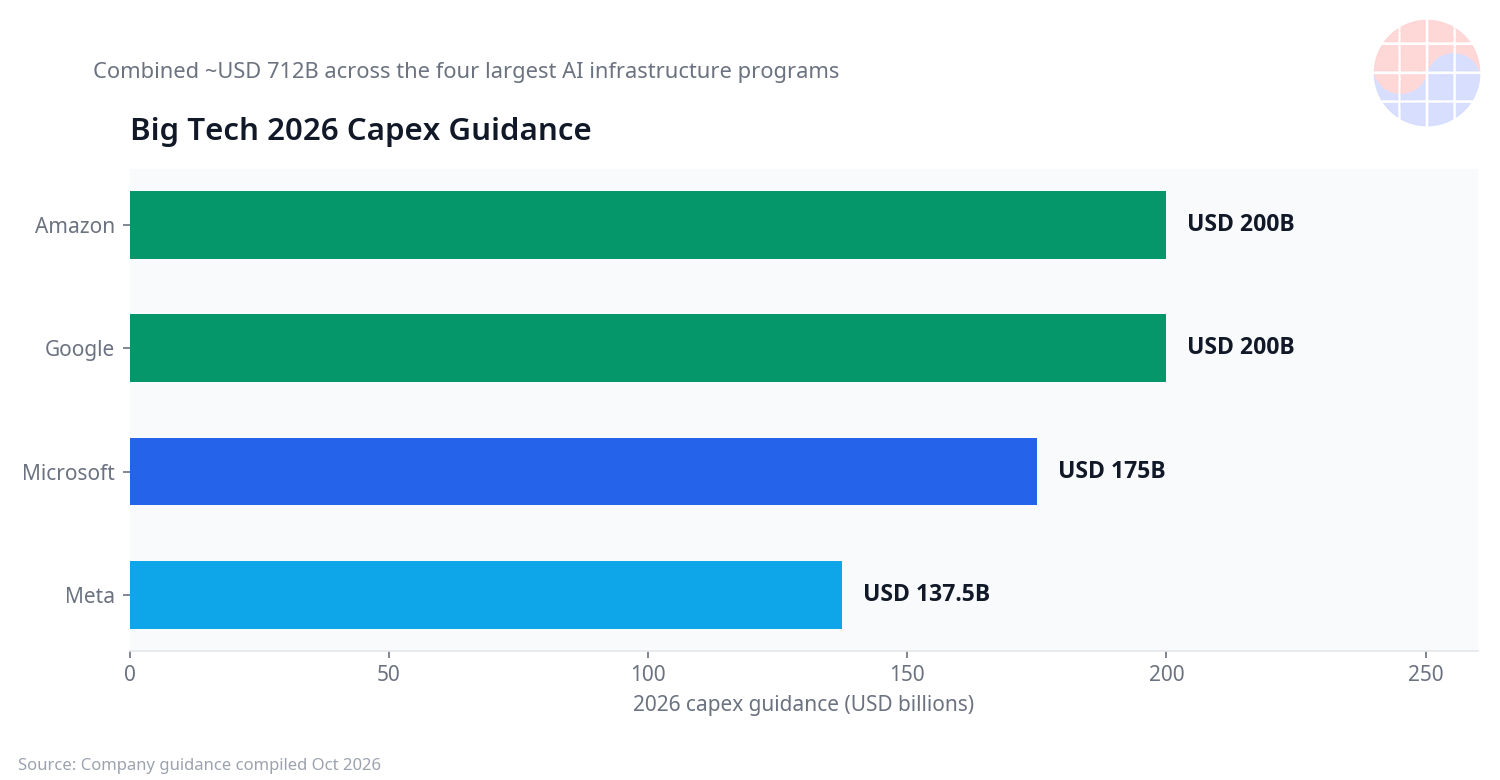
2026 capex guidance of the four largest hyperscalers: Amazon ~USD 200B, Google ~USD 200B, Microsoft ~USD 175B, Meta ~USD 137.5B — over USD 712B combined. (Source: company guidance compiled, October 2026)
Peak-Out Case 2: The Electricity Logic — Power Before GPUs
Through 2024, the AI industry's question was "how many GPUs can you secure?" In 2026, it became "how much electricity can you secure?" Chips are useless without power to run them.
In the US, individual AI campuses are scaling to gigawatt class. Microsoft added 1 GW of capacity in a single quarter, and the proposed Nvidia–OpenAI partnership targets at least 10 GW. The PORTS-Pike project in Ohio is designed as an 8 GW AI compute campus, with OpenAI signed as the customer under a 20-year lease. Meta's Prometheus data center in Ohio was estimated at 600 MW and USD 24 billion in 2025, with projections reaching 2 GW and USD 80 billion by 2027 and as much as 9 GW and USD 200 billion by 2030 (Epoch AI estimates). The exact numbers are ranges, but the direction is unambiguous: data centers are becoming power-plant-scale infrastructure.
The problem is that the grid cannot keep up. In the UK, 315 data centers were waiting for national grid connections as of June 2026, with combined demand of 73 GW — more than 60% above the country's entire 45 GW generation capacity. Nscale's NeoCloud project, once spotlighted as the UK's flagship AI supercomputer, has been delayed over power supply: the facility needs about 90 MW, equivalent to the electricity used by roughly 315,000 households.
South Korea faces the same wall. At an October 13, 2026 forum hosted by the Korean Academy of Science and Technology, professor Park Jong-bae of Konkuk University said a 1 GW-class AI data center applying for power in the Seoul metropolitan area could wait "7–8 years or more" for actual delivery. The cause is not generation capacity but grid connection headroom in the metro area. As professor Kim Seung-wan of KENTECH put it: projects are blocked not by a lack of electricity but by a lack of grid. The bottleneck is transmission, not generation.
Efficiency compounds the problem. Figures disclosed by Nvidia indicate that in a 1 GW data center, only about 70% of input power reaches actual AI compute; the remaining 30% is lost to cooling and power distribution (~20%) plus system failures and restarts (~10%). A third of the electricity evaporates before any computation happens. Nvidia believes optimization can push that above 90%, but in today's architecture, building more data centers also means wasting more power.
In short, the peak-out camp's "electricity wall" is not a temporary bottleneck but a structural constraint. Power plants take 5–10 years to build; transmission expansion takes years too. GPUs can be stamped out in a year. Electricity cannot.
Supercycle Case 1: The Earnings Logic — Real Money Is Flowing
Where the peak-out camp questions future revenue, the supercycle camp points to present revenue. For the quarter ended July 26, 2026, Nvidia reported USD 96.2 billion in revenue and USD 59.7 billion in net income, with data-center revenue up 117% year over year. Anthropic's revenue run-rate passed USD 65 billion by the end of July 2026, and it reported positive adjusted operating income. Hyperscaler cloud revenue is growing 37–82%. This is audited cash, not narrative.
Demand-side indicators are equally strong. Goldman Sachs projects cumulative AI infrastructure spending of USD 7.6 trillion from 2026 through 2031. For US large hyperscalers alone, capex is forecast at USD 800 billion in 2026, USD 1.2 trillion in 2027, and USD 1.4 trillion in 2028. The growth rate decelerates — from nearly 100% in 2026 to 54% in 2027 and 12% in 2028 — but the absolute scale keeps climbing. Enterprise adoption is structural: 88% of firms report regular AI use, though ROI tracking lags behind. Put differently, adoption is done; the industry is now in the measurement phase.
Valuations add an interesting wrinkle. AI infrastructure stocks have fallen to decade-low valuations: the median forward P/E dropped from 32x in April 2026 to 22x, and memory stocks trade at 4x two-year forward earnings — half their 15-year average of 8x. That is a thin reed for a "bubble" story; skepticism is arguably already priced in.
Supercycle Case 2: The Memory Logic — DRAM Is Still Rising
Few sectors signal as clearly as memory. In Q3 2026, DRAM and NAND average selling prices rose nearly 20% quarter over quarter, and tight supply-demand conditions are expected to persist through 2027 (Bernstein). The DRAM supply sufficiency rate sits around 79% in 2026 and NAND around 80% — far below the 100% equilibrium line — recovering toward balance only in 2027.
HBM (High Bandwidth Memory) has structurally changed the cycle. HBM demand from AI servers now accounts for more than half of total DRAM shipments, and the HBM market is projected at USD 77.4 billion in 2026 (+124% YoY), expanding to USD 152.8 billion in 2027. OpenAI's Stargate project reportedly secured up to 900,000 DRAM wafers per month from Samsung and SK hynix — roughly 40% of total global DRAM output. HBM capacity is sold out through 2026. SK hynix posted a 72% operating margin in Q1 2026 — higher than Nvidia or TSMC.
Crucially, this rally looks like real demand, not inventory stuffing. PC and smartphone makers have already begun cutting unit shipments under memory-cost pressure — yet prices keep rising because AI servers are absorbing the volume. Q4 2026 forecasts point to further contract-price gains: conventional DRAM +10–15% QoQ, HBM-inclusive DRAM +15–20%, NAND +15–20% (market research compilations).
The industry's overall scale has shifted too. The Semiconductor Industry Association reported 2025 global semiconductor sales of USD 791.7 billion (+25.6% YoY), and coverage of the October 2026 SEMICON West opening noted the industry crossing USD 1 trillion in annual revenue for the first time — four years ahead of earlier expectations.
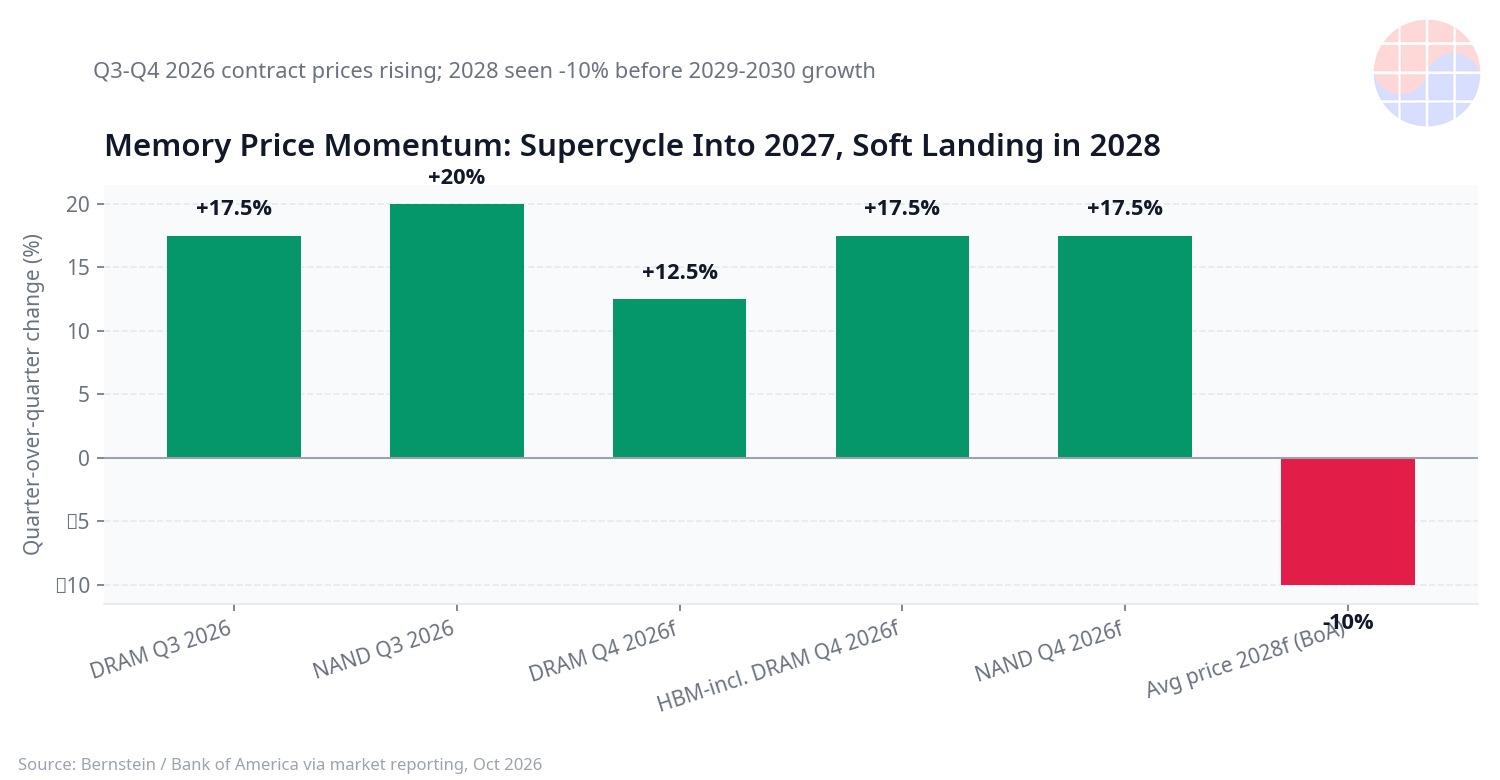
Memory price momentum: contract prices rose double digits through Q3–Q4 2026; a ~10% soft landing is expected in 2028 before renewed growth in 2029–2030. (Source: Bernstein / Bank of America compilations, October 2026)
Supercycle Case 3: The Hegemony Logic — Why It Cannot Stop
Beyond economics sits geopolitics. AI has become an arena of national power competition, not just industrial rivalry. The US government has pushed TSMC's planned American investment to USD 265 billion across 12 semiconductor and packaging facilities, and governments worldwide are showering subsidies on fab projects. State subsidy races now overlap private investment races.
In this structure, the normal cycle logic — "cut investment when demand softens" — may not apply. If the cost of falling behind exceeds the cost of overinvestment, spending continues even at a loss. In July 2026, US private data-center spending hit a record USD 75 billion annualized pace, up 57% year over year — while overall private construction was flat. Data-center investment has eclipsed residential construction for the first time in modern records. Capital is voting with its feet.
The structural growth of inference demand is the supercycle camp's other pillar. Training demand can swing with model development cycles, but inference demand accumulates with user counts as AI agents proliferate. That is exactly where the memory industry is looking: inference is bottlenecked by memory capacity, so even lighter models do not reduce memory demand.
Chase's Take: A Power-Governed Supercycle
Laying both cases side by side, I have come to think the debate's framing is wrong. It is not "peak-out versus supercycle" — both phenomena are unfolding simultaneously.
My judgment: the fundamentals of 2026–2027 are a supercycle. Nvidia's USD 59.7 billion quarterly net income, sold-out HBM, and double-digit DRAM price gains are cash, not narrative. The geopolitical engine of AI hegemonic competition will not switch off soon. Add structurally growing inference demand, and a technology-demand peak-out still looks distant.
But the power bottleneck is forcibly governing this supercycle's speed. With 315 data centers queuing for UK grid connections and 7–8-year waits for 1 GW in the Seoul metro area, even the most aggressive capex plans face multi-year lead times to actual operation. Paradoxically, this makes the cycle healthier. Unlike the 2000 dot-com bubble, a physical constraint is now slowing overinvestment. Power is acting as a natural circuit breaker.
The real risk sits in the financing structure, not in technology demand. A 10-to-1 spending-to-revenue gap, negative free cash flow, USD 450 billion in bond issuance, circular deals, the depreciation debate — this rhymes with Britain's Railway Mania of the 1840s. The rails were actually built and eventually used, but most investors who financed them at the peak lost money. AI infrastructure may follow the same script: the technology stays, the financing structure shakes. That 40% of BofA survey respondents named AI capex as the most likely source of a systemic credit event points the same way.
So here is my scenario. 2026–2027: a power-governed supercycle continues, with memory strength into 2027. Around 2028, the memory soft-landing (~-10% price outlook) coincides with a stress test of the financing structure. If a peak-out comes, it arrives then — in the form of a credit cycle, not a technology-demand collapse. Investors should enjoy the 2026–2027 semiconductor strength while pre-planning hedges for the 2028 leverage window.
Implications for Investors, Engineers, and Policymakers
- Investors: AI infrastructure valuations sit at decade lows — skepticism is substantially priced in. In this phase, "whoever secures power wins." The power value chain — generation, transmission, transformers, ESS — matters as much as GPUs. On memory, manage positions with the 2028 soft-landing scenario in mind.
- Engineers: The data-center bottleneck is migrating from chips to power and cooling. Demand for talent in "infrastructure semiconductors" — power devices, liquid cooling, power distribution architectures — is structurally rising. From a career standpoint, power and thermal design capability will command a premium alongside GPU design.
- Policymakers: In Korea's case the bottleneck is grid connection headroom, not generation. If 1 GW in the metro area takes 7–8 years, AI data-center attraction must be planned as a package with grid expansion. Filtering duplicate power applications and improving ESS compensation are near-term tasks.
FAQ
Is the AI semiconductor bubble the same as the 2000 dot-com bubble?
Similarities and differences both exist. The similarity is financing fragility: debt-built infrastructure, inflated demand figures, valuation debates — patterns repeated in 2000 and in the 1840s Railway Mania. The difference is cash. The dot-com bubble was a bubble of loss-making companies; today Nvidia earns USD 59.7 billion in quarterly net income. The technology is real and money is actually flowing. So watch for a "financing bubble," not a "technology bubble."
If the power shortage is resolved, does the supercycle accelerate?
Counterintuitively, maybe not. Resolving the power bottleneck speeds up data-center commissioning — and with it, overinvestment risk. Today's power constraint also serves as a safety valve slowing the cycle. "Managed expansion" with parallel power-infrastructure investment is the healthiest scenario.
How long does the memory supercycle last?
Current outlooks see shortages persisting through 2027. The DRAM sufficiency rate rises from 79% in 2026 toward the 100% balance line only in 2027. Bank of America, however, projects a 2028 soft landing — average prices down ~10% (DRAM -5%, NAND -13%) — before renewed growth in 2029–2030. That fits the power-governed supercycle scenario.
How should individual investors approach semiconductor stocks now?
Valuations have fallen to decade lows, so one can argue skepticism is largely priced in. But with credit-cycle risk around 2028 in mind, staggered entries and diversification into the power and infrastructure value chain look more sensible than lump-sum bets. This article is not investment advice.
Note: This article was written on October 16, 2026, based on publicly available materials. Capex outlooks and price forecasts may change with market conditions and do not constitute buy/sell recommendations for any security.