VLSI Korea
Synthara Deep Dive: ComputeRAM, the SRAM That Computes, the 100x Claim, and the USD 16 Million Reality
Synthara sells an SRAM macro that computes: digital in-memory computing inside a drop-in SRAM, a 100x performance claim resting on simulation, Bosch as the one named client, and only about USD 16M raised against rivals with 450M. The full deep dive.


Conclusion first
- Synthara does not sell chips. It sells an SRAM macro. The Zurich startup's ComputeRAM is a drop-in macro with the same interface as conventional SRAM, except that digital compute logic is fused to the memory array so matrix operations execute where the data already sits. The bet is on eliminating data movement, the dominant energy cost in the von Neumann architecture.
- The differentiator is the word "digital." Where Mythic and IBM's analog compute-in-memory (CIM) approaches compute inside the bitcell's physics, Synthara never touches the foundry-supplied bitcell. The price is roughly 5 to 10 percent more area in peripheral logic (company description); the reward is that porting and verification follow an ordinary digital flow.
- Every headline number is a company claim. Up to 139x speed and 158x energy efficiency versus a Cortex-M0 with conventional SRAM comes from company materials and post-synthesis simulation, not from independent benchmarks on production silicon. The test chip was built on GlobalFoundries 22FDX, and Bosch, disclosed as an early client in 2023, remains effectively the only named customer.
- The balance sheet is the thinnest in its peer set. Cumulative funding is estimated at roughly USD 16 million, and no new round has been confirmed since the June 2024 raise of USD 11 million (USD 5.5 million equity plus USD 5.9 million in grants). Axelera AI has raised USD 450 million cumulatively; Mythic has spent roughly USD 300 million. The team is about 20 people.
- Verdict: the technical direction is right and the entry wedge is clever, but this company's fate depends less on capital than on a single design win at a major MCU vendor — and on having enough cash left when that win turns into royalties.
Company overview
| Item | Detail |
|---|---|
| Founded | 2019, Zurich, Switzerland (spin-off of the Institute of Neuroinformatics, ETH Zurich and University of Zurich) |
| Founders | Manu V Nair (CEO), Alessandro Aimar (CTO) — the company is based on their doctoral research |
| Nair background | Chip design at Analog Devices and Apical Imaging, MPhil at Manchester, PhD in neuromorphic computing at the Institute of Neuroinformatics |
| Aimar background | PowerVR GPU verification and architecture at Imagination Technologies from 2014, then a PhD on energy-efficient AI computation |
| Product | ComputeRAM — SRAM-based in-memory computing IP macro plus SDK |
| Silicon | GlobalFoundries 22FDX test chip (18 kB macro; a 2x2 mm demonstrator chip was reported). A memory compiler and FinFET variants are described by the company as in development |
| Team | About 20 people (as of June 2024 reporting) |
| Cumulative funding | Estimated at roughly USD 16 million including the 2024 round and earlier seed and grants; the company has never published an official cumulative figure |
| Revenue | Undisclosed; believed to be pre-royalty |
| Notable names | Advisor Hermann Hauser (Arm co-founder); chairman Sean Mitchell (Movidius co-founder), per 2023 reporting |
Founding story: the anti-analog decision out of a neuromorphic lab
Synthara starts in January 2016, when Manu Nair and Alessandro Aimar began their PhDs at the Institute of Neuroinformatics on the same day. Both were chip engineers who had returned to academia chasing AI and efficient computation. The institute's home discipline is neuromorphic computing. Yet when the two founded Synthara in 2019, their defining decision ran against the lab's orthodox line.
Analog CIM has seductive physics: currents inside the bitcell array perform multiply-accumulate operations almost for free, at least on paper. The bill arrives in manufacturing and verification. Analog blocks must be re-characterized at every process node, and calibration for temperature, voltage, and process variation follows the product for life. Nair's argument is blunt: the industry does not want analog. MCU vendors want a macro that drops into their proven digital flow, and most of the efficiency prize comes simply from collapsing the distance data travels. That is Synthara's bet.
It is also a product of the Zurich ecosystem, where ETH and University of Zurich research, Innosuisse and Swiss Accelerator grants, and global accelerators such as Silicon Catalyst and Intel Ignite overlap. In 2023 Synthara won the ZKB Pionierpreis Technopark, Switzerland's flagship deep-tech startup award (CHF 100,000). But Zurich's ecosystem is strong on talent and grants and weak on late-stage capital and anchor fabless customers. That asymmetry shows up directly in Synthara's funding structure.
ComputeRAM dissected: in-memory computing that leaves the bitcell alone
ComputeRAM has three layers.
1. The macro looks like SRAM. A ComputeRAM macro keeps the conventional memory interface. To the host SoC it is memory you read and write as usual, with compute commands layered on top. Synthara sells "memory that can compute," not a new accelerator, and that framing is what lowers the adoption barrier.
2. The primitive is the dot product. Unlike a classic multiply-accumulate array, the low-level computational primitive is the dot product, as the company describes it. Weights stay resident in memory; an input vector arrives and the matrix-vector product executes inside the macro. Because most AI and DSP workloads reduce to matrix-vector operations, the company claims up to 99 percent of model operations can be offloaded to memory, cutting bus activity, latency, and energy together.
3. The compute lives in the periphery, digitally. Bitcells come from the foundry's standard offering, or from compiled memory arrays. What is added is digital logic at the array boundary, at an area overhead of about 5 to 10 percent by the company's account. The macro is fully CMOS-compatible, processor-agnostic (Arm, RISC-V, x86), memory-technology-agnostic in principle, supports integer and block floating-point data types, and is dynamically reconfigurable at run time. Full floating point was not yet supported, per the founder.
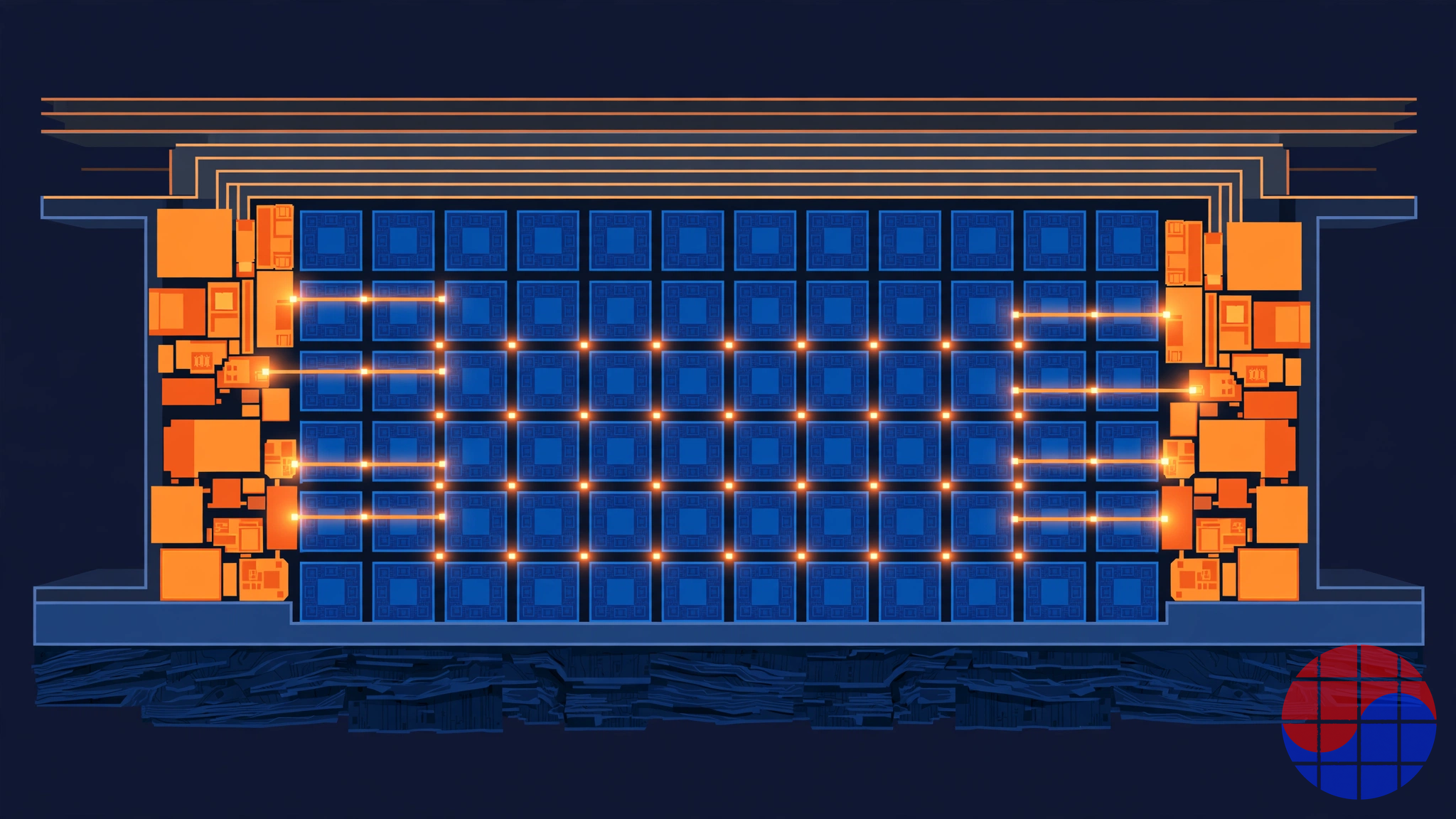
The silicon record so far: Synthara produced an SRAM-based test chip on GlobalFoundries' 22FDX process, with samples going to a few customers, per reporting. The founder noted ComputeRAM does not need 22FDX's body-biasing features. A port to a TSMC process was expected by the end of 2024, with the node to be chosen by lead-customer requirements. As of October 2026, neither that port nor a FinFET tape-out has been publicly confirmed. The silence itself becomes evidence in the risk section below.
Digital versus analog: the CIM comparison
| Dimension | Synthara ComputeRAM (digital) | Mythic (analog, Flash) | IBM research line (analog, PCM) | Samsung HBM-PIM (near-memory digital) |
|---|---|---|---|---|
| Where compute happens | Digital logic at the SRAM array periphery | Inside the Flash array, current summation | Inside the PCM array, conductance summation | Compute units inside HBM dies |
| Bitcell | Foundry standard cell, untouched | Proprietary Flash cell operation | Proprietary PCM device | Standard DRAM plus added logic |
| Precision | Integer and blockFP, deterministic | Analog approximation, calibration required | Analog approximation, drift management | Digital, fixed-point oriented |
| Process porting | Follows digital flow, comparatively easy | Re-characterization burden per node | Strong device-process dependence | Internalized in Samsung's DRAM process |
| Verification and timing | Standard STA and digital verification apply | Separate analog verification and calibration regime | Research-stage validation | Internal big-company flow |
| Business model | IP licensing | Sells its own chips | Research program, not a product | Embedded in own products |
| Capital base | About USD 16M (estimated) | About USD 300M (press tally) | IBM research budget | Samsung internal budget |
The table describes a trade-off, not a ranking. Analog extracts efficiency from physics and pays in manufacturing, calibration, and porting. Digital may cap out lower on raw efficiency but reuses the customer's existing design assets and verification stack. Synthara's contest is therefore not about the absolute performance number; it is about adoption cost. The catch is that "easy to adopt" is a claim only customers can confirm, and public customer testimony is nearly nonexistent.
Software stack: turning a hardware problem into a programming problem
Synthara names its own innovation as abstraction, not circuits: making in-memory computing a programming problem rather than a hardware problem.
- SDK and libraries. The ComputeRAM SDK ships optimized AI and DSP building blocks and targets compatibility with standard frameworks such as TensorFlow Lite, PyTorch, and ONNX, with extensibility to BLAS-based libraries per the product brief.
- Automatic partitioning. The toolchain is described as automating how algorithms are partitioned between in-memory compute and the CPU, including synchronization, so programmers can run existing code without writing ComputeRAM-aware code.
- Programming model. The product brief's example code is deliberately mundane: copy the matrix into memory once, feed input vectors, and computation is self-triggered. You write to it like memory and program it like memory.
The performance figures belong in this software context. Per the product brief, a 64x256 matrix-vector product (8-bit weights and inputs) on a Cortex-M0 showed up to 130x latency and 150x energy improvement in post-synthesis gate-level simulation, and MLPerf Tiny simulations showed up to 30x latency and 32x energy gains versus the best accelerator submission. Company communications in 2024 restated these as up to 139x speed and 158x energy efficiency. All are simulation or company-measured numbers; no independent benchmark on production silicon has been published.
Customers and partnerships: what is proven, what is not
Four items are verifiable.
- Bosch, early client (2023 reporting). eeNews Europe reported in December 2023 that Bosch had been disclosed as an early client. Which division, and into which chip, was not disclosed.
- Board and advisors. The same reporting named Sean Mitchell, co-founder of Movidius (acquired by Intel in 2016), as chairman. In 2024, Arm co-founder Hermann Hauser joined as an advisor. For a 20-person company, the surrounding network punches far above its weight.
- Siemens Cre8Ventures PAVE360 (October 2024). Siemens EDA's Cre8Ventures announced a collaboration with Synthara through its PAVE360 automotive digital-twin marketplace, positioned at ADAS and EV efficiency. This is ecosystem entry, not a vehicle program win.
- Arm case study. Arm published a case study combining ComputeRAM with Cortex-M-class cores. Being presented inside the Arm ecosystem lowers the psychological barrier for MCU customers.
The negative list is equally clear. No production customer product names, no shipment volumes, no royalty revenue, and no design-win pipeline size have ever been disclosed. At the 2023 award, the company aimed to sell its first products within 12 months. As of October 2026, no company announcement confirms what that first sale became.
Financial teardown: a capital structure that is half grants
| When | Event | Amount |
|---|---|---|
| 2020-2021 | Seed round (High-Tech Gruenderfonds, Zuercher Kantonalbank, others) | Undisclosed |
| 2022 | Seed extension closed | Undisclosed |
| April 2023 | Swiss Accelerator selection (Innosuisse) | CHF 2.5M grant (included in the round below) |
| June 2023 | ZKB Pionierpreis Technopark 2023 | CHF 100,000 prize |
| June 2024 | Growth round: USD 5.5M equity led by Vsquared Ventures (OTB Ventures, Onsight Ventures, Deep Tech Labs, HTGF, DeepIE, Excellis, ZKB, Sandeep Raju) plus USD 5.9M in European and Swiss grants | USD 11M+ combined |
| After 2024 | New round | None confirmed as of October 2026 |
Cumulative funding of roughly USD 16 million is a reasonable press-based ceiling once seed money and grants are included; the company has never published an official total.
The structure matters more than the sum. Half of the 2024 round was grants. Grants do not dilute, but they are tied to R&D work packages, disburse slowly, and are not the market pricing the company. Participation in EU projects REBECCA, CENTRIC, and TRISTAN is of the same nature: consortium prestige, not revenue.
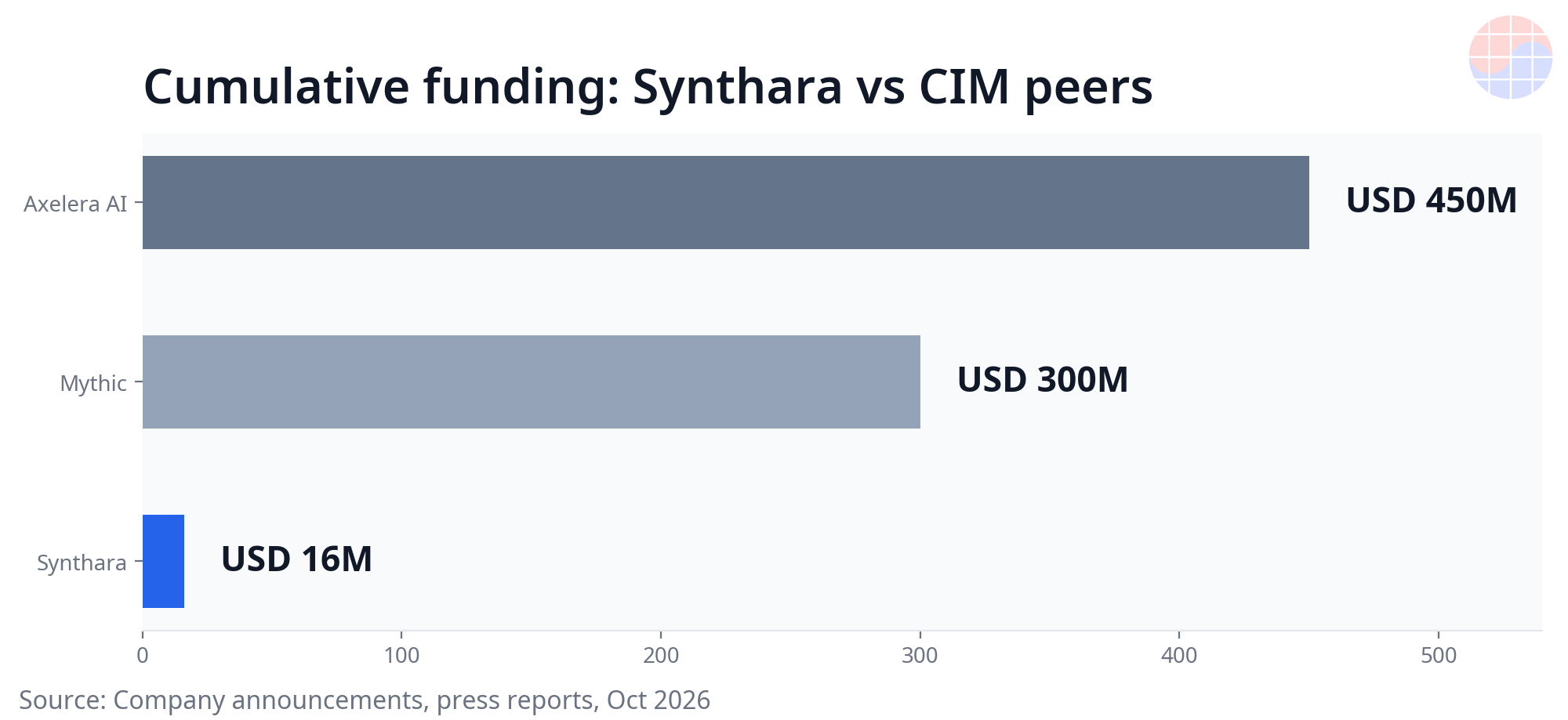
The runway arithmetic is unforgiving. A 20-person semiconductor team in Zurich costs several million francs a year even with grant co-funding. Add mid-2024 cash to seed remnants and the company naturally enters the zone where a new raise or a revenue conversion is needed around late 2026. No news can mean cash remains, or that a raise is dragging. Either way, the next announcement decides what this company is.
Competitive map: four camps
Digital IMC chip sellers — Axelera AI. Eindhoven's Axelera sells edge AI chips (Metis) and chiplets (Titania) built on digital in-memory computing. A raise of over USD 250 million in 2026 took cumulative funding to USD 450 million, with a claimed 500 customers. Its technical philosophy is close to Synthara's; its business model is the opposite. Axelera uses capital to buy volume and manufacture a market. Synthara tries to live inside other people's chips.
Analog CIM — Mythic and IBM. Mythic went through a near-death restructuring in late 2022, then raised USD 125 million in 2025. It is the field's demonstration of both analog CIM's promise and its pain. IBM's PCM research marks the academic ceiling but is not a product. This camp educates Synthara's market, but Synthara's "alternative to analog" positioning only shines if analog keeps struggling.
In-house giants — Samsung HBM-PIM and the MCU majors. Samsung's HBM-PIM shows how a memory giant internalizes PIM. NXP, Infineon, STMicroelectronics, and Renesas all run their own NPU and acceleration strategies. They buy external IP for speed; when a technology becomes core differentiation, they build it or buy the company. A large share of realistic exit scenarios for an IP startup like Synthara is acquisition by this camp.
Near alternatives — NPUs and compiler software. Dedicated NPU IP (Ceva, Arm's Ethos line) and software companies that stretch MCUs with better compilers compete for the same budget line. For many customers, swapping a compiler is cheaper than swapping a memory macro.
The Korean semiconductor lens: signoff culture and the IP valley of death
Three angles matter for Korean readers.
First, the structure of the timing problem. The heaviest burden analog CIM imposes on a customer is verification. Folding temperature- and corner-dependent analog behavior into a signoff regime built around tools like PrimeTime is a foreign discipline for digital organizations. A digital macro that leaves the bitcell alone reuses existing STA, equivalence checking, and DFT infrastructure. Synthara is competing on performance and, in effect, on the cost of persuading the customer's verification organization — a contest where Korea's conservative signoff culture could paradoxically favor the digital entrant.
Second, adjacency to a memory powerhouse. Korea is less an SRAM-macro nation than the home of HBM and PIM. ComputeRAM's stage is on-chip SRAM, but its thesis — compute where the data lives — points the same way as HBM-PIM. When Korean MCU and edge SoC fabless firms in automotive, appliances, and sensor hubs evaluate European IP, the comparison set is always in-house development and Arm-ecosystem IP. Synthara occupies the "one notch of differentiation" slot between them.
Third, the business-model lesson. IP licensing means an upfront fee and royalties years later; the gap between design win and royalty is the startup valley of death. Synthara's grant-heavy structure is the European answer: cross the valley on public money. It resembles Korea's TIPS and deep-tech support programs in structure, and it tests the same proposition — grants extend runway, but they only postpone the market's verdict, they do not replace it.
Counterarguments and risks
- Unverified performance. The 100x, 139x, and 158x figures are company claims and simulations. Until independent benchmarks on production silicon appear, they belong in the marketing column.
- The quiet period. Milestones the company itself set — a TSMC port expected by end-2024, first product sales within 12 months of mid-2023 — have produced no follow-up announcements. For startups, silence usually signals delay rather than disaster, but at this cash scale delay and funding are the same story.
- Long IP payback. Even a design win takes two to four years to become meaningful royalty revenue. The capital available to survive that interval is an order of magnitude thinner than peers'.
- In-house absorption. The moment MCU majors classify CIM as strategic, an external IP vendor's seat narrows to acquisition target or benchmark for an internal team.
- Market timing. Much of today's edge AI budget is being absorbed by NPUs and software optimization. The inflection where CIM moves from nice-to-have to must-have has not yet arrived.
- Geography and support. European sovereign-semiconductor policy is a tailwind, but the volume customers sit in Asia and the US. Whether a 20-person Zurich team can support global customers across time zones is an operational risk.
Fairness demands the other side: a team that has survived seven years, heavyweight names around it in Hauser and Mitchell, one named customer in Bosch, and a technology choice aimed precisely at analog's pain points. This is not a reckless profile. The question, as usual, is whether the timing or the cash runs out first.
Timeline
| When | Milestone |
|---|---|
| January 2016 | Nair and Aimar start their PhDs at the Institute of Neuroinformatics on the same day |
| 2019 | Synthara founded as an ETH Zurich / University of Zurich spin-off (some outlets date incorporation to 2020) |
| 2020-2021 | Seed round (HTGF, ZKB, others); accelerator programs including Silicon Catalyst |
| 2022 | Seed extension closed; ComputeRAM test chip on GF 22FDX enters public view |
| April 2023 | Swiss Accelerator selection, CHF 2.5M |
| June 1, 2023 | Wins ZKB Pionierpreis Technopark 2023 (CHF 100,000) |
| December 2023 | Bosch disclosed as early client; Sean Mitchell reported as chairman |
| June 2024 | USD 11M+ round (USD 5.5M equity + USD 5.9M grants), led by Vsquared; Hermann Hauser joins as advisor |
| October 2024 | Siemens Cre8Ventures PAVE360 partnership announced |
| End of 2024 | Founder-cited window for a TSMC port; completion unconfirmed as of October 2026 |
| February 2025 | Continued visibility, including the Venture Leaders Mobile delegation |
| October 2026 | No new funding or production-customer announcement; slated for an electronica 2026 startup spotlight |
FAQ
Q: What does Synthara actually sell? A: IP, not chips. ComputeRAM is an in-memory computing macro with the same interface as conventional SRAM. MCU and edge SoC designers license it and integrate it into their own chips, with an SDK and optimized libraries on top.
Q: How is ComputeRAM different from analog compute-in-memory? A: It does not compute in the bitcell. Mythic and IBM-style approaches use the memory cell's current or conductance to compute in analog. ComputeRAM keeps the foundry's standard bitcells and attaches digital compute logic at the array periphery. The company puts the area cost at about 5 to 10 percent, in exchange for normal digital porting and verification.
Q: Should the 100x performance claim be believed? A: Read it as a company claim. The stated figures — up to 139x speed and 158x energy efficiency for a Cortex-M0 with ComputeRAM versus conventional SRAM — rest on post-synthesis simulation and company measurements. No independent benchmark on production silicon had been published as of October 2026.
Q: Who is the confirmed customer? A: Bosch is the only name in public. It was introduced as an early client in 2023 reporting, with no disclosure of which product uses the technology. Beyond that, the Siemens PAVE360 ecosystem partnership and an Arm case study are the verifiable external proof points.
Q: What is the funding situation? A: Cumulative funding is estimated at roughly USD 16 million, about half of it Swiss and European grants. The last confirmed round is June 2024's USD 11 million. Against Axelera AI (USD 450 million cumulative) and Mythic (roughly USD 300 million), Synthara is far more thinly capitalized, and its next raise or revenue conversion is the company's inflection point.
Q: What does success look like for Synthara? A: ComputeRAM shipping inside one or two major MCU vendors' production chips with royalties compounding — or a strategic acquirer arriving during that process. The failure mode is rarely bad technology; it is the classic IP-startup path where capital runs out before design wins convert into royalties.
Facts in this article were cross-checked on October 22, 2026 against company materials (including the ComputeRAM product brief) and independent reporting (startupticker.ch, eeNews Europe, Electronics Weekly, Embedded.com, Siemens). Figures labeled as company claims are reproduced from company materials and have not been independently verified. Synthara is privately held and does not publish financial statements; cumulative funding and revenue-related figures are press-based estimates.
📩 Subscribe to VLSI Korea
Get our daily semiconductor deep-dives delivered to your inbox first. Free to subscribe.