VLSI Korea
The USD 1 Trillion Circular Loop: Nvidia, OpenAI, AMD and the New Industrial Finance of AI
The circular-deal problem is not fake demand. It is double-counted headlines, an unfinalized USD 100 billion pledge, and risk concentrated on one node. A four-structure teardown, and what it means for HBM.


📌 Key takeaways
- The AI circular-investment debate is not about fake demand. Demand is real. The problems are double-counted headline numbers, commitments that were never finalized, and concentration risk: every loop runs through a single node, OpenAI.
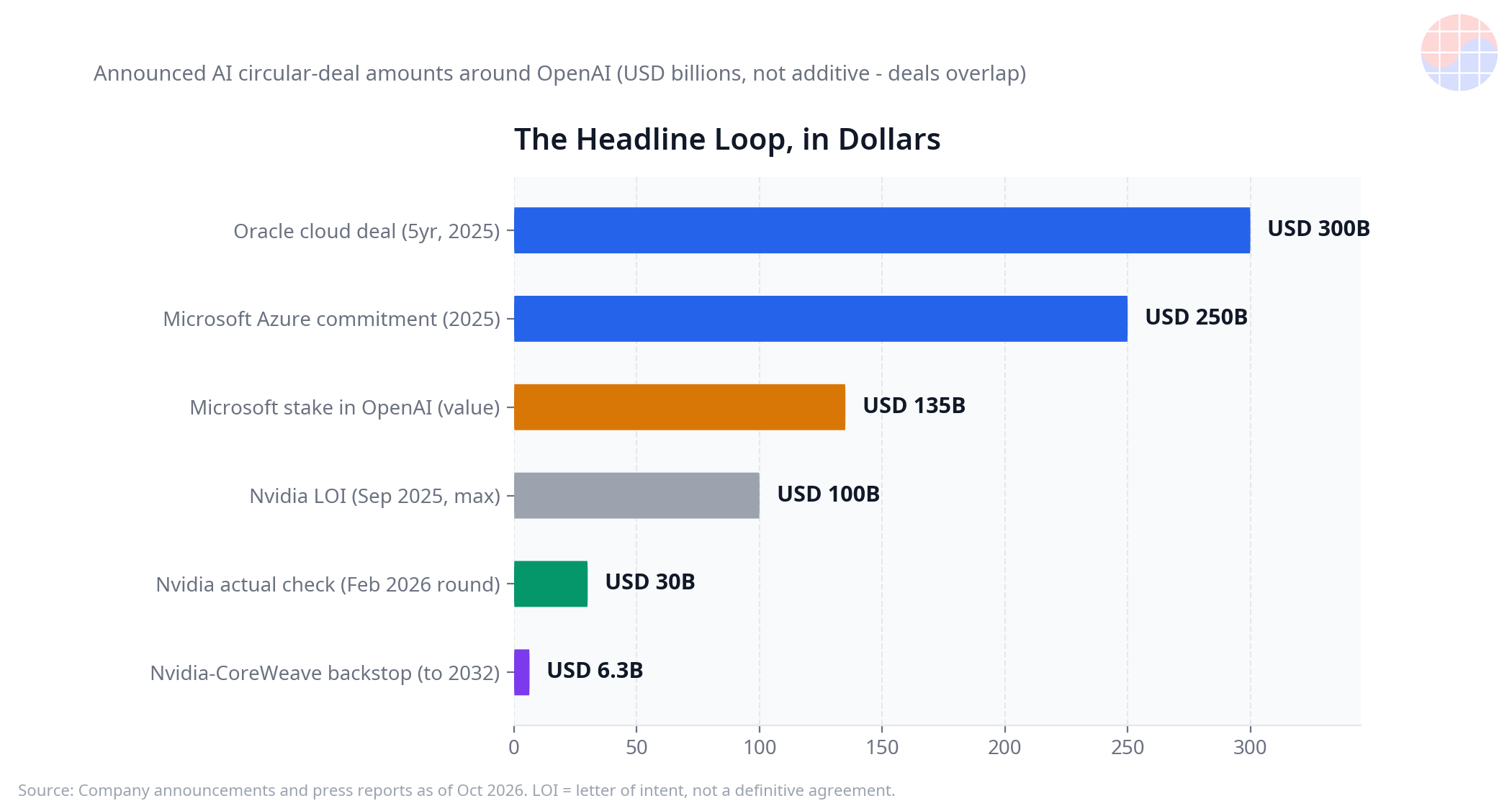
- Nvidia's "USD 100 billion investment" in OpenAI was a letter of intent, not a definitive agreement. The check that actually cleared was USD 30 billion in the February 2026 funding round. There is a USD 70 billion gap between announcement and execution.
- There are four distinct circular structures: supplier equity stakes, reverse equity paid to the customer (the AMD warrant), supplier backstops of unsold capacity, and equity-free concentration (the Oracle contract).
- The layer that resembles Lucent and Nortel in 2000 is the middle layer — debt-funded neoclouds and AI labs whose revenue must catch up with their commitments. The end demand, unlike in 2000, is real.
- Korean memory makers sit outside the loop, selling for cash. Their position is the cleanest in the chain, but their capacity expansions are built on demand signals this loop generates. The verdict arrives in 2027, when the Oracle contract starts and the first gigawatts of AMD and Nvidia capacity either ship or slip.
1. What the viral diagram shows — and what it hides
The widely shared diagram of circular investment among AI companies is broadly accurate. OpenAI sits at the center, tied to Microsoft, Oracle, Nvidia, AMD and CoreWeave through equity investments, chip purchases, and infrastructure contracts. But the diagram hides three things. First, the legal weight of each arrow differs enormously. Second, the same money and the same capacity are drawn on several arrows at once. Third, one of its biggest arrows has already shrunk since the diagram was drawn in the fall of 2025.
Here is the full inventory this analysis covers:
| Deal | Size | Structure | Status as of Oct 18, 2026 |
|---|---|---|---|
| Microsoft → OpenAI | ~27% stake, ~USD 135B value | Equity + USD 250B Azure purchase commitment | Finalized in the Oct 28, 2025 restructuring; ~USD 13B invested marked at USD 135B |
| Nvidia → OpenAI | Up to USD 100B, at least 10GW | Staged equity tied to GPU deployment | Sep 2025 LOI only; no definitive agreement. Actual check: USD 30B in Feb 2026 |
| OpenAI → Oracle | USD 300B, 5 years, 4.5GW | Cloud purchase commitment (Stargate) | Signed; service starts 2027. Core of Oracle's backlog surge |
| OpenAI ↔ AMD | 6GW + warrant for up to 160M shares (~10%) | Chip purchase + equity warrant paid to the customer | Announced Oct 6, 2025. First 1GW on MI450 in H2 2026 |
| Nvidia ↔ CoreWeave | ~7–10% stake + USD 6.3B backstop | Equity + guarantee to buy unsold capacity through 2032 | Active; additional USD 2B invested in Jan 2026 |
| Microsoft → CoreWeave | Multiple long-term capacity deals | Infrastructure rental | Microsoft alone was ~67% of CoreWeave's 2025 revenue |
| OpenAI ↔ Broadcom | 10GW of custom accelerators | Pure supply contract | No equity disclosed — the control case, not a circular deal |
One deal missing from the diagram completes the picture. In November 2025, Microsoft and Nvidia committed up to USD 15 billion to Anthropic, and in the same announcement Anthropic committed USD 30 billion of Azure compute. The investment and the purchase commitment now ship in a single press release. This is no longer an OpenAI pattern; it is the financing grammar of every frontier lab.
2. Four kinds of circularity
Lumping everything under "circular deals" destroys the analysis. The risk profile depends on how the money loops.
Type A — Supplier equity. A chip or cloud supplier buys a stake in its customer, and the customer spends the proceeds on the supplier's products. Nvidia→OpenAI, Microsoft→OpenAI and Nvidia→CoreWeave belong here. The supplier books both an investment gain and revenue; the problem is verification. When invested cash returns as revenue, outsiders cannot easily tell how much of that revenue is external.
Type B — Reverse equity to the customer. The AMD warrant is the purest form. AMD issued OpenAI a warrant for up to 160 million shares at one cent each, vesting on deployment milestones and AMD share-price targets, with the final tranche reportedly tied to a USD 600 share price. In substance, the supplier pays the customer, in its own stock, to buy its chips. UBS noted OpenAI could sell the shares to pay AMD's bills — in which case public-market investors ultimately fund the chip purchase. AMD's stock closed up 23.7% on announcement day: the announcement itself manufactures the warrant's value.
Type C — Backstops and guarantees. The least visible and the deepest intervention. Nvidia agreed to buy up to USD 6.3 billion of CoreWeave capacity that CoreWeave cannot sell, through 2032. Reporting on Nvidia's 2026 filings puts the pattern at a larger scale: a guarantee capped at USD 105 billion behind data-center leases of an OpenAI affiliate in Ohio, and roughly USD 36 billion of commitments to AI cloud partners. Guarantees cost nothing on the income statement until the customer wobbles — at which point they become real obligations.
Type D — Equity-free concentration. Oracle's USD 300 billion OpenAI contract has no equity at all. It is still the largest single risk. Oracle's remaining performance obligations jumped to USD 455 billion on the back of this deal and later reached USD 664 billion, with USD 300 billion tied to one customer. Oracle borrows to build the capacity, then buys Nvidia GPUs to fill it. The money flows OpenAI → Oracle → Nvidia, and Nvidia is an OpenAI investor. The triangle closes without a single share changing hands. This is why Moody's flagged counterparty risk and leverage.
3. The critique: not the demand, the numbers
Double counting. Add up the "USD 1 trillion of circular deals" headlines and the same capacity is counted two or three times. Stargate's USD 500 billion envelope contains Oracle's USD 300 billion, which contains the GPU purchases that Nvidia's investment plan also counts. The headline sum measures how many press releases a gigawatt appeared in, not how much new demand exists.
The announcement–signing–shipment gap. Nvidia is the documented case. The September 2025 announcement ("up to USD 100 billion, at least 10GW") moved markets, but by December 2025 Nvidia's CFO confirmed no definitive agreement existed. The investment that actually closed was USD 30 billion, as part of a USD 110 billion round in February 2026, and Jensen Huang later indicated the USD 100 billion figure was probably not in the cards. When LOI-stage numbers are priced as firm revenue, the correction eventually arrives as an earnings problem. In semiconductor language: a forecast was booked as an order.
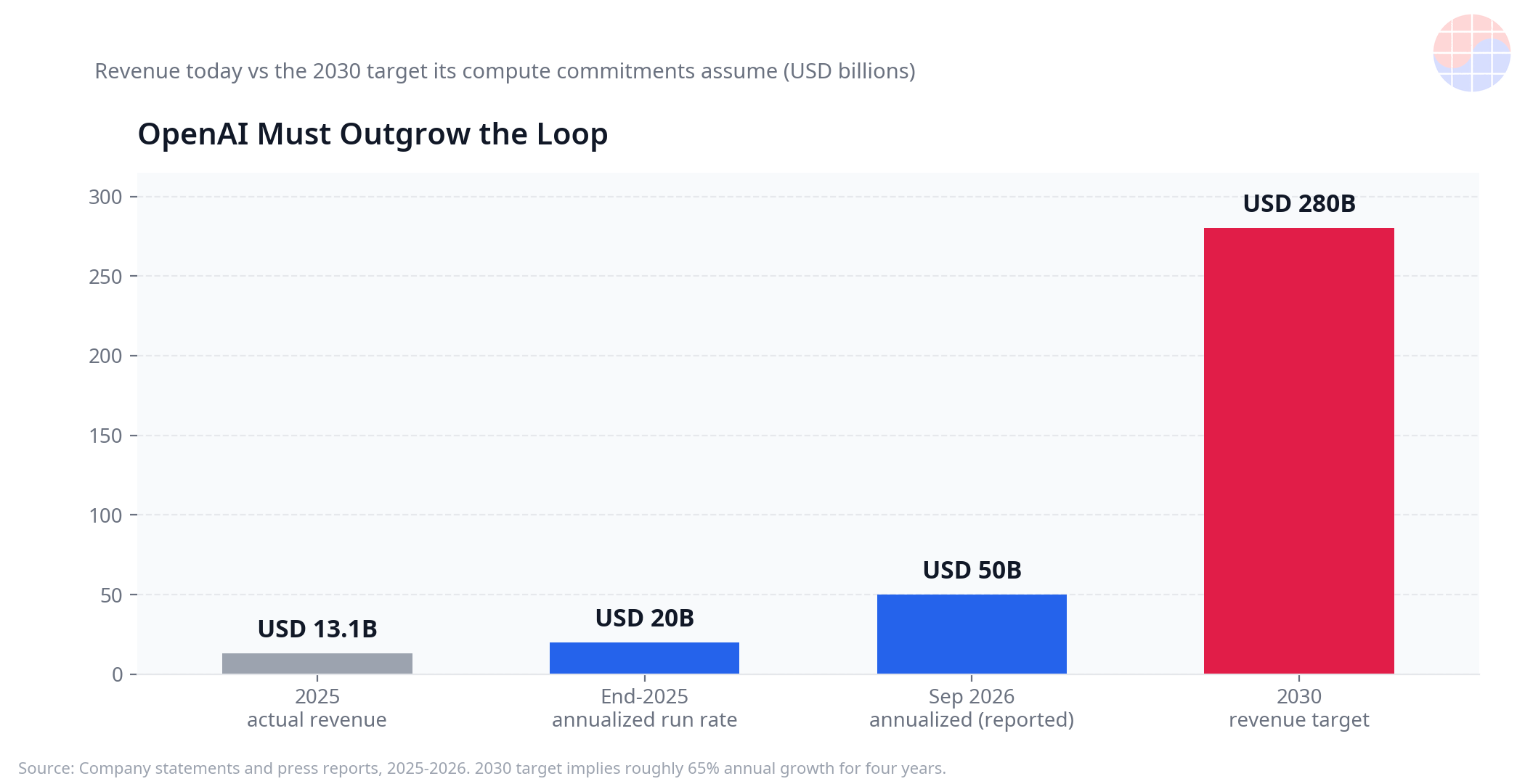
Single-node concentration. Every loop passes through OpenAI, and OpenAI's numbers do not yet carry the loop alone. Actual 2025 revenue was about USD 13.1 billion. The annualized run rate passed USD 20 billion at the end of 2025, and by September 2026 the company was describing an annualized figure near USD 50 billion to investors. Growth is historically fast — but the 2030 target presented to investors is USD 280 billion in revenue, against compute spending plans that moved from USD 1.4 trillion to USD 600 billion and, by later reporting, back up toward USD 750 billion. The target implies roughly 65% annual growth for four consecutive years. Slip a few quarters, and Oracle's backlog, CoreWeave's debt and Nvidia's guarantees are tested at the same time.
Stress is already priced — in debt, not equity. CoreWeave carried about USD 35.1 billion of total debt as of mid-2026, with two-thirds of revenue from one customer. On October 14, 2026, its shares fell 15% in a day while its unsecured 2032 bonds traded below 80 cents on the dollar at yields near 14.8%. The same week, Jensen Huang said CoreWeave does not need a backstop. Circular structures reveal their health in bond prices before stock prices.
The historical precedent. In 1999–2001, Lucent and Nortel financed their telecom customers' equipment purchases directly. By the end of fiscal 2000, Lucent had committed USD 8.1 billion in credit and guarantees — about 24% of its annual revenue. When the customers failed, Lucent's revenue collapsed from roughly USD 30 billion to USD 12 billion. One market tally of today's loans, guarantees and backstops across Nvidia, Broadcom and AMD puts supplier financing near USD 204 billion gross, equal to about 41.8% of the trailing revenue of the five-chipmaker basket it tracks. The methodology is debatable; the direction is not. Suppliers are deeper into their customers' balance sheets than Lucent ever was.
4. The rebuttal: why it is not all manufactured demand
The end users are real. OpenAI serves hundreds of millions of weekly users and its enterprise revenue is growing quickly. Hyperscalers are funding record capex from their own operating cash flow, most of it unrelated to OpenAI. Huang's rebuttal targets exactly this point: Nvidia's investments are "a small percentage of the amount of money they ultimately have to go raise," and the circularity charge is, in his word, "ridiculous." Nvidia's own quarterly operating income is large enough to dwarf the value of its CoreWeave stake; this is not a supplier propping up its only customer.
The financing gap is structural. Data centers are asset-heavy. Neoclouds and AI labs with plausible future revenue but no current cash cannot raise project debt on their own. A supplier's equity and backstop function as credit enhancement — and the supplier is arguably the best-informed underwriter of a project built around its own chips. Anthropic CEO Dario Amodei has defended the pattern on these grounds: one side has capital and a commercial interest in selling chips, the other expects future revenue but lacks up-front capital. Exchanging the two is how markets are supposed to work.
Non-circular demand is the same order of magnitude. Broadcom's 10GW OpenAI program carries no disclosed equity. Google's and Amazon's custom-silicon programs do not loop either. Strip out every circular structure and the remaining demand is still historically large. Circularity did not create the demand; it distorted how the demand gets financed and reported.
The decisive difference from 2000 is the end market. Telecom carriers laid fiber for traffic growth that did not exist. Today there are real users, real revenue, and profitable hyperscaler customers. What resembles 2000 is the middle layer: neoclouds buying GPUs with debt to rent them back out, and labs whose revenue must chase their commitments. If there is a bubble, it is most likely confined to that layer.
5. The semiconductor read: outside the loop, building on top of it
A gigawatt is an HBM order. In October 2025, Samsung Electronics and SK hynix signed a letter of intent with OpenAI under which Stargate's memory demand was projected to reach up to 900,000 DRAM wafers a month — a substantial share of global DRAM output, and not a number that can be physically supplied in the near term. Its function is a demand signal, not a firm order. The problem is that memory capacity decisions take exactly such signals as inputs. The current expansion cycle — SK hynix's M15X and advanced packaging investments, Samsung's Pyeongtaek P5 — stands on top of this signal.
Korea's seat is the cleanest in the chain. Samsung and SK hynix take no equity in this loop and give none. They sell chips to OpenAI, Nvidia and the hyperscalers, and they get paid in cash. The combined USD 37 billion one-day market-cap gain after the OpenAI LOI reflects that "outside supplier" premium.
But the transmission path is open — through orders, not equity. If OpenAI's fundraising stalls, cloud commitments slow, GPU orders slip, and HBM volumes and pricing get renegotiated, in that order, with a lag of two to four quarters. This is the classic memory-cycle mechanism: the whole industry expands simultaneously on customer forecasts, and when the signal breaks, the adjustment arrives as inventory and price. 2018–19 and 2022 worked exactly this way. The difference this time is that the signal originates unusually close to a single company. Watch these indicators, not the debate:
| Indicator | What to check | What it tells you |
|---|---|---|
| Definitive-agreement conversion | Share of LOIs/MOUs becoming signed contracts, and the pace | Whether announcement-stage numbers become real |
| Oracle backlog conversion | RPO-to-revenue pace, debt growth vs capex, credit spreads | Whether the USD 300B commitment gets built and paid for |
| CoreWeave debt prices | Bond levels, single-customer revenue share, interest coverage | The neocloud layer's leading stress gauge |
| OpenAI revenue trajectory | Progress vs the USD 280B-by-2030 path (~65%/yr) | The collateral value of the entire loop |
| Nvidia's disclosed commitments | Quarterly change in cloud commitments and lease guarantees | Whether Type C backstops are growing or shrinking |
| AMD warrant vesting | MI450 first-1GW ramp in H2 2026 | The physical evidence behind the Type B deal |
| GPU rental prices and utilization | Spot compute price trend | The real-time thermometer of end demand |
6. Verdict: bubble, or a new industrial finance?
Neither fraud nor harmless partnering. The accurate description is: real demand, inflated numbers, and risk concentrated on a single node — a new form of industrial finance.
The verdict date is close. In 2027 the Oracle contract begins, and the first gigawatts of AMD MI450 and Nvidia Vera Rubin capacity either show up as shipments and revenue or they do not. If announcements convert to shipments, this episode will be remembered as aggressive project financing that worked. If conversion stalls and neocloud debt breaks first, the adjustment will appear in orders before it appears in stock prices. For anyone who reads semiconductors for a living, the discipline is the one this industry relearns every cycle: never confuse a forecast with an order.
Frequently asked questions
Q. What is an AI circular deal?
A structure in which a chip or cloud supplier invests in, or guarantees purchases from, a customer that then spends the money on the supplier's own products. Nvidia–OpenAI, the AMD–OpenAI warrant, and Nvidia's CoreWeave backstop are the leading examples.
Q. Did Nvidia actually invest USD 100 billion in OpenAI?
No. The September 2025 announcement was a letter of intent and no definitive agreement was completed. The investment that closed was USD 30 billion in the February 2026 funding round.
Q. Why is AMD's warrant to OpenAI controversial?
Because the supplier pays the customer up to ~10% of its own equity at a nominal price, and the warrant's value is created by the stock-price reaction to the deal announcement itself — a self-fulfilling structure. If OpenAI sells shares to pay for AMD chips, public investors ultimately fund the purchase.
Q. How is this different from the dot-com and telecom bubbles?
End demand is real this time: real users, real revenue, and profitable hyperscalers. The resemblance is in the middle layer — debt-funded neoclouds and AI labs whose revenue must catch up with their commitments.
Q. What happens to Korean chipmakers if the loop breaks?
There is no equity loss; Korean memory makers are outside suppliers paid in cash. The risk travels through orders: a GPU order adjustment would reach HBM volumes and pricing with a two-to-four-quarter lag, against capacity that was expanded on the loop's demand signals.
As of October 18, 2026. Figures are based on company announcements and reporting that cites company filings; letter-of-intent amounts are labeled as such and distinguished from signed contracts. Limitation: OpenAI is private, and its financial figures rest on company statements and press reporting rather than audited financial statements.
Key sources: company announcements and reporting — the Microsoft–OpenAI restructuring (Oct 28, 2025), Nvidia–OpenAI letter of intent and February 2026 funding round reporting, the Oracle–OpenAI Stargate contract reporting, AMD–OpenAI 6GW announcement (Oct 6, 2025), CoreWeave filings and bond-market reporting, and the Samsung Electronics / SK hynix–OpenAI letter of intent (Oct 2025).