VLSI Korea
Market Bulletin: The 800-Volt Rewire — AI Data Centers Are Rebuilding Power Delivery Around GaN and SiC
At OCP 2026, power delivery stole the show: Navitas showed a 24-kW 800V GaN board with NVIDIA targeting 97% efficiency, as 1-MW racks loom in 2027. VLSI maps the 800V rewire — copper, TCO, and who wins.


AI data centers are being rewired for the megawatt era. At the OCP Global Summit in San Jose (Oct 13–15, 2026), power delivery — not GPUs — took center stage: Navitas showed a 24-kW 800V-to-12V GaN power delivery board built with NVIDIA, targeting 97% full-load efficiency and eliminating the 50-V intermediate bus converter stage entirely. The showcase confirmed that NVIDIA's 800V HVDC architecture, announced in 2025, is moving from roadmap to hardware ahead of 1-megawatt racks arriving with Kyber systems in 2027. With onsemi estimating that power semiconductor content per 1-MW rack has doubled to $100,000, the bottleneck of AI scaling has shifted from compute to copper.
Key Highlights
- Navitas–NVIDIA 24-kW GaN board: an 800V-to-12V power delivery board shown on NVIDIA's AI Factory MGX Wall at OCP 2026 targets 97% efficiency at full load (company target) with over 2,000 W/in³ power density, removing one full conversion stage from the rack (EE Times, Oct 16, 2026).
- Infineon answered with 27 kW: a three-phase PSU reference board for AI servers meets the OCP ORV3 spec at 116 W/in³ versus the 94 W/in³ minimum, built on five-level ANPC PFC plus three-level LLC with digital control (EE Times, Oct 16, 2026).
- 800V HVDC is the system bet: NVIDIA's architecture converts 13.8 kV AC to 800 V DC at the data-center perimeter, targeting ~45% less copper, up to 85% more power per conductor, and up to 30% lower TCO (all NVIDIA targets), with full-scale production alongside Kyber systems in 2027 (TokenPost).
- Content per rack is doubling: onsemi estimates power semiconductor content per next-generation 1-MW AI rack has risen from $50,000 to $100,000 (AInvest).
- The ecosystem is lining up: NVIDIA lists ABB, Eaton, Schneider Electric, and Vertiv as 800VDC partners and LITEON as a system-component supplier; LITEON says AI-related business was 20% of 2025 revenue and could reach 40% in 2026 (CommonWealth English, Oct 2025).
Market Update
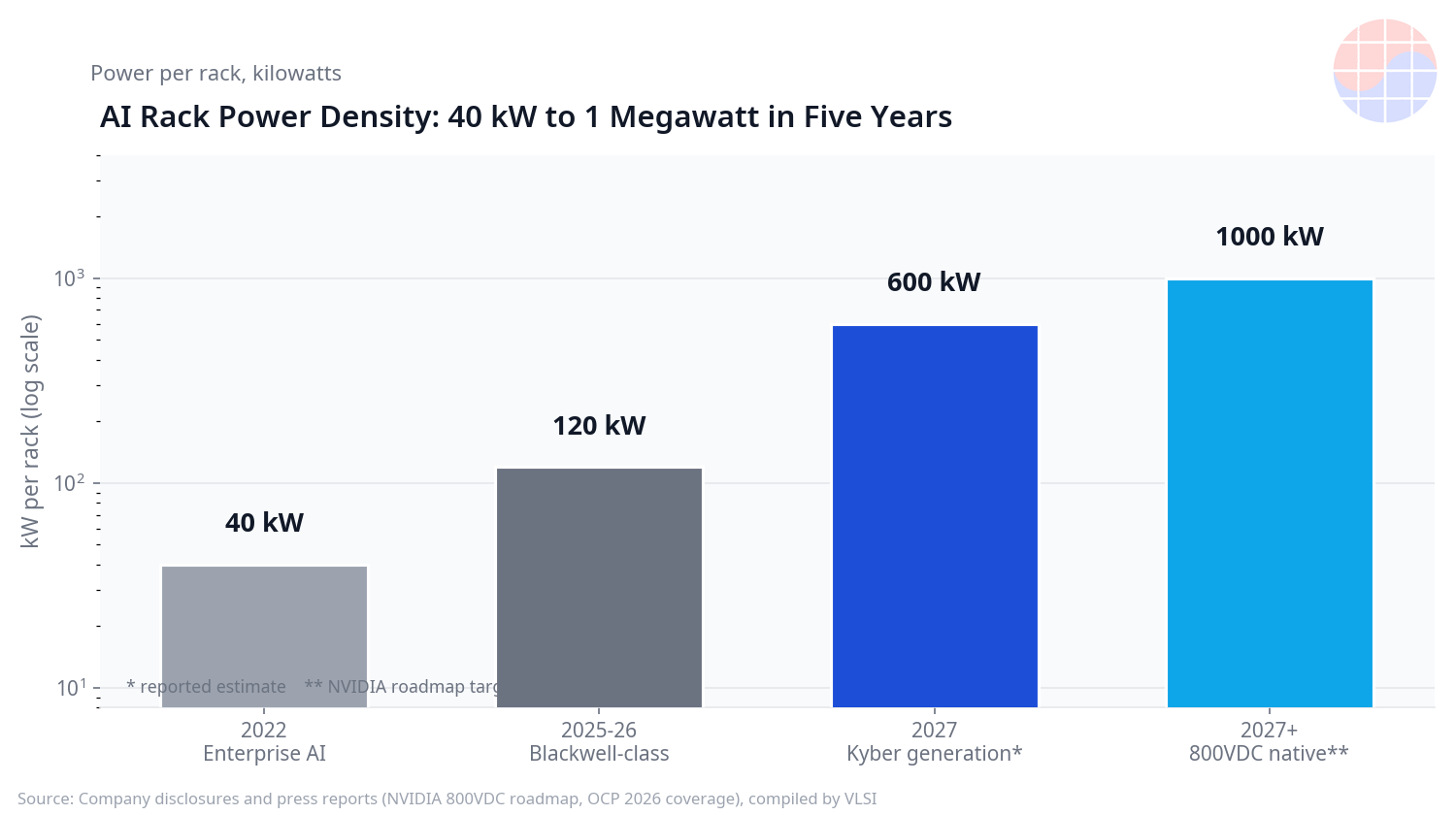
Legacy data-center power chains were designed for racks that drew tens of kilowatts. Early-2020s AI racks ran near ~40 kW; 2026-era architectures exceed 120 kW; Kyber-generation racks approach ~600 kW; and 800VDC targets 1 MW per rack from 2027 (Wedbush/TokenRing; GPU rack power planning guide). Copper busbars cannot carry 1 MW at 50 V — the current would be absurd — so the industry is pushing voltage up and conversion stages out.
| Legacy AC chain | 800V HVDC chain | |
|---|---|---|
| Rack power | ~40–120 kW | Up to 1 MW per rack (from 2027) |
| Grid-to-rack distribution | AC through UPS + multiple conversion stages | 13.8 kV AC → 800 V DC at perimeter, row power centers at 2 MW per row |
| Copper per rack | Heavy busbars at low voltage | ~45% less copper (NVIDIA target) |
| Power per conductor | Baseline | Up to 85% more (NVIDIA target) |
| Total cost of ownership | Baseline | Up to 30% lower (NVIDIA target) |
| Conversion stages | UPS → 48 V/50 V bus → 12 V | 800 V → 12 V direct (50-V bus stage eliminated, Navitas board) |
| Production timing | Installed base | Full-scale production alongside Kyber systems in 2027 |
Copper, conductor, and TCO figures are NVIDIA's stated targets for the 800V HVDC architecture (Cobtel).
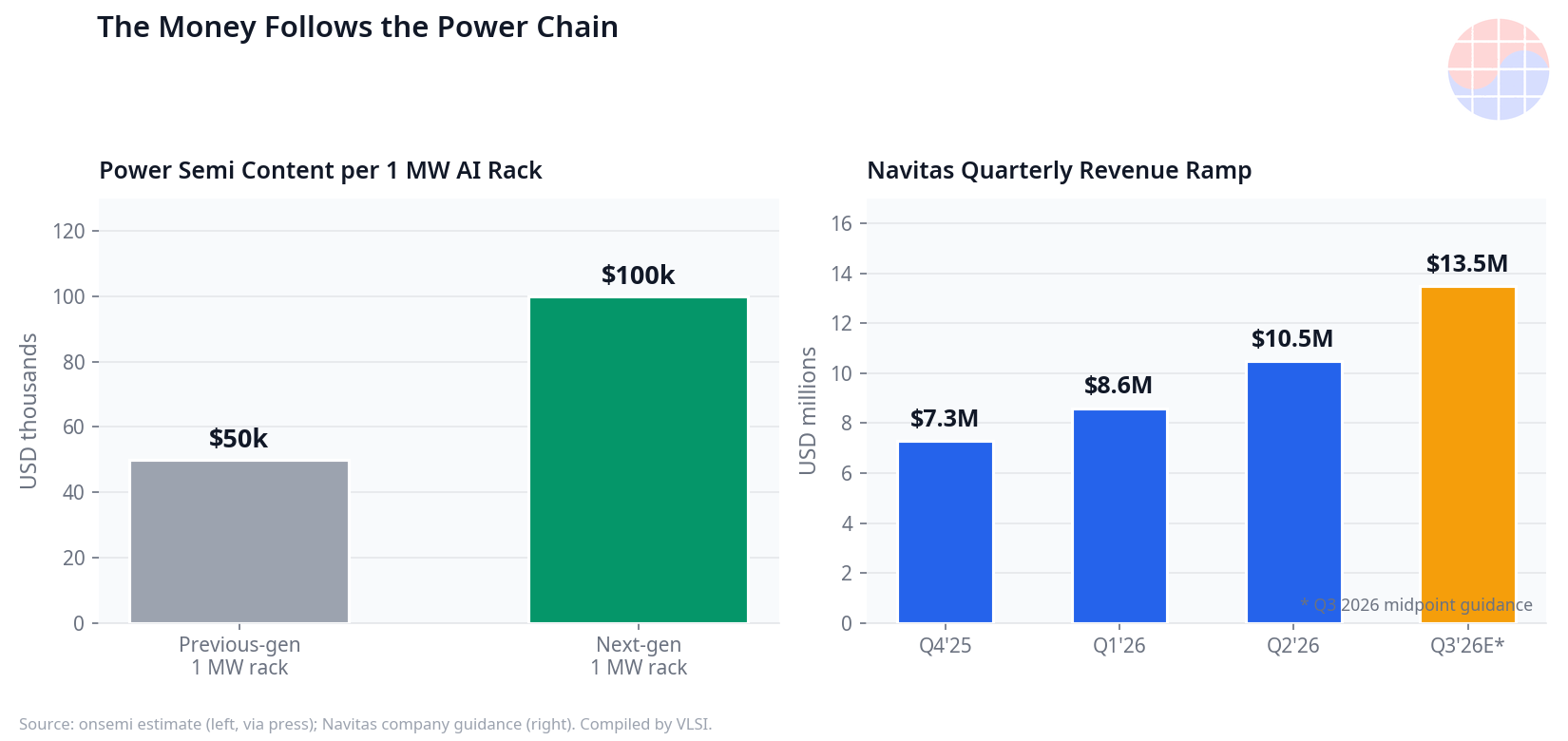
The numbers that matter most are in the supply chain. Navitas, a GaN pure-play, is guiding ~$13.5M revenue at the midpoint for Q3 2026 — roughly +28% quarter over quarter — on a ramp from $7.3M (Q4 2025) to $8.6M (Q1 2026) to ~$10.5M (Q2 2026), with Q3 results due November 3 (Tickeron; Finimize). The revenue is still small, but the vector is unmistakable: wide-bandgap devices are moving from niche to the critical path of AI infrastructure.
VLSI's View
The binding constraint of AI scaling is no longer compute — it is power delivery physics. GPU performance scaled 100x in a decade; copper busbars did not. At 1 MW per rack, legacy low-voltage distribution is physically untenable — you either raise the voltage or you rebuild the building. NVIDIA chose the former, and the choice cascades down the stack: every conversion stage you eliminate is efficiency you gain and copper you save. That is why the Navitas 24-kW board matters beyond its spec sheet: removing the 50-V intermediate bus is the architectural signature of the 800V era.
Winners and losers are being sorted by voltage, not node. GaN and SiC suppliers with data-center-qualified portfolios gain leverage; so do PSU makers with 800V-ready designs — LITEON's listing by NVIDIA as an 800VDC system-component supplier puts Taiwan squarely in the supply chain. Foundries matter too: high-voltage BCD and GaN process capacity becomes strategic. On the other side, silicon-only IGBT portfolios designed for industrial drives face a squeeze as the highest-growth power socket in the world migrates to wide-bandgap. The onsemi doubling estimate — $50,000 to $100,000 of power semiconductor content per 1-MW rack — quantifies the prize.
The Korea angle is real but early. DB HiTek's official Q3 2025 earnings presentation lists GaN as a new-process expansion area alongside high-voltage BCD/MOSFET (DB HiTek IR) — Korea's 8-inch power foundry, serving 400+ global customers (Asia Business Daily, Nov 2025), is positioning for exactly this demand wave. If Korean hyperscale and GPU-cloud buildouts adopt 800V architectures, domestic power foundry and module capacity becomes a national lever, not just a component story.
Chase's Take: I've spent my career in STA signoff, where the lesson is always the same — the constraint you ignore is the one that kills you. For a decade, the industry obsessed over FLOPS and ignored watts. That era is over. Power delivery is now the gating item on the AI roadmap, and 800VDC is NVIDIA's answer the way HBM was its answer to the memory wall. The question for investors isn't whether GaN wins — it's whether your supplier is qualified in the MGX ecosystem by 2027.
Outlook
- 2027 Kyber ramp: 800VDC full-scale production is tied to Kyber systems; any slip in Kyber pushes the whole power ecosystem's revenue recognition.
- ORV3 adoption: Infineon's 116 W/in³ vs. the 94 W/in³ ORV3 minimum shows headroom; watch whether OCP tightens the spec and who qualifies first.
- SiC vs. GaN split: GaN dominates sub-kW-to-rack conversion today, but SiC has the high-voltage track record — the 800V bus and grid-tie stages are the contested frontier.
- China WBG capacity: massive Chinese investment in GaN/SiC capacity could reset pricing for power devices the way it did for panels and solar — a risk to every margin assumption above.
FAQ
Why 800V for AI data centers? At 1 MW per rack, low-voltage distribution would require physically impossible copper busbars. Raising the bus voltage to 800 V DC slashes current, cutting copper (~45% less, NVIDIA target) and conversion losses, while delivering up to 85% more power per conductor.
What did Navitas actually show at OCP 2026? A 24-kW 800V-to-12V GaN power delivery board, built with NVIDIA and displayed on NVIDIA's AI Factory MGX Wall. It targets 97% full-load efficiency (company target, not a measured guarantee) and over 2,000 W/in³ density, eliminating the 50-V intermediate bus stage (EE Times).
When do 1-MW racks ship? NVIDIA targets full-scale 800VDC production alongside Kyber systems in 2027, with row power centers supporting 2 MW per row and Rubin Ultra-class systems aiming at ~576 GPUs per rack at ~1 MW.
How big is the power semiconductor opportunity? onsemi estimates power semiconductor content per next-generation 1-MW rack has doubled from $50,000 to $100,000 — with global data-center electricity consumption forecast at ~1,000 TWh by 2026 (IEA), efficiency gains compound into real energy and cost savings.