VLSI Korea
Smartphones Running on Recycled DRAM: The Shadow Supply Chain the Memory Shortage Built
DRAM used for 5-6 years is being desoldered in Huaqiangbei and reused for another 5-6 years. Some phone makers are reportedly reviewing it; no adoption is confirmed. The economics of a shortage-built shadow chain.


30-Second Summary
- DRAM chips that already worked for five to six years are being pulled out of discarded devices and put back to work for another five to six years. Reporting on October 20, 2026 describes recycled-memory trading in Shenzhen's Huaqiangbei electronics district, where DRAM is desoldered from used phone mainboards, cleaned, reworked and resold.
- The total working life implied is 10 to 12 years for a single chip. DRAM does not stop working at that age, but its ability to retain data weakens with use, and the probability of errors rises. A recycled chip is not a new chip with a discount. It is an aged component with a shorter reliability margin.
- Some Chinese smartphone makers are reportedly reviewing recycled memory as a sourcing option. That is the exact level of the claim: under review, according to reporting. No company's actual adoption has been officially confirmed, and this article treats it that way throughout.
- The feedstock pool is widening beyond phones. Alongside discarded handsets, end-of-life PCs and servers — and even older DDR4 modules decommissioned by US data center operators — are discussed as streams that could flow into the same recycling chain.
- The cause is structural, not exotic. Memory makers are prioritizing server DRAM and HBM, LPDDR supply for phones stays tight, and the bill of materials of an ultra-budget smartphone cannot absorb new DRAM at shortage prices. The shadow supply chain is what fills the gap.
Background
What is actually being traded in Huaqiangbei
Huaqiangbei in Shenzhen is one of the world's densest electronics trading districts, a place where components move in every state from factory-sealed to hand-recovered. The trade described in the October 20, 2026 reporting works like this: used phone mainboards arrive as feedstock, technicians desolder the DRAM packages from the boards, the chips are cleaned and reworked, tested and sorted, and then sold onward as low-cost memory supply.
None of the individual steps is new. Board-level repair and component harvesting have existed in Huaqiangbei for decades. What is new is the rumored destination. Harvested memory has traditionally served the repair market — keeping old devices alive. The reporting now describes recycled DRAM being considered as an input for new devices, which is a different business with different stakes.
A chip with two lives
The reported pattern is specific. A DRAM chip spends five to six years in a first device. The device is discarded, the chip is recovered, and the chip then spends another five to six years in a second device. Total service: roughly a decade or more on silicon that was designed, binned and warranted for one product life.
| Stage | Typical duration | What happens to the chip |
|---|---|---|
| First life | 5–6 years | Ships in a phone, PC or server; normal wear accumulates |
| Recovery | Days to weeks | Board collected, chip desoldered, cleaned, reworked, tested and graded |
| Second life | 5–6 years | Installed again, reportedly in budget smartphones |
| Total | 10–12 years | Retention margin narrows; error probability rises with age |
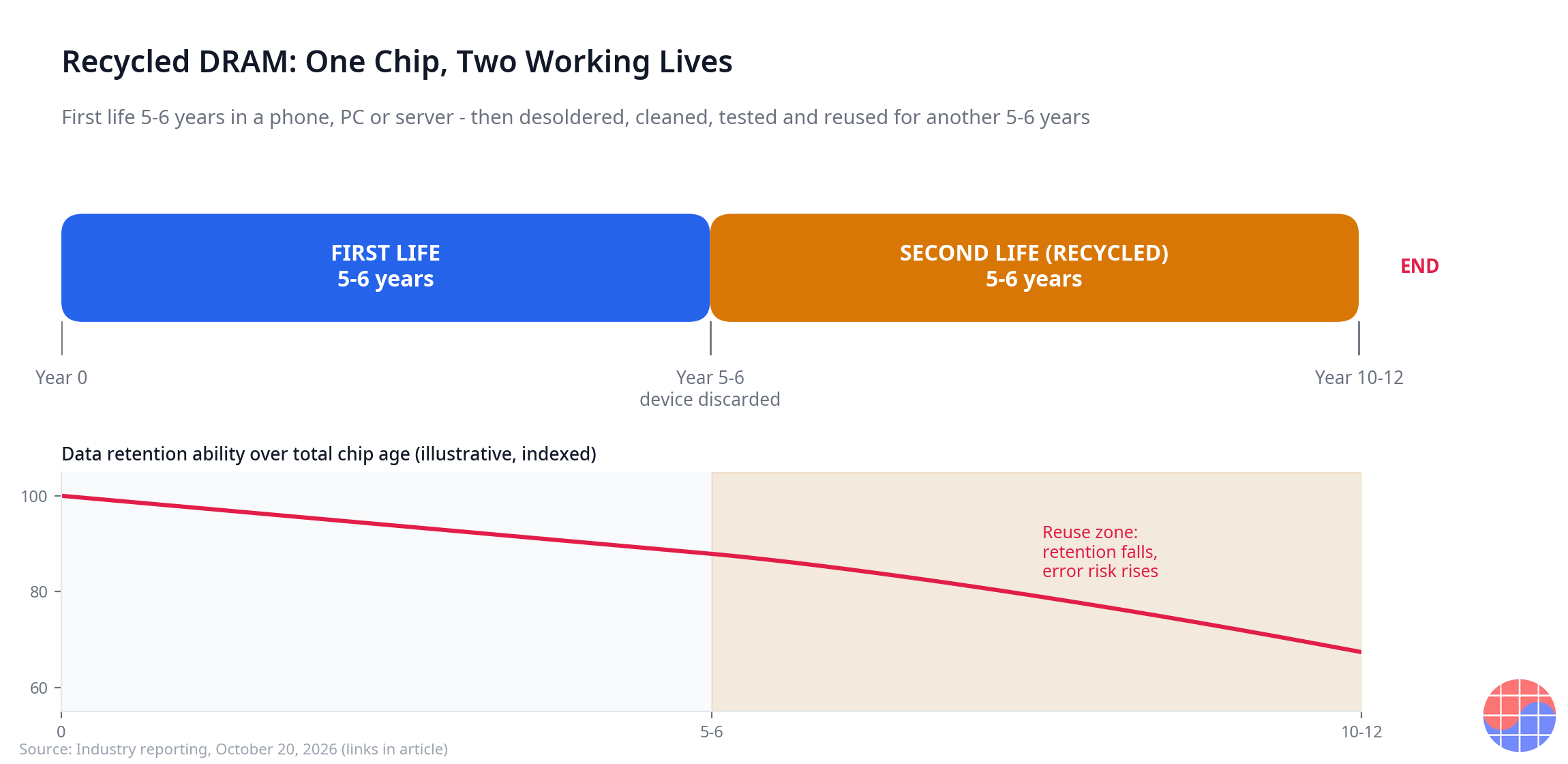
Source: Industry reporting, October 20, 2026 (links in the footnote). Durations as reported; the retention trend is the standard aging behavior of DRAM described in the same reporting.
DRAM is a volatile memory: each cell holds charge in a tiny capacitor that leaks and must be refreshed constantly. As cells age through years of charge cycles, temperature exposure and a desoldering heat cycle, the time a cell can reliably hold its state — its retention — degrades. The practical consequence is not instant failure. It is a rising probability of bit errors, especially at temperature extremes, in exactly the component a phone can least afford to have misbehave, because memory errors corrupt everything above them.
Why now: the shortage reached the bottom of the market
Three structural facts sit underneath this story.
First, wafer allocation at the major memory makers is being prioritized toward server DRAM and HBM, the products AI data centers are absorbing in volume. That priority is rational for the suppliers and durable for as long as AI build-outs run.
Second, the side effect lands on LPDDR, the low-power DRAM family smartphones use. When leading capacity is spoken for, the mobile grades stay tight for longer than a normal cycle would suggest.
Third, the ultra-budget smartphone segment has no pricing slack. At the bottom of the phone market, the bill of materials is the product strategy: a model exists because every component was sourced at a price the retail tag can carry. When new DRAM is priced by a shortage, the arithmetic breaks — and buyers start listening to anyone offering memory at a fundamentally different cost base. That is the demand the Huaqiangbei trade is built to serve.
Business Deep Dive
The economics of a shadow supply chain
A recycled chip competes with a new chip on one variable: cost. Its cost stack looks nothing like a fab's.
| Cost element | New DRAM | Recycled DRAM |
|---|---|---|
| Core production | Wafer fabrication, the dominant cost | None — the wafer was paid for years ago |
| Feedstock | Raw wafer and materials | Discarded boards and modules, priced as scrap |
| Processing | Packaging and final test at scale | Desoldering, cleaning, rework, test and grading — labor-heavy |
| Quality assurance | Full specification, warranted | Grading by the recycler; narrower, informal assurance |
| Supply ceiling | Fab capacity | The flow of discarded devices |
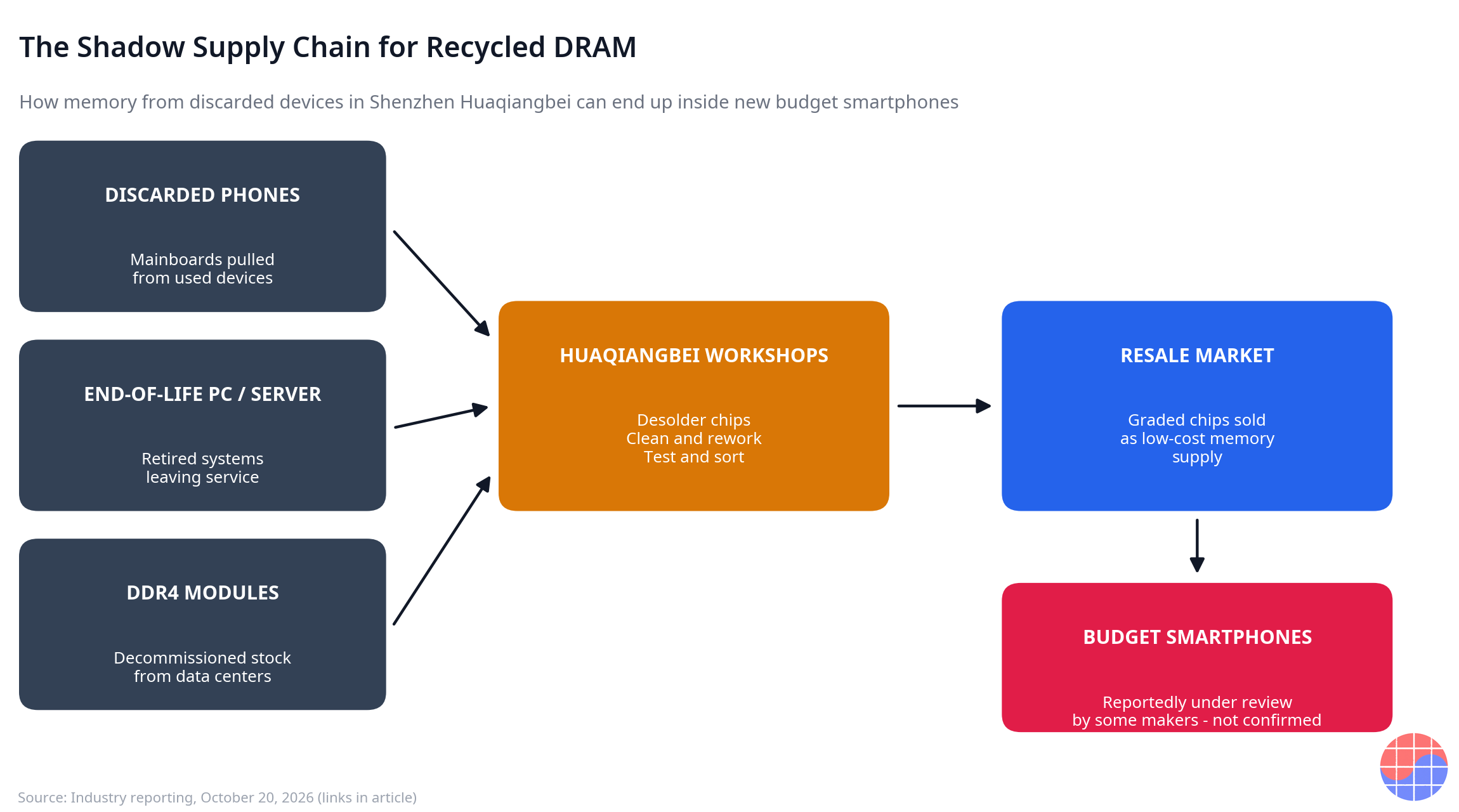
The recycled route replaces capital cost with labor cost and scrap-priced inputs. That is why it can exist only where two conditions meet: a large, cheap stream of discarded electronics, and skilled, inexpensive bench labor to recover components from it. Huaqiangbei has both at unmatched density. The trade is not a loophole in the memory market. It is an arbitrage between the scrap value of an old board and the shortage price of a new chip, and it stays open exactly as long as that gap stays wide.
The widening pool: phones are only the first feedstock
The reporting points to a feedstock pool that extends well past handsets.
| Feedstock stream | What enters the chain | Status in the reporting |
|---|---|---|
| Discarded smartphones | DRAM desoldered from used mainboards | Observed trade in Huaqiangbei |
| End-of-life PCs and servers | Memory from retired systems | Discussed as an expanding source |
| Decommissioned DDR4 modules | Older modules retired by US data center operators | Raised as a possible inflow |
Each stream matters for a different reason. Phones supply volume and proximity — the boards are already in Shenzhen's orbit. PCs and servers supply standard parts in larger per-unit quantities. Decommissioned data center DDR4 is the strategically interesting stream: hyperscale operators retire modules on disciplined schedules, in large homogeneous lots, which is precisely the kind of feedstock a grading operation can process efficiently. Whether that stream actually reaches the recycling market at scale is unproven — but the fact that it is being discussed shows buyers are mapping every pool of aged silicon the shortage has made valuable.
Who carries the quality risk
Every supply chain allocates risk somewhere. The formal memory market allocates it to the manufacturer: specifications, datasheets, warranties, failure liability. The shadow chain allocates it downward, and the final bearer is the person who buys the phone.
| Participant | What they gain | What risk they carry |
|---|---|---|
| Recycler / trader | The arbitrage margin | Inventory and grading reputation only |
| Device maker (if it adopts) | A viable bill of materials at the budget tier | Field failures, returns, brand damage if quality slips |
| End user | A cheaper phone | Data errors, instability, shorter useful life — with no way to know the memory is recycled |
This is why the brand question decides who can play. A no-name ultra-budget device competes almost purely on price, sells through channels with thin after-sales expectations, and risks little reputation it does not have. A global brand cannot make the same trade: a memory-attributable failure pattern across a model line would cost more in warranty, returns and trust than the sourcing saved. The incentive structure therefore predicts exactly what the reporting describes — interest concentrated at the price-driven bottom of the market, expressed as review and evaluation rather than announced adoption.
The suppliers' dilemma: allocation creates its own gray zone
There is an irony the memory makers will recognize. Prioritizing HBM and server DRAM is the correct profit decision, and it is also the decision that manufactures a secondhand market underneath their own product. Tight LPDDR supply does not eliminate budget-phone demand; it reroutes that demand to any silicon that stores bits cheaply enough, including their own chips, five years later, through a channel they do not control and cannot price.
The shadow chain also blurs the signal suppliers plan against. If recycled chips quietly satisfy part of low-end demand, measured demand for new low-end DRAM understates real device production — and when the shortage eases, that hidden substitution unwinds in ways a capacity planner cannot see from order books alone.
Why "reportedly reviewing" is the whole story — for now
It is worth being precise about the evidence, because the headline version of this story writes itself too easily. As of the October 20, 2026 reporting, what is established is narrow: a recycled-DRAM trade operates in Huaqiangbei; chips recovered after five to six years of use are being reused for comparable second terms; and some Chinese smartphone makers are reported to be reviewing this sourcing route. What is not established is any named company's adoption, any production volume, or any shipping product built on recycled memory.
That distinction is not pedantry. A review costs a procurement team a few meetings and sample tests. Adoption costs a company its quality reputation if it goes wrong. Markets should price the first as a signal of shortage severity — which it genuinely is — and wait for evidence before pricing the second.
Chase's Take
Read this market as a thermometer, not a scandal. A recycling trade in five-year-old memory becomes interesting to device makers at exactly one moment: when the formal market has stopped serving the bottom of the demand curve at prices the bottom can pay. The shadow supply chain is the shortage, made visible at street level.
Two lessons generalize. First, allocation decisions at the top of a supply chain create ecosystems at the bottom that the allocators never designed. HBM prioritization was decided in supplier boardrooms; its second-order effect is a bench technician in Huaqiangbei desoldering a phone board, because that board is now, economically, a memory mine.
Second, price signals this strong do not respect product categories. The same shortage logic that has buyers paying premiums for HBM and server DRAM has other buyers paying for labor to un-solder history. Both are the market clearing. One just looks respectable in an earnings deck and the other does not.
The endgame is equally signal-driven. When new LPDDR supply loosens and prices normalize, the arbitrage that funds desoldering benches collapses, and the shadow chain shrinks back to its repair-market core. Nobody will announce its end. The benches will simply go quiet — and that quiet will be one of the cleaner tells that the memory shortage is actually over.
Implications
- For smartphone brands: recycled sourcing, while only reported as under review, is a reputation-priced option. It fits anonymous budget tiers; it is a poor fit anywhere a brand name is the product.
- For memory suppliers: allocation to HBM and server DRAM is spawning an uncontrolled secondary channel for their own aged chips. Worth monitoring as both a demand signal and a brand-protection issue.
- For buyers and channel partners: the existence of graded recycled DRAM in the component market raises the value of provenance. Knowing where memory came from becomes a purchasing specification, not an assumption.
- For investors: treat the Huaqiangbei trade as a shortage-severity indicator. Its expansion says low-end memory demand is unserved; its disappearance will say the cycle has turned.
- For consumers in budget segments: device longevity and data reliability are where recycled components would show up first. Warranty terms and update support matter more, not less, at the bottom of the price ladder.
FAQ
Are smartphones really being built with recycled DRAM?
Not on any confirmed record. Reporting on October 20, 2026 describes an active trade in DRAM recovered from discarded phone mainboards in Shenzhen's Huaqiangbei district, and says some Chinese smartphone makers are reviewing recycled memory as a sourcing option. No company's actual adoption has been officially confirmed.
How long can a recycled DRAM chip serve?
As reported, the pattern is five to six years of first use followed by another five to six years after recovery — 10 to 12 years of total service. The trade-off is reliability: data retention weakens as DRAM ages, so the probability of errors rises over that second life.
Where does the recycled supply come from?
Primarily discarded smartphone mainboards processed in Huaqiangbei, according to the reporting. End-of-life PCs and servers are discussed as additional sources, and decommissioned DDR4 modules from US data center operators have been raised as a possible further inflow into the same chain.
Why would any maker consider used memory for a new phone?
Because the formal market leaves the budget tier unserved. Memory capacity is being prioritized toward server DRAM and HBM, LPDDR stays tight, and an ultra-budget phone's bill of materials cannot absorb shortage-priced new DRAM. Recycled chips replace fab cost with recovery labor, which is what makes their price possible.
Sources: October 20, 2026 report on recycled DRAM trading and handset makers reviewing reused memory; October 2026 summary of the recycled-memory supply chain reporting. This article is analysis, not investment advice.
📩 Subscribe to VLSI Korea
Get our daily semiconductor deep-dives delivered to your inbox first. Free to subscribe.