VLSI Korea
The Chip Bonus Clash: The Economics of Shareholders vs Employees
On the day Samsung stock crashed 43.9%, employees cheered for it to fall further. The 2027 special bonus — 10.5% of DS operating profit, no cap, paid in shares — explains why. The shareholder-vs-employee bonus clash, dissected with economics.


The 30-second summary
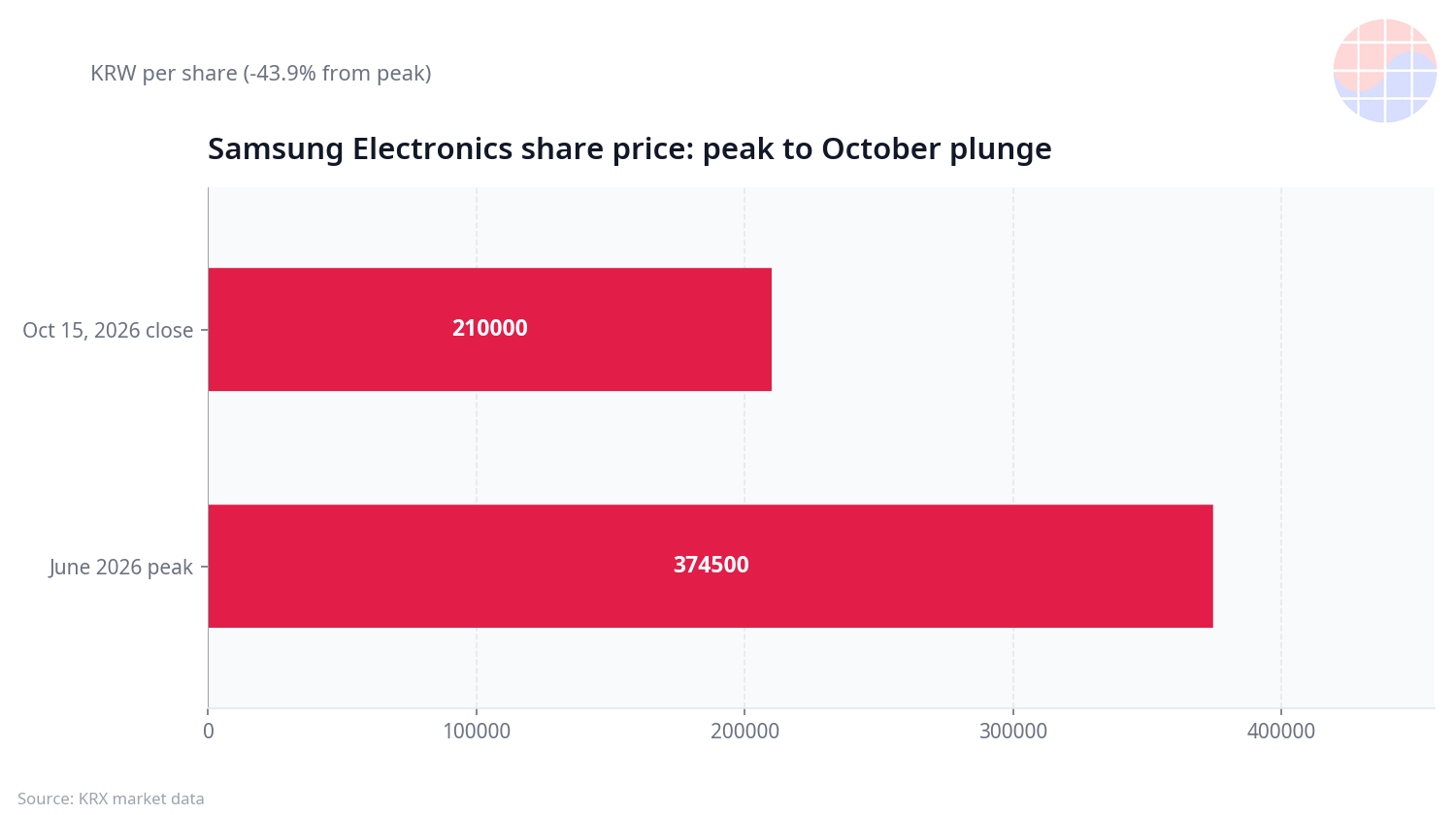
- On October 15, 2026, Samsung Electronics shares plunged 9.48% in a single day to close at 210,000 won — down 43.9% from the June peak of 374,500 won. That same evening, posts appeared on an anonymous workplace community cheering for the stock to fall further — written by Samsung DS division employees.
- The backdrop is the special performance bonus due in 2027. Funded by 10.5% of the DS division's operating profit with no cap, it will be paid in Samsung shares after taxes. The lower the share price, the more shares the same bonus buys.
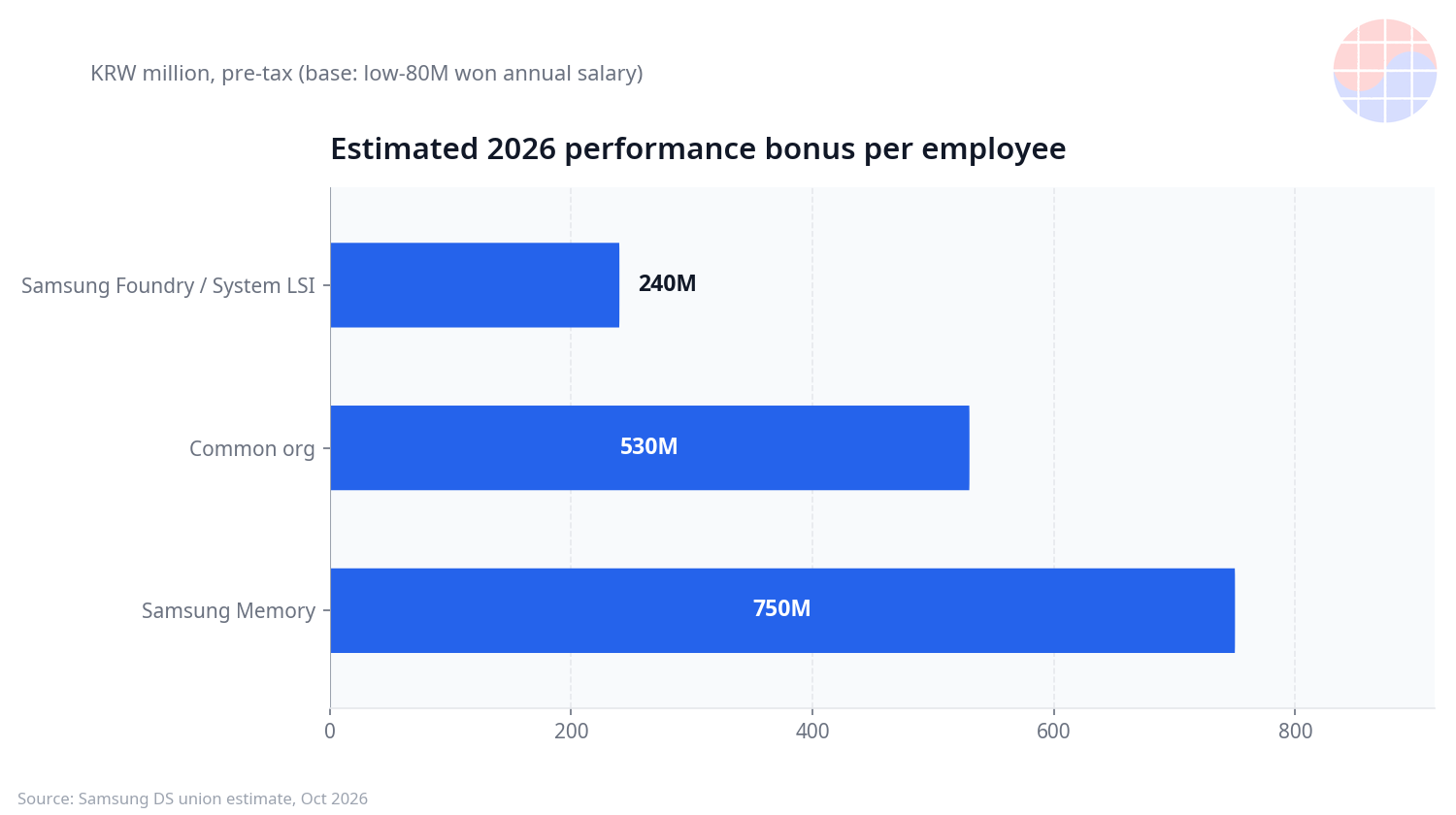
- Union estimates put pre-tax bonuses (for employees on low-80-million-won salaries) at roughly 750 million won for memory, 530 million for common organizations, and 240 million for foundry and System LSI — a more than 3x gap inside the same division.
- Shareholders are furious: "Does it make sense to hand out 10 percent of the profits earned with my investment as employee bonuses?" A retail-shareholder platform has delivered a fiduciary-duty letter to the National Pension Service.
- After-tax bonuses running into hundreds of millions of won flow into housing demand south of Seoul (Hwaseong, Pyeongtaek, Giheung). The Bank of Korea estimates immediately cashable annual bonuses at 21.9 trillion won — enough to lift growth by 0.06–0.09 percentage points if spent.
Background: "cheering for the fall" on the day the stock crashed
On Thursday, October 15, 2026, Samsung Electronics shares fell more than 9% intraday to close at 210,000 won — 43.9% below the June peak of 374,500 won. As retail shareholders fumed over their losses that evening, the company's anonymous workplace board filled with the opposite emotion: posts like "let the stock fall to 100,000 won" and "the further it falls, the better for us."
The reason employees welcome the decline is simple. The special performance bonus due in late March to early April 2027 will be paid in Samsung Electronics shares. After taxes and insurance are deducted from each individual's bonus, the remainder is converted into treasury shares — so a lower share price at payout means more shares for the same money. A 100-million-won after-tax bonus buys 400 shares at 250,000 won per share, or 500 shares at 200,000 won. If the price rebounds afterward, those who received more shares gain proportionally more.
Shareholders reacted coldly. "Do you not care at all about shareholder losses?" and "You made money selling semiconductors with my investment, and now it makes sense to hand out 10 percent of the profits as employee bonuses?" The controversy deepened when mocking comments from some employees — "Who told you to buy?" and "It's a sweet deal for us if it drops further, please fall to 70,000 won" — became public.
I will not name the community. But the fact that this emotional collision played out on a public board says everything about the nature of this dispute.
The special bonus: what the uncapped 10.5% really is
At the center of the dispute is the special performance bonus created by a May 2026 labor-management agreement. The pool equals 10.5% of the DS division's operating profit, with no cap — in contrast to the existing excess-profit incentive (OPI), which is capped at 50% of individual annual salary.
The allocation: 40% of the pool is shared across the DS division, while 60% varies by business-unit performance. The common-organization payout rate is set at 70% of the memory division's rate. A rule guaranteeing loss-making units 60% of the common payout rate exists but applies only from 2027 earnings, not this year's.
The union's estimates (based on employees earning low-80-million-won salaries, pre-tax, including the existing OPI) are staggering: roughly 750 million won for memory, 530 million for common organizations, and 240 million for foundry and System LSI. The gap between memory and non-memory exceeds 500 million won — more than 3x within the same division. Outside estimates agree. MIT Technology Review estimated this year's bonuses at roughly USD 400,000 for Samsung memory employees, USD 476,000 at SK hynix, and USD 135,000 for Samsung foundry workers.
The critical detail: it is paid in stock, not cash. After taxes and insurance are deducted, the remainder is paid in Samsung shares. Income tax at payout can hit the top 45% rate, and with local income tax the withholding rate can reach 49.5%. One-third of granted shares can be sold immediately; the rest face one- and two-year sale restrictions. Shareholder approval is also required.
Shareholders vs employees: two definitions of fairness
The shareholder logic — "10 percent of profits as bonuses?"
Shareholder anger has two layers. First, the sense of betrayal: watching employees cheer a decline while shareholders bleed. Second, a structural objection: that a pool of 10.5% of DS operating profit is excessive. Act, a retail-shareholder platform, visited the National Pension Service in July to deliver a fiduciary-duty letter aimed at blocking the special bonus payment. The NPS holds a 7.89% stake in Samsung Electronics and 8.06% in SK hynix — one of the largest shareholders of each.
From the shareholder's seat, bonuses are a direct dilution of shareholder value. Paying in treasury shares looks shareholder-friendly at first glance (fewer shares outstanding), but in the end a large slice of earned profit accrues to employees. In a phase where the stock is down 43.9%, "employees are receiving bonuses worth hundreds of millions of won" is a hard fact to swallow.
The employee logic — "remember what we gave up in the downturn?"
The labor side's rebuttal is formidable. During the semiconductor downturn, employees endured production cuts and losses without excess-profit incentives; sharing profits generously in the boom is equitable distribution. With AI-driven memory profits setting records, rewarding the workforce that produced them is also a retention imperative.
Indeed, at Samsung's foundry business, the pay gap is already converting into attrition. A union survey (June 17–30, 8,297 respondents) found 81.5% of foundry respondents — and 75.4% in System LSI — rated their intention to change jobs within two years as high or very high. Memory was 32.7%. More than 200 union members reportedly moved to SK hynix in four months. Bonuses are a survival strategy.
Business deep dive: the economics of bonus design
Retention vs shareholder value: the eternal tradeoff
At its core, the bonus dispute is a principal-agent problem. Shareholders (principals) want profits to accrue to them; management and employees (agents) want to maximize their own compensation. In an industry where human capital is the competitive advantage, the tension is especially sharp. Losing one key engineer to a rival can cost multiples of any bonus. With 81.5% of foundry staff signaling exit intent, compensation is a defensive line.
The shareholders' complaint is legitimate too. An uncapped 10.5% grows geometrically in a boom: per the union's math, an employee on an 80-million-won salary could receive 750 million won pre-tax. If that becomes a fixed cost, it could be a fatal burden on the company's finances in the next downturn — which is why industry voices warn that "unlimited cash-centered compensation could become a fatal fixed-cost bomb."
Variable pay in a cyclical industry: the paradox of no cap
Semiconductors are the textbook cyclical industry. With violent swings between bust and boom, compensation should lean variable rather than fixed. But the "no cap" special bonus creates a paradox: in booms it reaches astronomical levels and enrages shareholders; in busts it converges to zero and loses its retention function. Instead of buffering the cycle, variable pay amplifies it.
Global big tech already shows the way out: RSUs vesting over four years, engineered for long holding. That prevents cash outflows and binds key talent long-term. Industry voices now argue for "overhauling compensation structures by increasing RSU-linked compensation" for exactly this reason. Samsung's share-based payout is a first step in that direction — but one-third immediately sellable with one-to-two-year lockups is still short next to big tech's four-year vesting.
Cross-industry comparison: finance and big tech
Finance invented the bonus but has been heavily regulated since the financial crisis: bonus caps, deferred payouts, clawback clauses. If bad risk-taking surfaces, bonuses already paid can be reclaimed. The opposite philosophy from semiconductors' "no cap."
Big tech runs on RSUs. Because they move with the share price, employee and shareholder interests align — but in a falling market the real value of compensation evaporates and retention breaks. Samsung's treasury-share payout aims for a similar RSU-like effect, but because the share count is set by the price at payout, it produced the bizarre "cheering for the fall" phenomenon. A case study in how design details distort incentives.
Real estate south of Seoul: where the hundreds of millions flow
Where the bonus dispute meets the real economy is housing. Around Samsung's DS hubs — Hwaseong, Pyeongtaek, Giheung — after-tax bonuses in the hundreds of millions of won convert directly into home-buying demand. Reports that "Samsung's stock crash is shattering employees' dreams of new homes" show how tightly bonuses and real estate are coupled.
The scale is serious. The Bank of Korea estimates the after-tax, immediately cashable portion of annual bonuses at 21.9 trillion won (about USD 16.3B). If that flows into consumption, it could lift economic growth by 0.06–0.09 percentage points. The Korea Employers Federation's H1 2026 wage data shows average monthly wages in electronics and telecom (including chip manufacturing) at 9.434 million won, up 23.1% year over year, with special pay including bonuses surging 66.0%. Chip bonuses now move Korea's national wage statistics.
The paradox: with bonuses paid in stock and the share price down 43.9%, employees' paper wealth has shrunk dramatically. Dreams of homeownership tethered to the share price — that is the portrait of Korea's chip compensation system this dispute reveals.
Chase's Take
I read this dispute as a lesson that "institutions are never neutral." The moment the design said "a falling share price means more shares," cheering for the decline became the rational choice for employees. Before moral blame, it is an incentive-design problem. Had the share count been set by an average price over a period rather than the price on payout day, this bizarre episode would never have happened.
The deeper question: was the uncapped 10.5% an unavoidable choice to stop a talent exodus in the boom, or a reservation for the next cycle's fixed-cost bomb? My answer is "both." Facing 81.5% exit intent in foundry, Samsung had no real alternative. But if variable pay amplifies rather than buffers the cycle, this system will be back on trial in the next downturn. The wise move now is to evolve toward RSU-style long vesting before that day comes.
In MBA terms, optimal compensation design must satisfy three conditions at once: (1) large enough to bind talent in booms, (2) flexible enough not to threaten the company in busts, (3) aligned between employees and shareholders. Samsung's current system succeeds at (1) but has homework left on (2) and (3).
Implications
- Samsung Electronics: the "cheering for the fall" episode is a warning light on system design. Time to consider switching the reference price to an average and lengthening vesting.
- Shareholders: bonuses are an investment in talent retention, not just a cost. But watch that the uncapped structure does not become a fixed-cost bomb in the next downturn.
- Employees: 750 million won pre-tax is a paper number. Compute the real take-home after taxes (up to 49.5% withholding), sale restrictions, and share-price volatility.
- Real estate south of Seoul: watch end-user demand in Hwaseong, Pyeongtaek, and Giheung around bonus season (March–April 2027) — though the price drop has already shrunk real purchasing power.
- Other companies: Korea's chip bonus dispute is spreading to Taiwan and the US. With TSMC, Micron and others moving to lift compensation, global pay standards are being rewritten.
FAQ
Why did Samsung employees cheer for the stock to fall?
Because the special performance bonus due in late March to early April 2027 will be paid in Samsung Electronics shares. A lower share price at payout means more shares for the same bonus amount — so some employees posted messages welcoming further declines (as of 2026-10-16).
How large is the special bonus?
The pool equals 10.5% of DS division operating profit, with no cap. Union estimates (low-80-million-won salary base, pre-tax) put it at roughly 750 million won for memory, 530 million for common organizations, and 240 million for foundry and System LSI.
Why are shareholders pushing back?
Betrayal at seeing employees cheer losses they themselves suffer — plus a structural objection that 10.5% of operating profit is excessive. A retail-shareholder platform has delivered a fiduciary-duty letter to the National Pension Service.
How does this affect the housing market?
After-tax bonuses in the hundreds of millions of won feed home-buying demand in Hwaseong, Pyeongtaek, and Giheung south of Seoul. The Bank of Korea puts immediately cashable annual bonuses at 21.9 trillion won, estimating a 0.06–0.09pp growth lift if spent.
This article is for informational purposes and is not investment advice. Figures cited are as of 2026-10-16 and may change.