VLSI Korea
The Real Story Behind Korea's Semiconductor Military Exemption Debate
'Semiconductor military exemption' is the wrong frame. The reality of alternative-service bills, fairness issues, Taiwan/US/Japan cultivation strategies, and realistic alternatives — with data.


30-Second Summary
- Calls to "exempt semiconductor employees from military service" resurfaced in South Korea in the second half of 2026. The core argument: the 2026–2028 AI memory supercycle is a golden window for national technological hegemony, and an 18-month military-service gap for key talent equals a competitiveness gap.
- But the "exemption" framing is inaccurate. Bills pending in the National Assembly concern expanding or shrinking alternative service (professional research personnel / industrial technical personnel) — not exemption. For 2027, the Military Manpower Administration assigned 6,300 industrial-support personnel (2,300 professional research, 3,200 industrial technical, 800 boarding reserve), strengthening preferential treatment for AI, defense, and semiconductors.
- The fairness debate has two pivots: whether favoring one industry is justifiable as the conscript pool shrinks with demographic decline, and how to square it with the arts/athletics special-service debate.
- Taiwan, the US, and Japan solve this through "cultivation," not "exemption." Taiwan runs 57 semiconductor programs across 17 universities producing fab-ready graduates; the US CHIPS Act funds a five-year USD 200 million workforce program; Japan sent 100+ Rapidus engineers to IBM in the US for intensive training.
- This article's conclusion: the "exemption" debate uses the wrong frame. The realistic fix is a package — redesigning alternative-service quotas for semiconductors plus stronger technology-leakage defenses.
Background: Why the "Exemption" Argument Returned
In the second half of 2026, voices in South Korea's semiconductor industry community grew louder: "the military-service problem of core semiconductor talent must be solved at the national-strategy level." Two triggers sit on the surface. First, the AI memory supercycle. DRAM prices posted double-digit gains through 2026 and HBM is sold out. With Samsung Electronics and SK hynix holding more than half of global DRAM output, the industry widely perceives this moment as a "golden window" for national hegemony. Second, the technology-talent outflow scandal raised at the National Assembly's October 2026 audit: at least 27 core engineers from Samsung and SK hynix moved to a Chinese memory company over the past decade, averaging 15.4 years of domestic tenure — including specialists in HBM design and TSV (through-silicon via). The anxiety compounds: the talent we train leaves, and the talent that stays goes to the army.
The 2026 Aichi-Nagoya Asian Games reignited the arts/athletics special-service debate, adding a comparative frame: "athletes earn exemptions with gold medals — why not semiconductor engineers?" Bills to revise the Military Service Act are pending in the 22nd National Assembly across party lines.
Dissecting the "Golden Window" Argument
The exemption (or special-treatment expansion) argument has a three-step logic.
First, timing. 2026–2028 is the peak window of the AI-driven memory supercycle. DRAM shortages run into 2027 and HBM's 2026 output is sold out. Whoever wins the yield and customer-qualification race now shapes the next decade. An 18-month service gap is not a personal career gap but a national competitiveness gap, the argument goes.
Second, tacit knowledge. The heart of volume manufacturing is know-how that never appears in papers or patents: yield troubleshooting, equipment recipe tuning, customer-response experience. People are the weapon. The audit's finding — that the 27 engineers who left for China share an average 15.4 years of tenure as veterans — supports this. When trained tacit knowledge walks out the door wholesale, the service gap of remaining talent doubles the damage.
Third, asymmetric competition. Competitors face no military-service variable at all. Taiwanese, American, and Japanese semiconductor engineers do not lose 18 months of career to conscription. Korea's runners must stop mid-race on the same track.
The logic is internally consistent. The question is whether it leads straight to "exemption" as the remedy.
The Fairness Debate: What Is Actually at Issue
Issue 1: The arithmetic of a shrinking conscript pool. With demographic decline shrinking military manpower, alternative service is already on a reduction path. Under the 2019 alternative-service reform plan, 1,300 alternative-service slots were cut in stages from 2022 to 2026: industrial technical personnel from 4,000 to 3,200, master's-level professional research personnel from 1,500 to 1,200. Only the 1,000 PhD-level slots were kept. Growing one industry's share means someone else's burden grows. That is arithmetic, not a value judgment.
Issue 2: Fairness with arts/athletics special service. The other axis of the 22nd Assembly debate. In arts and athletics, bills move the opposite way — shrinking benefits or adding obligations. Rep. Cha Gyu-geun proposed requiring arts/athletics personnel to contribute a share of income earned during mandatory service. Rep. Kim Byung-joo argued for "gradual reform narrowing special-service targets and criteria." Expanding benefits on one side while shrinking them on the other breaks the system's coherence.
Issue 3: The scope of "semiconductor employees." The phrase is vague. Fab engineers? Design talent? Everyone working at a semiconductor company? Samsung's DS division alone employs tens of thousands. Blanket coverage would invite privilege accusations. That is why the current professional-research/industrial-technical system limits scope to designated companies and R&D/manufacturing roles.
Issue 4: Effectiveness. Even expanded special treatment may miss the real problem the 2026 audit exposed: outflow. Against competitors offering double salaries plus housing and education benefits, a military-service benefit is unlikely to be the decisive retention variable.
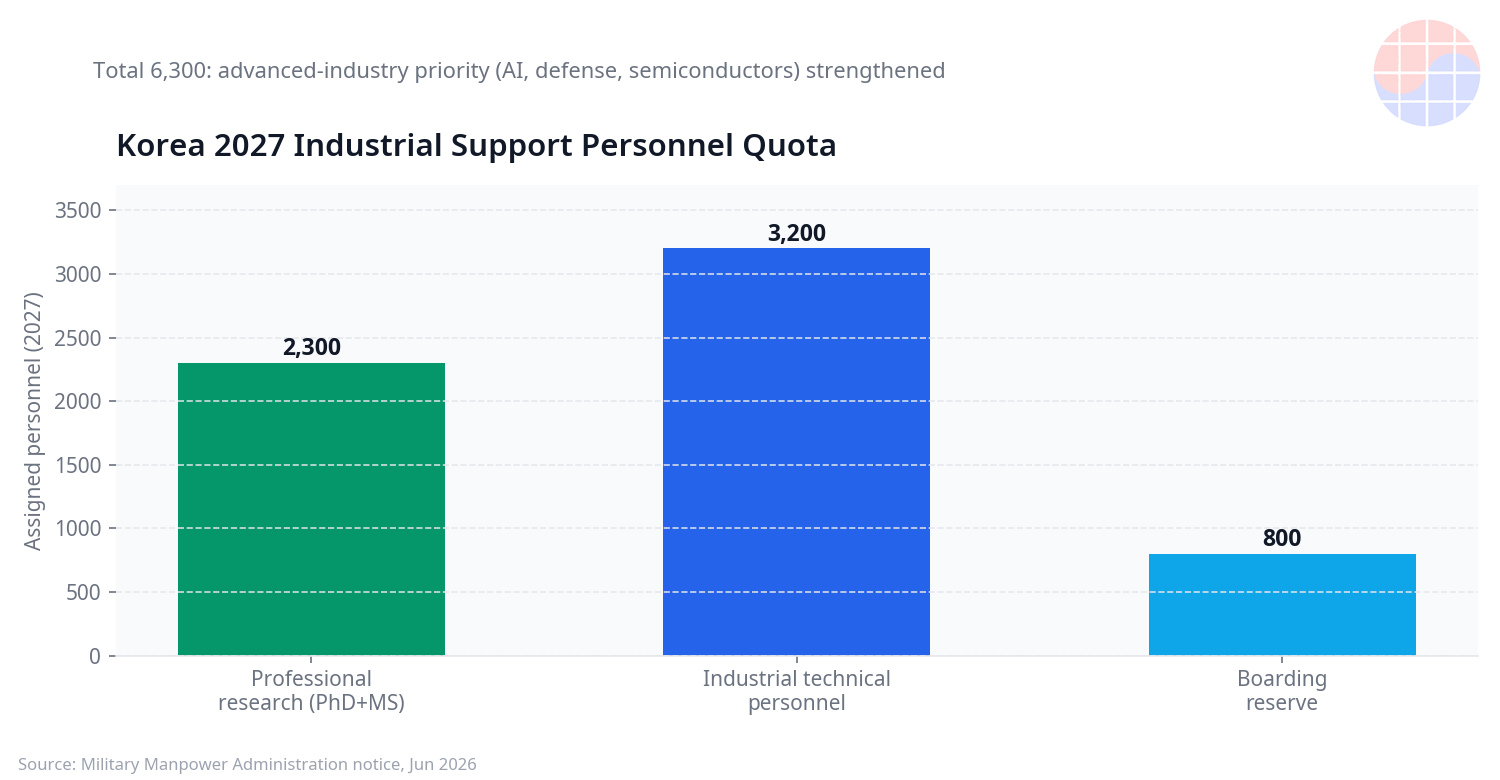
2027 industrial-support personnel quotas: 2,300 professional research personnel, 3,200 industrial technical personnel, 800 boarding reserve — 6,300 total, with strengthened preference for national strategic industries including AI, defense, and semiconductors. (Source: Military Manpower Administration notice, June 2026)
International Comparison: Taiwan, the US, and Japan Choose "Cultivation" Over "Exemption"
Notably, no semiconductor power solves its talent problem through military "exemption." All of them build cultivation pipelines.
Taiwan: universities as fab extensions. Taiwan operates 57 semiconductor programs across 17 universities (SemiAnalysis). Students receive advanced hands-on training while enrolled and graduate as immediately deployable fab talent — universities effectively function as fab training arms. On August 31, 2026, Taiwan and the US signed an MOU on semiconductor workforce development: American students train hands-on in Taiwan, linking education to employment. Taiwan has similar talent partnerships with Germany and Japan. The bet is on continuously producing talent, not on hoarding it.
The US: workforce provisions inside the CHIPS Act. The US semiconductor industry faces a projected shortfall of 157,000 workers by 2030 (joint SEMI–McKinsey–NSF analysis, reported July 2026); SEMI puts the near-term gap at "nearly 200,000" (October 2026 SEMICON West). The response is baked into law: the CHIPS Act assigned the National Science Foundation USD 200 million over five years for workforce development, funding the National Network for Microelectronics Education (NNME). The first four regional nodes launched in May 2026, each receiving USD 20 million over five years, running technician and operator training with 325+ industry-education partners. The National Semiconductor Technology Center (NSTC) hosts a USD 250 million workforce center of excellence. GlobalFoundries launched the industry's first registered apprenticeship — paid, two years or less, open to high-school graduates. TSMC is staffing its Arizona fabs with workers from Taiwan, India, Canada, Japan, and Europe while domestic pipelines catch up.
Japan: Rapidus's talent rebuild. Japan faces a shortfall of at least 40,000 semiconductor engineers over the next decade — decades of industry contraction drained the talent pool. Rapidus sent more than 100 engineers to IBM in the United States for intensive training, and has begun university pipeline partnerships including Hokkaido University. National Yang Ming Chiao Tung University (NYCU) in Taiwan set up a joint cleanroom research institute with four Japanese universities to co-train next-generation talent. Japan's lesson is blunt: money (subsidies) without people cannot run fabs.
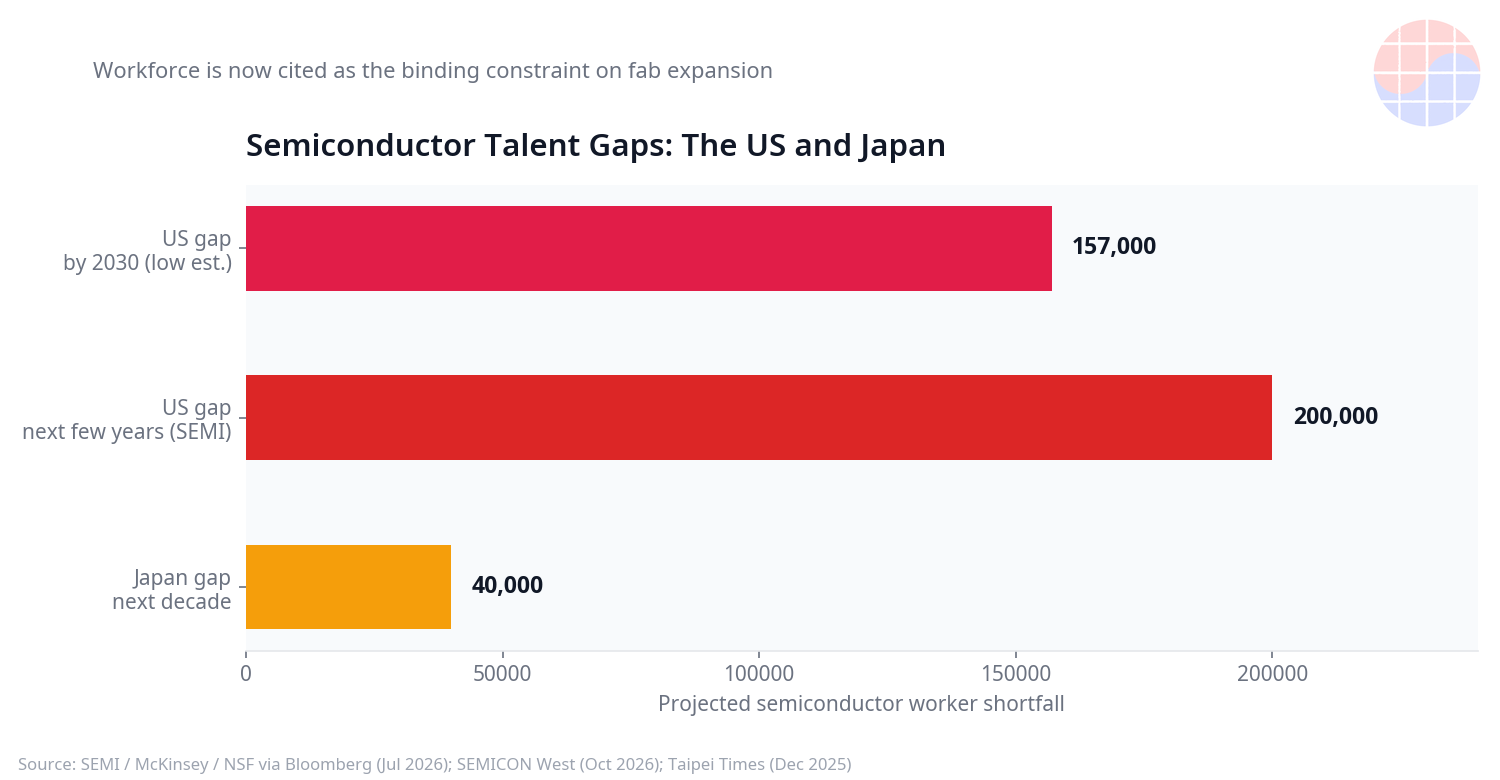
Projected semiconductor talent gaps in the US and Japan: ~157,000 by 2030 in the US; 40,000+ engineers over the next decade in Japan. (Sources: SEMI/McKinsey/NSF via Bloomberg July 2026; SEMICON West October 2026; Taipei Times December 2025)
The three countries share one approach: pipelines, not exemptions. The fix for talent is producing people faster and in greater numbers — without touching military-service systems.
Realistic Alternatives: Inside the Alternative-Service Framework
If the "exemption" frame is inaccurate, the discussion should move to alternative-service design. Considerable options exist within the current framework.
Alternative 1: Expand semiconductor/AI quotas for professional research personnel. The direction is already set. For 2027, the Military Manpower Administration separately assigned 240 master's-level slots to AI fields and 500 preferential slots to national strategic-industry companies. Designing these quotas more precisely around bottleneck fields — HBM, advanced packaging — is more realistic than an "exemption" debate. It is also consistent with keeping the 1,100 PhD-level slots.
Alternative 2: Stronger linkage with non-metro fabs. As in Rep. Choi Eun-seok's bill, exempting non-metropolitan large-company sites from quota restrictions on professional research and industrial technical personnel could ease regional fab talent shortages while slowing researcher concentration in Seoul. Transparent allocation criteria are the precondition for dodging large-company favoritism charges.
Alternative 3: Clarify the fab-technician path for industrial technical personnel. The industrial technical system was built around manufacturing roles. Explicitly linking its priority allocation of vocational-high-school graduates to semiconductor fab technician/operator training would match the system's original purpose — "alternative service as talent cultivation" — and parallels US apprenticeships and Taiwan's university-fab links.
Alternative 4: Package with technology-protection systems. The audit's real charge was that the industry ministry "doesn't even track overseas departures." Discussing service benefits without fixing leakage defenses is pouring water into a leaking bucket. Alternative-service expansion and stronger technology protection must move as one package.
Chase's Take: "Exemption" Is the Wrong Frame
Reporting and organizing this debate, the first thing to correct is the frame. What is being discussed right now is not "exemption." The bills pending in the 22nd National Assembly expand or shrink alternative service; none create a new military "exemption" for semiconductor employees. "Semiconductor employee military exemption" may fuel public heat, but it is an inaccurate starting point for policy discussion.
Second, the arithmetic of shrinking military manpower cannot be bypassed. Alternative service already absorbed a 1,300-slot cut from 2022 to 2026. In a demographic-cliff era, growing one industry's share grows someone else's burden. For the "golden window" logic to persuade, it must answer who bears that opportunity cost and how. From an MBA lens this is incentive design: no special treatment is sustainable unless benefit size and burden bearers are transparently matched.
Third, the international comparison teaches "speed," not "exemption." Taiwan turned universities into fab extensions, the US embedded workforce funding in legislation, Japan dispatches engineers abroad for training by the hundred. None touched military-service systems. All accelerated the talent-production pipeline. What Korea should learn is the speed of cultivation, not the expansion of exemptions.
So here is my conclusion. The "exemption" debate needs reframing from the ground up, and the realistic remedy is a three-part package. First, refine professional-research quotas for semiconductors and HBM. The 2027 allocation already includes 240 AI slots and 500 strategic-industry preferential slots — draw that blueprint more precisely. Second, explicitly connect industrial technical personnel to the fab-technician training path. A vocational-school → fab → alternative-service pipeline is the closest Korean analog to Taiwan's university-fab model. Third, bundle it with technology-leakage defenses. Without plugging the hole that lets trained talent flow overseas, no service system holds water. The 2026 audit's most important homework was not military service but statistics and management systems.
The golden-window logic itself is not wrong. I agree 2026–2028 is a critical window. But the way to buy that time is the speed of cultivation, not exemption — that distinction matters.
FAQ
Has a semiconductor-employee military exemption bill actually been proposed?
No. As of October 2026, the Military Service Act amendments pending in the 22nd National Assembly only expand or shrink alternative service (professional research / industrial technical personnel). No bill creates a military "exemption" for semiconductor employees. "Exemption" is a media-and-community frame, not legislative reality.
What is the difference between professional research personnel and industrial technical personnel?
Professional research personnel serve through R&D work at designated companies as master's/PhD-level researchers; industrial technical personnel serve in manufacturing roles, mainly vocational-high-school graduates. The 2027 quotas are 2,300 and 3,200 respectively. Both are alternative service, not exemption from duty.
How do Taiwan, the US, and Japan handle semiconductor talent and military service?
None of them use military exemptions. Taiwan cultivates fab-ready talent through 57 semiconductor programs at 17 universities; the US is building an education network with USD 200 million in five-year CHIPS workforce funding; Japan sent 100+ Rapidus engineers to IBM in the US for training. The common remedy is the speed of the cultivation pipeline.
What is the most realistic alternative?
A package inside the current alternative-service framework: refined professional-research quotas for semiconductors/HBM, an explicit fab-technician training path for industrial technical personnel, and stronger technology-leakage defenses. As the 2026 audit showed, statistics and management systems against overseas talent outflow are the precondition for any service-system debate.
Note: This article was written on October 16, 2026, based on publicly available materials. The status of Military Service Act amendments may change with the National Assembly's schedule.