VLSI Korea
Citi Keeps SK hynix Target at KRW 3 Million as AI Inference Drives eSSD Demand (HBM·eSSD)
Citi maintained Buy on SK hynix and its KRW 3 million target on Oct 20, 2026. Its Q3 operating profit forecast is KRW 81.3 trillion, above consensus, and it sees 2027 eSSD demand rising +52.9% YoY on AI inference growth.


🆓 Free article · Anyone can read this article for free
30-Second Summary
- Conclusion first: Citi maintained its Buy rating on SK hynix and kept its target price at KRW 3,000,000. In its report dated October 20, 2026, Citi did not raise the target — it maintained it, and grounded that decision in its earnings outlook and in eSSD demand (MK Economy, News1 via FnNews).
- The Q3 operating profit forecast is KRW 81.3 trillion. That is +8% above the consensus of KRW 75.5 trillion, +34% quarter on quarter, and +614% year on year (MK Economy).
- Price is what makes the profit. The Q3 revenue forecast is KRW 101.2 trillion, +28% quarter on quarter and +314% year on year, with Q3 DRAM ASP up +28% quarter on quarter and NAND ASP up +24% quarter on quarter (BigGo Finance).
- The new demand axis is eSSD. Citi expects enterprise SSD (eSSD) demand to grow +52.9% year on year in 2027, driven by AI inference growth and continual learning adoption, with KV-cache workloads raising memory and storage demand (BigGo Finance).
- The memory supply shortage is expected to run through 2028. Citi cited SK hynix's high-density QLC NAND leadership and its strengthened TLC NAND performance for AI-customized solutions as core strengths (News1 via FnNews).
- On Citi's reading, the extended upcycle is not fully priced in. The shares were presented at a forward PER of 2.7x and a PBR of 1.4x, and against the price of KRW 1,296,000 at 15:23 KST on October 21, the maintained target implies upside of +131%.
Every figure attributed to the report in this article comes from secondary reporting. The original report is client-only and was not directly verified — "original not directly verified." Each figure carries its source, and no figure that could not be checked has been included.
Introduction: Why an Unchanged Target Matters More Than a Raised One
The first word to read in Citi's October 20, 2026 report on SK hynix is "maintained." The Buy rating was maintained. The target price of KRW 3,000,000 was maintained (MK Economy). A report that raises a target draws attention by itself. The core of this report is different: through a lower share price and a fresh set of concerns, Citi did not change its standing judgment.
Citi weighed the FX headwinds and the HBM4-related concerns and still concluded that the earnings outlook, the memory supply shortage, and the structure of eSSD demand were the larger forces. The short-term concerns are acknowledged. They are just not judged strong enough to break the earnings outlook.
The context also matters. One day earlier, on October 19, Nomura maintained target prices of KRW 670,000 for Samsung Electronics and KRW 4,700,000 for SK hynix, while JPMorgan presented a fundamentally bullish view of the AI ecosystem and Korean equities over the next 6-12 months. That is prior coverage, not new content from Citi's report — but it shows that Citi's KRW 3,000,000 does not stand alone.
This article takes the report apart in three parts: how the Q3 operating profit figure of KRW 81.3 trillion is built out of ASP; why the eSSD demand forecast of +52.9% opens a different layer from the HBM-centered debate; and what gap a forward PER of 2.7x and a PBR of 1.4x create against the current price — and what would break that reading.
Episode 1: Dissecting KRW 81.3 Trillion — A Quarter Made by ASP
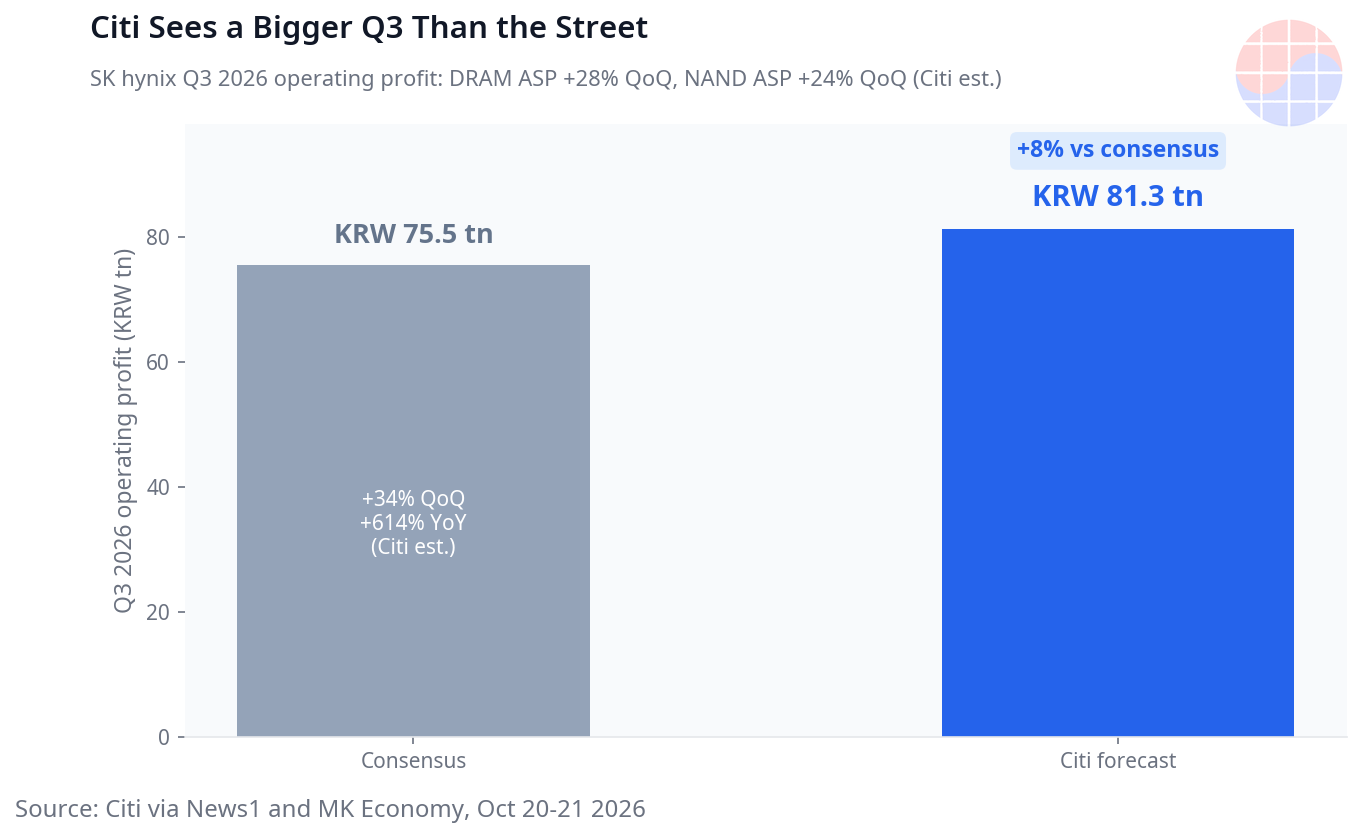
Citi's Q3 2026 operating profit forecast for SK hynix is KRW 81.3 trillion. Consensus sits at KRW 75.5 trillion, and Citi's forecast is +8% above it, +34% against the previous quarter, and +614% against the same quarter a year earlier (MK Economy). The premium to consensus is not large in itself. Its direction is what matters: at a moment when concerns around the stock had grown, Citi placed its forecast above the market average, not below it.
The revenue forecast is KRW 101.2 trillion, +28% quarter on quarter and +314% year on year (BigGo Finance). When revenue and operating profit grow together at this pace, price deserves to be read before volume — and Citi's pricing figures make exactly that point: Q3 DRAM ASP rose +28% quarter on quarter, and NAND ASP rose +24% quarter on quarter (BigGo Finance).
ASP is the average selling price. Even at unchanged volume, a higher ASP lifts revenue, and profit responds faster than revenue when the fixed cost structure holds. DRAM ASP at +28% and NAND ASP at +24% mean both product families have pricing power at the same time. This cycle draws its attention through HBM, but in Citi's Q3 numbers, conventional DRAM and NAND pricing also sit at the center of profit.
That point requires a second look at how SK hynix is usually described. The market explains SK hynix mainly through HBM, but a single quarter's profit is not a function of HBM alone. Pricing across DRAM as a whole, pricing in NAND, and the supply environment behind that pricing all work together. Behind Citi's decision to look through the FX headwinds and the HBM4-related concerns sits this reading: even outside the HBM axis, a pricing current is pushing profit upward.
These figures are forecasts delivered through secondary reporting, and they will be tested by the earnings release itself. Their meaning is still clear. Citi read Q3 not as a quarter in which a peak is close, but as one in which rising prices are still converting into profit. That quarterly number is the first ground for maintaining the target.
Episode 2: eSSD at +52.9% — Inference Calls Storage Back
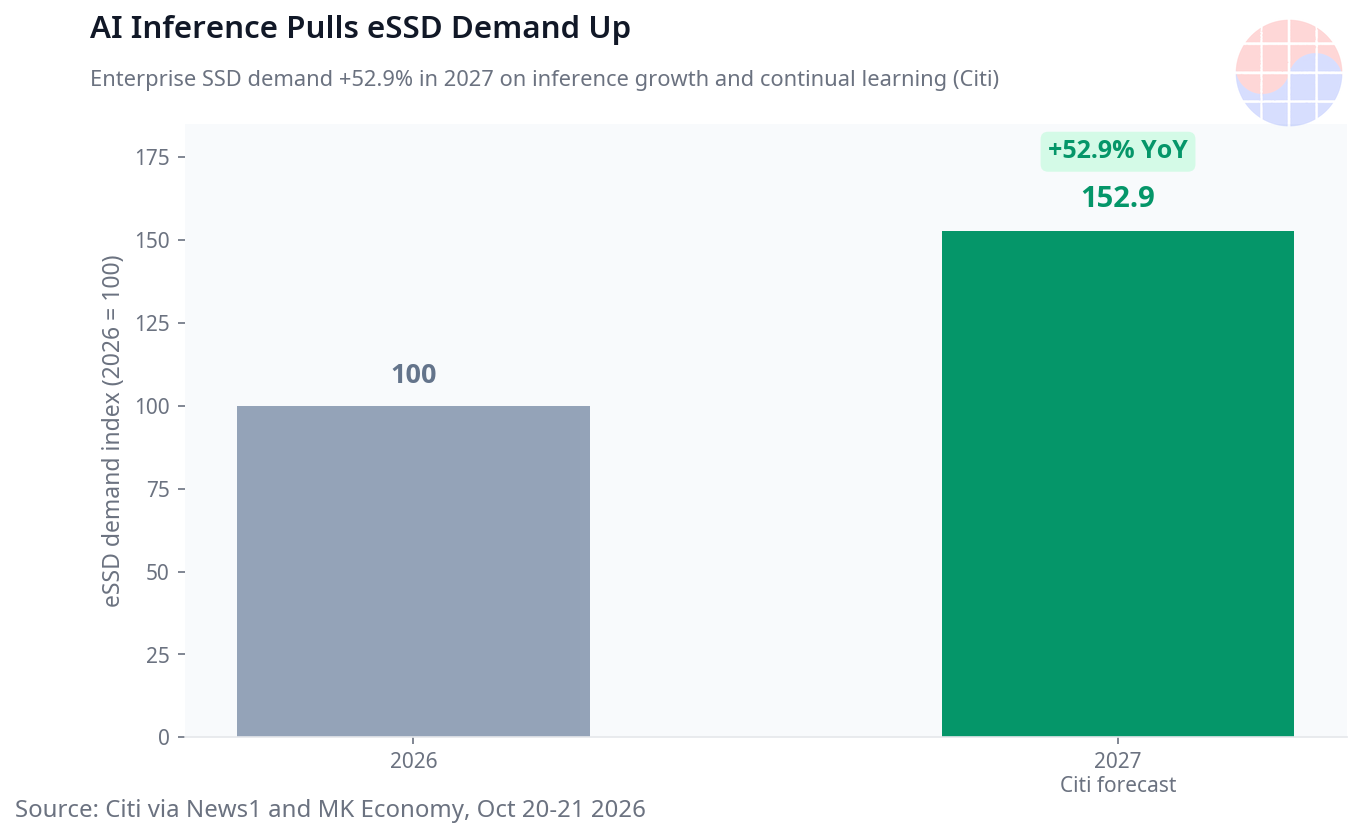
The newest number in this report is neither the target price nor the Q3 profit figure. It is the forecast that eSSD demand will grow +52.9% year on year in 2027 (BigGo Finance). An eSSD is an enterprise SSD, the storage that goes into data centers. The AI infrastructure debate so far has concentrated on GPUs, HBM, and DRAM. Citi's number widens that debate to storage.
The drivers Citi cited are AI inference growth and continual learning adoption. If training builds a model, inference is where the built model actually serves requests. As inference workloads grow, the data that must be referenced and stored grows with it. Citi pointed in particular to KV-cache workloads raising memory and storage demand: intermediate results generated during inference are stored and reused, and as that workload scales, so does the burden on the memory and storage layers that hold it and move it quickly.
Continual learning points in the same direction. Where a model is not trained once and fixed, but keeps taking in new data and updating, data keeps accumulating, keeps being read, and keeps being written again. In the inference era, storage is not a peripheral layer hidden behind compute. It is infrastructure that the shape of the workload itself requires. Citi's eSSD forecast is a number placed on that structural change.
This is where the strengths Citi attributed to SK hynix connect. The first is leadership in high-density QLC NAND — QLC raises density by storing more bits per cell, and density is itself an axis of competitiveness in large-capacity data center storage. The second is TLC NAND performance strengthened for AI-customized solutions: capacity alone is not enough without the performance the workload requires. On those two grounds, Citi named SK hynix a core beneficiary of the increase in eSSD demand (News1 via FnNews).
The supply-side judgment completes the picture. Citi expects the memory supply shortage to continue through 2028. Demand gains a new axis in eSSD while supply stays short — a combination that keeps the pricing environment favorable for makers, and that makes the NAND ASP figure of +24% in Episode 1 readable as an early sign of this structure already appearing in quarterly numbers.
📩 Following this story?
Get the follow-up analysis — earnings, reports and HBM supply — in your inbox daily at 10:30 KST. Subscribe free →
In short: if HBM was the symbol of the training era, eSSD is another memory layer that grows in the inference era. That expansion of the demand axis is the second ground for maintaining the target.
Episode 3: The Gap at PER 2.7x — and What Breaks the Thesis
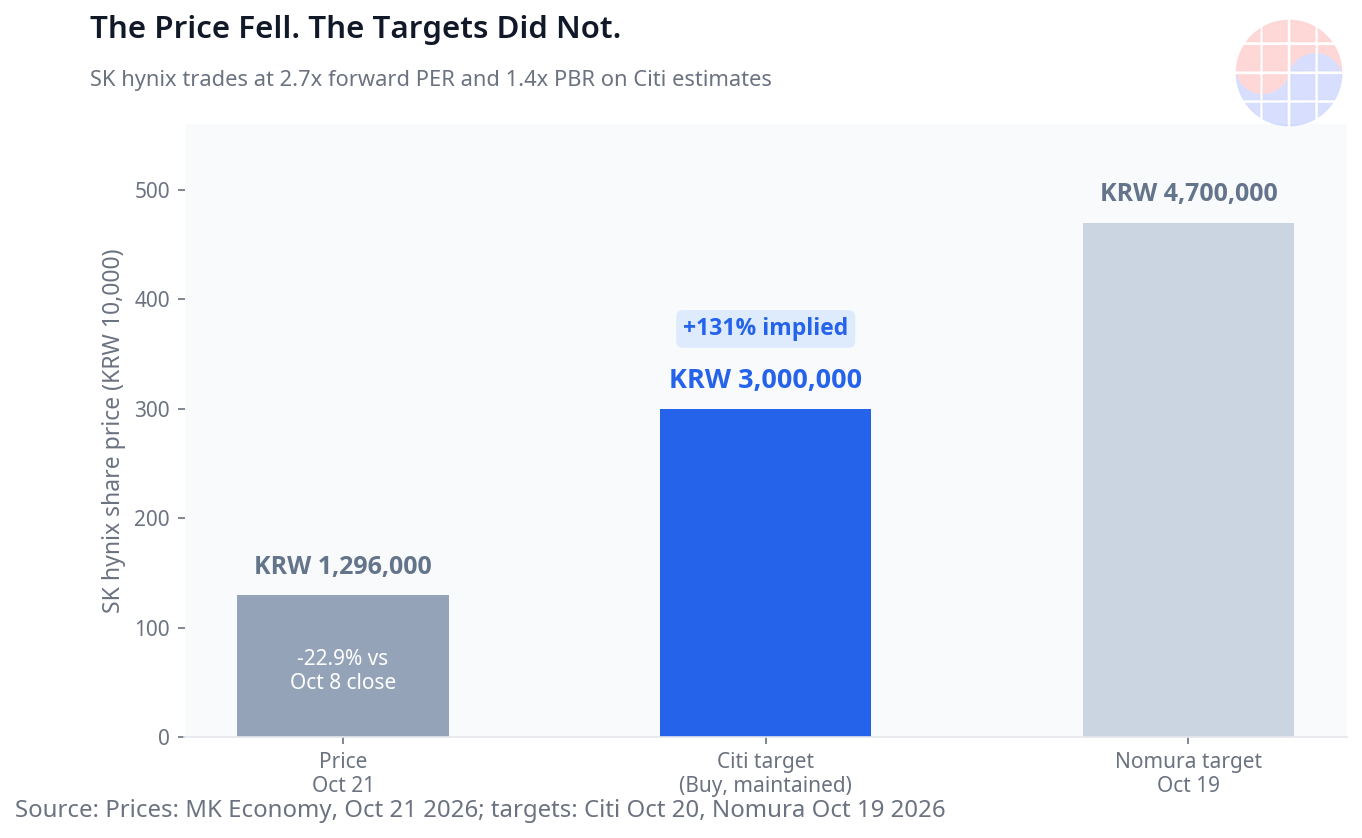
The valuation Citi presented is a forward PER of 2.7x and a PBR of 1.4x, with an explicit reading: the extended upcycle is not yet fully reflected in the share price (MK Economy). The question is whether the market reads that low PER as "cheap," or as "peak earnings that cannot be trusted." Citi's answer sits closer to the first. If the cycle runs long, a low multiple is not a trap but an incomplete reflection.
The gap can be checked in numbers. SK hynix traded at KRW 1,296,000 as of 15:23 KST on October 21, -22.9% against the October 8 close. The upside to Citi's target of KRW 3,000,000 is +131%. The forecast did not chase the price down, so the gap widened. Set beside Nomura's maintained SK hynix target of KRW 4,700,000, Citi's KRW 3,000,000 is not even the highest number in the field — yet the gap is still large. That gap is not a contest over targets. It is the distance the market price opened from the forecasts through the recent decline.
So where does this thesis break? Start with the items Citi itself weighed and looked through. The FX headwind has not disappeared: if that burden grows, the premises under the earnings forecast can be shaken. The HBM4-related concerns matter for the same reason — HBM sits at the center of SK hynix's profit structure, so if they are confirmed in real numbers, the premises of the whole report have to be read again.
The third condition is more fundamental. Citi's logic has two supports: the memory supply shortage continuing through 2028, and eSSD demand growing +52.9% year on year in 2027. If the shortage eases sooner than expected, or if inference growth and continual learning adoption convert into eSSD demand more slowly than forecast, the chain linking ASP, profit, and multiple weakens all at once. As long as both supports hold, PER 2.7x reads more naturally, on Citi's logic, as skepticism about a long cycle than as a warning about peak earnings.
What deserves checking is not the target. It is how close Q3 earnings land to the forecast of KRW 81.3 trillion, and whether the ASP current in DRAM and NAND holds. If the numbers follow the forecast, the gap narrows. If they diverge, the premises — not the maintained target — need re-examining first.
Chase's Take
Working in STA and physical design, I read the words KV cache in this report before I read the target price. The memory demand debate so far has flowed around training — how many GPUs go in, and how much HBM attaches to each. Inference is different. It is a workload that does not end: as long as requests keep arriving, it keeps running, and while it runs, storing intermediate results and reading them back repeats. That repetition loads the entire memory and storage hierarchy.
From a design standpoint, a KV cache is a question of where data is placed and how fast it can be brought back. However strong compute becomes, if needed data is not supplied in time, system performance is bound at that point. In physical design, timing closure is a problem of routing and placement; in an inference system, performance converges the same way into a problem of data movement. By citing KV-cache workloads as a ground for eSSD demand, Citi treated storage not as a peripheral around compute, but as a layer that sets system performance.
That is why I do not read the eSSD demand figure of +52.9% as a simple NAND upturn forecast. It is closer to a declaration that inference-era infrastructure does not end at HBM. If DRAM, NAND, and eSSD each support compute at a different distance, and supply across that whole structure stays short through 2028, the frame for viewing SK hynix should widen from a single HBM axis to memory as a whole. Citi's separate mention of QLC density and TLC performance belongs to the same context.
Three things are worth checking from here. Whether the pricing current of DRAM ASP at +28% and NAND ASP at +24% is confirmed as real profit in Q3. Whether the eSSD demand forecast remains Citi's number alone, or the same direction appears elsewhere. And whether the FX headwinds and HBM4-related concerns begin to appear in earnings as numbers rather than words. As long as the first two are confirmed and the third does not turn into figures, Citi's maintained KRW 3,000,000 reads as a stronger kind of maintenance than an increase: it was not raised, but it was not lowered either, and its grounds widened to a new axis called inference.
FAQ
What is Citi's target price for SK hynix, and did it raise it?
In its report dated October 20, 2026, Citi maintained its Buy rating on SK hynix and maintained its target price at KRW 3,000,000. The target was maintained, not raised. Against the share price of KRW 1,296,000 at 15:23 KST on October 21, the implied upside is +131%.
What is Citi's Q3 earnings forecast for SK hynix?
Operating profit of KRW 81.3 trillion, +8% above the consensus of KRW 75.5 trillion, +34% quarter on quarter, and +614% year on year. The revenue forecast is KRW 101.2 trillion, +28% quarter on quarter and +314% year on year, with DRAM ASP up +28% quarter on quarter and NAND ASP up +24% quarter on quarter.
Why did Citi emphasize eSSD demand?
Citi expects eSSD demand to grow +52.9% year on year in 2027. The background is AI inference growth and continual learning adoption, and a judgment that KV-cache workloads raise memory and storage demand. Citi named SK hynix a core beneficiary, citing its high-density QLC NAND leadership and TLC NAND performance strengthened for AI-customized solutions.
What would break Citi's thesis?
A case in which the premise that the memory supply shortage runs through 2028 and the eSSD demand growth forecast are shaken together. The FX headwinds and HBM4-related concerns that Citi weighed and looked through would also require the premises to be read again if they are confirmed in actual earnings figures. The indicators to check are how close Q3 earnings land to the operating profit forecast of KRW 81.3 trillion, and whether the ASP current persists.
This article is for information only and is not investment advice. Figures attributed to the report are based on secondary reporting, and the original report was not directly verified. Investment decisions are your own responsibility.
📩 Missed today's analysis? Get tomorrow's in your inbox
Daily Silicon at 10:30 KST plus earnings and analyst-report breakdowns, first. Samsung Electronics, SK hynix, TSMC and HBM supply, read by practicing engineers. Join 300+ subscribers.
Subscribe free →
Free · No spam · Unsubscribe anytime