VLSI Korea
Market Bulletin: Enterprise SSDs Become AI's Second Memory - Data-Center SSD Revenue Nears USD 10 Billion in a Single Quarter
Micron data-center SSD revenue approached USD 10 billion in fiscal Q4 2026, more than two-thirds of its USD 14.1 billion NAND revenue. SK hynix enterprise SSD revenue doubled quarter over quarter, with high-capacity products more than tripling.


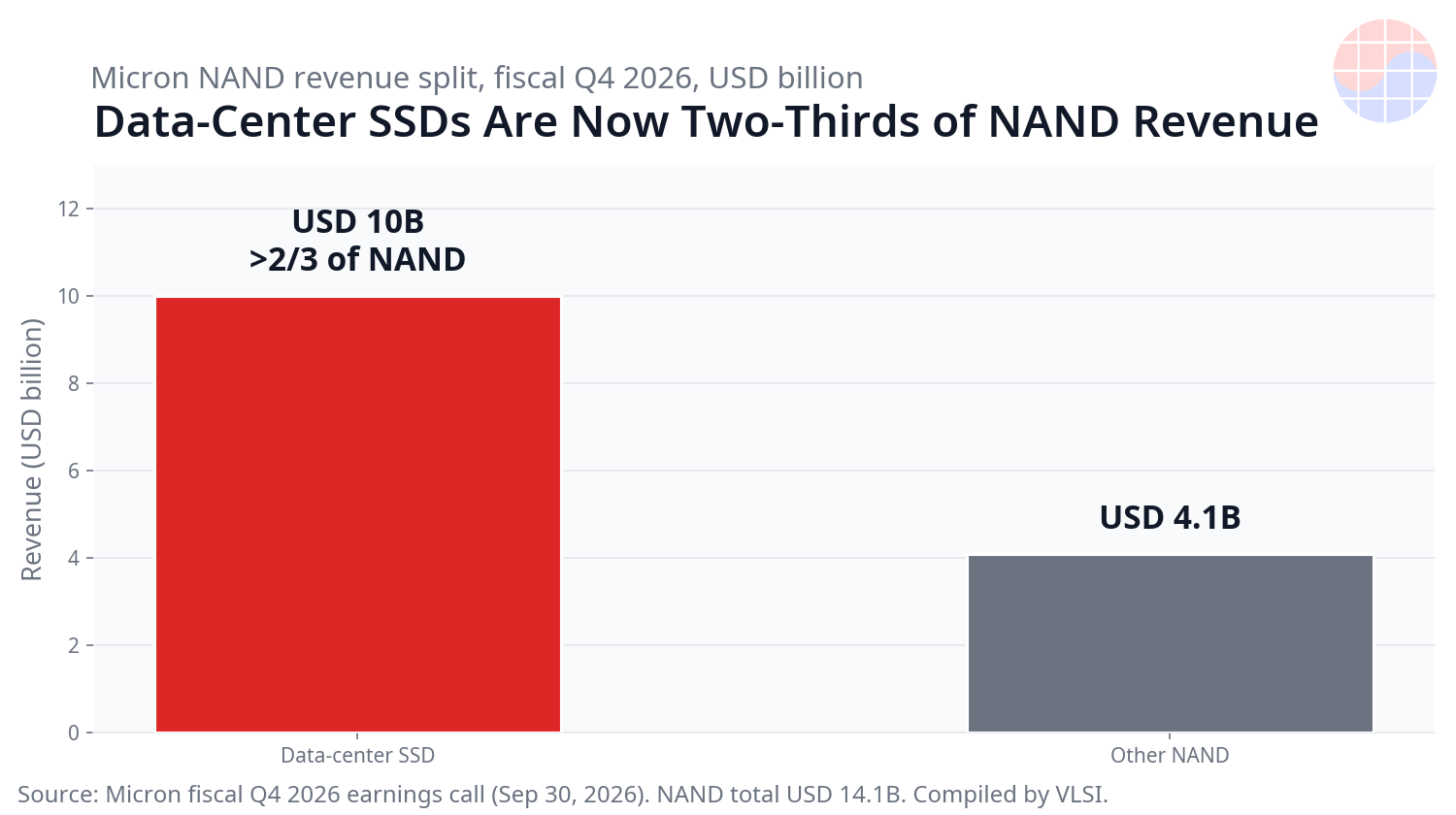
Enterprise SSDs have become the second memory tier of AI infrastructure. In Micron's fiscal fourth quarter of 2026, ended September 3 and reported on September 30, 2026, data-center SSD revenue approached USD 10 billion, more than two-thirds of NAND revenue of about USD 14.1 billion and more than 10 times the level a year earlier (Micron earnings call reporting, September 30, 2026). Total revenue reached USD 54.23 billion in the quarter and USD 133.19 billion for the full year (Micron official release, September 30, 2026). SK hynix told a similar story one quarter earlier: enterprise SSD revenue doubled quarter over quarter in Q2 2026. The driver is a workload shift, as AI moves from training toward inference, where KV cache, retrieval and checkpointing need large, fast storage placed close to accelerators.
Key Highlights
- Data-center SSD nears USD 10 billion: Micron's data-center SSD revenue approached USD 10 billion in fiscal Q4 2026, more than two-thirds of NAND revenue and more than 10x year over year (earnings call reporting, September 30, 2026).
- Record quarter at Micron: Total revenue was USD 54.23 billion in fiscal Q4 2026 and USD 133.19 billion for the full year. Guidance for fiscal Q1 2027 is USD 61.5 billion, plus or minus USD 1.5 billion (Micron official release, September 30, 2026).
- SK hynix enterprise SSD doubled: In Q2 2026, on revenue of KRW 79.3 trillion, enterprise SSD revenue doubled quarter over quarter and accounted for about 75% of NAND revenue. High-capacity Solidigm SSDs of 30TB and above more than tripled quarter over quarter (SK hynix Q2 2026 call, July 29, 2026).
- Price confirms demand: SK hynix NAND average selling price rose in the mid-50% range quarter over quarter in Q2 2026, while DRAM ASP rose about 30%. Storage pricing is now rising alongside memory pricing, not behind it (SK hynix Q2 2026 call, July 29, 2026).
- 2027 supply is largely spoken for: More than 75% of Micron's calendar 2027 output is already committed, under 26 strategic customer agreements carrying USD 32 billion in customer commitments. Server unit shipments are expected to grow in the high teens in calendar 2026 and 2027 (earnings call reporting, September 30, 2026).
Market Update
Start with the scale. A single product line inside NAND - data-center SSDs - approached USD 10 billion of revenue in one quarter at Micron, within total NAND revenue of about USD 14.1 billion. That mix matters more than the headline. NAND was long treated as the cyclical, commodity side of memory, sold on price per bit into consumer and client devices. A quarter in which more than two-thirds of NAND revenue comes from data-center SSDs describes a different business: engineered systems, qualified into server platforms, sold under agreements rather than on spot markets. Micron paired the result with fiscal Q1 2027 guidance of USD 61.5 billion, plus or minus USD 1.5 billion, and said server unit shipments should grow in the high teens in both calendar 2026 and calendar 2027. The commitment data point in the same direction: 26 strategic customer agreements, USD 32 billion in customer commitments, and more than 75% of calendar 2027 output already committed. Buyers are not ordering SSDs the way they once bought commodity flash. They are reserving capacity the way they reserve accelerator and memory supply.
| Latest figure | Detail / change | |
|---|---|---|
| Micron data-center SSD revenue | Approached USD 10 billion (fiscal Q4 2026) | More than two-thirds of NAND revenue, more than 10x year over year |
| Micron NAND revenue (total) | About USD 14.1 billion (fiscal Q4 2026) | Other NAND of about USD 4.1 billion after data-center SSD |
| SK hynix enterprise SSD | Doubled quarter over quarter (Q2 2026) | About 75% of NAND revenue |
| Solidigm high-capacity SSD (30TB and above) | More than tripled quarter over quarter (Q2 2026) | High-capacity demand inside SK hynix NAND mix |
| NAND ASP (SK hynix) | Up mid-50% range quarter over quarter (Q2 2026) | DRAM ASP up about 30% quarter over quarter in the same quarter |
| Calendar 2027 output commitment (Micron) | More than 75% already committed | 26 strategic agreements, USD 32 billion in customer commitments |
Micron fiscal Q4 2026 ended September 3, 2026 and was reported September 30, 2026. SK hynix Q2 2026 results were discussed on the July 29, 2026 earnings call. Figures are company-reported results and call disclosures, not estimates.
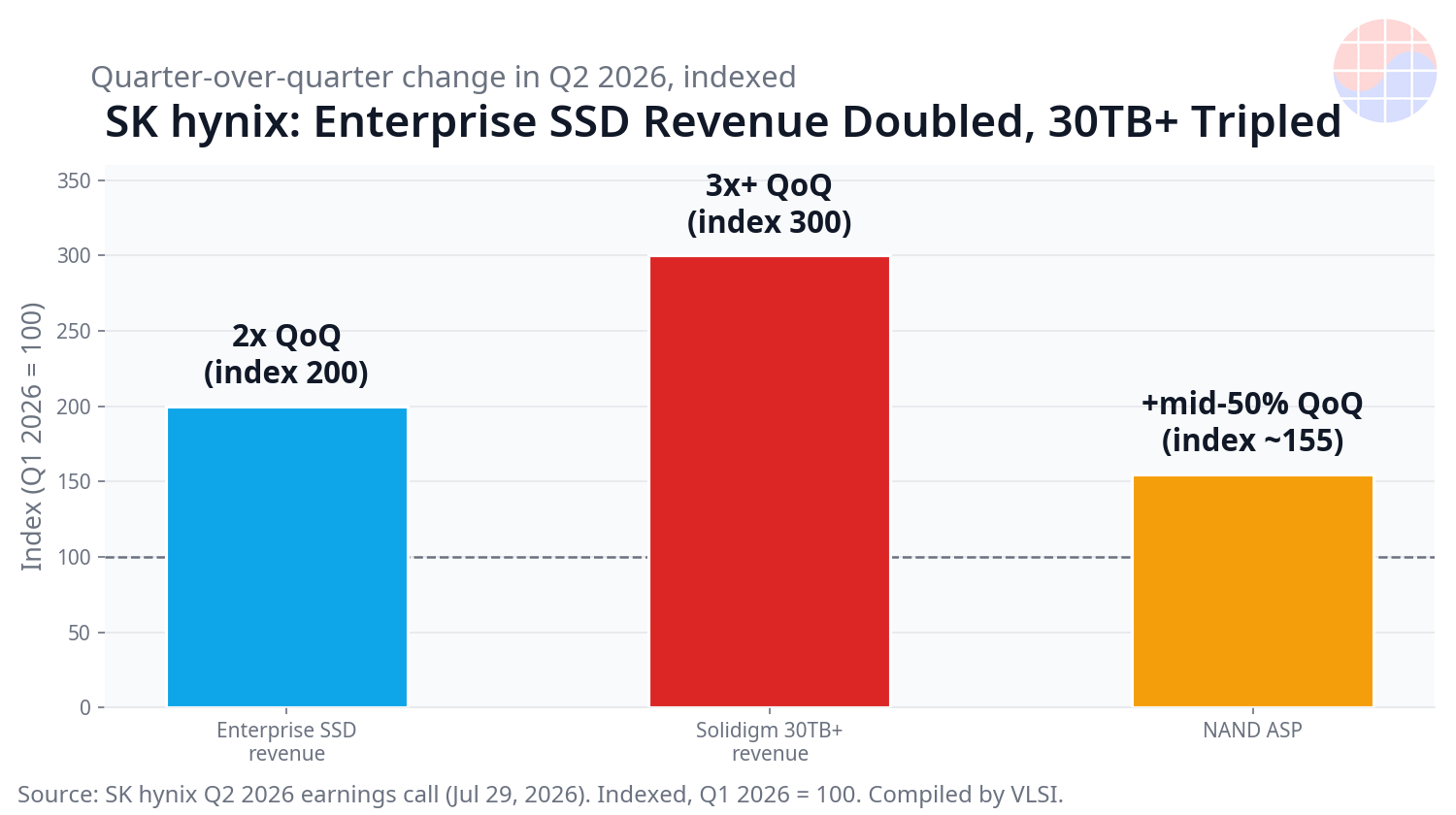
SK hynix shows the same shift from the Korean side, one quarter earlier. Revenue reached KRW 79.3 trillion in Q2 2026. Enterprise SSD revenue doubled quarter over quarter and represented about 75% of NAND revenue, while high-capacity Solidigm products of 30TB and above more than tripled. NAND ASP rose in the mid-50% range and DRAM ASP rose about 30%, and the company pointed to long-term agreements with about 10 key customers. The workload explanation connects both companies. Training clusters are dominated by compute and high-bandwidth memory feeding accelerators. Inference serving is different: models hold KV cache, retrieve context, checkpoint state and stream data for many concurrent requests, all of which need high-capacity, fast storage near the accelerator. That splits the SSD market by job. QLC NAND fits the capacity tier, where cost per terabyte and density decide. PCIe 5.0 TLC products fit the performance tier, where latency and throughput decide. A market that once bought one commodity part now specifies two different storage tiers, and both tiers are growing at once.
VLSI's View
The storage tier is becoming a designed tier. The most important change in these two reports is not the growth rate. It is where SSDs now sit in system design. When data-center SSDs are more than two-thirds of one supplier's NAND revenue and about three-quarters of another's, storage is no longer an afterthought fitted around the accelerator budget. Platform teams now plan capacity, endurance and interface speed alongside compute. That raises switching costs, lengthens qualification value and makes committed supply worth paying for - exactly what the calendar 2027 commitment figure shows.
The Korea angle runs through SK hynix and Solidigm. Korea's position in AI memory is usually told through DRAM. The Q2 2026 numbers add a second leg: enterprise SSDs at about 75% of NAND revenue, with the high-capacity Solidigm line more than tripling in a single quarter. High-capacity QLC systems are precisely the tier inference serving needs for KV cache overflow, retrieval stores and checkpoint volumes. If inference keeps scaling, Korean suppliers hold exposure to both the memory tier and the storage tier of the same rack, rather than depending on one component cycle.
📩 Following this story?
Get the follow-up analysis — earnings, reports and HBM supply — in your inbox daily at 10:30 KST. Subscribe free →
Winners sell tiers, losers sell bits. The split between QLC capacity products and PCIe 5.0 TLC performance products rewards suppliers that can qualify complete systems - controller, firmware, capacity point and interface - into server platforms. It is less kind to undifferentiated NAND sold purely on price per bit, because inference buyers are purchasing behavior under load: sustained throughput, predictable latency and endurance across a fleet. The ASP data support that reading. A mid-50% range quarterly rise in NAND ASP, faster than DRAM ASP growth in the same quarter, is not what a commodity glut looks like.
Chase's Take: This is the memory hierarchy lesson every implementation engineer learns the hard way. In timing closure, you do not solve a critical path by making one stage faster and ignoring the rest; you build a hierarchy - registers, cache, on-chip SRAM, off-chip memory - and each level exists because the level above it overflows. Inference is forcing the same hierarchy into AI systems. HBM and DRAM hold the working set, and enterprise SSDs are becoming the next level down: the cache overflow, retrieval and checkpoint tier that keeps accelerators fed. Teams that size only the top of the hierarchy will watch expensive accelerators wait on storage, the data-center version of a timing violation you could have predicted at the floorplan stage.
Outlook
- Micron fiscal Q1 2027 results: whether revenue tracks the USD 61.5 billion guidance, plus or minus USD 1.5 billion, and whether data-center SSD holds its share of NAND revenue.
- SK hynix Q3 2026 enterprise SSD momentum: whether enterprise SSD revenue keeps growing after doubling, and whether the 30TB-and-above line sustains its pace.
- Commitment conversion: how the 26 strategic agreements and USD 32 billion in customer commitments convert into reported 2027 revenue, and whether the committed share of output rises further.
- Tier mix in inference fleets: the balance between QLC capacity SSDs and PCIe 5.0 TLC performance SSDs as inference serving, KV cache and retrieval workloads scale.
FAQ
Why are enterprise SSDs called AI's second memory? Inference serving needs KV cache, retrieval data and checkpoints held close to accelerators at a scale DRAM alone does not serve economically. Enterprise SSDs form the next tier below memory in the AI system hierarchy, which is why data-center SSD revenue approached USD 10 billion in a single quarter at Micron.
How big was Micron's data-center SSD business in fiscal Q4 2026? Data-center SSD revenue approached USD 10 billion, more than two-thirds of NAND revenue of about USD 14.1 billion and more than 10 times the year-earlier level (Micron earnings call, September 30, 2026). Total company revenue was USD 54.23 billion in the quarter.
What did SK hynix report for enterprise SSDs in Q2 2026? Enterprise SSD revenue doubled quarter over quarter and was about 75% of NAND revenue. High-capacity Solidigm SSDs of 30TB and above more than tripled quarter over quarter, and NAND ASP rose in the mid-50% range (SK hynix earnings call, July 29, 2026).
How much of 2027 supply is already committed? Micron said more than 75% of its calendar 2027 output is already committed, under 26 strategic customer agreements with USD 32 billion in customer commitments (earnings call, September 30, 2026).
📩 Missed today's analysis? Get tomorrow's in your inbox
Daily Silicon at 10:30 KST plus earnings and analyst-report breakdowns, first. Samsung Electronics, SK hynix, TSMC and HBM supply, read by practicing engineers. Join 300+ subscribers.
Subscribe free →
Free · No spam · Unsubscribe anytime