VLSI Korea
CPU Prices Up 20%: Mapping the 2027 Semiconductor Cost Pass-Through Chain
Intel CPUs up to 20% more expensive, Qualcomm up 10% — TSMC's reported 2027 wafer hikes (3–6%) are still working down the chain. With CPU+DRAM+SSD at 68% of a $900 notebook's BOM, 2027 brands must pick: raise prices, absorb margin, or cut specs. The consumer sits at the end of the chain.


CPU Prices Up 20%: Mapping the 2027 Semiconductor Cost Pass-Through Chain
In brief: Taiwanese supply-chain press reported around October 12, 2026 that Intel raised prices across three CPU generations — up to 20% on Panther Lake, its third increase since late 2025 — while Qualcomm lifted Snapdragon X/X2 Elite 10%. AMD adjustments are also reported but unconfirmed. Layered on top: TSMC's reported 2027 wafer hikes (3–6%) and ASML's 10% increase on EUV/DUV replacement parts for Samsung and SK Hynix (deliveries from January 2027). With CPU+DRAM+SSD at 68% of a $900 notebook's BOM, PC brands face a 2027 trilemma: raise prices, absorb margin, or cut specs. None of Intel, Qualcomm, AMD, or TSMC has officially confirmed these moves.
30-Second Summary
- Intel: Panther Lake +15–20% (eff. Sept 1, 2026), Meteor/Arrow Lake +5–10%, Alder/Twin Lake +10–20% — third hike since late 2025, per reports. (Source)
- Qualcomm & AMD: Snapdragon X/X2 Elite +10% (effective Oct 1, 2026); AMD reportedly preparing adjustments to some Ryzen/EPYC parts (magnitude, scope, timing unconfirmed). (Source)
- TSMC: 2027 wafer hikes reported at 3–6%; analysts estimate advanced nodes 5–10%, advanced packaging 10–15%, 2nm possibly +6–8% more in Q1 2027. All reported/estimated — TSMC has confirmed nothing. (Source)
- ASML: +10% on EUV/DUV replacement parts for Samsung/SK Hynix (deliveries from Jan 2027, accepted after Sept consultations). Installed-base revenue ~25% of total (EUR 8.19B of EUR 32.67B, 2025), +30% growth expected this year. (Source)
- Notebook BOM: CPU+DRAM+SSD = 68% of a $900 notebook's BOM (Q3 2026). Contract DRAM ~$25 (4.4x YoY); NAND ~$30.50 (~9x YoY). (Source)
- 2027 outlook: Shipments seen down low-single-digit % (base case) or high-single-digit % (if costs pass through); China's notebook production share forecast above 80%. (Source)
- The call: Not a blip — a structural, AI-demand-triggered cost pass-through across the supply chain. Prices are set upstream where scarcity lives; the burden flows downstream.
Background: After Memory, the CPU
2026 was the year of memory: as AI datacenters absorbed conventional DRAM supply, contract prices for a basic DRAM chip rose 4.4x YoY, the DDR4 8Gb spot price spiked to $42.50 on August 10, 2026 (spot and contract must never be mixed — more below), and NAND chips reached ~$30.50, roughly 9x YoY. PC and smartphone brands were already under memory-driven cost pressure. (Source)
Then, around October 12, 2026, Taiwanese supply-chain press (Commercial Times/CTEE lineage) reported that Intel had raised Panther Lake prices by up to 20%. Relayed by Wccftech, VideoCardz, and Gadgets360, the hikes were tiered: Panther Lake +15–20% (eff. Sept 1, 2026), Meteor/Arrow Lake +5–10%, Alder/Twin Lake +10–20%; Snapdragon X/X2 Elite +10% from Oct 1; AMD reportedly preparing adjustments to some Ryzen/EPYC parts (magnitude, scope, timing unconfirmed). (Source) (Source) (Source)
The detail that matters: this is Intel's third price increase since late 2025 — not quarterly opportunism but a structural cost push being formalized. Memory was the first domino; the CPU was next, and the three pillars of a $900 notebook's BOM — CPU, DRAM, SSD, fully 68% — are now rising together. (Source)
One premise: none of Intel, Qualcomm, AMD, or TSMC has officially confirmed any of this. Every figure below is cited from press reports and analyst estimates, and some may be negotiation trial balloons floated through the supply-chain press. The direction of the chain, however, is cross-confirmed across independent sources.
Business Deep Dive
(a) Anatomy of the Chain: From Wafer to Shelf
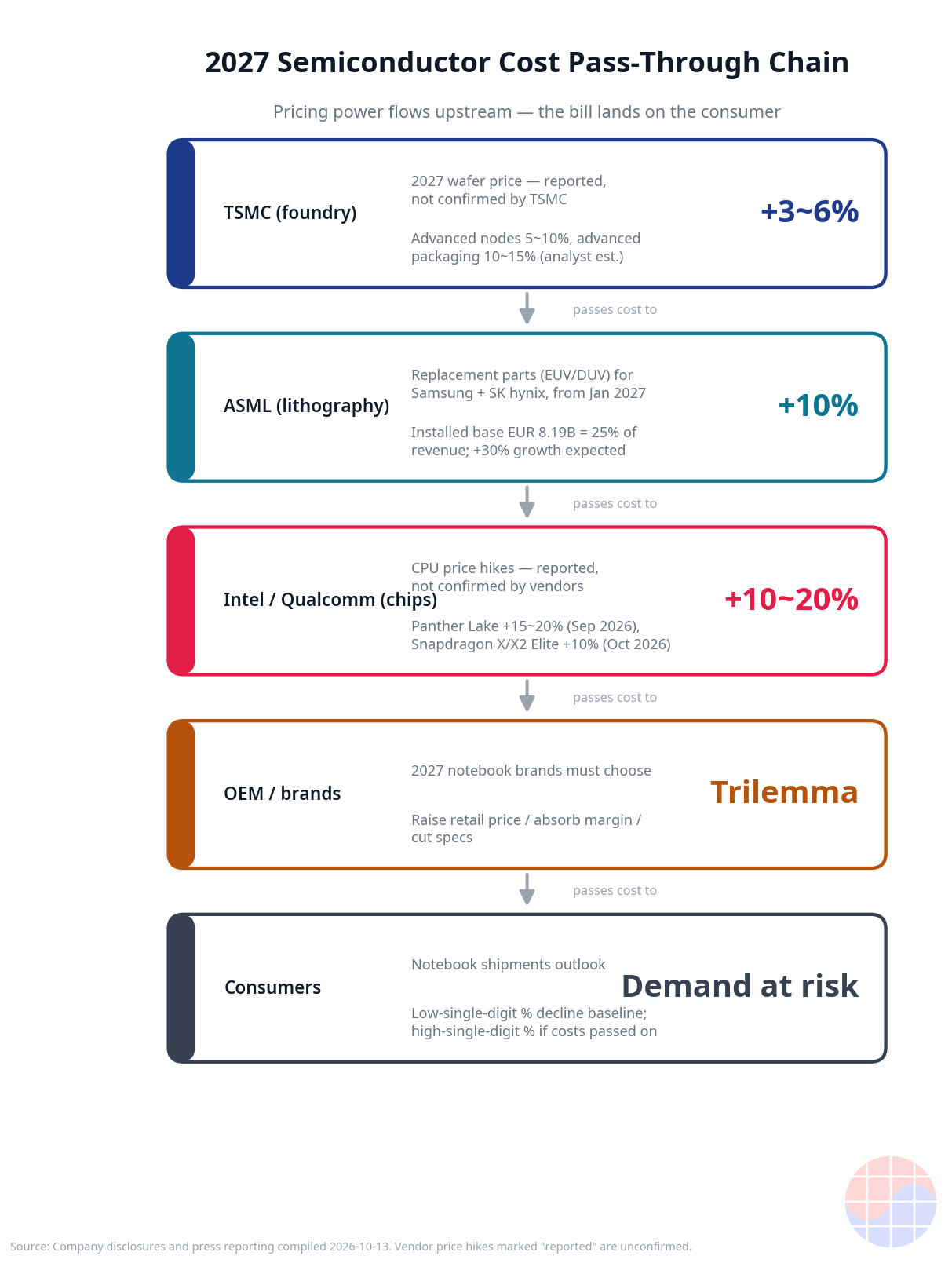
Step 1 — Foundry. TSMC's 2027 wafer price increase remains at the "reported" stage: Taiwanese media cite 3–6% overall; analysts estimate 5–10% for advanced nodes, 10–15% for advanced packaging, 3–5% for mature nodes; SemiMedia reports 2nm wafers could rise another 6–8% in Q1 2027. TSMC has confirmed nothing — and the width of the range itself suggests negotiations are still in motion. (Source) (Source)
Step 2 — Equipment parts. ASML notified Samsung and SK Hynix of a 10% increase on EUV/DUV replacement parts — accepted after September consultations, applying to deliveries from January 2027 (ASML had already told Chinese customers of a 10% DUV hike in July). Note the instrument: not the tool, the parts — consumable and repeat-purchased, so the increase compounds into recurring revenue every year. (Source) (Source)
Step 3 — CPUs. Intel +15–20% (Panther Lake), Qualcomm +10% (Snapdragon X/X2 Elite), AMD reportedly preparing (unconfirmed). CPU hike rates (10–20%) exceed the wafer headline (3–6%): a 5% wafer increase does not become a 5% chip increase, because each tier passes on cost plus its own margin expansion. This is not cost pass-through — it is cost pass-through + margin expansion, stacked. That stacking is the structural reason the 2027 retail shock will feel larger than the wafer headline suggests. (VLSI analysis)
Step 4 — OEM to consumer. See (b) below.
(b) The $900 Notebook BOM Waterfall: The Weight of 68%
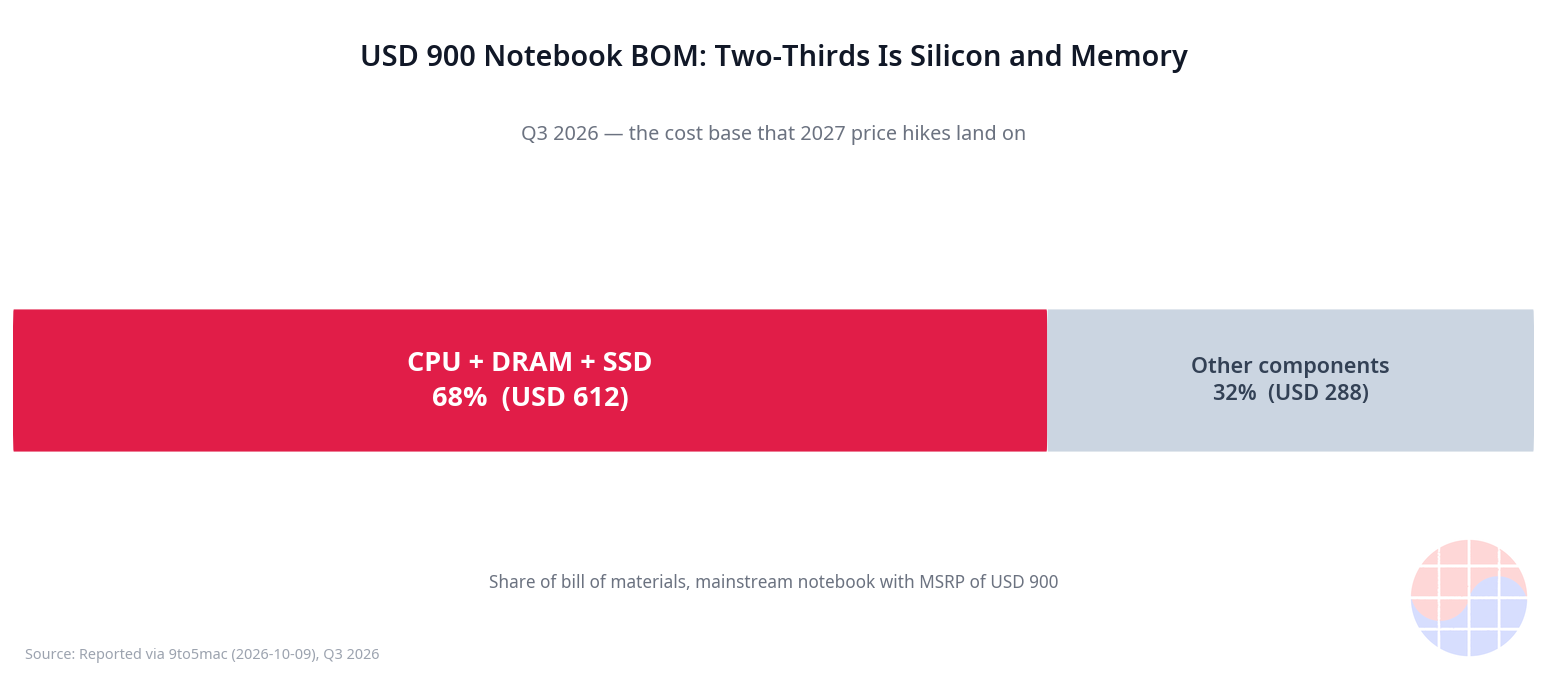
Per a 9to5mac report (October 9, 2026), CPU+DRAM+SSD are 68% of a $900 notebook's BOM as of Q3 2026 — and with all three rising, that 68% is where 2027 pricing gets decided. (Source)
Memory first — spot and contract strictly separated. As of August 2026, the contract price of a basic DRAM chip was ~$25, up 4.4x YoY; the spot price (DDR4 8Gb) peaked at $42.50 on August 10, 2026. 4GB DDR4 contracts had already exceeded 4x YoY by January 2026, and NAND chips sat near $30.50, ~9x YoY. DRAMeXchange data via the Seoul Economic Daily put the August average DDR4 8Gb contract at $25 (+4.2% MoM); Korean press (MK) had the same chip at $1.35 last March, $25 this August. (Source) (Source)
Now layer on the CPU hikes. A quick sensitivity check (explicitly illustrative — stated assumptions, not a confirmed BOM): on a ~$620 BOM the silicon trio is ~$422 (68%); if the CPU is half (~$211), a 15% hike adds ~$32 per unit. On top of memory already up 4x+, $32 a unit is not something PC OEMs can quietly absorb — hence the 2027 trilemma: raise retail prices (risking weaker demand), absorb margin, or cut specs. Forecasts split accordingly: a low-single-digit % shipment decline in the base case, high-single-digit % if costs pass through. The industry is already pricing in sacrificed volume. (Source)

Chart: CPU+DRAM+SSD share (68%) of a $900 notebook BOM (Q3 2026 basis) and shipment impact under 2027 cost pass-through scenarios. Source: 9to5mac report (2026-10-09); scenario bars are VLSI estimates
(c) OEM Strategic Options and the Competitive Board
Unpack the trilemma.
Raise prices. The honest, riskiest option: a first-mover disadvantage applies — whoever raises first loses share — producing a coordination game where everyone waits while quarterly results wobble.
Absorb margin. PCs are a thin-margin volume business; few brands can absorb 4.4x memory and +15–20% CPUs at once. Expect cross-subsidy: premium margins covering entry-level pain.
Cut specs. The quiet option: hold the sticker while trimming SSD 512GB→256GB or stepping down display grades — the industry's standby "stealth downgrade." Consumers notice with a lag, making it the near-term favorite. (VLSI analysis)
Relocate production — a fourth lever. China's share of notebook production: 76% (2025) → 79% (2026) → 80%+ forecast (2027), tariff pressure the driver. If tariffs don't rise further, moving some production back to China to cut costs is on the table. (Source)
The competitive board is shifting too. Intel's third hike since late 2025 signals structural cost push — but hands AMD a pricing-gap opportunity: with AMD's adjustments still merely "reported," a smaller AMD increase could shift DIY and commercial share. Qualcomm's 10% Snapdragon X/X2 Elite hike lands just as Arm PCs scale — a headwind for premium Copilot+ pricing that could open room for an x86 counter. (VLSI analysis)
On memory: one certainty, one relief valve. Micron's guidance (75% of 2027 supply sold; moderate price increases through FY2027) makes "wait for prices to fall" a 2027 losing trade. The relief valve is NAND: new capacity should ease constraints in 2H 2027. DRAM stays tight on AI demand. (Source)
(d) ASML's Installed Base: The Countercyclical Winner
The quiet winner is ASML: per its 2025 disclosure, installed-base revenue was EUR 8.19B (~25% of EUR 32.67B total), with +30% growth expected this year. Unlike new-tool sales, parts, service, and upgrades are recurring revenue — when new capex pauses, the installed base ages and needs more service. A textbook countercyclical business. (Source)
The pricing power comes from single source: EUV has no alternative, and DUV parts are effectively locked in by tool compatibility. Note ASML's choice of instrument — replacement parts, not tools. A tool hike touches customers' next-generation investment decisions; a parts hike seeps into fab operating cost, meeting less resistance. That a 10% increase stuck at all is proof of the moat. (VLSI analysis)
(e) The Bargaining-Power Asymmetry: TSMC Pushes Back, Samsung and SK Hynix Accept
The same 10% notice drew split reactions: TSMC reportedly pushed back on ASML's equipment price hikes, while Samsung and SK Hynix accepted after September consultations ("reportedly" — a single relay, so no firm conclusions.) (Source)
Why the split? The bilateral-monopoly geometry differs: TSMC is ASML's largest strategic EUV customer, and leading-edge expansion converts directly into EUV orders — ASML cannot afford to lose TSMC, so there is room to negotiate. The memory makers carry a smaller lithography share of cost (memory is etch- and deposition-heavy) and hold DRAM pricing power: accepting +10% on parts and recovering it through contract DRAM at 4.4x YoY is arithmetic, not surrender. (VLSI analysis)
The Korean angle: Samsung and SK Hynix are price-takers on equipment, price-makers on memory. A 10% parts hike amortizes across enormous wafer volumes and is recoverable through the DRAM oligopoly; the real pain concentrates mid-chain (PC OEMs) and at the end (consumers). The law of the chain holds: whoever holds scarcity upstream sets the price; everyone downstream shares the burden.

Diagram: the cost pass-through chain from TSMC wafers (reported +3–6%) → ASML replacement parts (+10%) → CPUs (+10–20%) → OEMs → consumers, with margin expansion stacked at each tier. Source: VLSI analysis based on reported figures (Wccftech, SemiMedia, Seeking Alpha)
Chase's Take
Three interpretations.
First, pricing power flows to the scarcest node. The 2026–2027 lesson: EUV (no substitute), leading-edge foundry capacity (TSMC), DRAM supply (oligopoly + AI crowding out conventional). Whoever sits on scarcity names the price; everyone else picks their poison. Intel's hike follows the same grammar. Three increases since late 2025 is not quarterly opportunism — it is a declaration that the cost floor has moved.
Second, the 2027 PC trilemma is really a demand-management problem. The forecasts say the industry has already made peace with sacrificed volume. The rational play: segment the pain — raise prices where demand is inelastic (premium), cut specs where elastic (entry). A single strategy — all-hike or all-absorb — will not survive 2027.
Third, Korea sits in a defensible position in this chain. Samsung's and SK Hynix's memory price-maker status is the breakwater absorbing the ASML shock. But Korean consumers — and the PC businesses of Samsung and LG — face the same trilemma. And the wave exposes a familiar sore spot: the equipment (price-taker) vs. memory (price-maker) asymmetry is another name for the tax a country that doesn't build lithography tools must pay.
Counterarguments and verification points. First, the TSMC hike is unconfirmed — supply-chain press reports can be negotiation trial balloons. Second, AMD's adjustment is unconfirmed; if AMD holds prices, Intel's hike leaks share. Third, if AI demand cools or 2H 2027 NAND easing materializes, the chain loosens. Watch Q1 2027: whether 2nm wafers actually print that "additional 6–8%" — the litmus test for this entire chain.
Implications
Investor checklist 1. In 2027, pricing power sits upstream (equipment/service, leading-edge foundry, memory), not with downstream brands — screen names by margin defensibility. 2. Watch the Intel–AMD price gap — a widening gap precedes share shifts in DIY and commercial. 3. NAND easing in 2H 2027 is deflationary; DRAM tightness is inflationary. Memory mix decides winners. 4. Notebook shipment forecasts gauge demand health; a tilt toward the pass-through scenario is a warning light for consumer hardware broadly. 5. ASML's installed-base growth (+30% expected) is the metric for re-rating equipment services as cyclical hedges. (Source)
Management takeaways 1. Lock memory supply early. Per Micron, 75% of 2027 supply is already sold — "wait for prices to fall" is not a 2027 strategy. (Source) 2. Split the trilemma by price band: raise on premium, spec-down on entry. One strategy fails. 3. Finish renegotiations with single-source suppliers before January-2027 delivery windows — the ASML +10% acceptance is now the precedent. 4. Review the production footprint. In an 80%+-China world, pre-compute cost sensitivity under tariff scenarios. (Source)
FAQ
Will notebook prices really rise in 2027?
Likely — but unevenly. With CPU+DRAM+SSD at 68% of a $900 notebook's BOM and all three rising, brands must raise prices, absorb margin, or cut specs. Forecasts see high-single-digit % shipment declines if costs pass through — the industry is already bracing to sacrifice volume. Expect price hikes on premium models and spec cuts on entry models. (Source)
What is the root cause of the CPU price hikes?
The proximate cause is Intel's and Qualcomm's pricing, but the root cause is chain-wide cost push: TSMC's reported 2027 wafer hikes (3–6%), ASML's 10% parts increase (Samsung/SK Hynix, January-2027 deliveries), and AI-driven memory inflation (contract DRAM 4.4x YoY). Each tier stacks its own margin on cost, so the final CPU increase (10–20%) far exceeds the wafer headline. (Source) (Source)
Who benefits most — Intel, AMD, or Qualcomm?
Near term, whoever raises least. Intel is on its third hike since late 2025 while AMD's adjustment remains merely reported (unconfirmed) — a smaller AMD increase could shift DIY and commercial share. Qualcomm's 10% Snapdragon X/X2 Elite hike lands as Arm PCs scale, pressuring premium price competitiveness. Longer term, the portfolio that can absorb TSMC-driven cost through mix wins. (Source)
When does the memory price surge end?
DRAM and NAND run on different clocks. DRAM should stay tight through 2027 on AI demand — Micron guides 75% of 2027 supply already sold, with moderate price increases through FY2027. NAND constraints should ease in 2H 2027 as new capacity comes online. SSD costs may breathe in the second half; DRAM pressure likely lasts all year. (Source)
Worth Reading
For the backstory on semiconductor supply-chain geopolitics and pricing power, Chris Miller's "Chip War" — a history of the TSMC–ASML–Intel power structure — is the prequel to this cost pass-through wave. (Chip War — Amazon)
Purchases via this link may earn a commission.
Further reading
- TSMC 2nm yield vs. wafer pricing: why yield matters more at the leading edge
- The economics of ASML's installed-base business: why the toolmaker smiles in downturns
- Anatomy of the 2026 DRAM 4.4x surge: how AI devoured conventional DRAM, and HBM cost structure per Gb
Key figures in this article cite press reports and analyst estimates; some of the reported hikes remain officially unconfirmed. Check the original sources before making investment decisions.