VLSI Korea
Google's TPUs Pay Back in Under a Year: Custom Silicon Economics vs NVIDIA
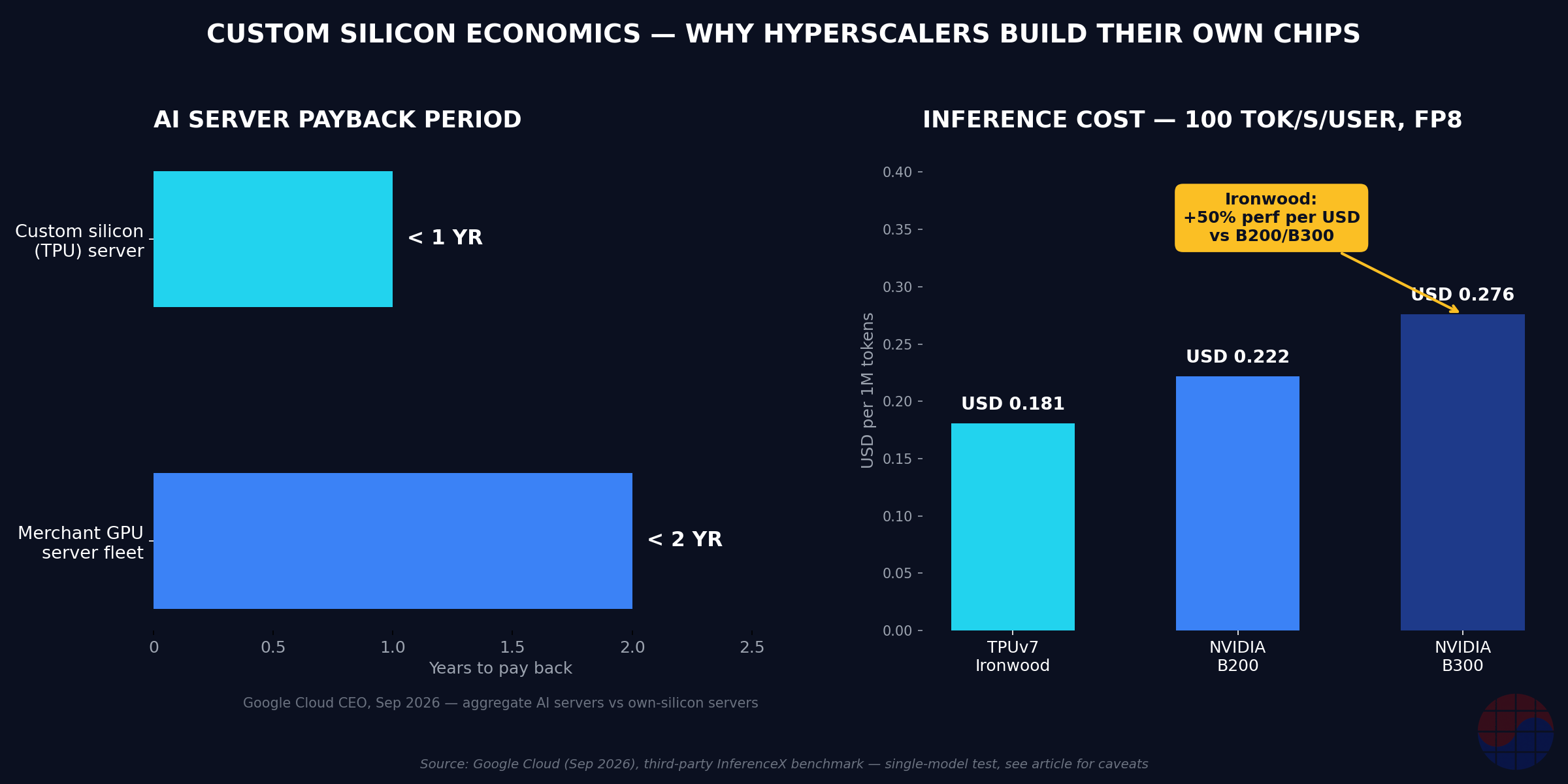
Google's TPU servers pay back their investment in under a year. TPUv7 Ironwood delivers up to 50% better inference performance per dollar than the B200/B300. When payback is one year, building your own chip isn't a choice — it's financial common sense.


Excerpt: Google's TPU servers pay back their investment in under a year. TPUv7 Ironwood delivers up to 50% better inference performance per dollar than the B200/B300. When payback is one year, building your own chip isn't a choice — it's financial common sense. The Broadcom–MediaTek ASIC value chain is entering structural growth.
The 30-Second Summary (AEO)
- Google Cloud CEO Thomas Kurian disclosed in September 2026: AI servers pay back in under two years in aggregate; servers with in-house silicon (TPUs) do it in about half that time. A one-year payback turns custom silicon from a "strategic choice" into financial common sense. (Source)
- Third-party benchmarking (InferenceX) found TPUv7 Ironwood delivers "up to 50% better performance per dollar" versus B200/B300 on like-for-like inference — with the caveat that it is a single-model (Qwen 3.5 397B, FP8) vendor-run test. (Source)
- Anthropic disclosed a five-year, USD 125.2 billion TPU capacity lease in its October 2026 IPO filings; Broadcom agreed to up to USD 42 billion in convertible-note financing. Chip sales plus finance is a new go-to-market model. (Source)
- MediaTek doubled its 2026 ASIC revenue forecast to over USD 2 billion, with its first Google-linked AI ASIC entering mass production in Q4 2026. (Source)
- Bottom line: at hyperscale, the make-vs-buy debate is over. Payback period decides.
Background: Why Custom Silicon, Why Now
For years the AI chip debate was about who was faster. In the second half of 2026 the question changed. With Alphabet guiding USD 195–205 billion in 2026 capital expenditure (source), shareholders stopped asking about FLOPS and started asking when the money comes back.
Kurian's answer was unusually specific. At the Goldman Sachs Communacopia + Technology Conference on September 8, 2026, he said aggregate AI-server payback was under two years, and payback on Google's own silicon was roughly half that. Google Cloud repeated the claim in an official recap on September 11. He added that Google Cloud offers 2.7x better price performance for training and 80% better for inference, and that its accelerator business is more than twice the size of the next-largest hyperscaler's. (Source)
The weight of the statement isn't the number two. It's what a one-year-class payback does to the economics of building your own chip. NRE for a leading-edge AI ASIC (design, masks, validation) runs roughly USD 100–200 million. Spread over one million chips, that's USD 100–200 per chip — trivial next to the merchant margin wedge on GPUs (NVIDIA's gross margin sits above 70%). When volume cooperates, building your own silicon is unconditionally cheaper. Kurian's statement is effectively a CEO-level declaration that the volume cooperates.
Business Deep Dive
Market size: an ~USD 80 billion custom AI chip market by 2027
Brokerage estimates put the custom AI chip TAM at roughly USD 70–80 billion by 2027. MediaTek told investors in July 2026 it aims to capture 15–20% of it. (Source)
Hyperscaler moves are already on the scoreboard:
- Google: At Cloud Next in April 2026, Google unveiled eighth-generation TPUs — 8t for training, 8i for inference — and a new Virgo network fabric linking 134,000 TPUs in a single data center and over one million across sites into one logical cluster. (Source) The binding constraint is no longer silicon supply but power — at hundreds-of-thousands scale, how much conditioned power you can feed the racks caps growth. (Source)
- Anthropic: A multi-year agreement signed in October 2025 commits up to one million Ironwood TPUs (reported in the tens of billions of dollars), and October 1, 2026 IPO filings disclosed a USD 125.2 billion five-year TPU capacity lease. (Source)
- Meta: 'Iris', the MTIA-program chip co-designed with Broadcom, entered volume production at TSMC on 3nm in September 2026. Meta plans to roughly double AI compute capacity from 7GW in 2026 to 14GW by end-2027. (Source)
- OpenAI: Unveiled its first custom chip 'Jalapeño' with Broadcom in June 2026, with 10GW of co-development underway. Rack deployments begin late 2026 and run through 2029. (Source)
Cost structure: where TCO diverges
Ironwood's economics rest on three levers.
1. Performance per dollar. In the InferenceX benchmark (Qwen 3.5 397B, FP8, 100 tokens/s/user), Ironwood cost USD 0.181 per million tokens versus USD 0.222 for B200 and USD 0.276 for B300 — the basis for the "up to 50% better performance per dollar" claim. On internal TCO, an Ironwood server is estimated ~44% cheaper than an equivalent GB200 Blackwell server; external customers like Anthropic see roughly 30% savings versus NVIDIA. (Source) Caveat: single-model, single-condition, vendor-run testing. A counterpoint with independent flavor: startup Inferact benchmarked Moonshot AI's Kimi K3 on the same vLLM engine — 16 TPUv7 chips hit 709 tokens/s versus 452 on 16 GB200s, a 57% edge including software-stack optimization. (Source)
2. Removing the merchant margin. When Google sells or rents its own chips externally, the price carries no NVIDIA-style merchant margin wedge. It's vertically integrated hardware — chip, interconnect, software stack — at internal cost plus cloud service fees. Same FLOPS, different invoice structure.
3. Power and scale economics. Power and cooling approach 40% of data center TCO. Per-chip watts matter, but at million-chip scale fabric efficiency (goodput) decides the money — which is why Google advertises "over 97% goodput" for TPU 8t. It's the same structural game memory makers play with yield: not unit performance, but the economics of surviving cycles.
Competitive positioning: four axes
| Axis | Players | Position |
|---|---|---|
| Hyperscaler in-house chips | Google TPU, Meta MTIA, Amazon Trainium, Microsoft Maia, OpenAI Jalapeño | Workload-specific; kills merchant margin |
| ASIC design partners | Broadcom, MediaTek, Marvell, Alchip | Win on design + CoWoS + HBM integration |
| Foundry | TSMC (effective monopoly) | Allocator of leading-edge capacity |
| Memory | SK hynix, Samsung, Micron (HBM) | HBM stacks per chip (hundreds of Gb per chip) are a major cost axis |
Broadcom's position is the most interesting. It signed a long-term TPU and networking supply deal with Google through 2031 in April 2026 (source), expanded its Meta MTIA collaboration on April 14 (over 1GW), and is co-developing 10GW with OpenAI. In other words, Broadcom simultaneously designs chips for three competing AI camps — the armory of the custom-silicon war.
MediaTek attacks from a different angle: recycling smartphone-era CPU, GPU, NPU IP and low-power design assets into data center ASICs. In Q2 2026, its Smart Device Platform segment (including ASICs) overtook smartphone chips as the largest revenue contributor for the first time. April and July earnings calls doubled the 2026 ASIC revenue forecast to over USD 2 billion, with the first Google-linked AI accelerator ASIC entering mass production in Q4 2026. (Source) One thing to watch: market chatter about sample-delivery and yield hiccups means Q4 execution is the real test.
Strategic options: three scenarios
- Vertical integration accelerates (base case): If TPU externalization succeeds, 20–30% of inference workloads run on custom silicon rather than merchant GPUs by 2027. ASIC design partners get multiple re-rating.
- Merchant strikes back: NVIDIA can narrow the TCO gap with pricing and bundling in the Rubin generation. The CUDA switching cost remains a moat. Ironwood's native-FP8-only compute caps the comparison's valid range until TPUv8i adds FP4.
- Financing risk materializes (bear case): Broadcom-style customer financing structurally resembles the vendor financing of Nortel and Lucent during the 2001 telecom bust — equipment makers propped up customer purchases until customer credit collapsed. The USD 29 billion maximum backstop exposure in Broadcom's own quarterly filing shows both sides of this structure. (Source)
Chase's Take
The MBA-case reading is single: make-vs-buy is decided by payback period, not technology.
In classic manufacturing make-vs-buy, you divide fixed cost (NRE) by volume. In AI chips the denominator is growing exponentially while the numerator, though rising with leading-edge nodes, can't keep up. One million chips × thousands of dollars saved per chip = billions. The moment that equation holds, the CFO asks engineering "why aren't we building our own?" Kurian's statement is the CEO-level answer to that question.
Second: Broadcom's GTM innovation. A chip company lending its customer USD 42 billion isn't a discount — it's "finance as sales." Read positively, it's entry-barrier maximization (customer lock-in); read negatively, it's credit-risk internalization. Investors should read Broadcom's balance sheet with a quasi-bank's eyes, not a chip company's.
Third, the Korea angle. Korea's seat in this game is in two places. One is HBM — with 8–12 HBM stacks (hundreds of Gb per chip) attached to every custom accelerator, ASIC volume growth is HBM demand growth. SK hynix and Samsung win whether the memory ships for merchant GPUs or custom ASICs. The other is the fabless playbook — MediaTek's smartphone-IP-recycling strategy is a template Korean fabless startups could follow into workload-specific ASICs (inference, edge). The difference: Korea's fabless players hold design talent rather than IP portfolios, so "whose volume do we design for" is the question. Where Samsung Foundry's leading-edge capacity meets them is Korea's semiconductor story for the next two years.
Implications: Investment and Management
- Investment: ASIC design partners (Broadcom, MediaTek, Marvell, Alchip) are in a structural growth phase. But multiples may already reflect much of it — track MediaTek's Q4 production ramp and Broadcom's financing exposure quarterly. In foundry, TSMC's leading-edge capacity allocation increasingly determines customer-portfolio quality.
- Management: Cloud buyers should not budget 2027 inference TCO on merchant-GPU quotes alone. Always run a parallel TPU-externalization bid — the negotiation leverage alone has cut existing GPU pricing by ~30% in documented cases (OpenAI). (Source)
- Risk: The scenario where customer-financing structures break comes not from a chip-demand cliff but from a credit crunch. With AI infrastructure financing now in the hundreds of billions, the monitoring metric is spreads and default swaps, not chip shipments.
FAQ
Q1. Do TPUs really pay back in under a year? That's the Google Cloud CEO's stated figure from a September 2026 conference: under two years for AI servers in aggregate, about half that for own-silicon servers. It reflects Google's internal accounting — it doesn't mean external customers can reproduce the same terms. (Source)
Q2. Is Ironwood's "50% better performance per dollar" a fair comparison? It has the limits of a single-model, single-condition, vendor-run test. But an independent startup benchmark (Inferact) also showed TPUv7 ahead of GB200, and internal-TCO analyses point the same direction. The counter-argument: native FP8-only compute constrains the comparison. (Source)
Q3. Why does Broadcom lending Anthropic USD 42 billion matter? It's a new sales model where chip revenue and finance are fused — the vendor underwrites the customer's purchasing power to win the order, absorbing customer credit risk in return. The structure echoes 2001-era telecom vendor financing, so read both sides. (Source)
Q4. What does this mean for Korean companies? On the HBM side it's favorable for SK hynix and Samsung — custom chips carry HBM too. On the design side, MediaTek's "smartphone-IP recycling" playbook is a template for Korean fabless, with Samsung Foundry's leading-edge capacity as the key variable.
Further Reading
- The big picture of the AI chip power struggle: Chip War — Chris Miller (Amazon)
- Anatomy of NVIDIA's business model: The Nvidia Way — Tae Kim (Amazon)
Purchases via this link may earn a commission.
This article is analysis based on public press releases, earnings calls, and press reporting; it is not investment advice. Figures cited are as of their sources' publication dates (April–October 2026) and may have changed.