VLSI Korea
Why DUV Export Controls May Bite Harder Than EUV Bans
EUV bans are old news — the fight has moved to DUV immersion tools: 39% of ASML's Q3 2026 system sales, ~296 advanced scanners in China. The U.S. MATCH Act proposal targets maintenance services, not just sales. Numbers, technology, pro/con case, and fallout for Korean fabs in China.


Why DUV Export Controls May Bite Harder Than EUV Bans
30-Second Summary
The ban on EUV lithography exports to China is old news — the real front line has shifted to DUV immersion tools, technology often dismissed as a generation behind. In ASML's Q3 2026 (reported 2026-10-14), DUV immersion was 39% of system sales (about €3.27 billion), second only to EUV at 49%. Roughly 296 advanced immersion DUV scanners are already installed across Chinese fabs (report published 2026-10-05), and the U.S. MATCH Act — a legislative proposal as of 2026-10-18, not enacted — targets maintenance services on installed tools, not just equipment sales. This piece breaks down, in numbers, why service rather than hardware is the real lever, and how the fallout reaches Samsung's Xi'an and SK hynix's Wuxi/Dalian fabs.
Background: The EUV Ban Is Done — The War Moved to DUV
The U.S. campaign to block EUV exports to China, running since 2018, is effectively complete. Not a single ASML EUV tool has entered China, and Chinese foundries including SMIC chose a different path to 7nm-class production: DUV immersion lithography plus multi-patterning.
That is where the problem starts. With EUV blocked, China's DUV demand exploded, and ASML's China revenue came to rest on DUV. In Q3 2026, ASML's regional system-sales mix was Taiwan 32% / Korea 31% / China 23% / U.S. 13%. China's quarterly trajectory: 41% in 2024 → 33% in 2025 → 19% in Q1 2026 → 14% in Q2 → 23% in Q3. ASML expects China's full-year 2026 share at roughly 20%.
Washington reads this as a loophole. The MATCH Act (Multilateral Alignment of Technology Controls on Hardware Act), introduced in the House on 2026-04-02, passed the House Foreign Affairs Committee 44–0 on 2026-04-22. Its Senate companion (S. 4281) was referred to the Senate Banking Committee on 2026-04-13, with no markup scheduled as of 2026-09-09. Two core provisions: a full ban on sales of immersion DUV lithography tools and other chokepoint equipment to all of China, and a requirement that ASML obtain licenses to provide maintenance services on already-installed tools. SMIC, CXMT, and YMTC are named in the bill text. As of 2026-10-18, the bill remains a legislative proposal and has not been enacted. Separately in force: the Dutch licensing regime (applied to NXT:2000i-class and above since September 2023, expanded to NXT:1980i in September 2024 with case-by-case approvals possible) and the U.S. Commerce Department's 2024-12-02 control package (24 types of chipmaking equipment, 3 types of software, HBM controls, 140 Entity List additions).
Deep Dive 1: The Numbers — DUV Is ASML's Second Pillar
ASML's Q3 2026 results (reported 2026-10-14) reveal DUV's standing. Total revenue was €11.7 billion (+55% year over year), with system sales of €8.4 billion. The technology mix: EUV (NXE+EXE) 49% (€4.1 billion, including one High-NA system) / DUV immersion 39% (about €3.27 billion) / DUV ArF dry 3% / DUV KrF 5% / DUV i-line 1% / metrology and inspection 3% (back-calculated from published rounded percentages).
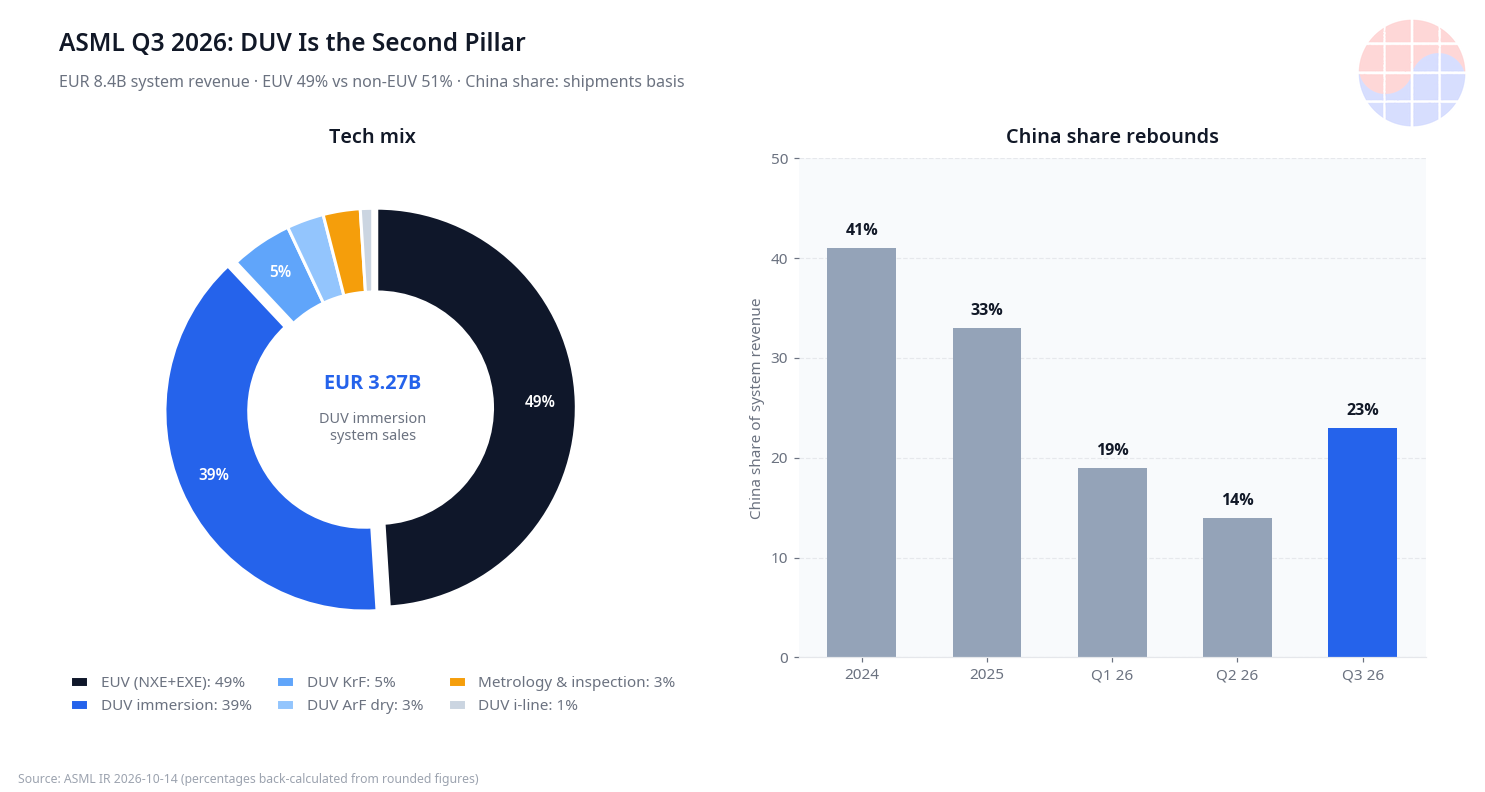
DUV immersion systems carry an average selling price of roughly €30–70 million each — far below an EUV tool, but volume compensates. The more important number is installed base management (service and upgrades) revenue: €3.3 billion in Q3 2026, beating guidance by about €400 million, with roughly 50% annual growth guided for 2026. The CFO attributed the strength to productivity-upgrade demand across both EUV and DUV. Equipment companies are increasingly not "companies that sell tools" but "companies that earn money managing installed tools for life" — precisely where export controls are headed next.
Deep Dive 2: The Technology — How 'Last-Generation' Tools Print 7nm
DUV immersion lithography is conceptually simple. ASML's flagship TWINSCAN NXT:2050i (per ASML's official product page) uses a 193nm ArF light source with ultrapure water filling the gap between lens and wafer, pushing effective NA above 1.0 — to NA 1.35, the industry's highest. Volume production resolution is 40nm (C-quad) / 38nm (dipole), throughput 295 wafers per hour. Unlike EUV (13.5nm reflective optics in vacuum), transmissive optics let fabs reuse mature resist and process stacks, and ASML positions the tool as a "cost-effective solution for multi-patterning requirements."
Features finer than the single-exposure limit (~38–40nm) come from multi-patterning (LELE, SADP/SAQP) — splitting one layer into several exposures. Overlapping 38nm-class single patterning three or four times shrinks effective pitch below half, enabling 7nm-class transistors and interconnects. The price: more masks, more steps, harder yield management, higher cost, and surging overlay precision requirements (why the NXT:2050i leads with overlay performance). In memory (DRAM and NAND), producing advanced cells with DUV immersion multi-patterning alone — no EUV — is already standard industry practice. In short, DUV is not obsolete; it is the practical bottleneck behind China's EUV-free advanced chip production.
Deep Dive 3: The Real Lever — Not Hardware Sales, but Service
The case for controls rests on three arguments.
Argument 1 — Blocking military modernization and AI dominance. Rep. Bill Huizenga (R-Michigan, chair of the House export-control subcommittee) said on 2026-04-15 that China had "exploited access to U.S. and allied chip manufacturing equipment to modernize its military and pursue global AI dominance," backing the bipartisan bill.
Argument 2 — Closing the loophole. Rep. Maggie Goodlander (D-New Hampshire) called it, the same day, a bill that "closes dangerous loopholes China has exploited." A think-tank report published 2026-10-05 names the loophole concretely: tools sold for mature nodes can be repurposed, at additional cost, onto 7nm-class production lines. Partial controls leak by design.
Argument 3 — Sales bans are already neutralized; service control is the only lever left. Industry analysis (October 2026) holds that CXMT and YMTC have already stockpiled enough DUV to cover roughly three years of expansion from the point of cutoff — the sales-ban provision is, in effect, preemptively neutralized. What stockpiling cannot defeat is a ban on service and technical support: installed DUV tools require professional maintenance performed on-site by ASML roughly every six months. Cut off spare parts and engineers' hands, and 296 installed scanners slowly grind to a halt. External analysis (Bank of America estimates) puts the damage of a full DUV sales-plus-service ban at 14–15% of ASML revenue and 16–17% of operating profit — a measure of how large the installed-base business has become.
The counterargument is formidable. ASML CFO Roger Dassen publicly opposed the MATCH Act on the Q3 earnings press call on 2026-10-14 (reported by Reuters): it would be counterproductive and would accelerate China's development of indigenous alternatives, adding that "common sense will prevail." Controls may squeeze China's output near term while accelerating its self-sufficiency long term — the classic dilemma of supply-chain weaponization.
Deep Dive 4: The Damage Map — 296 Scanners and Korean Fabs
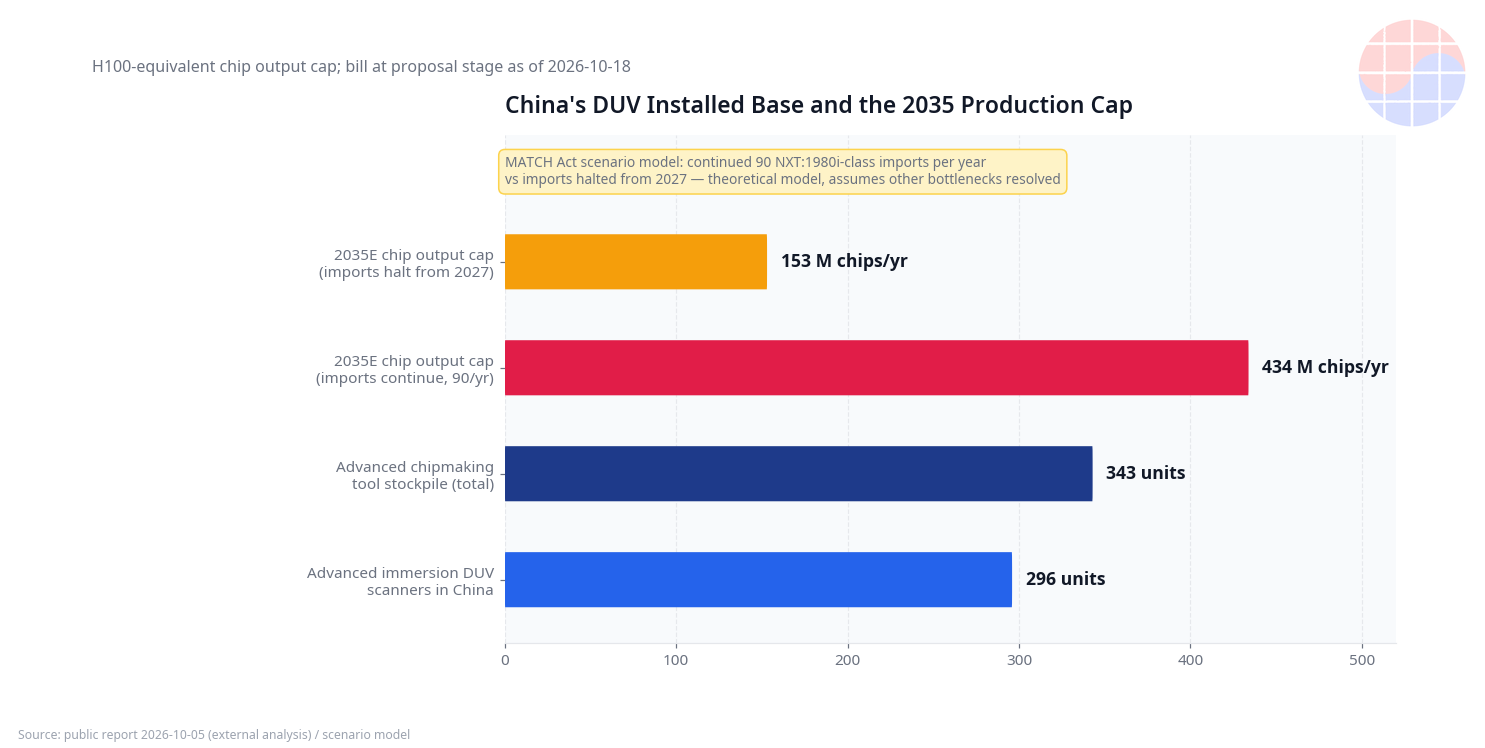
The 2026-10-05 report estimates Chinese fabs hold about 296 advanced immersion DUV scanners, with 343 advanced chipmaking tools stockpiled in total. Its model draws two futures: if imports of ~90 NXT:1980i-class tools per year continue, China's DUV fleet could support up to 434 million H100-equivalent AI chips per year by 2035; halting new imports from 2027 caps output at 153 million — theoretical estimates assuming other bottlenecks are resolved, but they illustrate how different "sales bans" and "import halts" look in practice.
Chinese memory makers are moving beyond stockpiling. On 2026-09-28, CXMT announced a new investment plan totaling 34.9 billion yuan (about KRW 6.7 trillion), allocating 92.9% of a 24.1-billion-yuan technology R&D project to equipment purchases. External analysis puts CXMT's global DRAM revenue share at roughly 10% in Q2 2026, up from 4% a year earlier — DUV-driven memory expansion showing up in the numbers.
The damage map extends to Korean companies' China fabs. The U.S. Commerce Department revoked the VEU (Validated End User) status of Samsung's and SK hynix's China plants in late 2025, switching them to annual licenses effective 2025-12-30. Those licenses expire 2026-12-31. U.S.-origin equipment shipments into Samsung's Xi'an NAND fab — one of Asia's largest memory production sites — depend on this annual license, as do SK hynix's Wuxi DRAM fab and Dalian NAND plant.
SK hynix's Dalian Mod B is the emblematic case. Per Reuters (2026-10-14), the Dalian plant is the world's only facility producing 192-layer floating-gate 3D NAND for Solidigm SSDs. Its Mod B building, completed in 2023, sat under-equipped through the memory downturn; construction and equipment move-in resumed in August 2026, targeting volume production in the first half of 2027 with NAND capacity expansion of roughly 50%. Solidigm has applied for export licenses for additional equipment, while the Commerce Department's 2026 licenses cap equipment quantities and take the position that capacity-expansion or technology-upgrade equipment will not be approved. SK hynix stated that "Mod B work is within the scope approved by the U.S. government and is not pursuing capacity expansion."
Both Samsung and SK hynix worry that future controls could extend beyond new equipment to service, repair, and replacement parts for already-installed Western tools (Reuters, August 2026). Both were reported to be testing Chinese vendor AMEC's etch tools — both officially denied it. AMEC tools run 20–30% cheaper than Western equivalents, per industry analysis. With NAND prices up roughly 700% since mid-2023 on the AI-datacenter memory shortage, supply constraints translate directly into price.
Chase's Take: The Target Isn't Equipment — It's the 'Equipment + Service' Bundle
Viewed through a VLSI+MBA lens, the export-control debate needs reframing.
First, the business model defines the lever. ASML's Q3 2026 installed base management revenue was €3.3 billion, with roughly 50% annual growth guided for 2026. Tool sales are a one-time cash cow; service and upgrades are perpetual recurring revenue — and lock-in. The MATCH Act's service provision is no accident: the bill's drafters read ASML's income statement, and geopolitics is aiming at the most profitable part of the business model.
Second, a chokepoint is defined not by how advanced it is, but by how irreplaceable it is. EUV is more advanced, but with zero tools in China there is nothing to control. DUV immersion is a generation older, yet 296 scanners are installed and 7nm-class production runs on them. Bottlenecks are defined by depth of dependence, not by technology vintage. In MBA terms: supply-chain power comes not from scarcity but from switching costs.
Third, Dassen's warning is a structural truth beyond ASML's self-interest. Cutting supply lowers China's output ceiling near term (the 434M → 153M scenario), but long term it opens the TAM (total addressable market) for Chinese equipment makers. If China cannot buy DUV, Chinese vendors will build DUV: the harder the control, the better the economics of self-sufficiency — a self-reinforcing loop and the fundamental trade-off in every technology-control policy.
Fourth, from Korea's perspective, China fabs have become 'time-limited assets.' Under the post-VEU annual-license regime (expiring 2026-12-31), Samsung Xi'an and SK hynix Wuxi/Dalian need Washington's stamp every year. If controls extend to service, higher maintenance costs and utilization risk hit the P&L directly. Samsung and SK testing Chinese tools is not ideology — it is hedging, and for domestic Korean equipment vendors, geopolitics has opened a window of opportunity.
Fifth, don't forget the price mechanism. Tighter controls mean tighter memory supply. NAND's +700% is not just AI demand — it is a leading indicator of how inelastically supply-side constraints feed into price. The final invoice for DUV controls may land not on Chinese fabs, but on memory buyers worldwide.
Implications: What Investors and Operators Should Watch Now
For investors
- ASML: The Q3 2026 China rebound to 23% is a near-term positive, but policy risk is now a constant — price in the external downside scenario (revenue -14% to -15%, operating profit -16% to -17% under a full DUV sales-plus-service ban). The guided ~50% annual growth in installed base management shows the service business's defensibility.
- Memory: Supply constraints are structurally supporting prices. CXMT's ~10% DRAM share (external estimate, Q2 2026) is a speedometer for China's domestic substitution — and a tighter-control scenario reads as upward pressure on memory prices.
- Equipment sector broadly: Controls don't destroy equipment demand — they relocate it. China's self-sufficiency push becomes orders for Chinese vendors; allied reshoring becomes fab investment in the U.S., Japan, and Europe.
For operators and engineers
- Dual-sourcing procurement: Qualification of Chinese alternative tools should accelerate across etch, deposition, and beyond. The reported AMEC tests by Samsung and SK are the signal.
- Geopolitics clauses in service contracts: Reflecting sanctions risk on maintenance and spare-parts supply is becoming standard.
- The Korean vendors' opening: DUV itself is ASML's domain, but localization of surrounding processes (etch, clean, metrology) rides geopolitical demand. For companies in the memory capex cycle's beneficiary lane, controls are a favorable variable.
FAQ
Q1. Are DUV export controls in force now? The Dutch licensing regime is in force: since September 2023 for NXT:2000i-class and above immersion DUV, expanded to NXT:1980i in September 2024 (case-by-case approvals possible). The U.S. MATCH Act passed the House Foreign Affairs Committee unanimously in April 2026, but Senate procedure remains — as of 2026-10-18 it is a legislative proposal, not enacted. The earlier U.S. control package (announced 2024-12-02: 24 equipment types, HBM controls, 140 Entity List additions) is separately in force.
Q2. Can 7nm really be built with DUV alone, without EUV? Yes. A 193nm ArF immersion tool at NA 1.35, like the NXT:2050i class, delivers 38–40nm volume production resolution, and multi-patterning (SADP/SAQP) that overlaps three to four exposures per layer can shrink effective pitch below half. The cost is more masks, more steps, and far tighter overlay requirements — raising cost and yield-management burden. In memory (DRAM/NAND), building advanced cells with DUV immersion multi-patterning alone is standard industry practice.
Q3. How big is the hit to ASML? External analysis (Bank of America estimates) puts a full DUV sales-plus-service ban at -14% to -15% of revenue and -16% to -17% of operating profit. In Q3 2026, DUV immersion was 39% of system sales (about €3.27 billion) and China was 23% of the regional mix. ASML's CFO publicly opposed the MATCH Act on the 2026-10-14 press call, arguing it would accelerate China's indigenous alternatives.
Q4. What is the impact on Korean companies? Samsung's Xi'an NAND fab and SK hynix's Wuxi DRAM fab and Dalian NAND plant have operated under annual licenses since 2025-12-30, expiring 2026-12-31. If controls extend from new equipment to service and spare parts for installed tools, higher maintenance costs and utilization risk hit directly. SK hynix's Dalian Mod B — the world's only facility producing 192-layer floating-gate 3D NAND for Solidigm SSDs — resumed equipment move-in in August 2026 targeting H1 2027 production, with export licenses for additional equipment now the point of contention.
Market-model figures and estimates cited in this article (stockpiled tool counts, production-ceiling scenarios, revenue-impact estimates, market shares) are based on published reports and external analyses and may differ from actual outcomes. The MATCH Act is a legislative proposal as of 2026-10-18, not an enacted measure.
Sources: ASML TWINSCAN NXT:2050i product specifications · ASML investor relations — financial figures per ASML's 2026-10-14 announcement. Bill provisions, statements, and reported items are per publicly available materials dated as noted in the text.
<!-- CHART-SPECS chart-duv-revenue-mix (bar/donut chart):
- ASML Q3 2026 system sales technology mix (per ASML 2026-10-14 announcement, back-calculated from rounded percentages):
EUV (NXE+EXE) 49% / DUV immersion 39% (about EUR 3.27B) / DUV ArF dry 3% / DUV KrF 5% / DUV i-line 1% / metrology & inspection 3%
- Regional mix (system sales by shipment destination): Taiwan 32% / Korea 31% / China 23% / US 13%
- China quarterly trend: 41% (2024) → 33% (2025) → 19% (Q1 2026) → 14% (Q2) → 23% (Q3) (per ASML earnings announcements)
chart-china-duv-base (map/infographic):
- ~296 advanced immersion DUV scanners installed in China; 343 advanced chipmaking tools stockpiled in total (report published 2026-10-05, external analysis)
- MATCH Act scenario model estimates: continued imports of ~90 NXT:1980i-class tools/year → production ceiling of 434M H100-equivalent chips/year by 2035 / halting new imports from 2027 → capped at 153M (theoretical model, assumes other bottlenecks resolved)
- Korean fabs: Samsung Xi'an NAND / SK hynix Wuxi DRAM & Dalian NAND — annual license regime, expiring 2026-12-31
-->