VLSI Korea
Etched at $21 Billion: Anatomy of a Valuation Built on a Transformer-Only Chip
Etched raised $700M in August 2026 at a $21B valuation for Sohu, a chip that hardwires the transformer into silicon. With $1B+ in signed contracts and a first rack delivered to Jane Street, we dissect what must be true for that price to hold.


30-Second Summary
Etched, a San Jose AI chip startup founded in 2022, raised $700 million in August 2026 at a $21 billion post-money valuation (about 29.4 trillion won at 1,400 won per dollar), in a Series D led by Jane Street. That price doubled in 26 days: its Series C had closed on July 23, 2026 at $10.3 billion, itself a doubling from $5 billion in December 2025. The product behind the price is Sohu, an ASIC built on TSMC's N4P process that hardwires the transformer architecture into silicon instead of running it as software on a programmable GPU. Etched claims an eight-chip Sohu server delivers more than 500,000 tokens per second on Llama 70B and can replace 160 NVIDIA H100 GPUs. Those figures are company claims with no independent public benchmark behind them. What is verified is harder evidence: first-pass A0 silicon success, more than $1 billion in signed customer contracts, a first rack shipped to Jane Street in July 2026, and a lead investor that tested the hardware as a customer before it led the round. The $21 billion price is therefore not a payment for current revenue. It is a payment for a specific future: transformers stay dominant, Sohu's efficiency edge survives contact with production workloads, and Etched scales from first racks to gigawatt-class deployments before hyperscalers and NVIDIA close the gap.
Background
Etched was founded in 2022 by Gavin Uberti, Chris Zhu and Robert Wachen, Harvard dropouts who spent 2023 pitching a 30-page memo arguing that AI would outgrow general-purpose GPUs and need silicon built for one architecture. Most investors passed. The memo did not change; the market did. As inference — running trained models, not training them — became the recurring cost of the AI era, the economics of specialization started to look different.
The company's first chip, Sohu, is the physical form of that memo. A GPU is a programmable machine: it runs transformers, convolutional networks, classical simulation and almost anything expressed in CUDA, and it pays for that flexibility with efficiency. When a GPU runs a transformer, part of its silicon, scheduling logic and memory traffic serves generality rather than the workload. Etched removed the generality. Sohu implements the transformer — attention, feed-forward networks, the KV cache traffic pattern — as fixed-function hardware on TSMC's 4-nanometre N4P process, with 144GB of HBM3 memory per chip. The company argues this is why Sohu can sustain FLOPS utilization far above the 30–40% typical of GPUs on the same workload.
Etched stayed in stealth until June 30, 2026, then disclosed several facts at once: A0 silicon had come back from TSMC and worked on first pass, the company had raised $800 million by that point, and customers had signed contracts worth more than $1 billion for its rack-scale systems, which it calls frontier inference clusters. It also disclosed the December 2025 round that had priced it at $5 billion. Reported timelines say the team went from receiving test chips to running real inference in 44 days, a fast bring-up by industry standards. The company employs more than 400 people, operates a 2MW data center in San Jose, opened an 80,000-square-foot, 10MW facility in Milpitas with an in-house SMT line and NPI lab, and runs a factory in Taiwan.
One nuance matters for everything that follows. In its July 2026 announcements, Etched reframed the product: no longer just a transformer-only chip, but a rack-scale inference system that the company describes as architecture-agnostic, running large mixture-of-experts models such as DeepSeek and Qwen and even Mamba, a non-transformer state-space architecture. Whether that breadth lives in the silicon, in the surrounding system and software, or in the next hardware generation is precisely the question the valuation turns on.
Business Deep Dive
The funding staircase: $5B to $21B in eight months
| Round | Date | Amount | Post-money valuation | Lead |
|---|---|---|---|---|
| Series A | June 2024 | $120M | Undisclosed | Primary Venture Partners, Positive Sum |
| Unannounced round | December 2025 | $500M | $5B | Stripes |
| Series C | July 23, 2026 | $300M | $10.3B | Sequoia |
| Series D | August 18, 2026 | $700M | $21B | Jane Street |
Total funding is approximately $1.9 billion. The Series C was, by the company's statement, the highest valuation ever for a Sequoia-led Series C, and it included SK hynix, a16z, Jane Street and Diffusion. The Series D added Kleiner Perkins, Tiger Global, Bain Capital Ventures, Neo, Primary, Stripes, Positive Sum and Blackstone. Two features of this staircase deserve attention. First, the repricing speed: a 4.2x increase in eight months, with the last doubling in 26 days, is momentum pricing — each round validates the previous one partly on the evidence of the round itself. Second, the identity of the Series D lead. Jane Street is not a venture firm; it is a quantitative trading house that runs some of the most latency- and precision-sensitive compute in finance. It tested Etched's chip, took delivery of the first rack in July 2026, put it into production in its own data center, and then led a $700 million round. A customer that bears the operational risk of the hardware voting with a purchase order first and a term sheet second is the strongest single piece of evidence in the Etched story.
What specialization buys, and what it costs
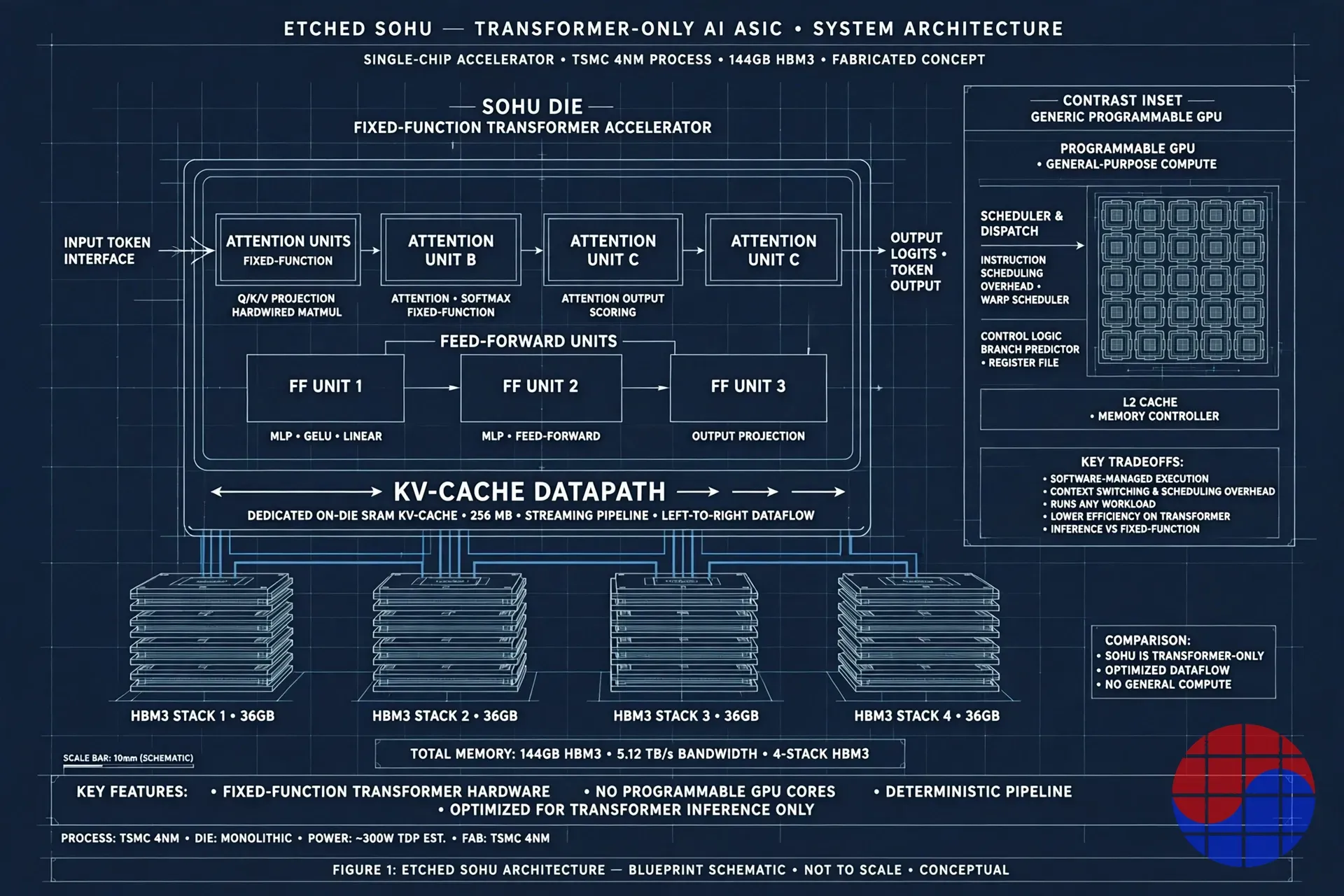
The technical case rests on utilization and memory behavior. Autoregressive decode is bound by memory bandwidth and by how much of the chip is doing useful work per cycle. A fixed-function transformer datapath removes kernel-launch overhead, scheduler decisions and the programmable machinery a GPU carries for workloads Sohu will never run. Etched's headline claims follow from that: more than 500,000 tokens per second for an eight-chip server on Llama 70B versus roughly 23,000 for an eight-H100 system, one Sohu server replacing 160 H100s, and a "Low Voltage Inference" design that targets less than half the operating voltage of conventional AI chips while sustaining more than 80% of peak FLOPS on trillion-parameter sparse mixture-of-experts models.
The cost side of the trade is equally concrete. A hardwired chip cannot follow the field if the field moves. It cannot run a convolutional encoder, a diffusion U-Net step, or a state-space scan that does not map to its circuits, and it has no training or backpropagation path — it is inference-only. Etched's answer is twofold: first, that transformers and their MoE descendants are so entrenched in deployed models that the workload is effectively frozen at the level that matters; second, the newer architecture-agnostic framing, under which its clusters already run DeepSeek, Qwen and Mamba. Both answers can be partly true, but they are different claims. The first is a bet on workload stability. The second is a claim about system design that outside observers cannot yet verify, because there are no public third-party benchmarks, no published pricing, and no self-serve way to rent the hardware.
The business model: sell the cluster, not the chip
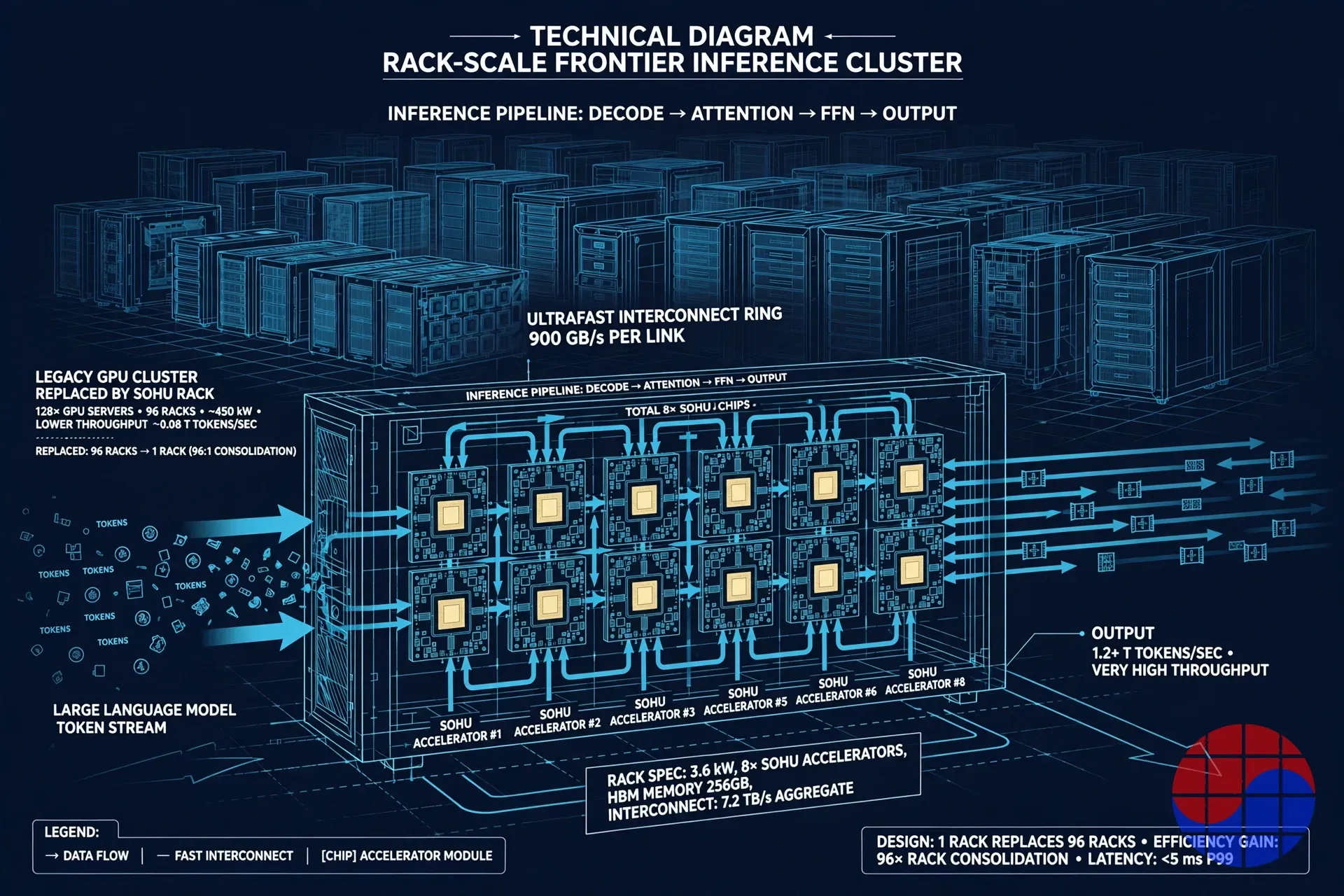
Etched does not sell bare chips. It sells frontier inference clusters — silicon, HBM memory subsystems, custom racks, networking and the software layer as one deployable unit. This matters for the economics. Rack-scale systems carry higher revenue per deployment than component chips, they lock the customer into Etched's full stack, and they let Etched control the variables — power delivery, cooling, memory configuration — that its efficiency claims depend on. The $1 billion-plus in signed contracts is contracted order value, not recognized revenue: as of the August 2026 announcement, exactly one customer delivery had been publicly confirmed, the Jane Street rack. The gap between contract value and delivered, accepted, paid systems is where chip startups historically succeed or fail, and it is the gap Etched says it is now sprinting across, with three hardware generations in development in parallel and a stated goal of gigawatt-scale production capacity by 2027.
What must be true for $21B to hold
Run the arithmetic that the price implies. At $21 billion, Etched trades at roughly 21 times its $1 billion-plus contract book — before most of that book has shipped. For the valuation to be ordinary rather than heroic, the company needs to reach one of these states within a few years: about $2.1 billion in annual revenue at a 10x sales multiple, or about $1.05 billion at 20x. That requires the signed contracts to convert into deliveries, the deliveries to expand into repeat fleet orders, and gross margins closer to a systems company than a component vendor. It also requires the performance edge to survive two moving targets: NVIDIA's roadmap, which reprices cost-per-token with every generation, and hyperscaler silicon — Google, AWS, Microsoft and Meta all field in-house inference ASICs with captive demand and no need to win an external sale. Finally, it requires HBM supply. A 144GB-per-chip design at gigawatt scale is a memory allocation problem as much as a logic problem, and allocation follows volume commitments that incumbents already hold.
Chase's Take
I work in timing signoff, so I read this story as an EDA and execution problem before I read it as a finance story. Three things genuinely impress me. First-pass A0 success on a fixed-function design of this complexity is not a marketing milestone; it means the architecture, the physical design and the verification plan were right the first time, which is rare and expensive to fake. Choosing N4P — a mature, high-yield node — instead of chasing the leading edge is the decision of a team optimizing for cost per token and schedule, not for a spec sheet. And the Jane Street sequence is the correct order of proof: test, deploy, then invest. Trading firms measure tail latency and numerical behavior with a cruelty that no benchmark suite matches.
My skepticism sits in two places. The first is the moving definition of the product. The founding thesis — hardwire the transformer, delete everything else — is falsifiable and therefore strong. The newer claim that the same systems comfortably run MoE routing and Mamba is a different, softer claim, and the company has published no independent data to separate what the silicon does from what the software and system layers absorb. If the flexibility lives in software emulation on fixed hardware, the efficiency edge narrows exactly on the models customers increasingly deploy. The second is repricing speed. A valuation that doubles in 26 days is not being set by discounted cash flow; it is being set by scarcity — there are very few credible, shipping, non-NVIDIA inference platforms, and strategic buyers are paying to keep an option on one. That can be rational and still be fragile: the same scarcity premium compresses fast if deliveries slip two quarters or if a hyperscaler opens its internal ASIC to external customers.
Net: the technology bet is real, the first customer proof is real, and the price is a forward option on flawless scale-up. I would rather own the question than the answer here — the next two data points that matter are repeat orders from a second named customer, and any independently measured cost-per-token figure at production batch sizes.
Implications
For AI infrastructure buyers, Etched's trajectory confirms that cost per token, not peak FLOPS, is now the purchasing metric — and that dedicated inference silicon is a board-level topic rather than an experiment. For NVIDIA, the risk is not this one startup; it is the template: a lead customer that is also the lead investor collapses the usual adoption timeline, and every hyperscaler watching Jane Street's deployment now has a reference case. For the memory industry, a 144GB HBM3-per-chip design scaling toward gigawatt deployments makes startups like Etched a new, concentrated source of HBM demand that allocation planners must price in. For chip startups, the bar has moved: stealth-to-$21 billion in eight months was built on first-pass silicon, a signed contract book and a customer-led round, in that order — narrative followed hardware. And for investors, the Etched staircase is a clean test of a live question in AI finance: whether inference, the recurring workload of the AI era, supports platform-scale valuations for the companies that serve it cheapest.
Note: Funding amounts, valuations and contract figures are as announced by the company and reported on the dates cited above (December 2025–August 2026); performance figures are Etched's own claims and had not been independently verified in public benchmarks as of publication.
FAQ
Q: What is Etched, and what is Sohu? A: Etched is a San Jose AI chip startup founded in 2022 by Gavin Uberti, Chris Zhu and Robert Wachen. Sohu is its first chip: an ASIC on TSMC's N4P process with 144GB of HBM3 per chip that hardwires the transformer architecture into fixed-function silicon for AI inference, trading a GPU's flexibility for speed and efficiency on transformer workloads. Etched now sells it as part of rack-scale systems it calls frontier inference clusters.
Q: Why is Etched valued at $21 billion? A: The $21 billion figure is the post-money valuation of its August 18, 2026 Series D, a $700 million round led by Jane Street (about 29.4 trillion won at 1,400 won per dollar). The price rose from $5 billion in December 2025 to $10.3 billion in a Sequoia-led Series C on July 23, 2026, then doubled again in 26 days. Investors are pricing expected future inference revenue — backed by $1 billion-plus in signed contracts and a first delivered rack — not current earnings.
Q: Has Etched shipped product, and who are its customers? A: Yes, at initial scale. Etched shipped its first rack to Jane Street in July 2026, and Jane Street — also its first named customer — said it tested the chip, was pleased with early results, and is running the rack in its own data center. The company says signed customer contracts exceed $1 billion across frontier AI companies and cloud providers, but most customer names have not been disclosed, and volume production is still ramping toward a gigawatt-scale target for 2027.
Q: What are the biggest risks to the Etched thesis? A: Four stand out. Architecture risk: hardware specialized for transformers loses value if model architectures shift, and Etched's newer claim of running MoE and non-transformer models has no independent verification. Evidence risk: headline performance figures are company claims without public third-party benchmarks or pricing. Competition risk: NVIDIA's roadmap and hyperscalers' in-house ASICs attack the same cost-per-token metric with far larger supply chains. Execution risk: converting a $1 billion contract book into delivered systems at gigawatt scale, with secured HBM supply, is unproven.
📩 Subscribe to VLSI Korea
Get our daily semiconductor deep-dives delivered to your inbox first. Free to subscribe.