VLSI Korea
Market Bulletin: $64 Billion and Counting — TSMC and ASML Say Fab Equipment Can't Keep Up With Chip Demand
TSMC held 2026 capex at $60-64B while lifting revenue growth guidance to ~44%, and ASML posted record Q3 results while warning 2027-2028 capacity cannot meet demand — with 2029-2030 orders already discussed. How the shortage moved from chips to fab tools, winners and losers, and the Korea angle.


Market Bulletin: $64 Billion and Counting — TSMC and ASML Say Fab Equipment Can't Keep Up With Chip Demand
October 16, 2026 — The most important semiconductor news this week wasn't about chips. It was about the machines that make them. TSMC held its 2026 capital expenditure budget at US$60–64 billion while raising its annual revenue growth forecast to around 44%, and ASML posted record third-quarter revenue of €11.662 billion alongside a blunt admission: its currently planned 2027–2028 supply capacity "will not be sufficient to fully meet customer demand." Some customers are already asking about equipment orders for 2029 and even 2030. The shortage has moved upstream — from chips to the machines that print them.
Key Highlights
- TSMC raised the outlook without raising the budget. 2026 capex stays at US$60–64 billion, yet the dollar-revenue growth forecast for 2026 moved from the low-40s to around 44%. Capex for 2026–2028 will exceed the previous three-year total. You don't get that combination without deep confidence in the order book. Reported by Focus Taiwan (CNA).
- The Q4 guide is overwhelming. TSMC guided fourth-quarter revenue at US$52.3–54.3 billion — up 14% quarter-on-quarter and up 58% year-on-year at the midpoint — with gross margin of 65–67%. Third-quarter EPS hit a record NT$29.43. Reported by Focus Taiwan (CNA).
- 2nm already accounts for 8% of sales. TSMC's 2nm process contributed 8% of total Q3 revenue, more than doubling from 3% in Q2, just months into volume production. The speed of the leading-node ramp is a direct leading indicator of equipment demand. Reported by Focus Taiwan (CNA).
- ASML can't build machines fast enough. It shipped 113 new lithography systems in Q3 versus 86 in Q2 (+31.4%), on revenue of €11.662 billion (+55.2% YoY, +25% QoQ), net income of €4.96 billion (+133.4% YoY) and gross margin of 57.5%. It raised the low end of full-year 2026 revenue guidance by €1 billion to €44–45 billion and guided Q4 sales at €14.2–15.2 billion. Reported by ChosunBiz.
- 2030 equipment orders are now a topic. ASML's CEO said some customers are showing interest in orders for 2029 and even 2030, and that the company is reviewing capacity expansion for 2028 beyond its previously announced 30% increase. Reported by ChosunBiz.
Market Update
The October 14–15 earnings double-header told the same story from opposite ends. The company that makes chips (TSMC) raised its revenue outlook while freezing capex; the company that sells the machines (ASML) posted its best quarter ever while saying it cannot build enough machines. Demand is overflowing, and the ceiling is now visible on the supply side. TSMC's guidance that 2026–2028 capex will exceed the prior three-year total effectively guarantees the equipment industry three years of order visibility.
The numbers pinpoint where the bottleneck sits. ASML's 113 lithography systems in Q3 — up 31.4% from 86 in Q2 — is a record pace, yet the CEO's message was that even this pace falls short. Customers asking about 2029–2030 slots means tool lead times have stretched structurally beyond the usual 12–18 months. The admission that even the planned 30% capacity increase for 2028 may need topping up reads as a confession: the current expansion cycle is not keeping up with demand.
TSMC's 2nm ramp accelerates the squeeze. Reaching 8% of sales within months of volume production — more than doubling from 3% in Q2 — means the leading-node transition is lifting equipment intensity: 2nm needs more EUV exposures and more complex process steps, so each wafer consumes more tool capacity. TSMC freezing capex while raising the revenue outlook to 44% is not a demand warning; it is a statement that the equipment already on order can carry that growth — and barely.
| Indicator | Figure | Period |
|---|---|---|
| TSMC 2026 capex | US$60–64B (unchanged) | FY2026 |
| TSMC 2026 revenue growth guide | ~44% (raised from low-40s) | FY2026 |
| TSMC Q4 2026 revenue guide | US$52.3–54.3B (+14% QoQ, +58% YoY) | Q4 2026 |
| TSMC 2nm share of sales | 3% → 8% | Q2 → Q3 2026 |
| ASML Q3 2026 revenue | €11.662B (+55.2% YoY, +25% QoQ) | Q3 2026 |
| ASML lithography systems shipped | 86 → 113 (+31.4%) | Q2 → Q3 2026 |
| ASML FY2026 revenue guide | €44–45B (low end raised €1B) | FY2026 |
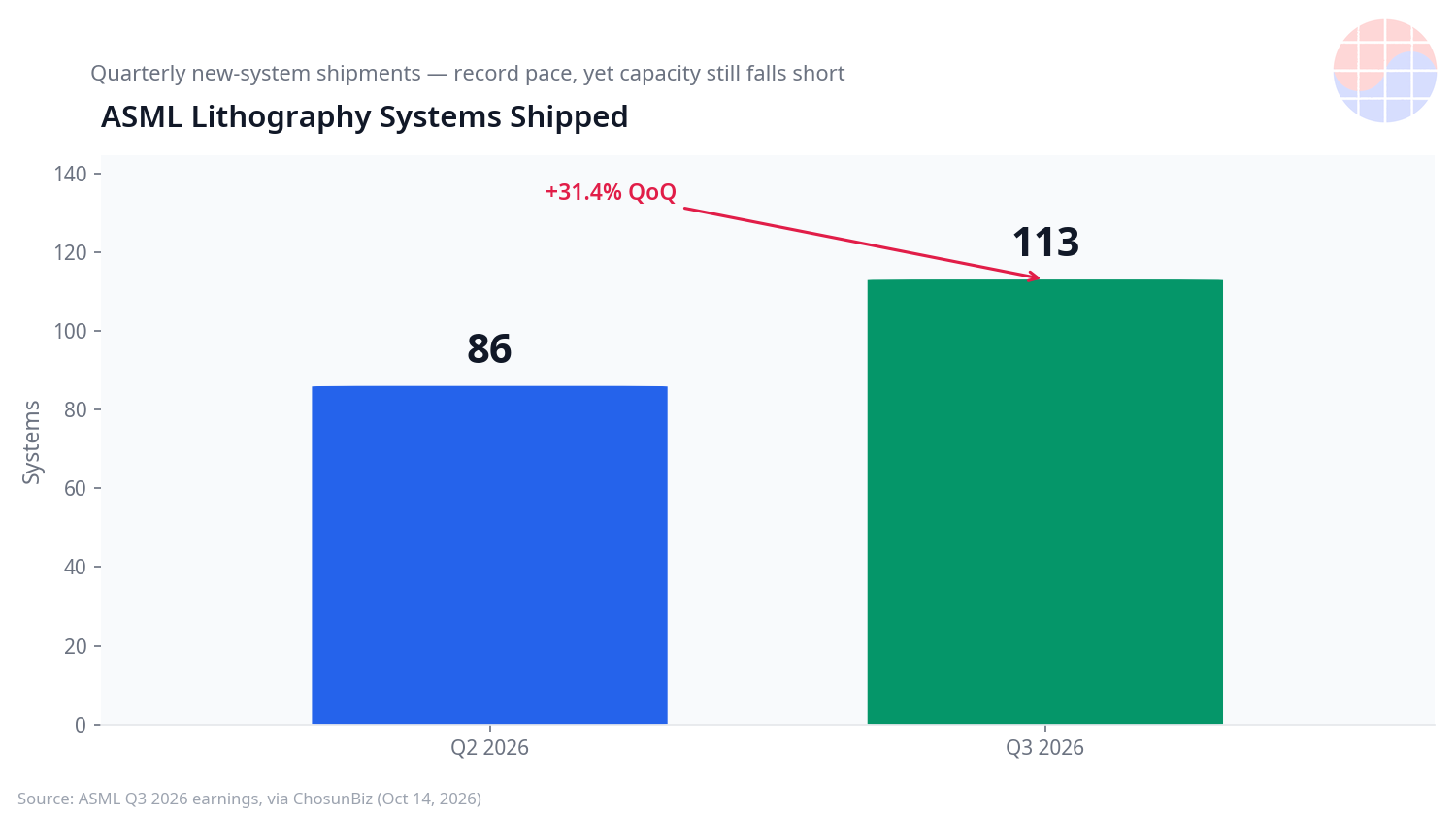
Figure 1: ASML quarterly lithography system shipments — 86 in Q2 2026 to 113 in Q3 (+31.4%). A record shipping pace, yet the CEO says planned 2027–2028 capacity still cannot meet demand. All chart labels in English.
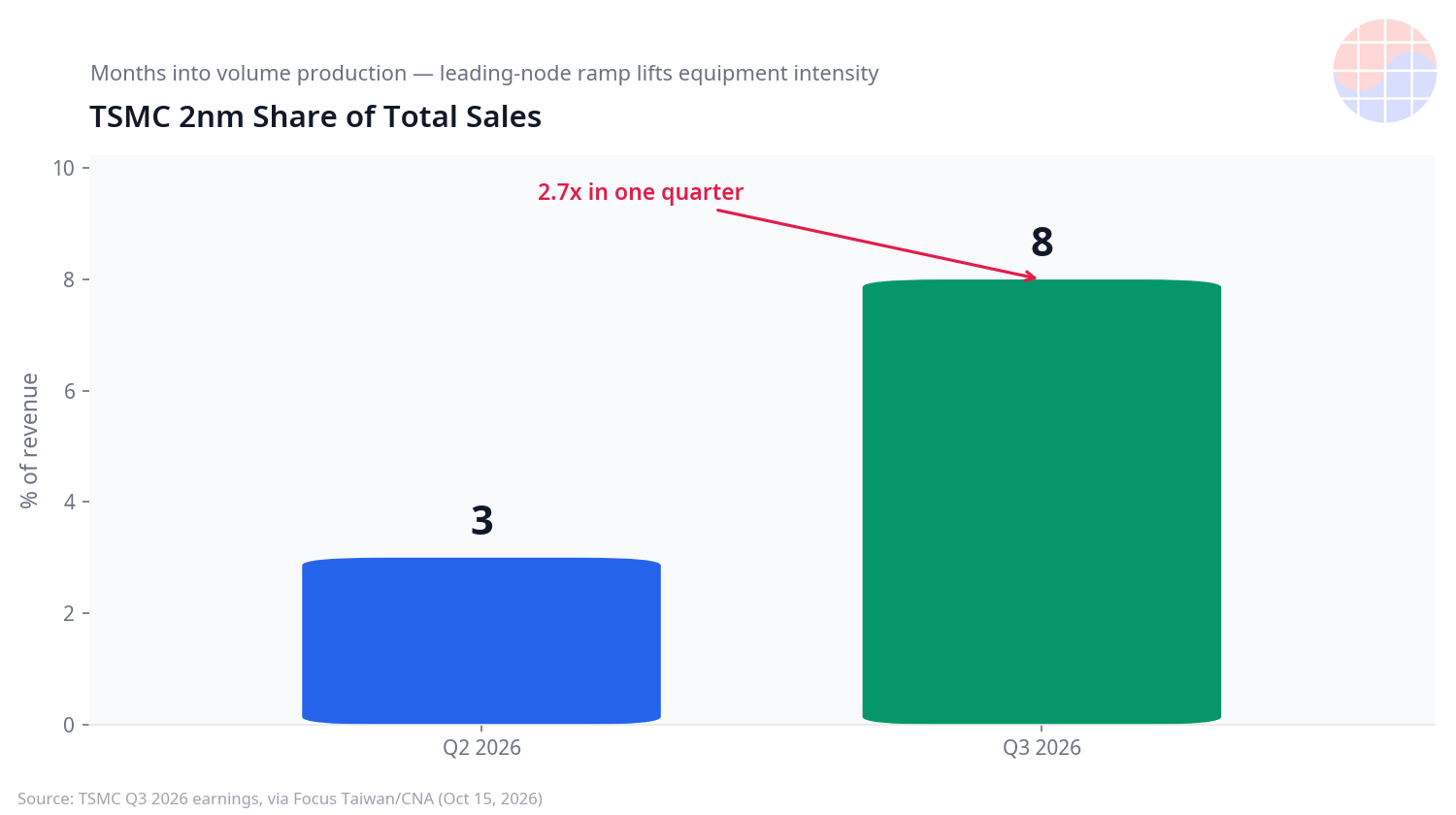
Figure 2: TSMC 2nm share of total sales — 3% in Q2 2026 to 8% in Q3. More than doubling within months of volume production, lifting equipment intensity per wafer.
VLSI's View
The structural read is simple. This capex cycle is demand-pulled, not speculative overbuilding. TSMC holding US$60–64 billion while guiding ~44% revenue growth means equipment spending is tracking the actual order book. The binding constraint is no longer chip demand — it is tool supply. The moment ASML publicly said planned 2027–2028 capacity cannot meet demand, equipment vendors stopped being passive cycle suppliers and became the bottleneck holders with pricing power.
Winners: equipment vendors with monopoly positions come first. ASML's EUV has no substitute, and now its capacity is the subject of 2029–2030 reservation talks. Deposition and etch players ride the same equipment-intensity wave, as do Korean equipment names like Hanmi Semiconductor and Wonik IPS. Losers: foundry customers without secured capacity. In an era where an equipment slot is a wafer slot, allocation — not design — decides who wins the leading-node race. Memory makers face the same fight for installation slots against logic fabs; SK hynix's HBM4 expansion is no exception.
The Korea angle is Samsung Foundry's fight for EUV slots. Its 2nm and 1.4nm ramp competes directly with TSMC for the same lithography capacity, as do the Taylor fab ramp in Texas and SK hynix's HBM4 expansion — all drawing on the capacity ASML says is spoken for into 2028. If tool scarcity becomes structural, the foundry gap could widen on equipment access rather than design capability. Samsung's Q3 earnings in late October, with its foundry and memory capex commentary, are the next checkpoint.
One balancing note. Equipment vendors have an incentive to talk up their own order books — "interest" in 2029–2030 orders is not booked revenue, and some of it may be strategic overbooking by customers grabbing slots early. The industry has seen this movie before: memory makers' double-booking in 2021–2022 later turned into cancellations. Still, TSMC's 44% revenue growth guide and the sheer speed of the 2nm ramp are hard evidence of real demand behind the bookings. The base case remains sustained tool tightness.
Chase's Take: Anyone who has worked in a fab knows what happens when tool lead times stretch: install schedules slip, ramp plans get rewritten around equipment arrival dates, and "when is the tool coming" displaces yield as the first topic of the morning meeting. ASML talking about 2029–2030 slots means that dynamic is now playing out at industry scale. In the chip-shortage era, fabs were kings; in the equipment-shortage era, whoever holds the tools is king. If you're an investor, watch equipment order backlogs before foundry margins. If you're an engineer, watch what etch, deposition and litho specialists are commanding in the job market. Whoever sees where the bottleneck moved knows the winners of the next three years.
Outlook
- Lam Research earnings (Oct 21): whether the etch leader updates the 2026 wafer-fab-equipment spending outlook — the next macro check on the equipment cycle.
- Samsung Q3 earnings (late October): foundry and memory capex signals plus Taylor fab ramp commentary — the Korean-side read on the EUV slot race.
- Applied Materials and Tokyo Electron (November): guidance from the deposition and coater/developer pillars to gauge the breadth of tool demand.
- ASML's 2028 expansion review: whether additional capacity beyond the planned 30% increase gets approved will define how long post-2028 tightness lasts.
- Q3 equipment billings data (early December): the macro tally of tool shipments to confirm the cycle's durability.
FAQ
Q1: Why did TSMC raise its revenue outlook while freezing capex?
Strong demand, executed inside the existing investment plan. Read together with the guidance that 2026–2028 capex will exceed the prior three-year total, this is acceleration of a US$60–64 billion program, not a cut. That TSMC can fund ~44% revenue growth — with the equipment-intensive 2nm ramp — without raising capex means the tools already on order are calculated to carry it.
Q2: Why does ASML mentioning 2029–2030 orders matter?
It signals structurally longer tool lead times. When lithography delivery slots that used to be discussed 12–18 months out are now negotiated three to four years ahead, the bottleneck has moved from chips to machine-building capacity. For foundry customers, the leading-node race variable shifts from design to equipment access.
Q3: How does tool scarcity affect chip prices?
In the near term it hardens the floor under foundry pricing. When an equipment slot equals a wafer slot, foundries have less incentive to cut prices to fill utilization — TSMC's Q4 gross-margin guidance of 65–67% is that pricing power expressed as a number. Over time it also strengthens equipment vendors' pricing power.
Q4: What does this mean for Korean companies?
Samsung Foundry's 2nm/1.4nm ramp, the Taylor fab and SK hynix's HBM4 expansion all compete with TSMC for the lithography capacity ASML says is spoken for into 2028 — the foundry race could be decided in the equipment allocation battle. On the flip side, Korean equipment names like Hanmi Semiconductor and Wonik IPS get multi-year demand visibility. Samsung's late-October earnings capex commentary is the next clue.