VLSI Korea
Market Bulletin: Foundry Utilization Reaches 91% — 8-Inch Capacity Falls 6% as Mature Nodes Tighten
Major global fabs are forecast at about 91% average utilization in Q4 2026, while 8-inch capacity fell 6% this year and 55/90nm prices keep rising. UMC climbed from 79% to 85% in one quarter. Why the AI boom is tightening old nodes first.


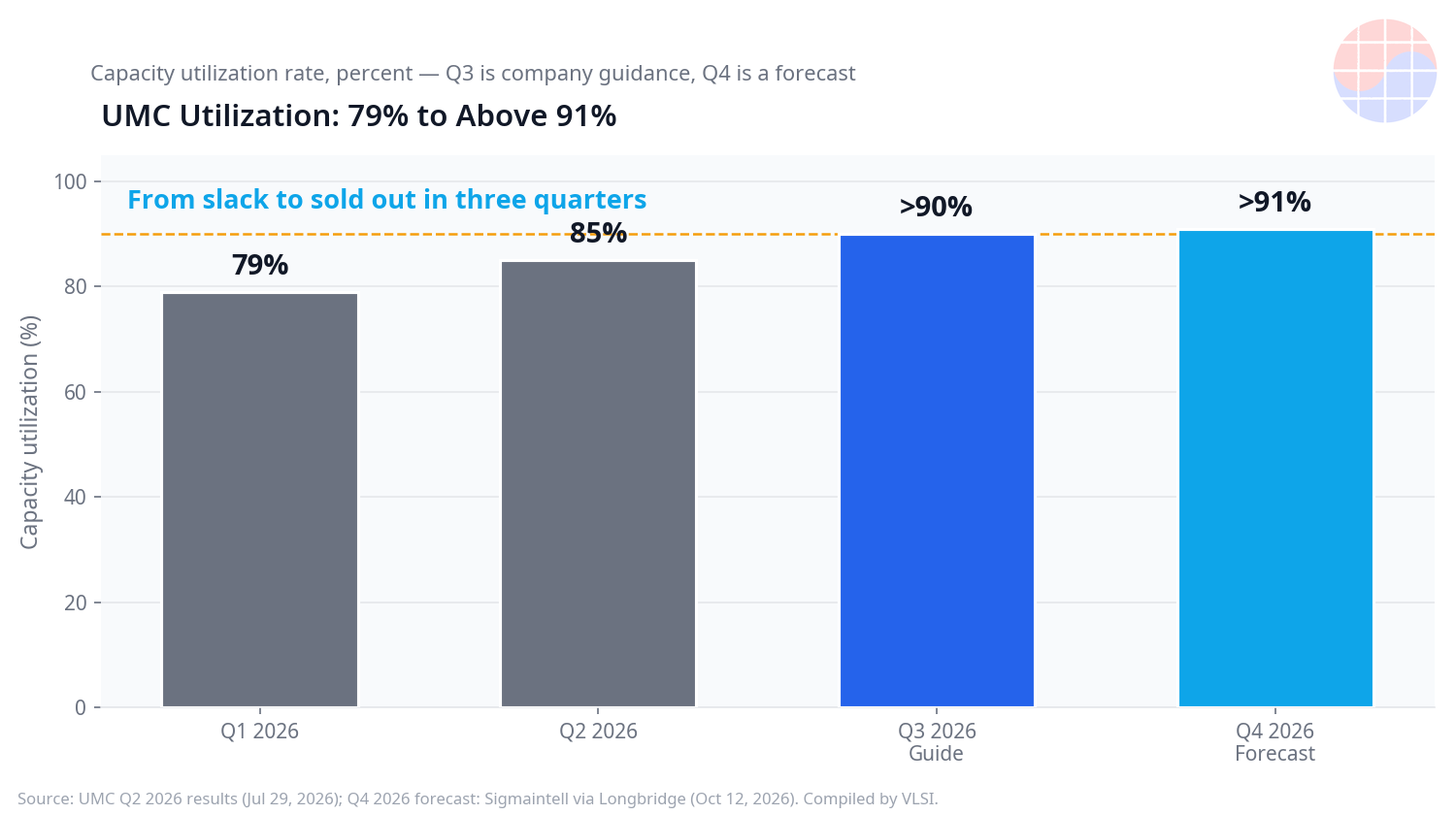
The bottleneck in semiconductors has moved from the leading edge to the old nodes. Average utilization at major global fabs is forecast at about 91% in Q4 2026, with 8-inch order visibility close to six months and global 8-inch foundry capacity down 6% year over year in 2026 (Sigmaintell, October 12, 2026). UMC shows the climb: utilization rose from 79% in Q1 to 85% in Q2 2026, was guided above 90% for Q3, and is forecast above 91% for Q4 (UMC second-quarter 2026 results, July 29, 2026). The tightness is not uniform — 55/90nm prices keep rising with larger increases expected in 2027, while 28/40nm prices stay flat this quarter.
Key Highlights
- 91% in Q4: average utilization at major global fabs is forecast at about 91% in Q4 2026. UMC's Q4 utilization is expected above 91%, up more than 10 percentage points year over year, with 22/28nm near 93%. SMIC, Hua Hong and Nexchip have been at full capacity since the start of 2026 (Sigmaintell, Oct 12, 2026).
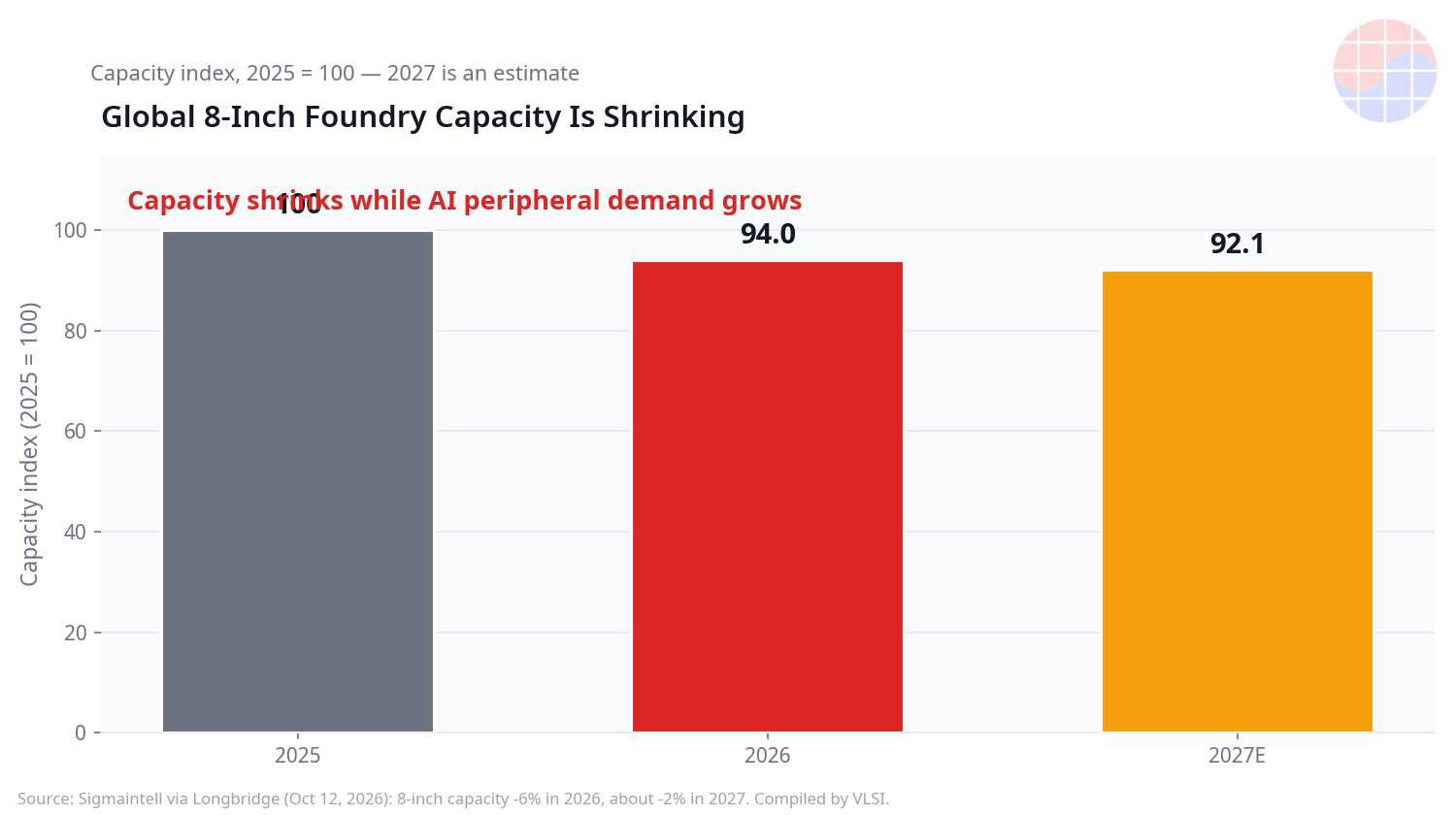
- 8-inch shrinks 6%: global 8-inch foundry capacity falls 6% year over year in 2026 and is forecast to decline about 2% more in 2027, as TSMC and Samsung Electronics reduce 8-inch capacity. Order visibility is close to six months, and 48V high-voltage PMICs for AI servers are predominantly made on 8-inch (Sigmaintell, Oct 12, 2026).
- Prices split by node: 55/90nm prices keep rising in Q4 2026 with larger increases expected in 2027, while 28/40nm prices are flat in Q4 2026 and the increase pressure is deferred to 2027 (Sigmaintell, Oct 12, 2026).
- UMC's quarter in one line: utilization 79% in Q1 to 85% in Q2, guided above 90% for Q3; revenue NT$68.73 billion (US$2.18 billion), up 17% year over year; gross margin 32.5%; a record 37% of wafer revenue from 22/28nm; shipments of 1.129 million 12-inch equivalents, up 10.6% quarter over quarter; 2026 capex raised to US$2 billion (UMC, Jul 29, 2026).
- The advanced edge is booked solid too: TSMC reported Q3 2026 revenue of US$46.72 billion, up 41.2% year over year, at 66.4% gross margin. Technologies at 7nm and below were 79% of wafer revenue (2nm 8%, 3nm 33%, 5nm 28%, 7nm 10%). Q4 guidance is US$52.3-54.3 billion in revenue and 65-67% gross margin, with 2026 capex reaffirmed at US$60-64 billion (TSMC, Oct 15, 2026).
Market Update
The squeeze has two drivers that multiply each other. Supply is leaving: global 8-inch foundry capacity drops 6% year over year in 2026 as TSMC and Samsung Electronics reduce their 8-inch lines, and the decline is forecast to continue at about 2% in 2027. Demand is staying: 48V high-voltage PMICs for AI servers are predominantly built on 8-inch, and 8-inch order visibility is close to six months. When capacity exits while demand holds, utilization passes 90% and the tightest nodes' prices rise first — exactly what 55/90nm shows.
| Before (early 2026) | Now / Q4 2026 (reported or forecast) | |
|---|---|---|
| UMC utilization | 79% (Q1 2026) | 85% (Q2); above 90% guided (Q3); above 91% forecast (Q4) |
| Global 8-inch capacity | Index 100 (2025) | 94 (2026); about 92 (2027E) |
| 55/90nm pricing | Stable | Rising in Q4 2026; larger increases expected in 2027 |
| 28/40nm pricing | Stable | Flat in Q4 2026; increase pressure deferred to 2027 |
| 22/28nm mix at UMC | Record set in Q2 | 37% of wafer revenue — a company record (Q2 2026) |
Utilization, capacity and pricing: Sigmaintell (October 12, 2026) via Longbridge; UMC figures from the company's Q2 2026 results (July 29, 2026). Q4 utilization and 2027 figures are forecasts or guidance, not reported results.
The advanced-node picture confirms this is a demand story, not just a supply exit. TSMC's Q3 2026 results — US$46.72 billion in revenue, up 41.2% year over year, 66.4% gross margin and 79% of wafer revenue from 7nm and below — show the AI compute wave in full force (TSMC, October 15, 2026). But the AI server bill of materials is not only accelerators. The 48V power delivery feeding those racks is built largely on 8-inch, so AI capex flows straight into the industry's oldest fab infrastructure. Capex confirms the breadth: UMC raised its 2026 capex to US$2 billion, while TSMC reaffirmed US$60-64 billion — expansion at both ends of the spectrum at once.
VLSI's View
AI demand is tightening the old nodes first. The surprise of this cycle is that 22/28nm — and even 55/90nm — are the pressure points, not advanced logic. The reason is the hidden AI bill of materials: 48V high-voltage PMICs and BCD/power management devices for AI servers are predominantly 8-inch and scale with rack deployments. Watch the power chain, not just accelerators: that is where lead times stretch.
"Mature node" is not one market. The price data splits cleanly: 55/90nm rising in Q4 2026 with bigger increases expected in 2027, 28/40nm flat this quarter with pressure deferred to next year. Capacity is node- and platform-specific — BCD, high-voltage and specialty qualification matter more than a generic "8-inch" label. Platform qualification locks customers in — switching foundries means requalification — so volume sticks to whoever has room.
The Korea angle is uncomfortable. Samsung Electronics is reducing its 8-inch capacity while its foundry chases advanced orders, leaving Korean fabless PMIC and DDI makers more exposed to an 8-inch squeeze. The spillover destination is obvious: SMIC, Hua Hong and Nexchip have been at full capacity since the start of 2026, and UMC is forecast above 91% in Q4. Korean fabless firms that treated 8-inch as always available now compete for allocation against earlier-qualified Chinese customers.
Chase's Take: In STA work, a block at 91% utilization has no slack left for ECOs — past about 90%, every extra gate costs disproportionately in routing congestion, and timing closure goes nonlinear. Foundry capacity is behaving the same way. At 91% utilization with six months of order visibility, there is no cheap marginal wafer: every additional order displaces another customer's slot, and prices rise the way congestion rises. Plan procurement like timing closure: build in margin, because there is no slack to borrow.
Outlook
- Q4 price check: whether 55/90nm increases land as expected in Q4 2026, and how much larger the 2027 increases are.
- 28/40nm timing: increase pressure is deferred to 2027 — watch when foundries start passing it through.
- 8-inch exits: further capacity cuts by TSMC and Samsung Electronics could steepen the 2027 decline forecast of about 2%.
- Allocation, not just price: with SMIC, Hua Hong and Nexchip full since January 2026, watch lead times and fabless dual-sourcing.
FAQ
How tight is foundry utilization right now? Average utilization at major global fabs is forecast at about 91% in Q4 2026. UMC rose from 79% in Q1 to 85% in Q2, was guided above 90% for Q3 and is forecast above 91% for Q4, up more than 10 percentage points year over year (Sigmaintell, October 2026; UMC, July 2026).
Why is 8-inch capacity shrinking? Global 8-inch capacity is down 6% year over year in 2026 and forecast to decline about 2% more in 2027, as TSMC and Samsung Electronics cut 8-inch lines — while AI server demand keeps 8-inch order visibility near six months (Sigmaintell, October 2026).
Which nodes are seeing price increases? 55/90nm prices keep rising in Q4 2026 with larger increases expected in 2027. 28/40nm prices are flat in Q4 2026, with the increase pressure deferred to 2027 (Sigmaintell, October 2026).
What does this mean for fabless customers? At 91% utilization with six months of order visibility, marginal wafers are scarce — customers compete for allocation, not just price. Qualified BCD/high-voltage products are the stickiest, because switching foundries means requalification.
📩 Subscribe to VLSI Korea
Get our daily semiconductor deep-dives delivered to your inbox first. Free to subscribe.