VLSI Korea
A Swedish Data Center Chose a Korean AI Chip: Inside FuriosaAI's 7,000-Unit RNGD Deployment
A Stockholm data center will deploy 1,800 FuriosaAI RNGD chips in early 2027 and 8,800+ at full build-out — alongside some 7,000 GPUs, not instead of them. Why Europe picked a Korean inference chip comes down to 180W power economics.



30-Second Summary
- In August 2026, South Korean fabless startup FuriosaAI, US infrastructure firm I/ONX HPC, and data center developer Velox announced a 15MW AI data center in Stockholm, Sweden, built around FuriosaAI's RNGD inference accelerators.
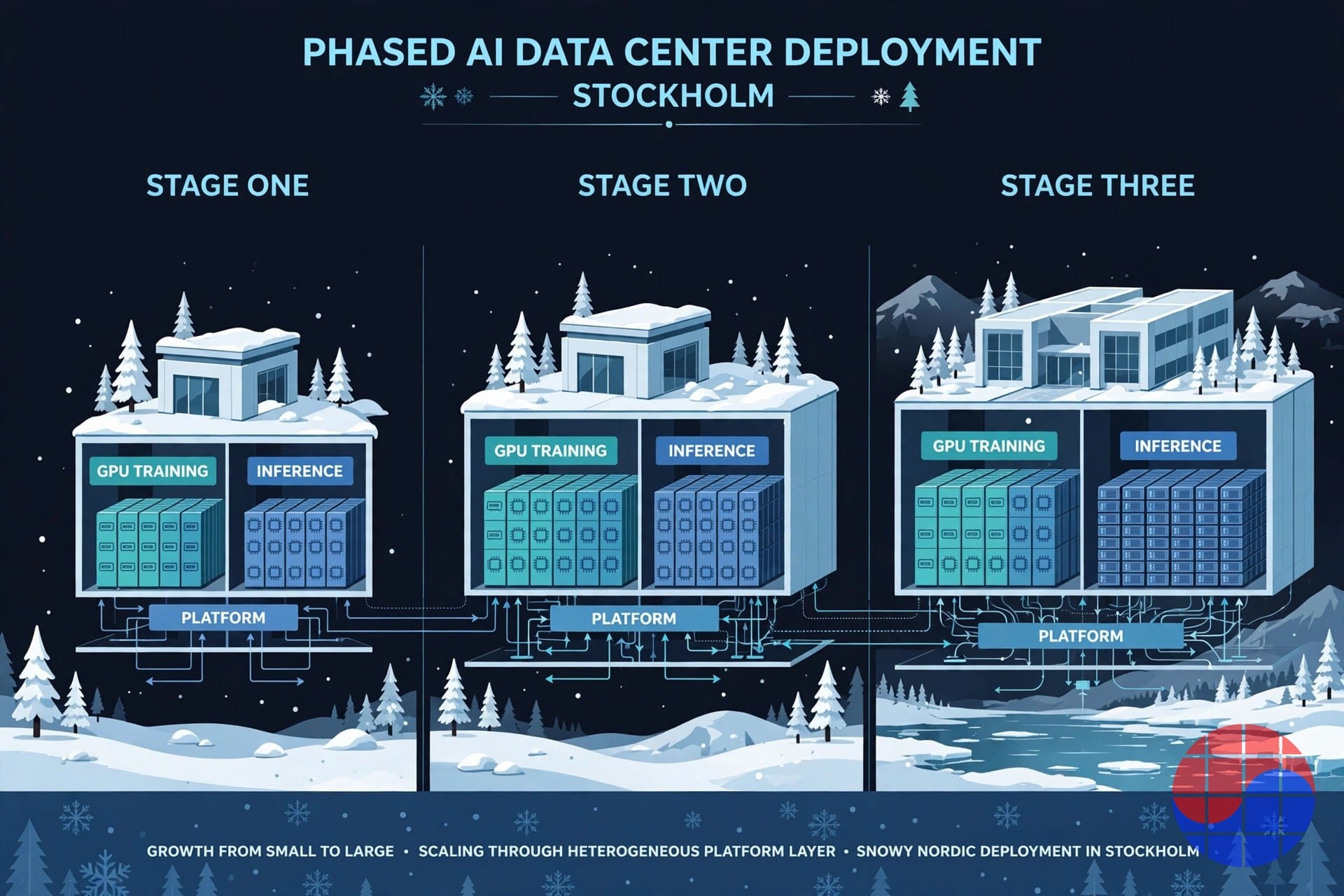
- Deployment runs in phases: 1,800 RNGD units in Phase 1, online in early 2027 with the first 2MW of capacity, then more than 7,000 additional units across expansion phases — a cumulative plan of over 8,800 accelerators at full build-out.
- The RNGD fleet will not replace GPUs. It will sit alongside roughly 7,000 Nvidia and AMD GPUs inside I/ONX's Symphony SixtyFour platform: GPUs handle training, RNGD handles LLM and agentic AI inference.
- The selection logic is power economics. RNGD is a 180W air-cooled PCIe card with independently measured performance-per-watt 2.25x better than a GPU-based alternative — a decisive profile in Europe, where electricity costs two to three times US and Chinese levels and most facilities are air-cooled.
- For FuriosaAI, Stockholm is the scale reference that converts domestic validations into an export business, arriving as the company pursues a reported $300–500 million pre-IPO funding round.
Background
The Stockholm project, announced on August 4, 2026, is a three-party build. Velox DCI Europe — the European arm of a Texas-based modular data center company launched in February 2025 — develops, manages, and operates the physical facility, selling capacity under an Infrastructure-as-a-Service model. I/ONX HPC, a Las Vegas-based heterogeneous AI infrastructure firm founded in 2020, acts as system integrator and platform partner. FuriosaAI supplies the RNGD accelerators, drivers, software stack, and architectural support. The partners say the coming months are for technical validation, software integration, and supply planning ahead of the first deployment phase.
| Phase | Facility capacity | RNGD accelerators | Timing |
|---|---|---|---|
| Phase 1 | 2MW | 1,800 units | Early 2027 |
| Expansion | +8MW (10MW cumulative) | 7,000+ additional units | Later in 2027 |
| Full build-out | 15MW | 8,800+ units in total | Subsequent phases |
The workload split is explicit. RNGD accelerators handle large language model and agentic AI inference; the GPU fleet handles model training and general computing. The chips are installed in I/ONX's Symphony SixtyFour high-density servers, which consolidate up to 64 accelerators into a single node. End customers are European enterprises and cloud service providers buying inference capacity, not hardware.
Stockholm is not FuriosaAI's first European step. In July 2026, RNGD servers were deployed at an Equinix data center in Lisbon, Portugal — a single-site beachhead. In Korea, Samsung SDS has launched an RNGD-based NPU-as-a-Service offering, and LG AI Research runs its EXAONE models on RNGD infrastructure. What changes in Sweden is scale: a multi-thousand-unit, multi-phase commitment operated by third parties whose business depends on the hardware performing.
Business Deep Dive
1. Europe is buying sovereignty — and sovereignty has a power bill
The demand side of this deal is structural. Through its InvestAI initiative, the European Union aims to mobilize €200 billion in AI investment. In July 2026, the Commission put €10 billion of public money behind seven AI gigafactories, expecting to crowd in a further €20 billion of private capital; each facility is to house at least 100,000 advanced AI chips, and winning consortia are due to be announced in early 2027. Henna Virkkunen, the Commission's executive vice president for tech sovereignty, called access to raw computing power "a strategic necessity for Europe."
Two constraints shape what Europe can actually buy. First, the European Commission's own analysis puts EU electricity costs at two to three times the levels in the US and China. In Europe, performance per watt is not an optimization target; it is the feasibility condition for adding capacity at all. Second, sovereignty demand means diversifying supply beyond a single dominant US GPU vendor — yet the default still rules at the top: Nvidia, AMD, and Qualcomm have signed letters of intent to supply the gigafactory program. Challenger silicon wins first at the independent edge of the market — commercially driven IaaS facilities exactly like the Stockholm build, where the operator's own margin, not a subsidy committee, makes the chip decision.
2. Complement, not replacement: the wedge that actually works
Every challenger to the GPU incumbents faces the same adoption wall: no operator wants to rip out a working GPU estate and bet the business on an unproven stack. FuriosaAI's Stockholm design sidesteps the wall instead of climbing it. Roughly 7,000 GPUs remain in the building. RNGD asks only for the inference layer — the layer where tokens are served, where utilization is continuous, and where performance per watt converts directly into the operator's gross margin.
Two packaging choices lower the adoption barrier further. The heterogeneous integration risk is absorbed by I/ONX's Symphony SixtyFour platform, which claims rack-scale TCO reductions of 50 percent or more from consolidating up to 64 accelerators per node; the customer never has to manage a mixed fleet. And because Velox sells Infrastructure-as-a-Service, European enterprises rent inference outcomes rather than evaluating a Korean startup's silicon themselves. The chip decision becomes one operator's TCO calculation — a far easier sale than thousands of individual design wins.
3. The 180W economics
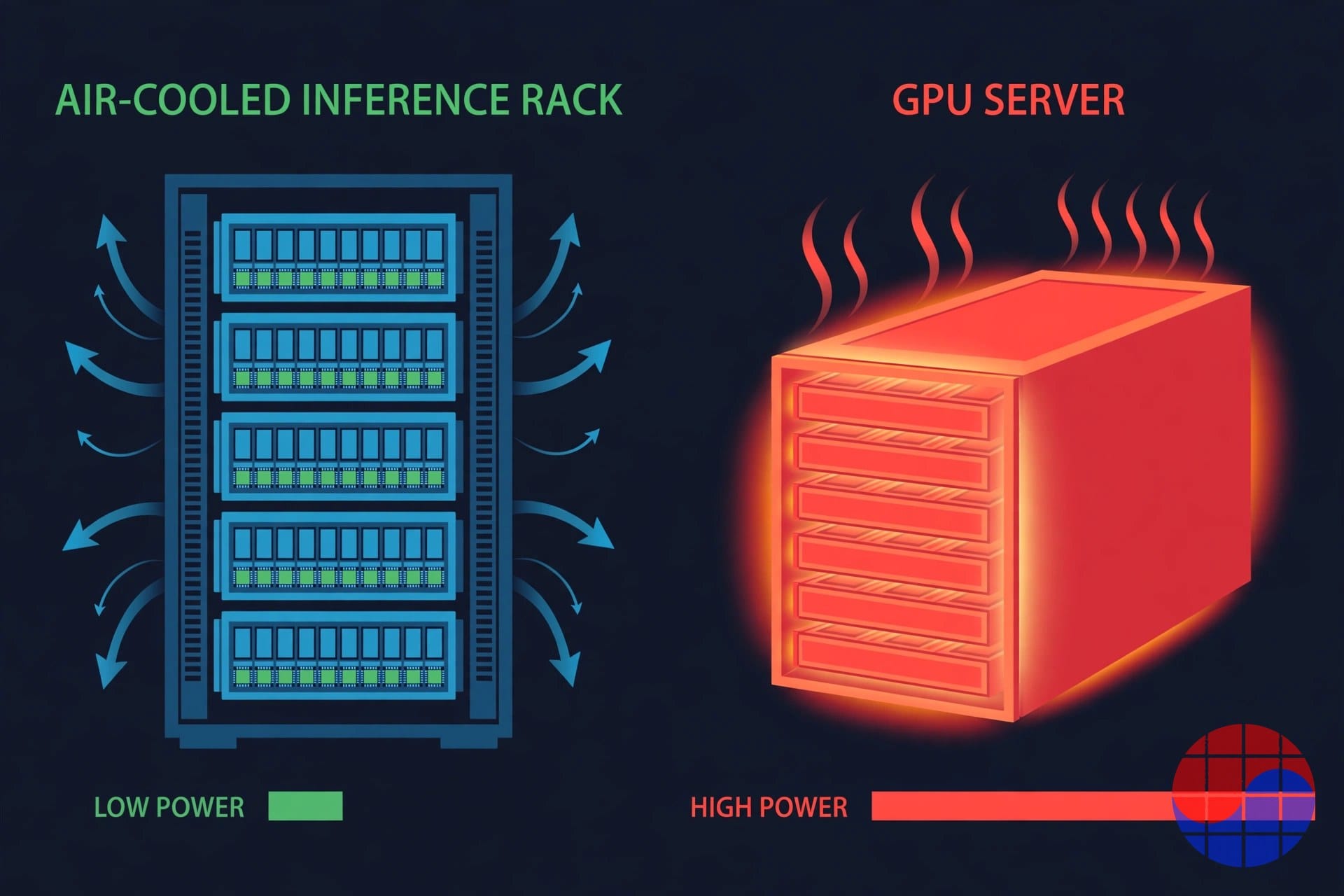
RNGD is built on TSMC's 5nm process around FuriosaAI's Tensor Contraction Processor architecture. Each PCIe card delivers 512 TFLOPS of FP8 compute with 48GB of HBM3 memory at a card-level TDP of 180W, passively cooled. The company's NXT RNGD server packs eight cards into a standard air-cooled 4U chassis — four petaflops of FP8 and 384GB of HBM3 — at roughly 3kW per server, against a maximum of 10.2kW for an Nvidia DGX H100 server. A standard 15kW air-cooled rack can therefore host up to five NXT RNGD servers where it would fit one DGX. FuriosaAI notes that more than 80 percent of data centers still run air-cooled at 8kW per rack or less — the installed base that high-density GPU retrofits cannot serve without rebuilding the facility.
The efficiency claim has third-party weight behind it. LG AI Research, running its EXAONE large language model on RNGD infrastructure, measured 2.25x better inference performance per watt than a GPU-based solution, and 3.75x more tokens from a rack held to the same power budget. The fleet arithmetic is equally simple: 8,800 cards at 180W draw about 1.6MW of accelerator power at full build-out — roughly a tenth of the Stockholm facility's 15MW envelope, leaving headroom for the GPU fleet, networking, and cooling inside a power budget that European grid connections actually allow.
4. What a reference deployment is worth
AI chip startups rarely die on silicon quality; they die at the reference stage, when no operator wants to be first at scale. FuriosaAI has now stacked references in sequence — LG AI Research for model-level validation, Samsung SDS for service packaging in Korea, Equinix Lisbon for a European beachhead, and Stockholm for multi-thousand-unit scale under a third-party operator. Each step retires a different class of buyer objection.
The timing matters. FuriosaAI closed a $125 million Series C bridge round in July 2025 led by Korean policy and strategic investors, and in January 2026 it was reported to be seeking $300–500 million ahead of an anticipated IPO. This is also the company that walked away from an $800 million acquisition offer from Meta, choosing independence. A European flagship reference — real units, a named facility, a dated go-live — is precisely the asset that supports that independence narrative in a pre-IPO raise. Meanwhile, its May 2026 partnership with Broadcom on a third-generation, chiplet-based rack-scale platform means Stockholm de-risks the current generation while the next one is being built.
Chase's Take
The instructive part of this deal is not that a Korean chip won in Europe. It is how it won: by declining to fight for the training layer. Training is a prestige market with an entrenched software moat; inference is a cost market where the buyer's spreadsheet decides. A 180W air-cooled card that serves 2.25x more performance per watt does not need to be loved — it needs to be cheaper per token inside a facility the operator already owns. That is a business argument, not a benchmark argument, and it is the only wedge that has consistently worked for challenger silicon.
Three risks deserve equal billing. First, execution: this is an announced plan entering technical validation, and Phase 1 must land on schedule in early 2027 for the expansion phases to be credible. Second, incumbent response: the GPU leaders improve inference efficiency every generation and own the software ecosystem; the efficiency gap is a moving target. Third, concentration: one facility and one integrator carry the European story, so any slippage is highly visible. None of these erase the structural point — sovereign demand plus power constraints plus complement positioning is a repeatable playbook, and FuriosaAI just ran it at a scale no Korean AI chip startup has reached before.
Implications
- For Korea's fabless ecosystem: Stockholm is export proof that a domestic AI chip can win on TCO in a foreign commercial facility, not only inside Korean enterprise anchors. Expect sovereign-AI positioning to become a standard go-to-market motion for Korean accelerator startups.
- For European operators: the project is a replicable template for extracting AI capacity from air-cooled, power-constrained facilities. The gigafactory awards in early 2027 will show whether challenger silicon can penetrate subsidized builds as well as commercial ones.
- For investors: the milestones that matter are Phase 1 going live on schedule in early 2027, closure of the pre-IPO round, and progress signals from the Broadcom third-generation program.
- For incumbent watchers: with roughly 7,000 GPUs in the same building, this deal grows the total accelerator market more than it shrinks the incumbents' share — for now. The strategic question is whether the inference layer, once conceded, stays conceded.
FAQ
How many FuriosaAI RNGD accelerators will be deployed in Stockholm? 1,800 units in Phase 1, more than 7,000 additional units in expansion phases, and over 8,800 units in total at full build-out, according to the companies' August 2026 announcement.
Why did a Swedish data center choose a Korean inference chip instead of more GPUs? Power and TCO. RNGD delivers 512 TFLOPS of FP8 compute at 180W per card in an air-cooled PCIe form factor, with 2.25x better measured performance per watt than a GPU-based alternative — a fit for Europe's high electricity costs and predominantly air-cooled facilities. GPUs remain in the same facility for training.
What is I/ONX's Symphony SixtyFour platform? A high-density AI server platform that consolidates up to 64 accelerators into a single node, mixing FuriosaAI RNGD NPUs with Nvidia and AMD GPUs in a heterogeneous system. I/ONX claims it reduces rack-scale TCO by 50 percent or more.
When does the Stockholm facility start operating? The first 2MW of compute capacity is scheduled to come online in early 2027, with a further 8MW added later in 2027 and an overall target capacity of 15MW.
Note: Deployment figures, power data, and performance-per-watt results are drawn from the companies' August 2026 announcements and LG AI Research's published evaluation. This article is industry analysis, not investment advice.
Sources: FuriosaAI announcement coverage (Korea Herald, Aug 5, 2026); European Commission InvestAI and AI gigafactory program documents (Jul 2026); I/ONX HPC Symphony SixtyFour platform materials.
📩 Subscribe to VLSI Korea
Get our daily semiconductor deep-dives delivered to your inbox first. Free to subscribe.