VLSI Korea
GlobalFoundries Malta Deep Dive: Japan's USD 21 Billion and the Allied-Fab Model (US Fab Race)
Japan funds up to USD 21 billion while GlobalFoundries operates two new Malta fabs. We break down the deal structure, the CHIPS reallocation and US equity stake, the US fab investment comparison, and the demand risk.


GlobalFoundries Malta Deep Dive: Japan's USD 21 Billion and the Allied-Fab Model (US Fab Race)
Japan supplies the capital, GlobalFoundries supplies the technology and operations, and the US government takes an equity stake — a division of labor that spreads the cost and risk of fab building across an alliance.
TL;DR
- GlobalFoundries was selected as the technology provider and operator for two new fabs at its Malta, New York site, with a US-Japan initiative providing up to USD 21 billion in funding (GlobalFoundries release, Oct 14, 2026).
- The first fab, at roughly USD 10 billion, is expected to come online in 2029, while a second fab of roughly USD 10 billion is conditional (GlobalFoundries release, Oct 14, 2026).
- At full ramp, each fab adds roughly 900,000 300mm wafers per year, for a combined roughly 1.8 million wafers per year, or about 150,000 wafers per month by our conversion (GlobalFoundries release, Oct 14, 2026 / monthly conversion is our calculation).
- The US Department of Commerce reallocated USD 955 million under an amended CHIPS award toward silicon photonics, SiGe, and advanced packaging in Malta, New York and Burlington, Vermont, and separately agreed to take an approximately 4% equity stake in GlobalFoundries (GlobalFoundries release, Oct 14, 2026).
- The deal is reported as the first semiconductor project under Japan's USD 550 billion US-investment framework, and USD 21 billion equals roughly 3.8% of that framework (reporting, Oct 2026 / percentage is our calculation).
Background
GlobalFoundries is a foundry that stepped back from the leading-edge node race after halting 7nm development in 2018 and has since focused on differentiated processes (company disclosures and reporting, Oct 14, 2026). Its areas of focus include RF, power, embedded memory, and photonics, and the demand context named in this announcement is automotive, industrial, and connected infrastructure (GlobalFoundries release, Oct 14, 2026).
The Malta site itself is not new ground. The Malta Fab 8 site has been under development since 2009 and has received support from New York's Green CHIPS program (GlobalFoundries release, Oct 14, 2026). What makes this deal notable is not the site but the funding structure. A large share of the money to build the fabs comes from a Japanese framework, while GlobalFoundries contributes differentiated technology, manufacturing expertise, and operating capability (GlobalFoundries release, Oct 14, 2026). Layered on top, the US government participates directly through a subsidy reallocation and an equity stake, producing a structure that differs from the conventional model in which a single company carries the entire capital expenditure on its own balance sheet (GlobalFoundries release, Oct 14, 2026).
That is the allied-fab model: capital from an allied country, operations by a specialist foundry, and host-government alignment through subsidies and equity.
Deep Dive 1: The Malta Deal Structure and Timeline
The skeleton of the deal is simple. GlobalFoundries was selected as the technology provider and operator for two new fabs at its Malta site in New York, and a US-Japan initiative will provide up to USD 21 billion in funding (GlobalFoundries release, Oct 14, 2026). In the first phase, roughly USD 10 billion will accelerate construction of a new 300mm fab that is expected to come online in 2029 (GlobalFoundries release, Oct 14, 2026). A further roughly USD 10 billion would fund a second fab, taking the combined program above USD 20 billion within a framework capped at up to USD 21 billion (GlobalFoundries release, Oct 14, 2026).
In capacity terms, each fab at full ramp adds roughly 900,000 300mm wafers per year (GlobalFoundries release, Oct 14, 2026). With both fabs complete, the combined addition is roughly 1.8 million wafers per year, which converts to about 150,000 wafers per month (GlobalFoundries release, Oct 14, 2026 / monthly conversion is our calculation). That is well beyond the scale of a typical single foundry fab, and the same number that describes the construction plan also describes the volume of demand that will eventually have to fill it.
The schedule starts from favorable conditions. Groundbreaking for the first fab is planned for later in 2026, the site is permitted and shovel-ready, and the project can use existing Malta infrastructure (GlobalFoundries release, Oct 14, 2026). The announced employment effect is roughly 27,000 construction and ecosystem jobs and more than 1,000 high-skilled manufacturing jobs (GlobalFoundries release, Oct 14, 2026).
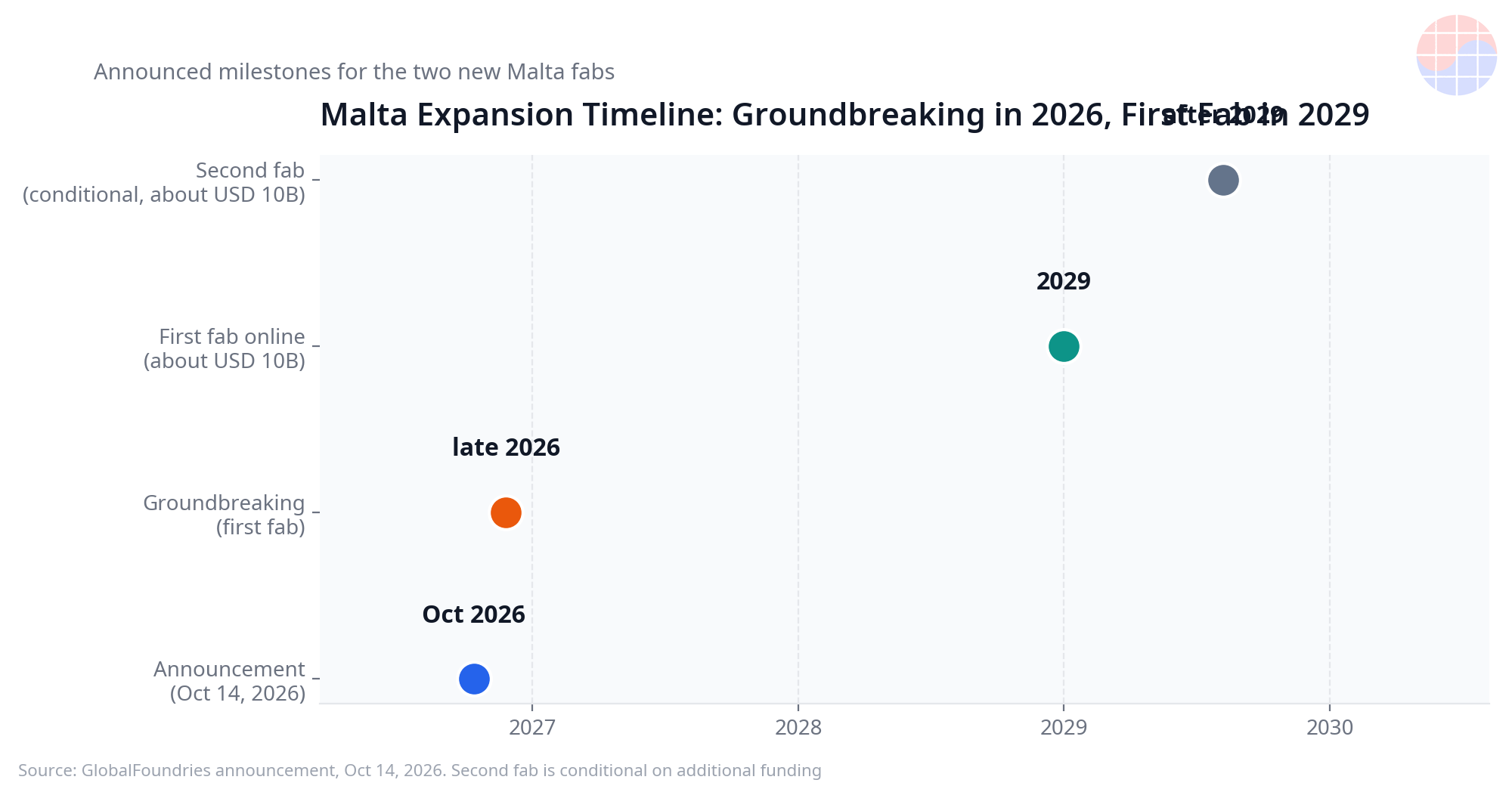
The second fab, however, should be read as conditional rather than committed. The additional roughly USD 10 billion was described as funding for a second fab, but its execution depends on follow-on conditions (GlobalFoundries release, Oct 14, 2026). The USD 21 billion figure is therefore best understood as the ceiling of a framework, not as a confirmed investment amount (GlobalFoundries release, Oct 14, 2026).
Deep Dive 2: The Government Layer — CHIPS Reallocation and a US Equity Stake
Alongside the Japanese funding sits a parallel set of US government moves. GlobalFoundries agreed with the US Department of Commerce to amend its existing CHIPS award and reallocate and accelerate USD 955 million toward silicon photonics, SiGe, and advanced packaging investments in Malta, New York and Burlington, Vermont (GlobalFoundries release, Oct 14, 2026). The fact that the reallocation targets silicon photonics, SiGe, and advanced packaging rather than leading-edge logic aligns precisely with the differentiated strategy GlobalFoundries has pursued since 2018 (GlobalFoundries release, Oct 14, 2026).
Under a separate agreement, the US Department of Commerce will take an approximately 4% equity stake in GlobalFoundries (GlobalFoundries release, Oct 14, 2026). That moves the government one step beyond grant-maker into shareholder. In this structure, the US government gains a direct interest in the outcome of the Malta investment, while GlobalFoundries accepts a more government-heavy capital structure in exchange for stronger policy backing (GlobalFoundries release, Oct 14, 2026).
The geopolitical layer is equally clear. The investment is reported as the first semiconductor project under Japan's USD 550 billion US-investment framework, which stems from the 2025 US-Japan trade deal and is linked to tariffs (reporting, Oct 2026). Dividing USD 21 billion by USD 550 billion gives roughly 3.8%, a small share of the overall framework but a symbolically important first execution in semiconductors (reporting, Oct 2026 / percentage is our calculation).
Malta's capital thus comes in three streams — Japanese framework funding, US CHIPS funding, and a US government equity stake — and its profitability equation differs fundamentally from that of a purely commercial fab (GlobalFoundries release, Oct 14, 2026).
Deep Dive 3: Why GlobalFoundries
The choice of GlobalFoundries as the operating partner for Japanese capital comes down to positioning. Since stepping back from the leading-edge race in 2018, the company has concentrated on differentiated processes whose demand base — automotive, industrial, and connected infrastructure — values long-term supply stability (GlobalFoundries release, Oct 14, 2026). In segments where process generations turn over slowly, a proven specialty process combined with a US production footprint is itself a supply-chain security asset (GlobalFoundries release, Oct 14, 2026).
Customer endorsements in the announcement support that reading. Renesas, Apple, GM, and Cirrus Logic expressed support, and equipment supplier Tokyo Electron was also quoted in the release (GlobalFoundries release, Oct 14, 2026). The presence of automotive and industrial customers among the endorsers indicates which demand the new fabs are aimed at (GlobalFoundries release, Oct 14, 2026).
Management's message points the same way. Chief Executive Officer Tim Breen said, in substance, that fabs need more than capital — they need differentiated technology and operational excellence (GlobalFoundries release, Oct 14, 2026). That is the company explaining, in its own words, why a funding provider would install an operator with manufacturing expertise rather than build alone (GlobalFoundries release, Oct 14, 2026). In a separate webcast, the company also noted that completing both fabs would raise US production capacity by roughly 10% (reporting, Oct 2026).
For GlobalFoundries, the appeal is the distribution of the fixed-cost burden. The company has explained that under this structure it can earn its current level of profit per wafer without carrying tens of billions of dollars in fixed costs (reporting, Oct 2026).
Deep Dive 4: Malta in the US Fab Race, and the Honest Limits
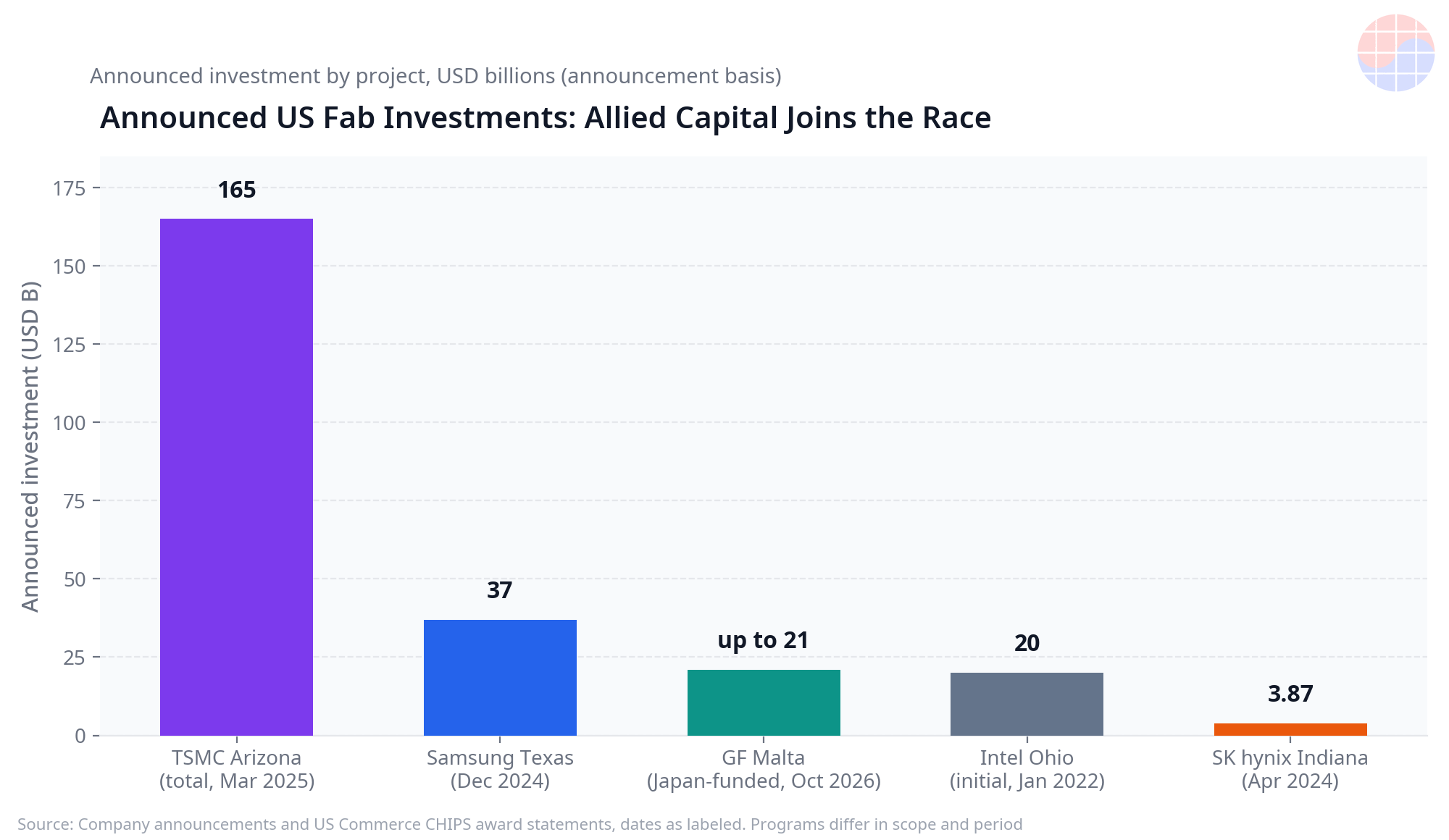
Placed side by side with other US fab investments, the scale of the Malta deal becomes clearer. TSMC's total Arizona investment of USD 165 billion was announced in Mar 2025, and Samsung's Texas investment of USD 37 billion is the figure from the Dec 2024 CHIPS final award announced by the US Department of Commerce (TSMC announcement, Mar 2025 / US Department of Commerce announcement, Dec 2024). GlobalFoundries Malta, at up to USD 21 billion, is in a similar bracket to Intel's initial Ohio announcement of USD 20 billion in Jan 2022, and far larger than SK hynix's USD 3.87 billion Indiana packaging investment announced in Apr 2024 (GlobalFoundries release, Oct 2026 / Intel announcement, Jan 2022 / SK hynix announcement, Apr 2024).
| Project | Announced investment | Basis |
|---|---|---|
| TSMC Arizona | USD 165 billion | Total investment, announced Mar 2025 (company announcement) |
| Samsung Texas | USD 37 billion | CHIPS final award, Dec 2024 (US Department of Commerce) |
| GlobalFoundries Malta (Japan-funded) | Up to USD 21 billion | Announced Oct 2026 (company release) |
| Intel Ohio | USD 20 billion | Initial announcement, Jan 2022 (company announcement) |
| SK hynix Indiana | USD 3.87 billion | Packaging, announced Apr 2024 (company announcement) |
As the table shows, the Malta deal is smaller than the US investments of TSMC and Samsung as a single-company commitment, but its character is different because the capital originates with a third-country ally (company announcements and US Department of Commerce announcement, as listed in the table). Where the Korean companies' US projects combine their own capital with US subsidies, Malta is a three-party structure in which allied capital builds a fab in the United States and a US company operates it (GlobalFoundries release, Oct 14, 2026).
The honest limits
The limits deserve to be stated plainly. First, the second fab is conditional: the additional roughly USD 10 billion is not committed spending and depends on later decisions (GlobalFoundries release, Oct 14, 2026). Second, filling the capacity is a real task. The new roughly 1.8 million wafers per year must be absorbed by mature and specialty process demand, and GlobalFoundries' average shipment utilization in 2025 was reported at roughly 86% (reporting, Oct 2026). Third, a 2029 start date carries the risk of landing out of phase with the actual demand cycle (GlobalFoundries release, Oct 14, 2026). Fourth, the capital structure is government-heavy: an approximately 4% US government equity stake, the CHIPS reallocation, and Japanese funding together make the project sensitive to changes in the policy environment (GlobalFoundries release, Oct 14, 2026).
The Korean angle
For Korean companies, this deal is not someone else's story. Samsung's Taylor, Texas fab and SK hynix's Indiana investment are the Korean versions of the same US production buildout (US Department of Commerce announcement, Dec 2024 / SK hynix announcement, Apr 2024). As more allied capital flows into US fabs, competition for equipment orders and skilled workforce intensifies in the same market. For Korean equipment and materials suppliers, a growing count of customer fabs in the United States makes local support capability a condition of winning orders, while a new large buyer such as Malta also represents additional opportunity (GlobalFoundries release, Oct 14, 2026).
Chase's Take
The most important number in this deal is not USD 21 billion. It is the separation of funding from operations. The long-standing problem in fab economics has never been the size of the capital expenditure alone; it is whether, after spending it, a fab has the operating capability and customer base to fill its utilization. Chief Executive Officer Tim Breen's point that fabs need more than capital addresses exactly that question (GlobalFoundries release, Oct 14, 2026).
If the allied-fab model spreads, the axis of foundry competition shifts with it. Competition moves from a contest fought only on process technology and yield toward one in which the capital structure behind a fab, and the government policies it is bound to, become part of competitiveness itself. GlobalFoundries, having exited the leading-edge race in 2018, has taken the earliest position in this new contest (GlobalFoundries release, Oct 14, 2026).
Ultimately, demand will judge the model: who fills roughly 1.8 million wafers per year of specialty capacity, at what price, and for how long? Until that answer exists, Malta is a well-structured bet, not a proven success (reporting, Oct 2026).
Implications
- If allied capital paired with a specialist operator becomes a repeatable template, mid-sized foundries can expand in the United States at a scale their own balance sheets could not support (GlobalFoundries release, Oct 14, 2026).
- The US government equity stake sets a precedent of the government entering a foundry as a shareholder rather than only as a grant-maker, which could shape the capital structure of follow-on deals (GlobalFoundries release, Oct 14, 2026).
- With a first semiconductor execution now visible under Japan's USD 550 billion framework, follow-on projects are more likely to reference the Malta structure (reporting, Oct 2026).
- Samsung and SK hynix US investments will compete in the same market for equipment and workforce as allied-capital projects, making US local support more important for Korean suppliers (US Department of Commerce announcement, Dec 2024 / SK hynix announcement, Apr 2024).
- Because the second fab is conditional and the start date is 2029, the real capacity contribution should be assessed against the demand cycle and whether follow-on funding is executed (GlobalFoundries release, Oct 14, 2026).
This article is analysis based on company releases and reporting publicly available as of Oct 21, 2026, and is not investment advice. Investments and schedules described as conditional may change in follow-on announcements.
FAQ
Q1. Who funds the two new Malta fabs, and who operates them? A: A US-Japan initiative provides up to USD 21 billion in funding, and GlobalFoundries acts as technology provider and operator, contributing its differentiated technology and manufacturing operations (GlobalFoundries release, Oct 14, 2026).
Q2. When does the first fab come online, and how much capacity does it add? A: The first fab, at roughly USD 10 billion, is expected to come online in 2029, and each fab at full ramp adds roughly 900,000 300mm wafers per year (GlobalFoundries release, Oct 14, 2026).
Q3. What role does the US government play in this deal? A: The US Department of Commerce reallocated USD 955 million under an amended CHIPS award toward silicon photonics, SiGe, and advanced packaging in Malta and Burlington, and separately agreed to take an approximately 4% equity stake in GlobalFoundries (GlobalFoundries release, Oct 14, 2026).
Q4. What are the biggest risks in this deal? A: The second fab is conditional, and the roughly 1.8 million wafers per year of specialty capacity needs demand to fill it, while GlobalFoundries' average shipment utilization in 2025 was reported at roughly 86% (GlobalFoundries release, Oct 14, 2026 / reporting, Oct 2026).
📩 Subscribe to VLSI Korea
Get our daily semiconductor deep-dives delivered to your inbox first. Free to subscribe.