VLSI Korea
Groq Deep Dive: From $6.9B to $3.5B — Pricing What Remains After Nvidia's $20B Deal
Groq closed a $350M round in August 2026 at a reported $3.5B valuation — half its September 2025 mark, after Nvidia's reported $20B licensing deal took the LPU technology and the founding team. What exactly is the remaining inference cloud worth, and what must be true for $3.5B to work?


The 30-Second Take
Groq is a US AI inference company founded in 2016 by Jonathan Ross, one of the creators of Google's TPU. Its Language Processing Unit (LPU) serves LLM tokens with deterministic, low-latency execution, and GroqCloud sells that speed as an API.
In August 2026, Groq closed a $350 million round led by Disruptive at a reported $3.5 billion valuation (about 4.9 trillion won at 1,400 won per dollar), with Nvidia planning to participate. That is roughly half the $6.9 billion valuation of its $750 million round in September 2025.
The reset has a specific cause. In December 2025, Nvidia entered a non-exclusive licensing deal for Groq's inference technology — reported at about $20 billion — and hired Ross, president Sunny Madra and much of the senior engineering team. The LPU's future now ships inside Nvidia's Vera Rubin platform as the Groq 3 LPX.
What remains is a different company: an inference neocloud with 13 data centers, a reported six million developers, and a plan to grow from 54 MW of capacity to more than 200 MW in 2027. The $3.5 billion price is a bet on that cloud — not on the chip.
Summary table: Groq at a glance
| Item | Detail |
|---|---|
| Founded | 2016, Mountain View — Jonathan Ross |
| Core product | LPU (Language Processing Unit) / GroqCloud |
| LPU memory | ~230 MB on-chip SRAM, ~80 TB/s on-die bandwidth |
| First-gen process | GlobalFoundries 14nm |
| Aug 2024 round | $640M raised, $2.8B valuation |
| Sep 2025 round | $750M raised, $6.9B valuation |
| Nvidia deal (Dec 2025) | Non-exclusive license, reported ~$20B |
| Jun 2026 round | $650M raised, valuation undisclosed |
| Aug 2026 round | $350M raised, $3.5B valuation |
| Data centers / capacity | 13 data centers, 54 MW → 200+ MW planned (2027) |
Background: The Chip That Scheduled Everything in Advance
Groq was founded in Mountain View, California in 2016. Ross had led the team that built Google's first TPU, and he left with a specific conviction: training gets the headlines, but inference — running trained models, token by token, for real users — would become the larger and more latency-sensitive business. A GPU is built to be flexible. Groq's bet was that inference does not need flexibility; it needs predictability.
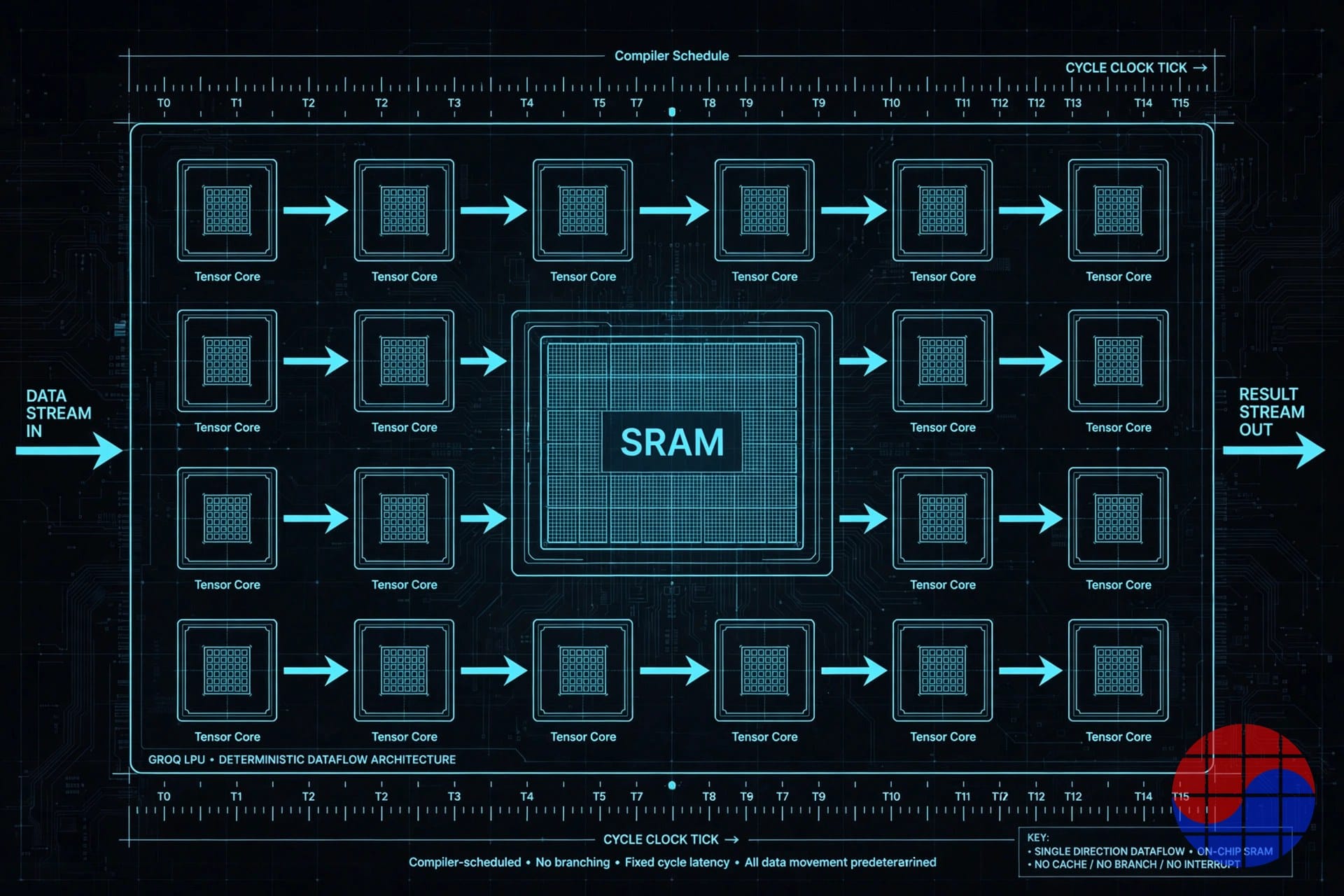
The LPU is a tensor streaming processor with a deliberately unusual design. Execution is scheduled by the compiler at compile time, not arbitrated by hardware at runtime. There is no dynamic scheduling, no cache hierarchy guessing what comes next. Every cycle is planned, so latency is not just low on average — it is deterministic, with minimal jitter. For chat, voice agents and agentic loops that chain thousands of sequential model calls, that predictability is the product.
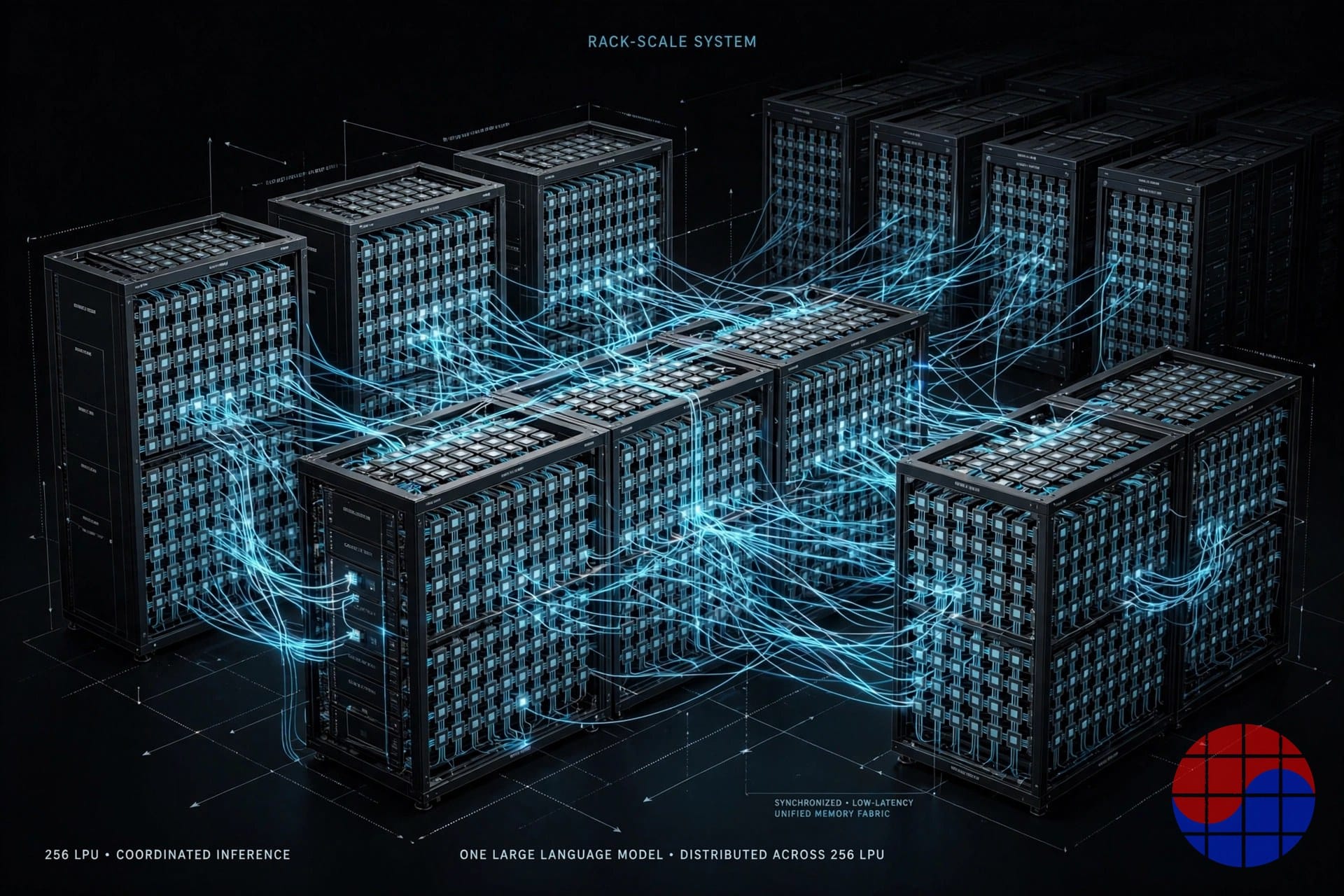
The memory design makes the same trade. Instead of external HBM, the first-generation LPU carries about 230 MB of on-chip SRAM as its primary memory, with roughly 80 TB/s of on-die bandwidth — an order of magnitude beyond the off-chip bandwidth of a flagship GPU. The cost of that choice is capacity: 230 MB cannot hold a production model, so hundreds of LPUs must operate as one coordinated machine. Serving a 70B-parameter model has historically meant a rack-scale system of several hundred chips. The computer is not the chip; the computer is the rack.
The first-generation LPU was manufactured by GlobalFoundries on a 14nm process — a mature node, chosen because the architecture wins on data movement, not transistor density. GroqCloud, launched as the company's hosted inference service, exposed the hardware through an OpenAI-compatible API serving open-weight models such as Llama, Qwen, Gemma and Whisper. Developer adoption compounded: about 360,000 developers in August 2024, more than 1.4 million by April 2025 when Meta chose Groq to serve the official Llama API, and a reported six million by 2026.
Geography followed demand for sovereign AI. In September 2024 Groq partnered with Aramco Digital in Saudi Arabia, brought the region's largest inference cluster online in Dammam in eight days in December 2024, and in February 2025 secured a $1.5 billion commitment from the Kingdom to expand LPU infrastructure. A first European data center followed in Helsinki with Equinix, alongside a sovereign AI factory with Bell Canada. By late 2025 Groq operated 13 data centers across North America, Europe, the Middle East and Asia-Pacific.
Business Deep Dive: Anatomy of a $3.5 Billion Reset
The funding timeline tells the story. In August 2024, Groq raised $640 million at a $2.8 billion valuation. In September 2025, it raised $750 million at $6.9 billion, led by Disruptive with BlackRock, Samsung and Cisco among the backers. Three months later came the Nvidia transaction. Then, in June 2026, Groq raised $650 million to fund its pivot — at an undisclosed valuation — and in August 2026 it closed a further $350 million, branded a Series A, at $3.5 billion. One billion dollars of new capital in about two months, at half the previous headline price.
Read the Nvidia deal carefully, because it defines what was sold and what was not. Announced on December 24, 2025, the transaction was structured as a non-exclusive license to Groq's inference technology, not an acquisition. Groq remained an independent company and GroqCloud kept running, under new CEO Simon Edwards. Court filings in a later shareholder lawsuit describe the reported $20 billion as roughly a $17 billion licensing fee shared among backers plus a $3 billion pool of Nvidia stock for engineers who moved — about 200 people, by the plaintiffs' estimate. Those are allegations in litigation, not court findings, and Groq has called the suit meritless. What is not disputed: the technology and the team that created it now work at Nvidia, where the Groq 3 LPU entered full production in August 2026 as the LPX accelerator inside the Vera Rubin platform — 256 LPUs and 128 GB of SRAM per liquid-cooled rack, with Nebius as the first deployment customer.
So what does the remaining Groq actually own? Three assets. First, an operating inference cloud: 13 data centers, roughly 54 MW of capacity, thousands of business customers and a developer base reported at six million, processing trillions of tokens per week. Second, distribution and trust: GroqCloud was an early, fast, OpenAI-compatible endpoint that developers already know, and in August 2026 Groq was certified as an NVIDIA Cloud Partner — it can now deploy Nvidia systems alongside its existing fleet. Third, sovereign and regional footholds, above all in Saudi Arabia, where governments want inference capacity inside their borders and are willing to fund it.
The revenue record is thinner than the valuation history. Third-party estimates put 2024 revenue at about $90 million. For 2025, Groq guided investors to more than $500 million — revised down from an earlier projection above $2 billion, with the shortfall attributed to data-center capacity constraints that pushed revenue into 2026. Investor documents reported at the time showed the cloud business running at a loss, with cloud revenue above $40 million against cloud expenses above $64 million in the period covered. In other words: demand was never the problem. Capacity, capital and unit economics were.
Now do the valuation math. Against the $500 million 2025 revenue guide — a target, not a reported result — $3.5 billion is 7x forward sales. Against the estimated $90 million of 2024 revenue, it is roughly 39x trailing sales. Neither multiple is absurd for AI infrastructure in 2026, and neither is comfortable for a capital-intensive cloud that must buy its next megawatts. The June and August rounds together injected $1 billion — close to 29% of the company's own post-money headline value — which tells you how much of the $3.5 billion story is capacity yet to be built rather than capacity already earning.
What must be true for $3.5 billion to work? Four things. (1) The expansion from 54 MW to more than 200 MW in 2027 must land on schedule and arrive utilized, not idle. (2) Token prices must fall slower than Groq's cost per token — the entire neocloud model is a spread between power-plus-hardware cost and the market price of inference, and that spread compresses every year. (3) Groq must keep anchor demand — sovereign programs, model makers and enterprise customers — now that its differentiation is operational rather than silicon-based. Its former chip advantage literally ships inside its largest partner's platform, available to rival clouds. (4) Nvidia must remain a partner rather than a squeeze: Nvidia is licensor, GPU supplier and prospective shareholder at once, which aligns incentives today and concentrates risk tomorrow.
The downside case is concrete, not hypothetical. GPU inference keeps getting cheaper per token as each Nvidia and AMD generation lands, and hyperscalers run inference on their own silicon — Google's TPU, Amazon's Trainium — at internal transfer prices no independent cloud can match on commodity workloads. Groq's defense is the latency-sensitive tier: real-time voice, agents and interactive code, where deterministic speed commands a premium and where capacity is sold out rather than discounted. If that tier stays scarce, $3.5 billion looks conservative next to a $20 billion technology license. If inference commoditizes uniformly, the remaining company is a mid-size cloud with expensive capital — and the reset will not be the last one. Regulatory risk also lingers: the Nvidia transaction has drawn reported antitrust scrutiny and shareholder litigation, either of which could reshape the relationship the new Groq depends on.
Chase's Take
The most misread number in this story is the $20 billion. It was not a valuation of Groq the company; it was the price of removing Groq the threat while absorbing Groq the technology — and of doing it in a structure that avoided a merger review. Nvidia paid roughly three times Groq's peak private valuation for a license and a team. That tells you the LPU architecture was worth more inside Nvidia's platform than the entire independent company built around it. Acquirers pay for distribution and roadmap control, not for elegance.
The second misread number is the $3.5 billion 'down round.' Comparing it with $6.9 billion is an apples-to-oranges error the headlines keep making. The September 2025 price valued a vertically integrated chip company with proprietary silicon, a founding team and a sovereign hardware pipeline. The August 2026 price values a cloud operator that licenses its differentiation from — and buys GPUs from — the same counterparty. Half the price for a fundamentally smaller claim on the industry's profit pool is not obviously a bargain, nor obviously a collapse. It is a repricing of a different asset.
As an infrastructure engineer, I find the technical lesson more durable than the financial one. Groq proved that deterministic execution and SRAM-first design are genuinely superior for decode-heavy inference — so superior that the dominant GPU vendor paid a record sum to own the idea and now builds it on an advanced process as a first-class part of its flagship platform. Architecture won. The company that invented it still had to become a cloud operator to survive. In semiconductors, inventing the better chip is only the first moat; owning the customer relationship and the balance sheet to deploy it at scale is the second, and it is the one that got repriced.
My verdict: $3.5 billion is a fair-to-full price for the remaining Groq, defensible only if the 200 MW build-out converts into contracted, utilized inference capacity through 2027. Watch three signals: disclosed anchor customers for the new capacity, whether the Nvidia equity participation actually closes, and token pricing in the real-time tier. If those three hold, the reset was the bottom. If capacity arrives before demand, this Series A will be remembered as a waypoint, not a floor.
Implications
For Nvidia: the LPX line turns a former rival's architecture into a platform feature, letting Nvidia sell deterministic decode alongside Rubin GPUs rather than lose latency-sensitive workloads to independent clouds. The reported regulatory and litigation overhang is the cost of that shortcut.
For independent inference providers: the Groq arc resets expectations. Proprietary silicon alone no longer guarantees an independent outcome; the viable endgames are becoming a cloud with contracted demand, being absorbed by a platform, or owning a niche the platforms cannot serve. Expect peers to emphasize signed capacity contracts over benchmark charts when they raise.
For hyperscalers and sovereign buyers: Groq's survival as an NVIDIA Cloud Partner shows the market bifurcating — platforms own the silicon roadmap, while regional and sovereign operators own permits, power and local trust. Saudi Arabia's $1.5 billion commitment bought exactly that layer.
For Korea: Samsung participated in Groq's September 2025 round, and the Groq 3 LPU inside Nvidia's LPX is reported to be manufactured by Samsung Electronics — a reminder that Korean foundry and memory suppliers monetize every side of the AI silicon contest, whoever wins the architecture war. Korean inference startups should read the $3.5 billion reset as the market's current price for a cloud pivot without proprietary silicon.
*Note on sources and limits: Groq is private. Revenue figures are third-party estimates or company guidance as reported at the time; the Nvidia transaction value is a reported figure — Groq's own announcement described a non-exclusive license without disclosing a price; litigation characterizations are the plaintiffs' allegations. Exchange rate used throughout: 1 US dollar = 1,400 Korean won.*
FAQ
What is Groq's latest valuation and when was it set?
Groq's latest reported valuation is $3.5 billion (about 4.9 trillion won), set by a $350 million round led by Disruptive that closed on August 17, 2026, with Nvidia planning to participate. It follows a $650 million raise in June 2026 at an undisclosed valuation, and it is roughly half the $6.9 billion valuation of September 2025 — a reset that reflects the company's transformation after the Nvidia licensing deal, not a like-for-like markdown of the same business.
Why did Nvidia pay a reported $20 billion if Groq was valued at $6.9 billion?
The December 24, 2025 transaction was a non-exclusive license to Groq's inference technology plus the hiring of founder Jonathan Ross, president Sunny Madra and much of the senior team — not an acquisition of the company. The reported $20 billion bought Nvidia the LPU architecture for its Vera Rubin platform (now shipping as the Groq 3 LPX) and removed its most credible independent inference rival, in a structure that did not require merger approval. Groq remained independent and kept operating GroqCloud.
What is an LPU and why is it faster than a GPU for inference?
The LPU (Language Processing Unit) is Groq's inference-only processor. It schedules all execution in the compiler ahead of time — deterministic execution with no runtime scheduling surprises — and uses about 230 MB of on-chip SRAM with roughly 80 TB/s of bandwidth as primary memory instead of external HBM. That makes token generation extremely fast and predictable. The trade-off is capacity: a single LPU cannot hold a large model, so hundreds of chips must work together as one system.
What does Groq sell now, after the Nvidia deal?
Groq now operates as an AI inference cloud (a 'neocloud'). GroqCloud serves open-weight models through an OpenAI-compatible API from 13 data centers, with a reported six million developers and trillions of tokens processed weekly. Certified as an NVIDIA Cloud Partner in August 2026, it is expanding from about 54 MW toward more than 200 MW of capacity in 2027, increasingly deploying Nvidia hardware alongside its existing LPU fleet, plus sovereign deployments such as its Saudi Arabia infrastructure program.
📩 Subscribe to VLSI Korea
Get our daily semiconductor deep-dives delivered to your inbox first. Free to subscribe.