VLSI Korea
Market Bulletin: RAMageddon — AI Data Centers Devour Memory as Smartphone Shipments Crash 20%
Global smartphone shipments crashed 20% YoY in Q3 2026 — the worst Q3 since 2012 — as AI data centers absorbed memory supply. Retail prices are up ~20% since January. Samsung's chip division posted a record KRW 89.2T profit while its device arm lost KRW 800B. Winners, losers, and what Q4 holds.


Market Bulletin: RAMageddon — AI Data Centers Devour Memory as Smartphone Shipments Crash 20%
October 15, 2026 — Global smartphone shipments fell 20% year on year in Q3 2026, the weakest third quarter since 2012, as the AI data-center buildout absorbed the memory supply phones depend on. Retail prices have climbed ~20% since January, pushing consumers to delay upgrades or buy refurbished, while Samsung reportedly cuts Q4 smartphone production by up to 30%. The same supercycle that handed Samsung's chip division a record KRW 89.2 trillion quarterly operating profit pushed its device division into an KRW 800 billion loss. This is RAMageddon: demand collapsing at the edge, funded by a boom at its core.
Key Highlights
- The shortage broke the quarter, not demand. Q3 shipments −20% YoY — worst Q3 since 2012 — on DRAM/NAND prices and shortages. (Edaily, JoongAng Ilbo, Channel News Asia)
- Share consolidated at the top. Samsung No. 1 at 23% (−3% YoY shipments, up from 19% share); Apple 22%, first Q3 above 20% (up from 18%). Xiaomi −30%+ to 10%; OPPO, vivo −20%+ each to 9%, 8%. (KBench)
- Sticker shock spreads. Retail prices +~20% since January; Galaxy S26 raised mid-cycle — ~KRW 150,000 more for the base in Korea, +$100 per model in the US. (JoongAng Ilbo, KBench)
- Samsung's double-edged sword. DS record KRW 89.2T Q2 operating profit vs. KRW 800B DX loss; Q3 DX loss estimated KRW 1.8–2.1T. (JoongAng Ilbo)
- Allocation is the binding constraint. Smaller makers face availability walls; scarcity seen through 2027. Samsung DS seeks 7–10% DRAM/NAND hikes from Chinese makers; Apple back at the table in Q4. (Reuters, GSMArena)
Market Update
The Q3 numbers landed in mid-October: global shipments down 20% YoY, the steepest Q3 decline since 2012. Not a demand story — consumers were priced out, not tuned out. With costs passed through, retail prices rose ~20% since January; buyers delayed upgrades, paid up for premium, or turned to refurbished.
The pain was strikingly unequal. Samsung's shipments fell just 3% YoY while share climbed 19%→23%, helped by early Galaxy Z Fold 8 demand and steady Galaxy A-series supply. Apple declined in absolute terms yet rose 18%→22% — its first Q3 above 20%. Xiaomi fell 30%+; OPPO and vivo 20%+ each. Budget phones carry thin margins and price-sensitive buyers: raise prices and lose volume, or hold prices and lose money. Samsung and Apple passed costs through premium mix; the Chinese brands could not.
Pass-through is now on shelves. On October 1, Samsung raised the Galaxy S26's Korean price seven months after launch — base 256GB from KRW 1,254,000 to KRW 1,403,600, Ultra 1TB up ~KRW 270,000. In the US, +$100 per model, +$200 for the Ultra 1TB. Apple priced the iPhone 18 Pro above its predecessor and raised iPhone 17 domestic prices. Mid-cycle hikes on shipping products signal cost pressure overwhelming the pricing calendar.
Behind the tags, the supply chain is being rewired for AI. Fabs prioritize high-margin HBM and server DRAM over smartphone LPDDR — some LPDDR5X diverted into AI servers — while NAND climbs on data-center demand. Memory is 20–50% of a phone/PC BOM, near 60% on ~$400 handsets: the spike detonates the low end first. Samsung DS seeks 7–10% DRAM/NAND increases from Chinese makers, Apple back at the table in Q4 — and Samsung's own MX gets no family discount, since DS and DX operate separately. The response is retrenchment: Samsung reportedly cutting Q4 output up to 30%, while smaller makers call availability, not price, the binding constraint.
| Brand | Q3 2026 shipments YoY | Q3 2026 market share |
|---|---|---|
| Samsung | −3% | 23% (up from 19%) |
| Apple | Down (figure undisclosed) | 22% (up from 18%; first Q3 above 20%) |
| Xiaomi | −30% or worse | 10% |
| OPPO | −20% or worse | 9% |
| vivo | −20% or worse | 8% |
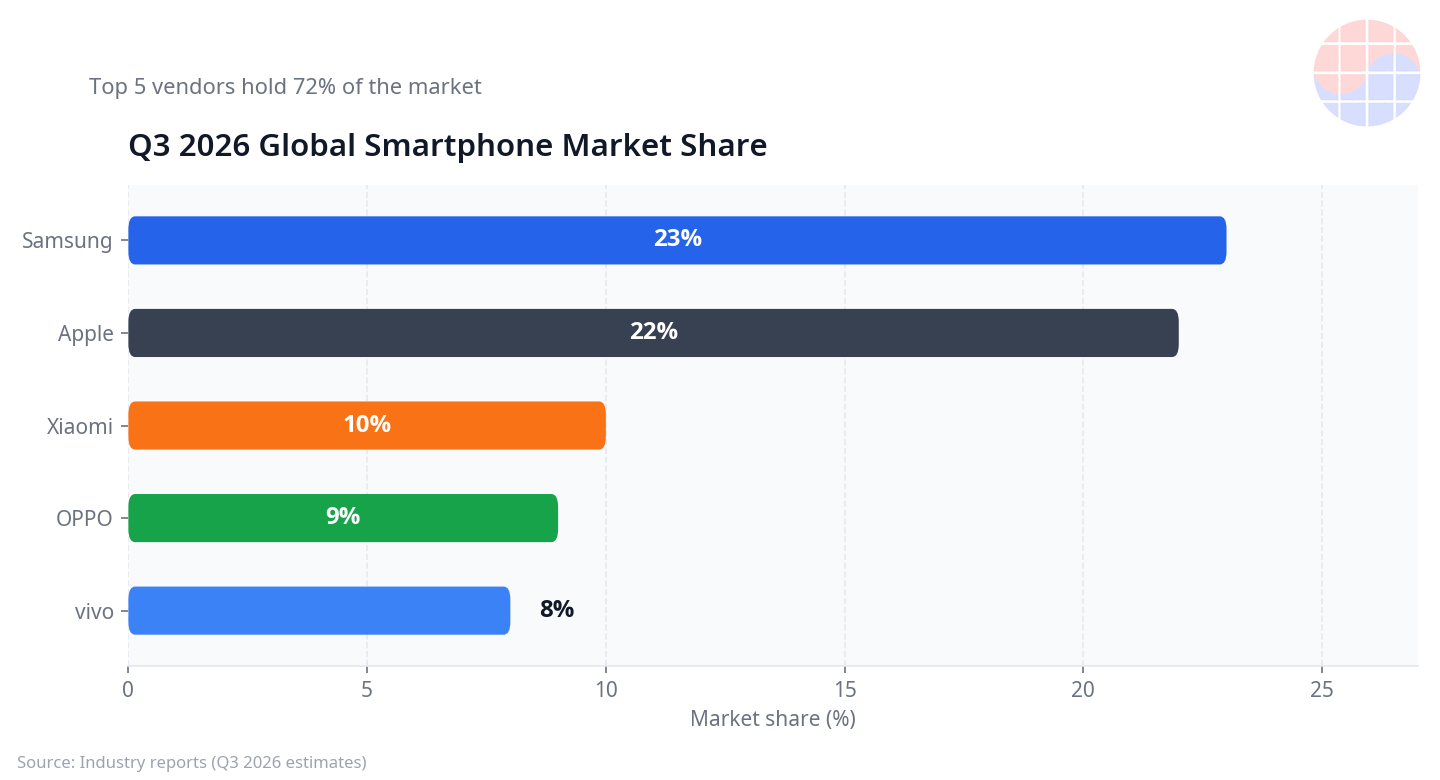
Figure 1: Q3 2026 brand shares (press-reported estimates). Samsung and Apple hold 45% of a shrinking market; Chinese brands retreat to the low end, where memory costs hurt most.
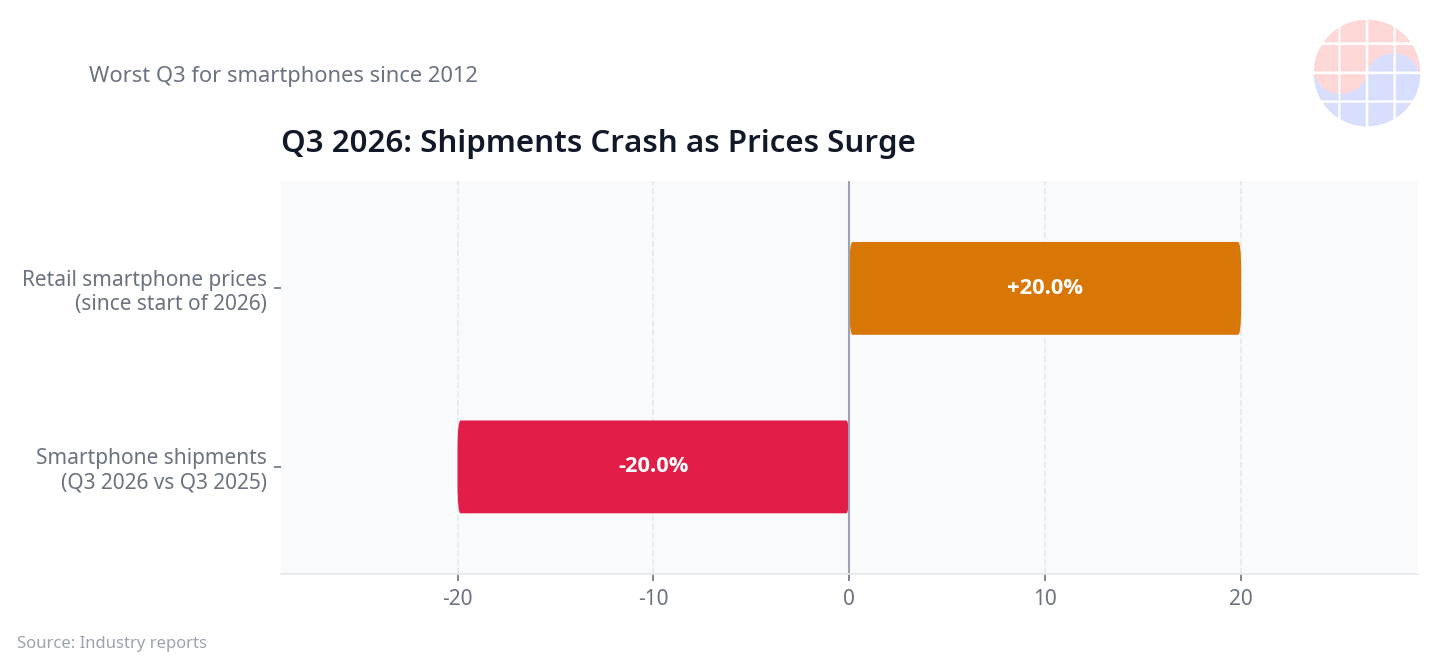
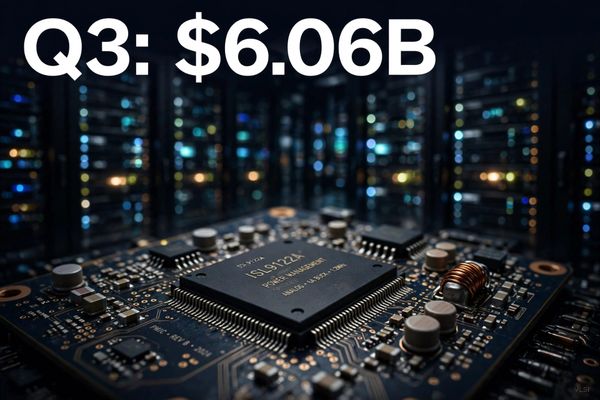
Figure 2: The Q3 2026 shipment shock — −20% YoY, weakest Q3 since 2012, driven by memory prices and shortages rather than collapsing demand.
VLSI's View
Memory has graduated from commodity to strategic allocation good. When fabs choose between a high-margin HBM stack for an AI cluster and a low-margin LPDDR package for a budget phone, the phone loses — now at industry scale. The smartphone downturn and the memory boom are one event seen from opposite ends: every gigabyte absorbed by a data center is a gigabyte repriced away from a handset.
Winners: memory suppliers first — Samsung DS just posted its largest quarterly profit ever; SK Hynix's HBM franchise confers similar pricing power. Apple and Samsung MX win relatively on premium mix; refurbished wins by default as cycles stretch. Losers: budget-first Chinese brands whose thin margins cannot absorb memory at up to half the BOM; small makers for whom allocation walls are existential; consumers facing ~20% higher prices with fewer affordable options.
The Korea angle is Samsung's double-edged sword. DS's record KRW 89.2 trillion Q2 operating profit (~KRW 127.5 trillion revenue) is the windfall; DX's KRW 800 billion Q2 loss — its first quarterly loss on record — is the cost, with KRW 1.8–2.1 trillion estimated for Q3. Separate P&Ls mean Samsung's phone business pays the same inflated prices as rivals: vertical integration is no shelter when upstream maximizes its own margin. SK Hynix sits on the trade's other side — its CEO warns 2027 would be the worst year from a supply perspective, demand outstripping capacity beyond 2030: forecast and pricing signal alike. For Korea, the supercycle is a national windfall concentrated in two companies and a national cost diffused across every device maker and consumer.
One check: not every signal points up. A European handset maker said its combined storage-and-DRAM package peaked at end-March and has held since, confounding forecasts of a doubling — a reminder that Q3 figures are preliminary press-reported estimates, and trajectories can bend if AI demand pauses or new supply arrives. The base case remains scarcity through 2027.
Chase's Take: I spend my days in STA signoff, and one rule has never changed: when a fab can choose between a high-margin HBM stack for an AI cluster and a low-margin LPDDR5X package for a budget phone, the phone loses. Every single time. This is not a demand crisis — it is an allocation crisis. Memory has become the strategic resource of the AI era, and the smartphone just got demoted from priority customer to price taker. The winners will be the companies that own supply — Samsung's DS division, SK Hynix with its HBM franchise — and brands like Apple and Samsung MX that can pass costs to premium buyers. Everyone else is negotiating for scraps. Holding a mid-range phone today? Keep it: the replacement will cost more and arrive later.
Outlook
- Q4 contract negotiations: Samsung DS seeks 7–10% DRAM/NAND increases from Chinese makers; Apple returns in Q4 with ~2x Samsung's and ~3x Xiaomi's buying volumes.
- Cuts vs. holiday demand: Samsung reportedly cutting Q4 output up to 30%; watch whether holiday demand absorbs higher prices or breaks.
- Shortage duration: press consensus: scarcity through 2027; SK Hynix's CEO warns on 2027 supply, some smaller makers see normalisation only from 2028. 2027 capacity additions are the key swing factor.
- The low-end question: sub-$200 smartphones face an existential squeeze; watch whether premium and refurbished keep absorbing the displaced demand.
- Allocation politics: with fabs structurally favoring AI infrastructure, the question for device makers is no longer price but secured supply.
FAQ
Q1: What exactly is "RAMageddon"?
A blend of RAM and Armageddon: runaway memory prices as AI data centers absorb DRAM and NAND supply. Fabs prioritize high-margin HBM and server DRAM, sending prices vertical — with memory at 20-50% of a phone's BOM, device economics detonate from the low end.
Q2: Why did global smartphone shipments fall 20% in Q3 2026?
Memory prices and shortages pushed retail prices up ~20% since January. Consumers delayed upgrades or bought refurbished; thin-margin budget brands — Xiaomi (-30%+), OPPO and vivo (-20%+ each) — took the worst of it, and Samsung is cutting Q4 output up to 30%.
Q3: How can Samsung post a record chip profit and a device loss in the same quarter?
DS and DX are separate businesses. DS sold memory at record prices (KRW 89.2T Q2 operating profit); DX, which buys that memory for phones and appliances, lost KRW 800B — its first quarterly loss on record. Even Samsung's own MX division pays the inflated prices.
Q4: When will the memory shortage end?
Press consensus: scarcity through 2027. SK Hynix's CEO warned 2027 would be the worst year from a supply perspective, demand outstripping capacity beyond 2030; some smaller makers expect normalisation only from 2028. Watch Q4 contract talks, where Samsung DS seeks 7-10% increases.
1 Shipment, share and price figures are preliminary press-reported estimates as of mid-October 2026 (Q3 data reported October 12–13); brokerage DX-loss estimates via the JoongAng Ilbo.