VLSI Korea
Why Micron Is Funding Mineral Refining: The Bottleneck Moves Outside the Fab
Micron is funding mineral refining in New York: strategic funding for Indium Corporation's Rome expansion, part of the up-to-USD 3B U.S. supply-chain plan, with a long-term supply agreement still planned, not signed. The USD 250B+ fab program is separate.


30-Second Summary
- On October 20, 2026, Micron announced an investment in critical minerals processing and high-purity materials manufacturing that supports the expansion of Indium Corporation in Rome, New York. The stated purpose is to restart domestic processing of critical minerals that advanced semiconductor manufacturing depends on.
- The money comes from a separate envelope: Micron's plan, announced in July 2026, to invest up to USD 3B to strengthen the U.S. semiconductor supply-chain ecosystem. This is not fab construction money. It is supply-chain money.
- The supply contract is not signed yet. Under the arrangement, the two companies will enter into a long-term supply agreement that gives Micron access to the high-purity minerals. It is a planned agreement, and this article treats it as one.
- Micron's chief procurement officer, Ben Tessone, framed the logic directly: advanced memory manufacturing depends on a reliable supply of critical minerals, and securing those inputs requires engagement well beyond direct suppliers.
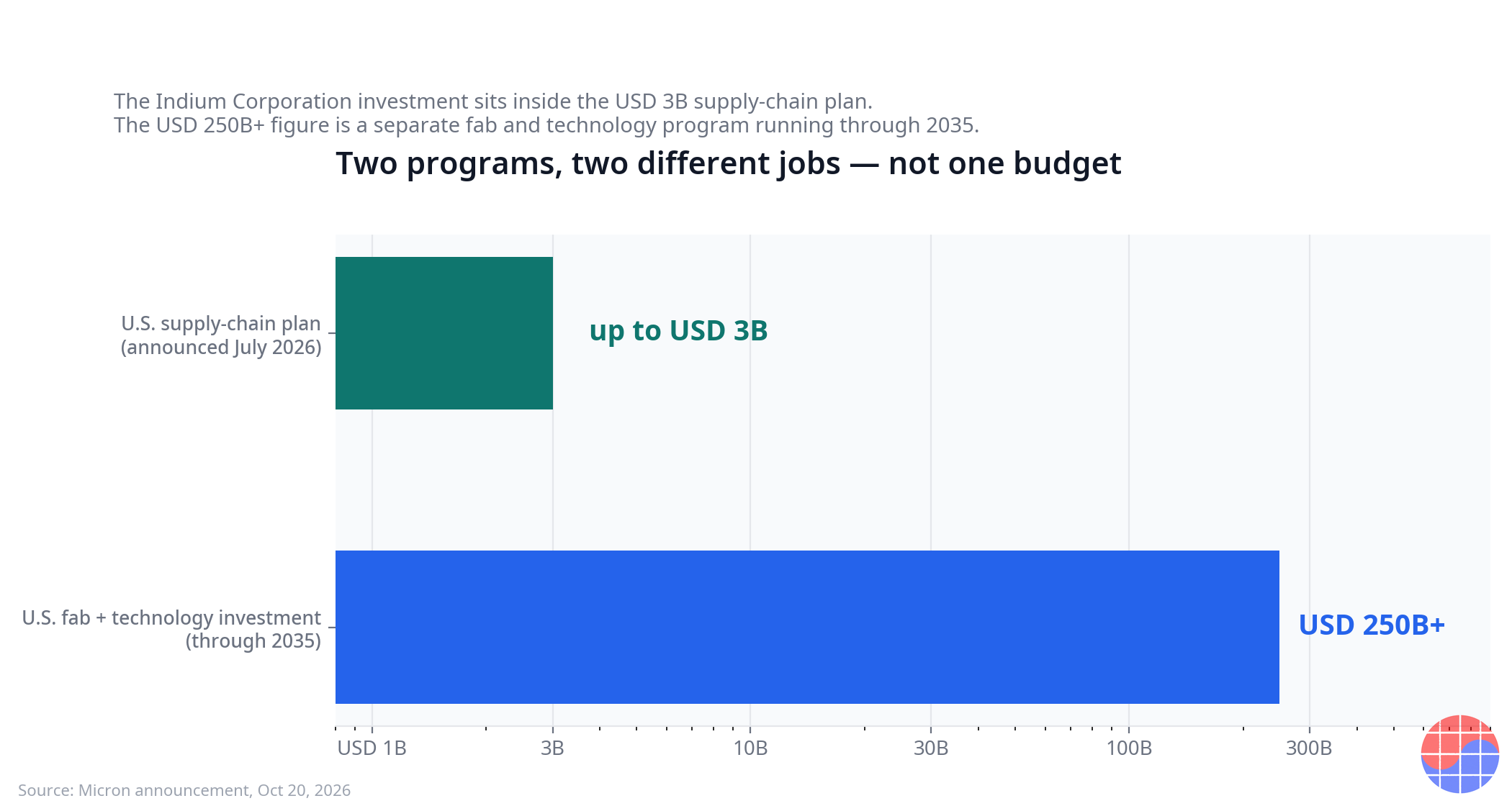
- A second, much larger number belongs to a different program. Micron plans to increase its U.S. fab and technology investment to more than USD 250B through 2035. The USD 3B supply-chain plan and the USD 250B+ manufacturing plan are separate programs with separate jobs, and they should never be merged into one headline figure.
Background
What was actually announced
Micron Technology (Nasdaq: MU) said on October 20, 2026 that it will provide strategic funding enabling Indium Corporation to expand its refining and manufacturing operations in Rome, in Central New York. The investment is expected to restart U.S. processing of critical minerals and expand domestic production of high-purity materials used in advanced semiconductor manufacturing.
| Item | Detail |
|---|---|
| Announcement date | October 20, 2026 |
| Investor | Micron Technology |
| Partner | Indium Corporation (headquartered in the U.S., 90+ years in Central New York) |
| Location | Rome, New York (Central New York) |
| Form | Strategic funding for refining and manufacturing expansion |
| Funding envelope | Part of Micron's plan, announced July 2026, to invest up to USD 3B in the U.S. semiconductor supply-chain ecosystem |
| Supply arrangement | A long-term supply agreement the companies will enter into — planned, not yet signed |
| Stated objective | Reduce reliance on concentrated global refining capacity; framed as a national security priority |
| Separate program | More than USD 250B of U.S. fab and technology investment through 2035 |
Source: Micron announcement, October 20, 2026. Link in the footnote.
Indium Corporation's materials portfolio includes indium, gallium, germanium and tin, along with solders, specialty alloys and inorganic compounds used across electronics and semiconductor production. These are not headline materials like silicon wafers or EUV photoresist. They are the quiet inputs — metals and compounds that sit underneath bonding, thermal management and device fabrication — whose absence stops a line just as completely as a missing wafer would.
Mining is not the bottleneck. Refining is.
Public debate about critical minerals usually stops at mining: who digs what, where. But a mine produces ore and concentrate, not semiconductor-grade material. Between the ground and a fab sits refining and purification — the step that turns concentrates into the high-purity metals and compounds a production line can actually consume.
That middle step is where capacity is concentrated. Mining supply is geographically dispersed; refining capacity for many critical minerals has pooled in a small number of locations over decades, because purification is energy-intensive, chemistry-heavy, permit-heavy and historically low-margin. When Micron says the investment is expected to reduce reliance on concentrated global refining capacity, it is naming that middle step precisely. The bottleneck in this supply chain is not the hole in the ground. It is the plant that cleans what comes out of it.
This is also why the announcement matters beyond its dollar size. A memory maker funding a refiner is an admission that building fabs onshore does not, by itself, onshore a supply chain. A fab in New York fed by refined materials from a concentrated overseas base is a partially built strategy: the most visible link is domestic, and the most fragile link is not.
One state, one cluster
The geography is deliberate. The expanded refining operation sits in Rome, New York — the same state as Micron's New York fab complex in Clay, which the Governor's office describes as the largest private investment in New York State history and which Micron says is months ahead of schedule. Refining, high-purity materials and wafer fabrication inside one regional cluster shortens qualification loops, cuts logistics risk and makes the materials base and the fab base reinforce each other. Clusters are not built by fabs alone; they are built when the upstream links move in next to the downstream ones.
Business Deep Dive
Two programs, two jobs — do not merge the numbers
The easiest mistake in covering this announcement is to add the two big numbers together or to treat the smaller one as a footnote of the larger. They are different instruments aimed at different layers of the stack.
| Program | Size | Horizon | What it buys |
|---|---|---|---|
| U.S. supply-chain ecosystem plan | Up to USD 3B | Announced July 2026; Indium investment is one deployment | Refining capacity, high-purity materials, supplier ecosystem depth |
| U.S. fab and technology investment | More than USD 250B | Through 2035 | Wafer fabs, technology development, manufacturing scale |
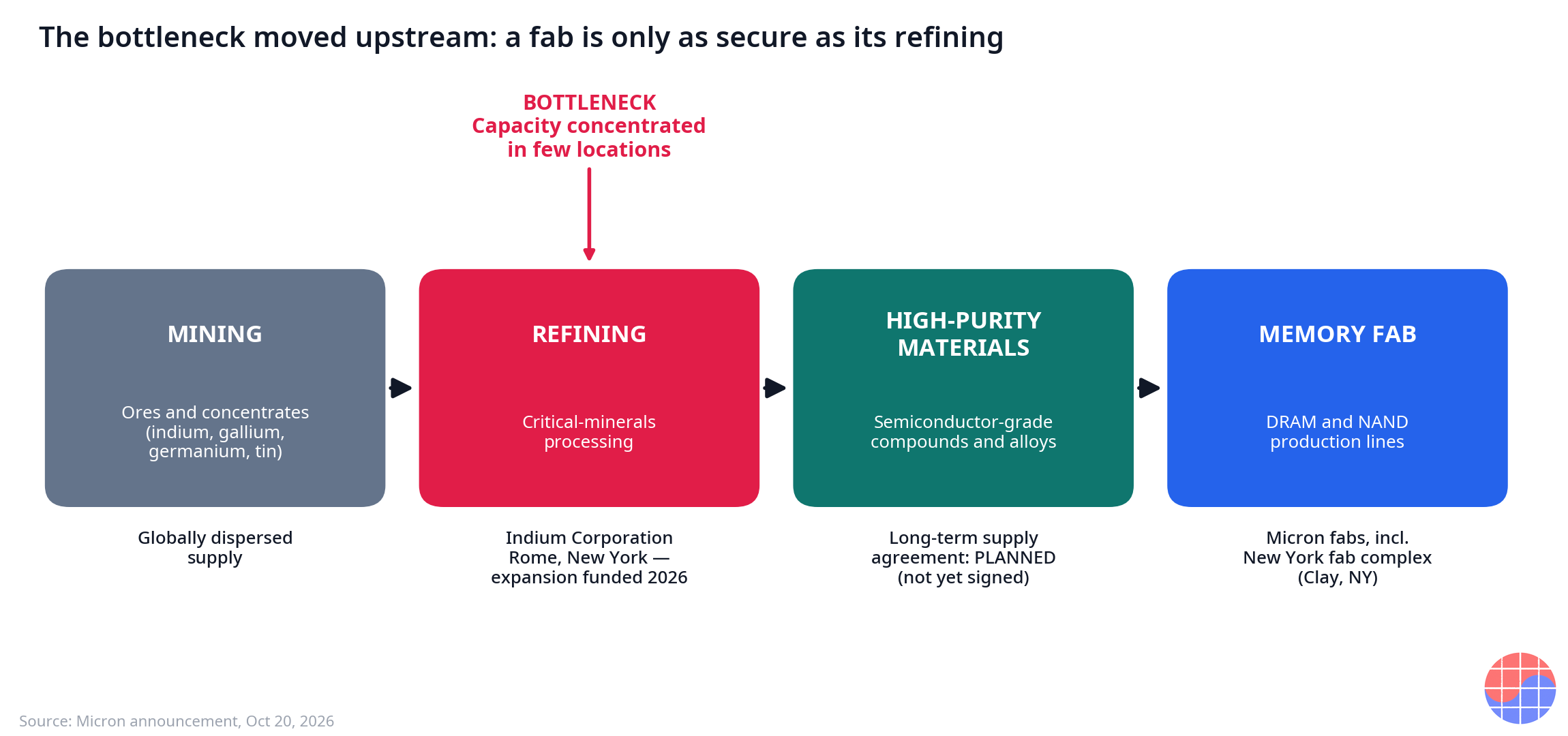
The USD 250B+ program builds the factories. The USD 3B program tries to make sure the factories can be fed. The first is roughly two orders of magnitude larger because fabs are among the most capital-intensive structures on earth. The second is strategically outsized relative to its size, because a single missing input can idle the output of the first. Capital allocation follows a simple asymmetry here: the cheapest link in the chain can hold the most expensive link hostage.
Funding plus a planned contract: quasi-vertical integration
Micron is not acquiring Indium Corporation, and it is not building its own refinery. The structure is lighter and, for this layer, smarter: strategic funding that expands the partner's capacity, paired with a long-term supply agreement the two companies will enter into, giving Micron access to the output.
That combination is quasi-vertical integration. Micron gets the two things vertical integration normally buys — capacity assurance and priority access — without owning an operation far outside its competence. Indium keeps its independence, its other customers and its 90-plus years of accumulated materials know-how, and gains a funded expansion anchored by a marquee customer's demand. Indium's president and CEO, Ross Berntson, framed the deal as trust in the company's people and delivery ability, and as an expansion of the supply of semiconductor-grade critical minerals for domestic manufacturing.
Note the sequencing, because it is the honest part of the announcement: the funding and the expansion intent are announced now; the long-term supply agreement is something the companies will enter into. Access is planned, not contracted. Anyone modelling this as secured volume today is one step ahead of the documents.
The CPO becomes a strategist
The most revealing quote in the announcement belongs to the procurement chief. Ben Tessone, senior vice president and chief procurement officer, said that advanced memory manufacturing depends on a reliable supply of critical minerals, that enabling that supply requires engagements well beyond direct suppliers, and that securing these inputs is essential to Micron's long-term growth and technology roadmap.
Read that as an org-chart statement. Procurement in a memory company used to mean negotiating price and terms with direct suppliers, tier one. Here the chief procurement officer is publicly justifying capital deployment two tiers upstream, into mineral processing, as a growth and roadmap issue. When the binding constraint on a business moves from price to physical availability, the purchasing function stops being a cost center and becomes a strategy function. The title on the quote — chief procurement officer, talking about the technology roadmap — is the tell.
There is a competitive logic too. Memory is a business where the three major producers buy many of the same inputs from many of the same suppliers. If refined critical minerals tighten, the producer with funded, contracted, geographically close capacity does not just pay less; it keeps lines running while rivals allocate. In commodity memory, uptime is share.
What Micron is not doing
Three clarifications keep this announcement in proportion.
First, Micron is not reshoring mining. The investment is in processing and high-purity materials manufacturing — the refining layer — which is where the concentration problem actually sits.
Second, the USD 3B is a ceiling ("up to") for an ecosystem plan, not a single check written to one company. The Indium investment is one deployment from that envelope; its individual size was not disclosed in the announcement.
Third, nothing in this announcement changes near-term memory supply. Refining expansions and supply agreements operate on multi-year timelines. The effect, if execution follows, lands in the same window as the New York fab ramp — which is precisely the point of pairing them.
The Korean mirror
Korean memory makers should read this announcement as a question addressed to them. Samsung Electronics and SK hynix run the same dependence structure: world-scale fabs at home and abroad, fed by a global base of refined materials and specialty chemicals whose capacity is also concentrated in a handful of locations. The Korean industry's traditional answer has been deep, long relationships with Japanese and domestic materials suppliers, plus strategic stockpiles. Micron's answer adds a new instrument: the chipmaker's own balance sheet, deployed upstream, in funding-plus-offtake form.
The question for Korean producers is not whether they face the same bottleneck — the structure of the refining layer guarantees they do — but which instrument fits: equity stakes in materials firms, funded expansions with planned offtake, or joint ventures. What is no longer credible, after this announcement, is treating the refining layer as somebody else's problem.
Chase's Take
The standard reading of this announcement is "Micron spends money in New York." The interesting reading is about where the semiconductor map is being redrawn.
For forty years, supply-chain thinking in chips stopped at the fab gate. What happened upstream was the suppliers' world: you issued purchase orders, negotiated, and assumed availability. That assumption died in stages — export controls, logistics shocks, and now the plain arithmetic of concentrated refining capacity. Micron's announcement is the moment a top-three memory maker says, in public and with its procurement chief's name attached, that the assumption is over.
Notice what the company chose to fund: not the mine, not the fab — the unglamorous middle. Refining has no ribbon-cutting glamour and no node names. It also happens to be the step where the world's capacity is thinnest relative to its importance. Strategy is often just the discipline of funding the boring bottleneck before it prices itself. USD 3B is small next to USD 250B. That ratio is the insight: the insurance premium on the entire domestic manufacturing program is about one percent of the program, and until this week, almost nobody was paying it.
The planned-but-unsigned supply agreement is the detail to watch. If it converts into a signed long-term contract with real volume, this becomes the template: chipmakers as anchor financiers of their own upstream. If it lingers, the announcement was positioning. Either way, the direction of travel is set — the boundary of the firm in semiconductors is moving upstream, one layer at a time.
Implications
- For memory competitors: the input-assurance race is now explicit. Funded refining capacity plus a long-term supply agreement is a template Samsung Electronics and SK hynix will be measured against, in Seoul as much as in Boise.
- For materials and refining companies: chipmakers have arrived as anchor financiers. A credible expansion plan with a marquee customer's funding and planned offtake is now a financeable structure, not just a hope.
- For policymakers: fabs attract the subsidies and the headlines, but this announcement argues the refining layer is where domestic capacity is scarcest. Support aimed only at wafer fabs leaves the chain's thinnest link foreign.
- For investors: separate the programs. The USD 3B supply-chain plan is strategic insurance inside the USD 250B+ manufacturing decade; judge it on whether the planned supply agreement gets signed and the Rome expansion gets built, not on headline addition.
- For the New York cluster: refining in Rome, fabs in Clay — the cluster thesis strengthens when upstream links co-locate with downstream ones. Watch whether other materials suppliers follow into the same region.
FAQ
What exactly did Micron announce on October 20, 2026?
Micron announced an investment in critical minerals processing and high-purity materials manufacturing that supports Indium Corporation's expansion of its refining and manufacturing operations in Rome, New York, restarting domestic processing of critical minerals for advanced semiconductor manufacturing. The investment is part of Micron's plan, announced in July 2026, to invest up to USD 3B to strengthen the U.S. semiconductor supply-chain ecosystem.
Is the long-term supply agreement between Micron and Indium Corporation already signed?
No. Under the arrangement announced on October 20, 2026, the two companies will enter into a long-term supply agreement that gives Micron access to the high-purity minerals. It is a planned agreement — announced as a future step, not a signed contract — and should be modelled as intended access rather than contracted volume.
How is the USD 3B plan different from the USD 250B+ figure in the same announcement?
They are separate programs. The up-to-USD 3B plan, announced in July 2026, funds the U.S. supply-chain ecosystem — refining, high-purity materials and supplier depth. The more-than-USD 250B figure is Micron's planned U.S. fab and technology investment through 2035. One feeds the factories; the other builds them. Adding them into a single headline number misrepresents both.
Why does refining matter more than mining for chip supply security?
Mines produce ore and concentrates, not semiconductor-grade inputs. Refining and purification convert those concentrates into the high-purity metals and compounds a fab can use, and that processing capacity is the concentrated layer of the chain. Micron's announcement states the goal directly: reduce reliance on concentrated global refining capacity. A domestic fab fed by foreign refining is only a partially domestic supply chain.
Source: Micron announcement, October 20, 2026 — investment in New York critical minerals processing with Indium Corporation. This article is analysis, not investment advice.
📩 Subscribe to VLSI Korea
Get our daily semiconductor deep-dives delivered to your inbox first. Free to subscribe.