VLSI Korea
Market Bulletin: 600,000 Capacitors in One Rack — AI Servers Make MLCCs a Strategic Bottleneck
Samsung Electro-Mechanics has locked in KRW 3.9 trillion of long-term MLCC deals as one AI rack now needs up to 600,000 capacitors. VLSI maps the volumes, the price increases, and who controls supply.


The smallest part in the AI server has become one of its tightest bottlenecks. Samsung Electro-Mechanics disclosed on October 6, 2026 that it had signed a KRW 290 billion (about USD 210 million) long-term agreement to supply multilayer ceramic capacitors (MLCCs) for AI servers through 2027 — its sixth such deal of the year, lifting disclosed long-term contracts since May to about KRW 3.9 trillion. An AI server rack can carry up to 600,000 MLCCs, more than ten times a conventional server, and buyers are now locking in that supply a year or more ahead. The component once bought on spot markets is being contracted like HBM.
Key Highlights
- KRW 3.9 trillion locked in: Samsung Electro-Mechanics' October 6 contract (KRW 290 billion, deliveries January 1 to December 31, 2027) is its sixth long-term supply agreement disclosed in 2026; cumulative disclosed long-term deals for AI components, including silicon capacitors and inductors, now total about KRW 3.9 trillion — more than a third of the company's 2025 consolidated revenue of KRW 11.31 trillion (ChosunBiz, Oct 6, 2026; Maeil Business Newspaper, Oct 2026).
- 600,000 per rack: a single AI server rack uses up to 600,000 MLCCs — more than 10 times a conventional server — with 15,000 to 25,000 MLCCs in each AI server, because accelerators draw heavy, fluctuating current that must be stabilized at high temperature and high voltage (ChosunBiz; BigGo Finance, Murata coverage).
- Over 40% share at the top end: Samsung Electro-Mechanics says it holds more than 40% of the global AI-server MLCC market, and it has signed long-term agreements with more than 10 global customers (ChosunBiz, Oct 6, 2026).
- Orders are outrunning capacity in Japan too: Murata's total orders in April–June 2026 reached JPY 673.9 billion, up 56.3% year over year to a quarterly record, while capacitor orders rose 85.5% to JPY 415.5 billion; its book-to-bill ratio hit 1.34, the seventh straight quarter above 1 (BigGo Finance, on Murata's July 31, 2026 results).
- Prices are following volume: distribution prices for IT MLCCs have already risen by an average of about 30%, direct-sale IT products have been in negotiation for similar increases since June, and AI data-center MLCCs are being negotiated individually at around 20% higher, according to brokerage analysis of the supply chain (Financial News, Sep 1, 2026).
Market Update
MLCCs store charge and release it instantly next to a processor, smoothing voltage and suppressing noise. That job scales with power: every GPU and accelerator added to a board adds decoupling demand around it, and AI boards run hotter, denser, and closer to their electrical limits than general-purpose servers. The result is a step-change in content per system — and a specification change, not just a volume change. AI-server MLCCs must hold high capacitance in small cases while surviving continuous high-temperature, high-voltage operation and board-flex stress.
| Conventional server | AI server | |
|---|---|---|
| MLCCs per rack | Baseline (1x) | Up to 600,000 — more than 10x |
| MLCCs per server | Low thousands | 15,000–25,000 |
| Key requirements | Standard capacitance and reliability | High capacitance, high reliability, high-temperature and high-voltage endurance |
| How supply is bought | Spot and short-term orders | Multi-year long-term agreements; Samsung Electro-Mechanics alone discloses 10+ LTA customers |
| 2026 pricing direction | Broadly flat outside AI grades | Rising — about 20% in individual AI data-center negotiations; about 30% already in IT distribution |
Counts and requirements: Samsung Electro-Mechanics disclosures via ChosunBiz (Oct 6, 2026) and Murata coverage via BigGo Finance. Pricing: brokerage channel checks via Financial News (Sep 1, 2026). Per-server conventional counts are described qualitatively in the sources; the 10x rack-level ratio is the disclosed figure.
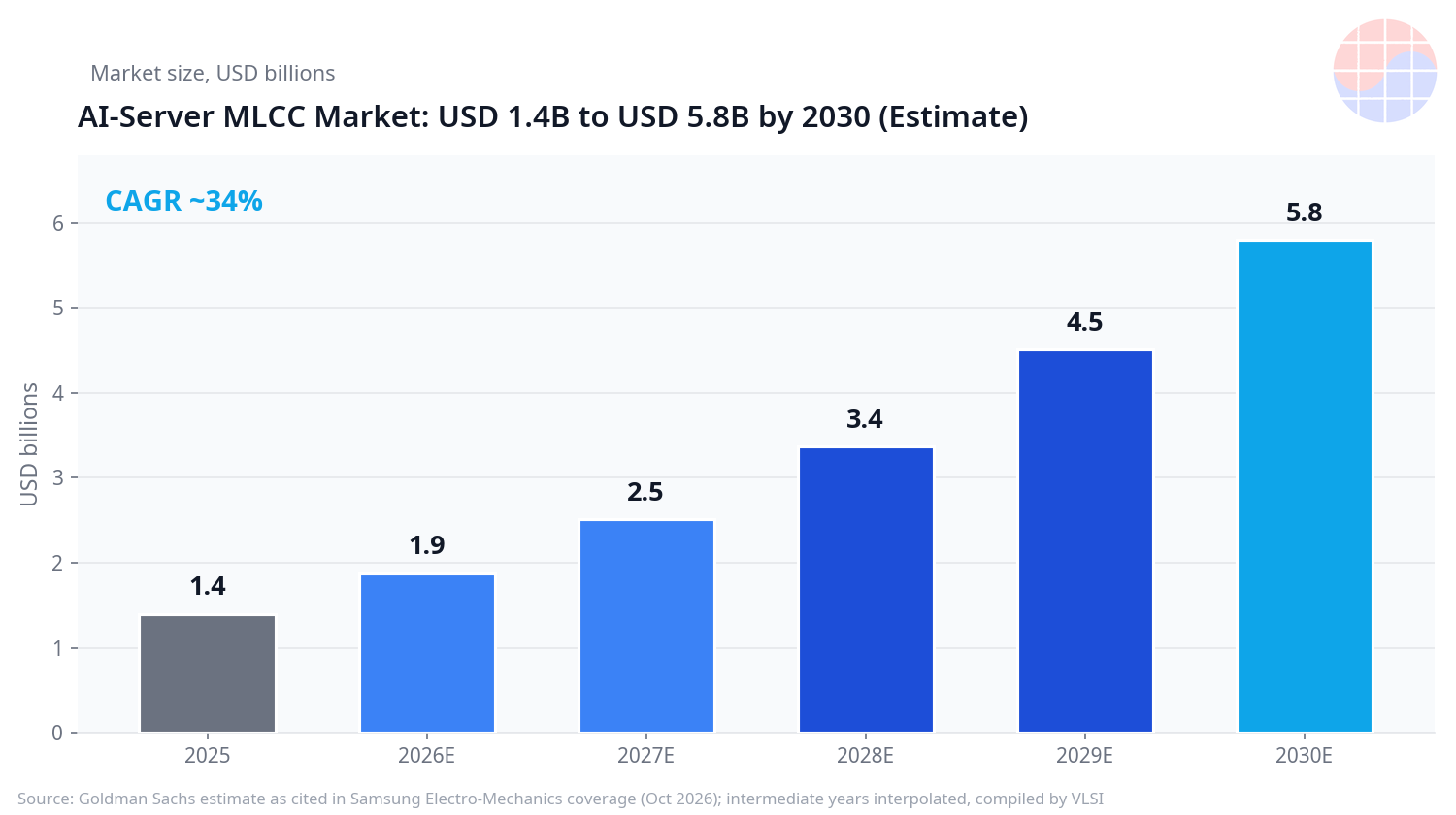
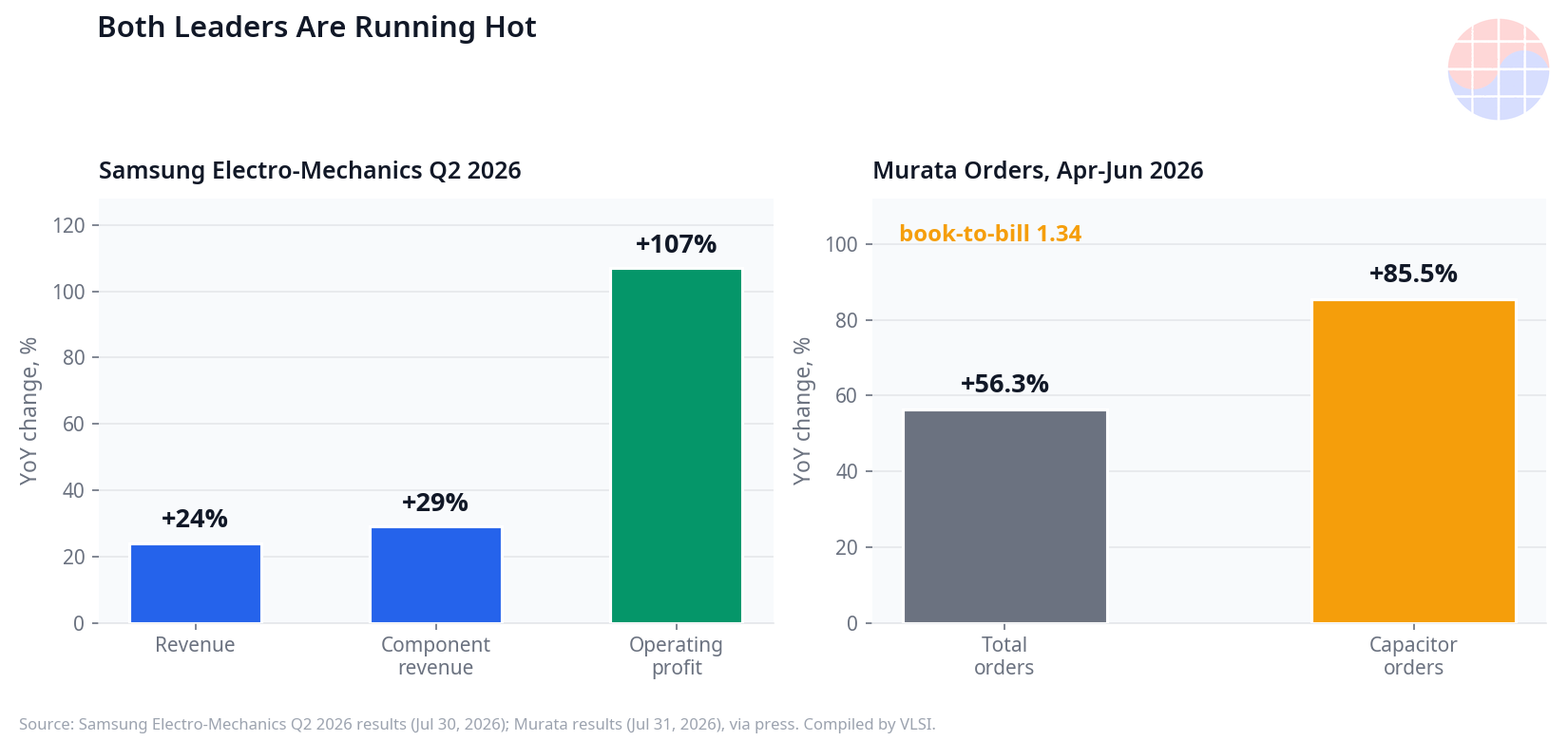
The earnings print already shows the mix shift. Samsung Electro-Mechanics reported Q2 2026 revenue of KRW 3.4572 trillion, up 24% year over year, and operating profit of KRW 440.4 billion, up 107% — with its component division, which houses MLCCs, up 29% to KRW 1.6494 trillion on data-center and automotive demand (BigGo Finance, on the July 30, 2026 earnings release). On the demand side, the AI-server MLCC market itself is estimated to grow from USD 1.4 billion in 2025 to USD 5.8 billion in 2030 — about 34% a year (Goldman Sachs estimate, as cited in company coverage). Murata, the other volume leader, says its Izumo plant was originally expected to reach full capacity in 2030 and may now get there this year, and that it is turning down some orders it cannot fill (BigGo Finance). When both leaders are sold out on the same component, the constraint is structural, not a stocking cycle.
VLSI's View
MLCCs are going through the HBM playbook. A commodity part becomes strategic when three things happen at once: content per system jumps by an order of magnitude, only a handful of suppliers can meet the top specification, and buyers respond by signing long-term agreements that convert spot demand into contracted backlog. All three are now visible in AI-server MLCCs. The KRW 3.9 trillion of disclosed long-term deals at one supplier — against KRW 11.31 trillion of prior-year revenue — is the clearest signal that purchasing behavior has changed, not just purchasing volume.
The winners are decided by qualification, not by headline capacity. High-capacitance parts at AI-server reliability grades are a materials and process game — ceramic powder formulation, thin-layer stacking, and yield at volume. That is why the supply response is slow: Murata describes even its accelerated expansion as insufficient, and new high-end lines take years to qualify. Suppliers of consumer-grade parts gain only second-order relief, as premium capacity absorbs factory resources and mainstream supply tightens behind it — the same spillover pattern seen when wafer capacity moved toward HBM.
For Korea, this is a second AI-infrastructure franchise after memory. Samsung Electro-Mechanics' stated share of more than 40% in AI-server MLCCs, its 10-plus long-term customers, and a component division growing 29% year over year put a Korean supplier at the center of a non-memory bottleneck for the first time in this cycle. The exposure is also a hedge inside the Korean tech complex: MLCC demand follows data-center power and board complexity, not handset units.
Chase's Take: In signoff work, the failures that hurt are never the headline blocks — they are the small cells everyone assumed were abundant. MLCCs are the standard cells of the AI buildout: individually trivial, collectively on the critical path. A rack that needs 600,000 of them does not have a capacitor problem; it has a supply-chain design problem. The long-term agreements are the industry admitting exactly that.
Outlook
- Japanese suppliers' pricing: Murata and its domestic peers have so far held list prices while Korean and other suppliers raised theirs; a Japanese move would confirm an industry-wide upcycle rather than a single-company adjustment.
- Contract coverage for 2027: Samsung Electro-Mechanics says discussions with additional global customers are ongoing; watch whether disclosed long-term volume grows beyond the current KRW 3.9 trillion before year-end.
- Capacity timing: Murata's Izumo ramp and any new high-end line announcements set the earliest date at which the shortage can ease; qualification, not construction, is the long pole.
- Spillover to consumer grades: if premium lines keep absorbing capacity, mainstream MLCC pricing for phones and PCs rises next — the cost pressure then lands on device makers already absorbing higher memory prices.
FAQ
Why does an AI server need so many MLCCs? Each accelerator draws heavy, rapidly fluctuating current, and MLCCs sit next to the chip to stabilize voltage and filter noise. An AI server carries 15,000–25,000 MLCCs and a full rack up to 600,000 — more than ten times a conventional server (Samsung Electro-Mechanics disclosures, October 2026).
How big is the AI-server MLCC market? It is estimated at USD 1.4 billion in 2025, growing to USD 5.8 billion by 2030 — roughly 34% compound annual growth (Goldman Sachs estimate, as cited in Samsung Electro-Mechanics coverage, October 2026). Samsung Electro-Mechanics states its share of this market is above 40%.
Why are MLCC prices rising in 2026? Demand from AI data centers is absorbing high-end capacity faster than suppliers can qualify new lines, so suppliers are raising prices and shifting resources toward premium grades. Distribution prices for IT MLCCs are up about 30% on average, and AI data-center parts are being negotiated around 20% higher (brokerage channel checks, September 2026).
Who supplies MLCCs for AI servers? The high end is concentrated: Murata is the global volume leader in MLCCs overall, and Samsung Electro-Mechanics states it leads the AI-server segment with a share above 40% and long-term agreements with more than 10 global customers. Both reported record order momentum in 2026.