VLSI Korea
The Bottleneck Moves Down: MLCC and Substrate Shortages and the Economics of Oligopoly
The AI bottleneck has moved down to MLCCs and substrates: 32-week MLCC lead times vs 12 normal, FC-BGA at 48-56 weeks, Samsung Electro-Mechanics Q3 consensus operating profit up 134%, LTAs with 10 hyperscalers and over 70% of substrate expansion customer-financed.


30-Second Summary
- The AI hardware bottleneck has moved down the value chain. After GPUs, HBM and advanced packaging, the binding constraint is now MLCCs (multilayer ceramic capacitors) and package substrates — the passive and carrier layers every AI server board depends on. (Source)
- Lead times say it plainly. MLCC lead times have stretched to 32 weeks against a normal 12 weeks. FC-BGA package substrates are at 48–56 weeks against a normal 12 weeks — described as the most severe shortage among IT components. (Source)
- The earnings are following the bottleneck. Samsung Electro-Mechanics' Q3 consensus is operating profit of KRW 526.9 billion, up 134% year on year, on revenue of KRW 3.8264 trillion, up 34%. The stock closed at KRW 1,174,000 on October 19, with target prices around KRW 2.41 million. (Source)
- Customers are pre-paying for capacity. Samsung Electro-Mechanics holds long-term agreements (LTAs) with 10 global hyperscalers and chip firms, booked roughly KRW 4 trillion of MLCC-related orders for the second half including silicon capacitors, and more than 70% of substrate expansion is reportedly financed by customer advances. (Source)
- Capital is being packaged around the theme. Two new Korean ETFs list within a week of each other — one on October 20 (Murata 19%, Unimicron 17%, Samsung Electro-Mechanics 17%) and one on October 13 (Murata 25%, Samsung Electro-Mechanics 25%, Taiyo Yuden 15%, LG Innotek 15%) — both built from the same 13 Korean, Japanese and Taiwanese MLCC and substrate makers.
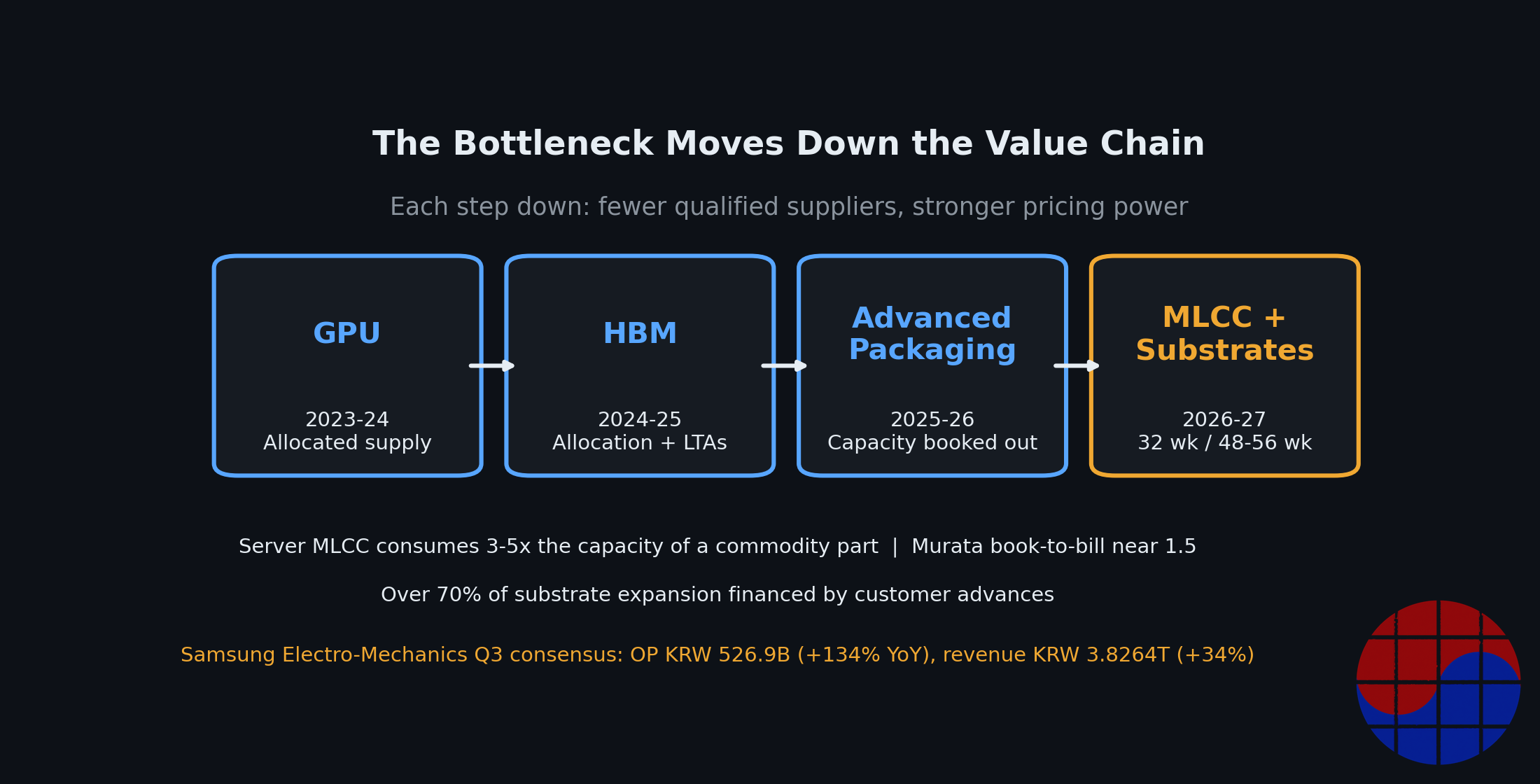
- Core judgment: when a bottleneck moves down the chain, the number of qualified suppliers shrinks and pricing power concentrates. A server-grade MLCC consumes 3–5x the production capacity of a commodity part, and Murata's book-to-bill ratio is approaching 1.5 — orders running 50% ahead of shipments. This is an oligopoly repricing, not a commodity cycle blip.
Background: The Constraint Nobody Was Watching
For three years, the AI buildout had a familiar list of scarce things. GPUs were allocated. HBM was allocated. Advanced packaging capacity was allocated. Every one of those constraints sat at the top of the value chain, inside products that cost thousands of dollars and carried famous brand names. The layers underneath — the capacitors that stabilize power delivery on a server board, and the substrate that carries the package — were treated as plumbing: cheap, plentiful, and somebody else's problem.
That assumption expired in October 2026. Reporting on October 19 described the shortage in MLCCs and substrates as the most severe among IT components, with MLCC lead times at 32 weeks against a normal 12, and FC-BGA substrates at 48–56 weeks against a normal 12. A lead time is the cleanest shortage signal in electronics because it cannot be spun: it is the queue, measured in weeks, between an order and a delivery. When the queue for a passive component approaches eight months, and the queue for a package substrate approaches a full year, the constraint is no longer at the top of the chain. It has moved down, into the layers that every board needs in volume.
The demand side explains why. An AI server is not one accelerator; it is a dense board of accelerators, memory, networking and power stages, and each of those stages needs high-specification MLCCs for power integrity. Server-grade MLCCs are not commodity parts with a different label. They are larger, tighter-tolerance, higher-reliability components, and producing them consumes 3–5x the production capacity of a standard part. That single ratio is the hinge of the whole story: even if unit demand merely doubled, effective capacity demand would multiply several times over, because each server part eats the line time of three to five commodity parts.
Supply, meanwhile, is concentrated by design. High-end AI server components can be supplied by Samsung Electro-Mechanics and only a small number of Japanese manufacturers — an oligopoly structure, not a competitive fringe. Murata, the industry's largest MLCC maker, is running a book-to-bill ratio approaching 1.5, meaning orders are arriving roughly 50% faster than shipments leave. Book-to-bill at 1.5 is not a forecast. It is a queue forming in real time.
One clarification matters before going further. This shortage is about the economics of today's production — lead times, capacity allocation and contract structures for existing MLCC and FC-BGA technology. It is a different subject from next-generation glass-core substrate technology, which concerns a future materials transition rather than the current shortage. Confusing the two leads to bad analysis: one is a 2026–2027 cash-flow story, the other is a late-decade technology story.
Business Deep Dive
1. Lead Times: The Queue Is the Data
| Component | Current lead time | Normal lead time | Stretch |
|---|---|---|---|
| MLCC | 32 weeks | 12 weeks | ~2.7x |
| FC-BGA package substrate | 48–56 weeks | 12 weeks | ~4.0–4.7x |
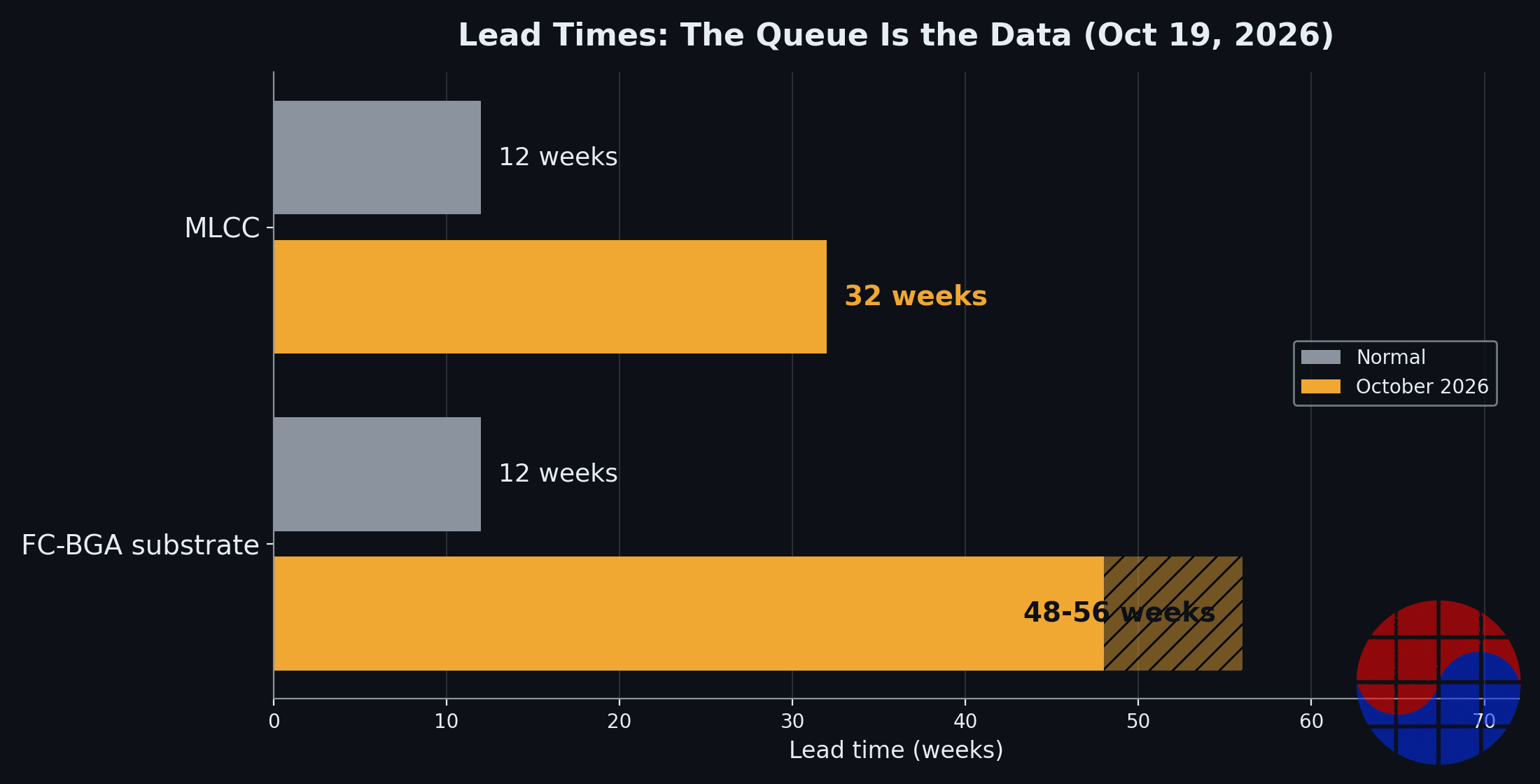
Source: Industry reporting, October 19, 2026. (Source)

Lead times versus normal levels. FC-BGA substrates show the deepest stretch in the chain.
Read the table as a map of where scarcity rents now sit. A 32-week MLCC queue means a server maker planning a mid-2027 build needed its capacitors ordered in late 2026. A 48–56-week substrate queue means package capacity for late 2027 was effectively being decided a year in advance. At those horizons, spot purchasing stops working as a strategy. The only instruments that function are allocation, long-term agreements and prepayment — which is exactly the contract behavior now visible across the chain.
2. Samsung Electro-Mechanics: The Consensus Repricing
| Item | Figure | Note |
|---|---|---|
| Q3 operating profit (consensus) | KRW 526.9 billion | +134% YoY |
| Q3 revenue (consensus) | KRW 3.8264 trillion | +34% YoY |
| Share price, Oct 19 close | KRW 1,174,000 | — |
| Target prices | Around KRW 2.41 million | Broker consensus range |
| H2 MLCC-related orders | Approx. KRW 4 trillion | Including silicon capacitors |
| 2027 MLCC volume within that | Approx. KRW 2.4 trillion | Forward-booked demand |
| Substrate supply contract (Oct 19) | KRW 360.5 billion (USD 267.3M) | Delivery Jan 1 – Dec 31, 2027 |
| Contract size vs 2025 revenue | 3.2% | Customer undisclosed |
Source: Consensus data and company disclosure reporting, October 2026. (Source) (Source)
Three things stand out. First, the profit elasticity: revenue up 34% but operating profit up 134% is the signature of mix shift into high-end parts plus pricing power, not volume alone. Second, the forward book: roughly KRW 4 trillion of second-half MLCC-related orders including silicon capacitors, with about KRW 2.4 trillion of that being 2027 MLCC volume, means a large share of next year's high-end output is already spoken for before the year begins. Third, the October 19 substrate contract — KRW 360.5 billion (USD 267.3M), deliveries across calendar 2027, equal to 3.2% of 2025 revenue, customer undisclosed — shows substrates being contracted on the same forward basis as the capacitors.
The market has noticed. A close of KRW 1,174,000 on October 19 with target prices around KRW 2.41 million implies analysts see roughly a doubling path — aggressive, but it is a target built on contracted volume and an oligopoly mix, not on hope about a spot price.
3. The Contract Structure: LTAs and Customer-Funded Capacity
The most important numbers in this story are not prices. They are contract terms.
| Mechanism | Evidence | What it does |
|---|---|---|
| Long-term agreements | LTAs with 10 hyperscalers and chip firms | Locks volume and allocation years ahead |
| Book-to-bill | Murata approaching 1.5 | Orders 50% ahead of shipments |
| Customer advances | Over 70% of substrate expansion financed by customer advances | Shifts expansion risk to buyers |
| Capacity intensity | Server MLCC consumes 3–5x commodity capacity | Shrinks effective supply per unit of demand |
Source: Company and industry reporting, October 2026. (Source) (Source)
Capacity reservation competition — the dynamic that defined HBM allocation — has now reached passive components. When more than 70% of substrate expansion (in the context of Samsung Electro-Mechanics' Sejong and Vietnam substrate build-out) is financed by customer advances, the supplier's balance sheet is no longer carrying the cycle risk of the expansion. The customer is. That is a structural change in who bears demand risk, and it only happens when buyers believe the shortage will outlast the construction period. Nobody prepays 70% of a factory to hedge a two-quarter blip.
LTAs with 10 hyperscalers and chip companies complete the picture. The buyers are not distributors or handset makers; they are the owners of the AI buildout itself, contracting directly for the passive layer. When the end customer of the entire chain signs long-term paper for capacitors and substrates, the bottleneck has been formally acknowledged by the people with the best demand visibility in the industry.
4. The ETF Wrapper: The Theme Becomes Tradable
| ETF launch | Manager type | Top disclosed weights |
|---|---|---|
| October 20, 2026 | Mirae Asset | Murata 19%, Unimicron 17%, Samsung Electro-Mechanics 17% |
| October 13, 2026 | Kiwoom | Murata 25%, Samsung Electro-Mechanics 25%, Taiyo Yuden 15%, LG Innotek 15% |
Source: Fund launch reporting, October 2026. (Source)
Two asset managers launched near-identical products a week apart, each holding 13 Korean, Japanese and Taiwanese MLCC and substrate makers. The overlap is the information: independent product teams, looking at the same chain, converged on the same short list — Murata and Samsung Electro-Mechanics anchor both funds, with Unimicron, Taiyo Yuden and LG Innotek filling out the substrate and component exposure. When a supply chain layer gets its own ETF wrapper, two things follow. Passive flows start buying the oligopoly as a basket, and the theme acquires a ticker-level identity that outlives any single earnings print. Neither effect changes the physics of lead times, but both change the shareholder base and the cost of capital for the suppliers — generally in the suppliers' favor.

The bottleneck has migrated down the value chain — and each step down has fewer qualified suppliers than the one before.
5. How to Tell a Cycle's Beginning from Its Peak
Price and volume rising together can mean two opposite things: the early phase of a capacity-constrained upcycle, or the late phase of double-ordering before a correction. The distinguishing evidence, in this case, points early. Lead times are stretching from demand for higher-spec parts (a mix effect, verified by the 3–5x capacity-consumption ratio), not from panic stocking of identical commodity parts. The forward book is contractual — LTAs, a disclosed 2027 substrate contract, KRW 2.4 trillion of 2027 MLCC volume — rather than speculative spot buying. And the financing structure, with customers funding over 70% of expansion, is the opposite of the supplier-funded overbuilding that usually marks a peak. The honest caveat is duration: substrate lead times of 48–56 weeks embed orders placed against AI demand forecasts for late 2027, and if those forecasts are cut, the same queues become the correction. That risk is real, but it is a 2027 question being priced with 2026 contracts.
Chase's Take
The pattern to internalize is the direction of travel. Every bottleneck in this buildout has moved in one direction: down. GPUs gave way to HBM, HBM to advanced packaging, and now packaging to the passive and carrier layers beneath it. Each step down the chain has the same two properties — fewer qualified suppliers, and less glamorous products with more pricing power than anyone assigned them a year earlier. The market keeps pricing the layer it can see and underpricing the layer underneath. By the time a layer gets an ETF, the repricing is well advanced but the capacity math has usually not finished moving.
The second point is about who pays for certainty. In a normal components cycle, suppliers build capacity on their own balance sheets and pray. In this one, hyperscalers are signing LTAs for capacitors and funding over 70% of substrate expansion with advances. That is the HBM playbook — allocation in exchange for commitment — applied to parts that cost fractions of a cent to a few dollars. When the richest customers in technology voluntarily absorb the demand risk of their smallest suppliers, they are telling you their internal forecasts show the shortage lasting longer than the construction cycle. Believe the revealed preference, not the commentary.
Third, watch the mix number, not the unit number. A server MLCC consuming 3–5x the capacity of a commodity part means the industry's nameplate capacity statistics are misleading by a factor of several for exactly the products that matter. Suppliers reporting "capacity additions" in unit terms are adding far less effective server-grade supply than the headline suggests. That is why a book-to-bill of 1.5 at the largest maker can coexist with announced expansions across the industry — the expansions are real, and they are still not enough, because each unit of new demand eats three to five units of line.
For Korea specifically, the striking fact is positioning. Samsung Electro-Mechanics sits inside both new ETFs at 17% and 25% weights, holds the LTA roster, and just disclosed a 2027 substrate contract worth 3.2% of its prior-year revenue with the customer unnamed. That combination — oligopoly seat, contracted forward book, customer-funded expansion — is the strongest structural position a component maker can occupy in an upcycle. The debate worth having is not whether the position is good. It is how much of it a share price moving from KRW 1,174,000 toward KRW 2.41 million targets has already paid for.
Implications
For investors:
- Track lead times as the primary indicator. MLCC at 32 weeks and FC-BGA at 48–56 weeks (vs 12 normal) are the cycle's tachometer. Compression from these levels, not earnings, will be the first reliable peak signal.
- Weight the contract book over the spot price. KRW 4 trillion of H2 MLCC-related orders, KRW 2.4 trillion of 2027 MLCC volume, LTAs with 10 hyperscalers and chip firms, and a KRW 360.5 billion 2027 substrate contract define forward visibility.
- Use the ETF overlap as a map, not a tip. Murata, Samsung Electro-Mechanics, Unimicron, Taiyo Yuden and LG Innotek are the names two independent product teams converged on — that is the oligopoly's membership list.
- Respect the valuation gap honestly. A close at KRW 1,174,000 against targets around KRW 2.41 million prices in substantial execution. The bear case is a 2027 AI demand revision hitting 48–56-week substrate orders, not near-term earnings.
For managers and strategists:
- Capacity reservation has reached passives. If your product roadmap depends on server-grade MLCCs or FC-BGA substrates and you are buying spot in 2026, you do not have a supply plan for 2027.
- Prepayment is the new allocation currency. With over 70% of substrate expansion customer-financed, balance-sheet commitment — not purchase orders — is what secures queue position.
- Re-audit your BOM for single-layer risk. The bottleneck migrated twice in three years. The correct response is mapping which layer binds next, not celebrating the layer that just loosened.
FAQ
Q1. Why are MLCCs and substrates suddenly a bottleneck for AI servers? Because server-grade parts are not commodity parts. A server MLCC consumes 3–5x the production capacity of a standard part, AI servers need them in dense volumes for power delivery, and high-end supply is limited to Samsung Electro-Mechanics and a small number of Japanese makers. The result is MLCC lead times of 32 weeks versus a normal 12, and FC-BGA substrate lead times of 48–56 weeks versus a normal 12. (Source)
Q2. What do Samsung Electro-Mechanics' numbers actually show? An oligopoly repricing in progress. Q3 consensus is operating profit of KRW 526.9 billion (+134% YoY) on revenue of KRW 3.8264 trillion (+34% YoY). The company booked roughly KRW 4 trillion of second-half MLCC-related orders including silicon capacitors, about KRW 2.4 trillion of it 2027 MLCC volume, and on October 19 disclosed a KRW 360.5 billion (USD 267.3M) package substrate contract for delivery across 2027, equal to 3.2% of 2025 revenue. (Source)
Q3. What are the new MLCC and substrate ETFs, and why do they matter? Two Korean asset managers listed thematic ETFs a week apart: one on October 20, 2026 (Murata 19%, Unimicron 17%, Samsung Electro-Mechanics 17%) and one on October 13 (Murata 25%, Samsung Electro-Mechanics 25%, Taiyo Yuden 15%, LG Innotek 15%), each holding 13 Korean, Japanese and Taiwanese makers. They matter because the overlap maps the oligopoly's membership and channels passive flows into it. (Source)
Q4. How are customers responding to the shortage? By absorbing the suppliers' risk. Samsung Electro-Mechanics holds long-term agreements with 10 global hyperscalers and chip firms, and more than 70% of substrate expansion is financed by customer advances — buyers are prepaying for capacity, which signals they expect the shortage to outlast the construction period. Murata's book-to-bill ratio near 1.5 shows orders running about 50% ahead of shipments. (Source)
Sources
- MLCC and substrate shortage reporting, October 19, 2026
- Samsung Electro-Mechanics Q3 consensus and target prices
- Samsung Electro-Mechanics substrate contract and LTA analysis
Note: Figures are as reported on October 19–20, 2026; Q3 figures for Samsung Electro-Mechanics are consensus estimates, not reported results. This article is analysis, not investment advice.
📩 Subscribe to VLSI Korea
Get our daily semiconductor deep-dives delivered to your inbox first. Free to subscribe.