VLSI Korea
Nomura: Memory Shortage Through 2028 — Samsung Target KRW 670,000, SK hynix KRW 4.7 Million Maintained (HBM, DRAM)
Nomura's Oct 19 global memory report says memory demand will outpace supply at least through 2028. It maintained Buy on Samsung Electronics (KRW 670,000 target) and SK hynix (KRW 4.7 million) as stocks to watch.


30-Second Summary
- Conclusion first: Nomura sees the memory shortage lasting at least through 2028. In its global memory report dated October 19, 2026, titled 'AI market concerns and the memory outlook', Nomura judged that memory demand growth will outpace supply growth at least through 2028, that the supply bottleneck will persist, and that the pricing environment will stay favorable for memory makers.
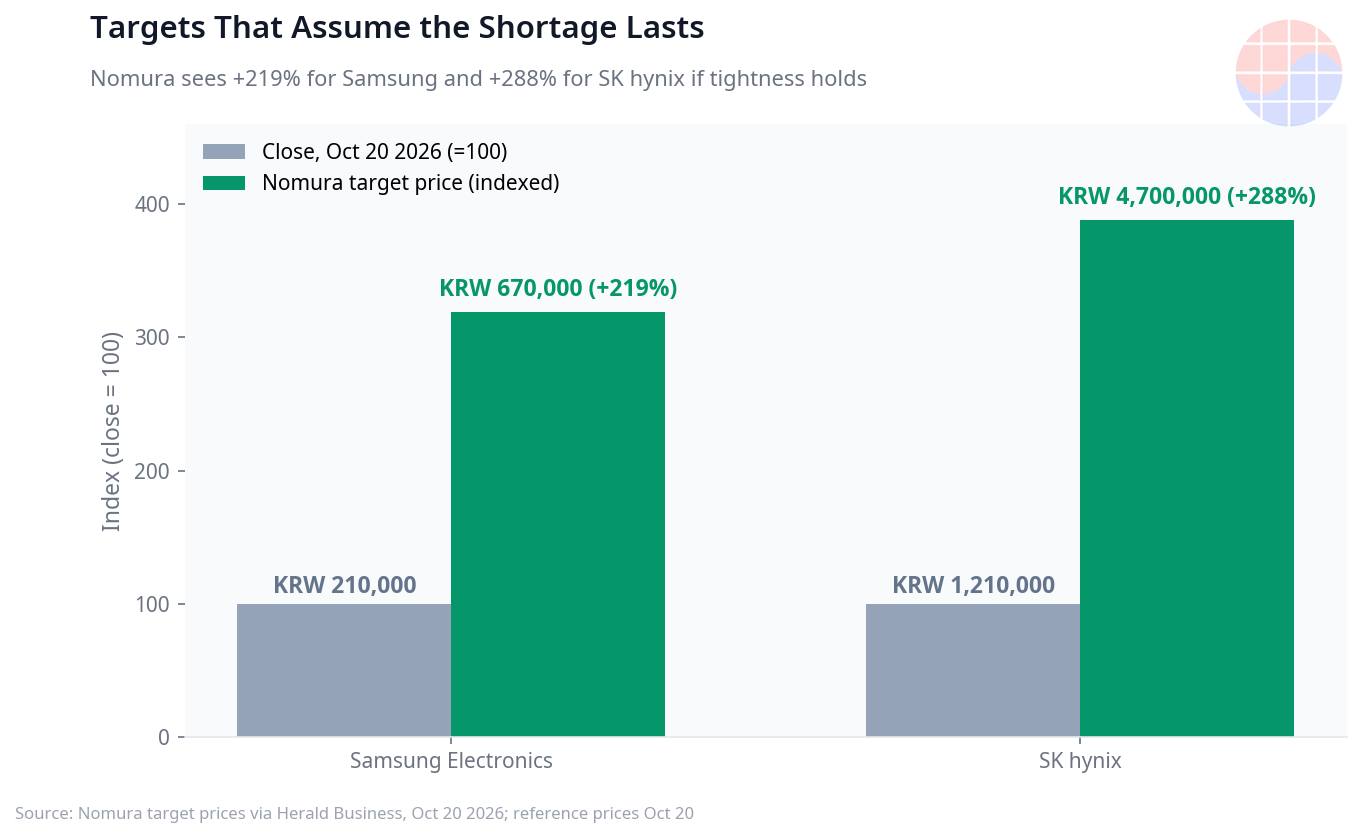
- Buy maintained, targets unchanged. Nomura maintained Buy ratings on Samsung Electronics and SK hynix and named both as stocks to watch, its top picks. The target prices were maintained, not raised: KRW 670,000 for Samsung Electronics and KRW 4,700,000 for SK hynix.
- The gap is extreme. Against reference prices on October 20 of roughly KRW 210,000 for Samsung Electronics and roughly KRW 1,210,000 for SK hynix, the targets imply upside of about +219% and about +288%, respectively.
- The argument starts with data centers. The new global data center capacity Nomura tracks reaches 22.3 GW in 2026, up +77% year on year, and 31.5 GW in 2027, up +41% versus 2026. The 2027 figure sits +6% above Nomura's own prior model estimate of 29.7 GW.
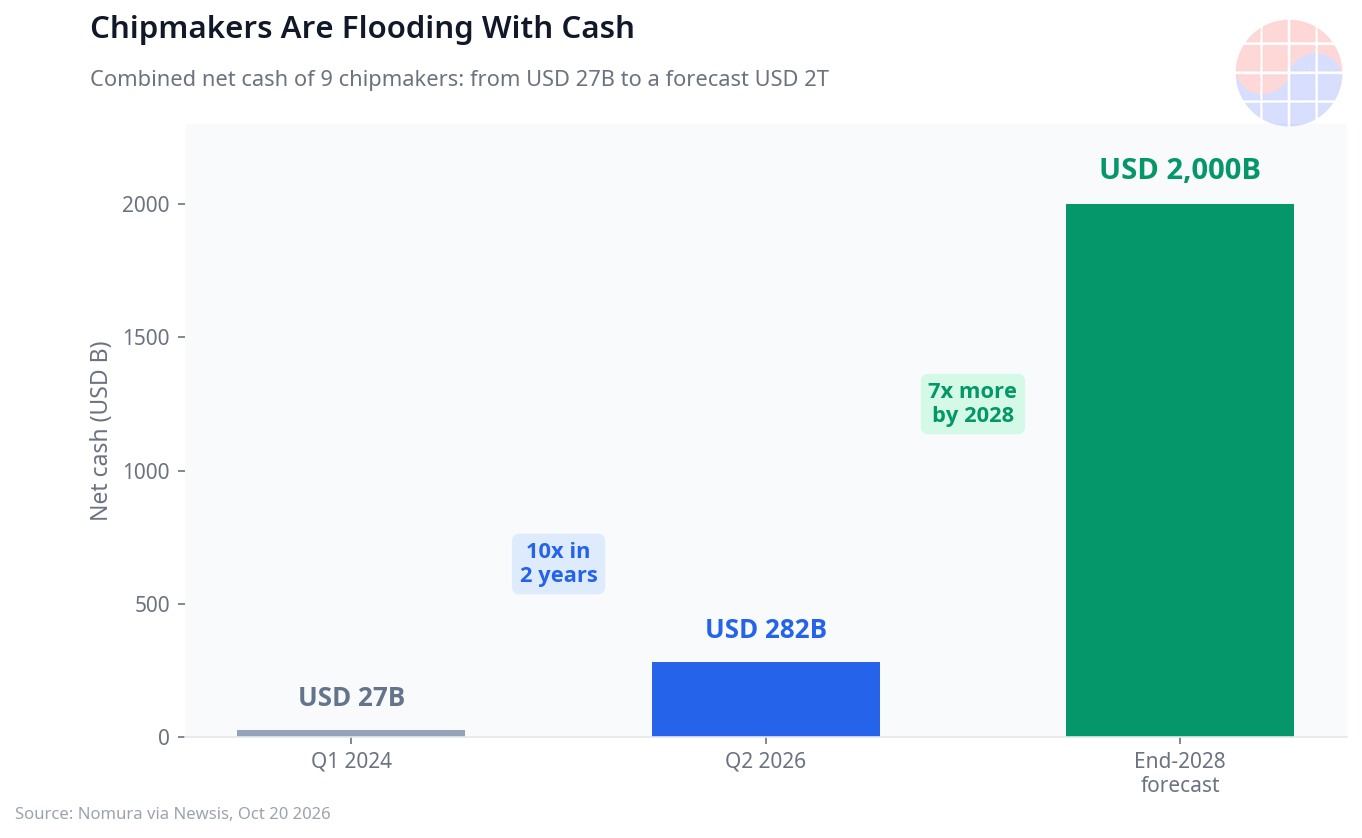
- Cash shows where the profit pools. The combined net cash of nine chipmakers, including Samsung Electronics and SK hynix, rose from USD 27 billion in Q1 2024 to USD 282 billion in Q2 2026, and Nomura forecasts roughly USD 2 trillion by the end of 2028.
- Chase's Take: Last week Morgan Stanley called memory a valuation trap and Goldman Sachs kept its Buy calls through a hedge fund unwind. Nomura is now the third voice saying the shortage runs through 2028. The houses are converging on supply and diverging only on valuation.
Every figure attributed to the report in this article comes from secondary reporting. The original report is client-only and was not directly verified — "original not directly verified." Each figure carries its source, and no figure that could not be checked has been included.
Intro: A Third Voice, the Same Conclusion
Over the past two weeks, the argument over memory stocks has split in two. One side has warned that earnings near a peak can make a stock look deceptively cheap. The other has answered that a positioning unwind does not change a supply shortage. A third voice has now joined.
In its global memory report dated October 19, 2026, Nomura maintained Buy ratings on Samsung Electronics and SK hynix and argued that the memory shortage will continue at least through 2028 (FN News). What stands out is the level of the target prices themselves. Back in May 2026, Nomura set a KOSPI target of 10,000–11,000 and presented Samsung Electronics at KRW 590,000 and SK hynix at KRW 4,000,000 as its bull case. The targets it has now maintained, KRW 670,000 and KRW 4,700,000, are higher than that bull case. In other words, for Nomura these targets are no longer an optimistic scenario. They are the base case.
This article takes the report's numbers apart: how data center capacity, AI revenue, and chipmaker cash connect into a single sentence about a shortage through 2028, why Nomura calls the market's three main concerns excessive, and what the gap to Korean brokerage targets actually means.
Episode 1: The Numbers — From 22.3 GW to 31.5 GW
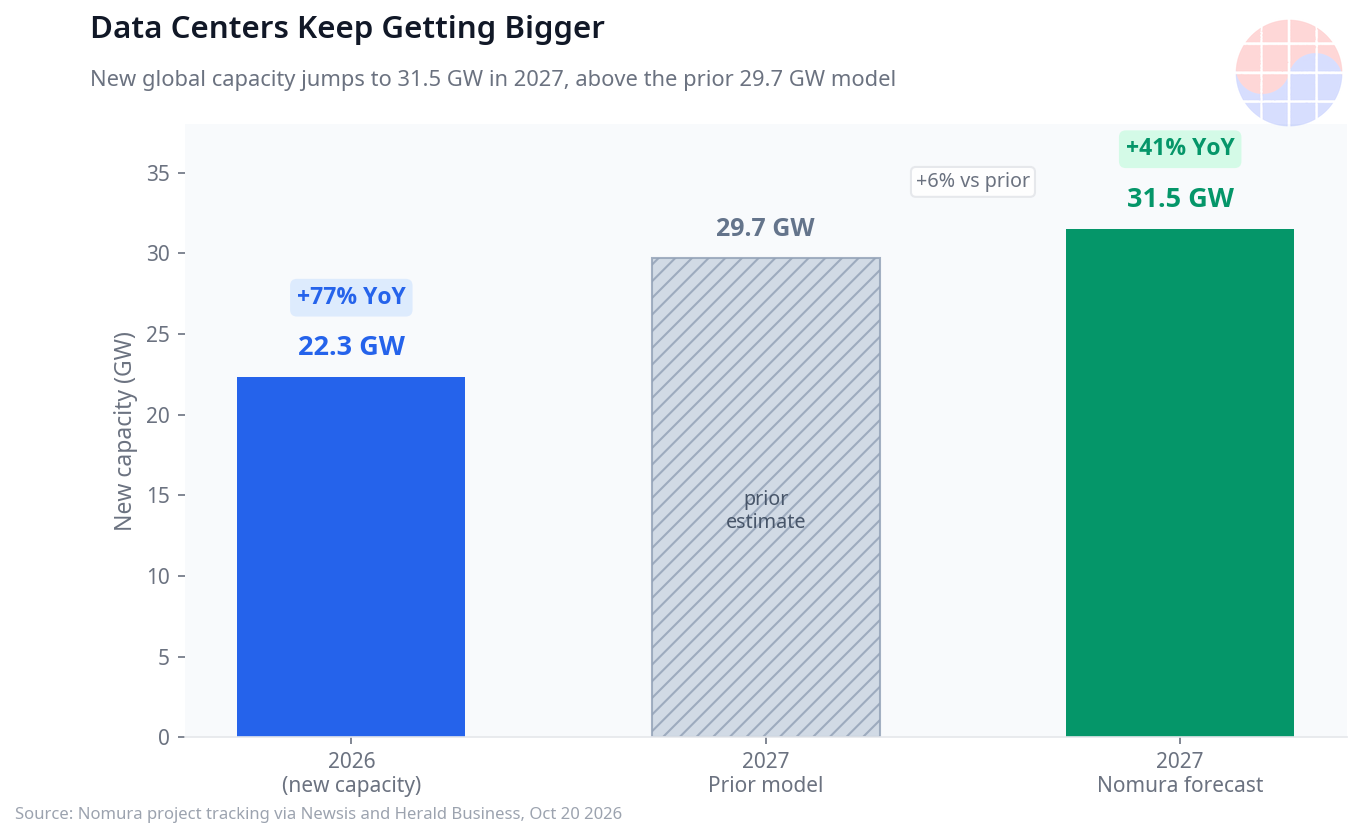
Nomura's logic does not start with demand forecasts. It starts with physical capacity. The new global data center capacity the firm tracks reaches 22.3 GW in 2026, up +77% year on year, and then 31.5 GW in 2027, up +41% versus 2026. The growth rates matter, but the second figure matters more. At 31.5 GW, the 2027 number sits +6% above Nomura's own prior model estimate of 29.7 GW. Capacity plans are pushing the model upward, not being revised down into it. That direction of revision does not appear in a cycle where build plans are shrinking.
Capacity measured in GW is, in itself, memory demand. When a data center is built, servers go in, and an AI server carries far more DRAM and HBM than a conventional server. Nomura's report connects those two facts and concludes that memory demand growth will outpace supply growth at least through 2028. As long as the supply bottleneck is not resolved, the pricing environment stays favorable for the makers. That is the report's central sentence.
The second set of figures covers the demand side's ability to pay. Nomura estimates that the combined revenue of OpenAI and Anthropic grew +507% year on year in Q3 2026. To reach the market's full-year 2026 expectation of roughly USD 100 billion combined, the two companies would need about USD 43.9 billion in Q4, a +61% increase quarter on quarter. If the September run-rate simply holds, Q4 revenue would come to roughly USD 29.7 billion, still +291% year on year. The point of this arithmetic is narrow but important. Even if the pair falls short of the full-year expectation, the growth rate itself remains in exceptional territory. There is a measurable distance between fears of an AI revenue slowdown and the estimated trajectory itself.
The third set of figures asks where the profit accumulates. The combined net cash of nine chipmakers, including Samsung Electronics and SK hynix, rose more than tenfold, from USD 27 billion in Q1 2024 to USD 282 billion in Q2 2026. Nomura forecasts that figure to reach roughly USD 2 trillion by the end of 2028. The report's claim that the market underestimates the profit pool created by strong AI demand is, in the end, a claim about this cash curve — that demand converts into profit across the value chain, and that the profit piles up as cash on the supplier side of it.
Nomura also viewed Samsung Electronics' and SK hynix's participation in the Anthropic investment positively — the link between the memory makers and a demand-side company extending beyond a supply contract into equity.
Episode 2: Why Three Concerns Look Excessive — and the Caveat Nomura Kept
Nomura addressed the market's three standing concerns directly, and judged all three excessive.
First, fears of an AI revenue slowdown. As the estimates above show, combined OpenAI and Anthropic revenue grew an estimated +507% year on year in Q3. A Q4 shortfall against the market's full-year expectation of roughly USD 100 billion is arithmetically possible, but Nomura's reading is that a shortfall against an expectation is not the same event as a slowdown in growth. The report separates the problem of the forecast from the problem of the trajectory.
Second, data center operator financing. Bonds issued by operators such as CoreWeave have fed a concern that if operator funding wobbles, demand wobbles with it. Nomura's counterargument rests on transferability: data centers already built, and the GPUs and equipment already installed in them, can be taken over and used by other operators. Individual operator risk therefore has a limited path to aggregate demand.
Third, CXMT's 4F2 progress. News that China's CXMT had advanced on a denser 4F2 DRAM cell structure was one of the triggers of last week's memory selloff. Nomura judged concerns over CXMT's 4F2 transition to be excessive. The reading is consistent with a distinction the industry knows well: progress on a cell structure is one milestone, and volume production at proven yield, followed by qualification at demanding customers, is a long sequence of further milestones.
Nomura did, however, keep an explicit caveat. If data center investment plans are repeatedly cut, or if even funded projects are heavily delayed, the outlook must be revisited. The risk the report itself underwrites is therefore not a scenario in which demand disappears. It is a scenario in which projects that are already financed slip in time. That distinction matters, and Chase's Take returns to it below.
Now return to the target prices. Nomura maintained KRW 670,000 for Samsung Electronics and KRW 4,700,000 for SK hynix. Against reference prices on October 20 of roughly KRW 210,000 and roughly KRW 1,210,000, the implied upside is about +219% and about +288%. Because the targets were not raised, a gap of this size means the prices moved away from the forecasts, not that the forecasts chased the prices. Morgan Stanley called memory a valuation trap last week, Goldman Sachs maintained its Buy calls in the same week, and Nomura has now fixed the shortage horizon at 2028. On supply, the three houses converge. What still divides them is the price to put on those earnings — how long the earnings plateau lasts, and what multiple it deserves while it does.
Episode 3: The Domestic Gap, and the Price on the Morning of October 21
Set Nomura's numbers beside those of Korean brokerages and the gap sharpens. According to Money Today's October 21 reporting, Mirae Asset Securities maintains target prices of KRW 400,000 for Samsung Electronics and KRW 3,100,000 for SK hynix, while Meritz Securities raised its SK hynix target from KRW 3.1 million to KRW 3.2 million on October 12 (Money Today).
Laid out plainly: for Samsung Electronics, Nomura's KRW 670,000 stands against Mirae Asset's KRW 400,000. For SK hynix, Nomura's KRW 4,700,000 stands against Mirae Asset's KRW 3,100,000 and Meritz's KRW 3,200,000. Targets for the same companies over the same twelve months differ by more than 1.5 times. That is not a difference in precision. It is a difference in assumptions — how many years the pricing plateau lasts, and what multiple to apply to its earnings. On Nomura's assumptions, it is the domestic targets that look conservative.
The market's short-term answer, for one morning at least, was a rebound. As of 09:46 KST on October 21, Samsung Electronics traded at KRW 222,500, up +5.20%, and SK hynix at KRW 1,303,000, up +6.54%. Both, however, remain below their October 8 levels — Samsung Electronics in the KRW 260,000 range and SK hynix in the KRW 1.68 million range. One morning of recovery does not close the distance that last week's decline opened.
The novelty of the report is not the size of its targets but the order of its logic. Gigawatts come first, AI revenue second, chipmaker cash last. When all three point the same way, "shortage through 2028" becomes the output of a calculation. What deserves watching is not the targets, but whether the report's two caveats — repeated plan cuts and heavy funded-project delays — start to become real.
Chase's Take
Working in STA and physical design, I read this report's 31.5 GW figure before I read its target prices. Data center capacity is not a number that can be expanded in a press release. Gigawatts exist only when power, land, and equipment are actually secured. And the moment those gigawatts are filled with servers, memory content stops being a negotiation and becomes a design input. DRAM capacity per server and HBM capacity per GPU do not change quarter to quarter once a board is designed and qualified.
Why HBM qualification keeps supply slow is close to common sense inside the industry. HBM has to pass qualification on the customer's platform, and DRAM supply is bound to the pace of new fabs and process transitions. Demand can jump in a single quarter. The supply curve cannot follow at that speed. Nomura's call that the bottleneck persists matches the sense of time you develop on the floor.
The second figure I keep returning to is the net cash curve. If the nine chipmakers' combined net cash really moves from USD 282 billion toward roughly USD 2 trillion by the end of 2028, then pricing power in AI infrastructure sits with suppliers, not operators. The side where cash accumulates is the side that sets prices. That is also the deeper reason Nomura treats financing risk at an individual operator such as CoreWeave as limited. The building and the GPUs remain, and there is a next operator able to use the assets that remain.
The real risk, as I see it, sits exactly where Nomura left its caveat. Not demand disappearing, but projects that are already funded running late. A delayed project pushes out the moment its gigawatts become real, and the timing of its memory demand moves with it. The shortage does not vanish — its calendar changes. So three things are worth checking from here. Whether the 31.5 GW figure for 2027 survives into the next tracking update. Whether reports of funded-project delays start to repeat. And which side of the gap between the domestic targets and Nomura's targets does the closing. If the three houses' convergence on supply is right, earnings will be what closes it.
FAQ
What is the core conclusion of Nomura's report?
That memory demand growth will outpace supply growth at least through 2028, that the supply bottleneck will persist, and that the pricing environment will stay favorable for memory makers. Nomura maintained Buy ratings on Samsung Electronics and SK hynix and named both as stocks to watch. The original report is client-only, so this summary is based on secondary reporting and the original was not directly verified.
What are Nomura's target prices for Samsung Electronics and SK hynix?
KRW 670,000 for Samsung Electronics and KRW 4,700,000 for SK hynix, both maintained rather than raised. Against reference prices on October 20 of roughly KRW 210,000 and roughly KRW 1,210,000, they imply upside of about +219% and about +288%. They stand well above Mirae Asset Securities' domestic targets of KRW 400,000 and KRW 3,100,000.
Why does Nomura call the market's concerns excessive?
For three reasons. Combined OpenAI and Anthropic revenue is estimated to have grown +507% year on year in Q3, which sits at a distance from AI revenue slowdown fears. Already-built data centers, GPUs, and equipment can be taken over and used by other operators, which limits individual operator financing risk. And concerns over CXMT's 4F2 transition are judged excessive. The forecast that nine chipmakers' combined net cash reaches roughly USD 2 trillion by the end of 2028 supports the same reading.
What would break this outlook?
Nomura attached the caveat itself. If data center investment plans are repeatedly cut, or if even funded projects are heavily delayed, the outlook must be revisited. The indicators to watch are therefore whether the 2027 new data center capacity estimate, currently 31.5 GW, is maintained in future updates, and whether delays to large funded projects begin to accumulate.
This article is for information only and is not investment advice. Figures attributed to the report are based on secondary reporting, and the original report was not directly verified. Investment decisions are your own responsibility.
📩 Subscribe to VLSI Korea
Get our daily semiconductor deep-dives delivered to your inbox first. Free to subscribe.