VLSI Korea
Rebuilding HBM ECC: SKKU's Cerberus Cut Redundancy 33.3% and Won ISCA 2026 Best Paper
SKKU's Cerberus won a Best Paper Award at ISCA 2026. Its Encode-Once, Decode-Many co-design unifies on-die, link, and system ECC into one shared redundancy, cutting HBM overhead 33.3% while raising reliability. We break down the method, the numbers, and the limits.


⏱ 30-Second Summary
Cerberus, from a Sungkyunkwan University (SKKU) team, won a Best Paper Award at ISCA 2026 (June 27–July 1, 2026, Raleigh, NC) — the first for a Korean university, according to SKKU. Its idea: stop letting the three ECC layers (on-die, link, system) work in isolation, and co-design them around one shared redundancy through an Encode-Once, Decode-Many (EODM) architecture. Against an HBM4 baseline it cuts redundancy from 48 bits to 32 bits per 256-bit block (−33.3%) while improving reliability. All numbers are from simulation and fault injection — there is no measured silicon.
Why This Paper
This week's shortlist had four candidates: the ISSCC 2026 LPDDR6 papers from Samsung and SK hynix, Intel's Diamond Rapids at Hot Chips 2026, the MFIT thermal-modeling work listed as a DAC 2026 paper, and Cerberus. Cerberus won on three counts. First, verifiability: it is the only candidate with the full text freely available on arXiv, so every number below was checked against the paper's own tables. The LPDDR6 originals sit behind the IEEE paywall and secondary coverage disagrees on several figures, and MFIT turned out to be an ACM TODAES journal paper, not a DAC paper at all. Second, HBM relevance: as AI accelerators push the bottleneck from compute into memory, a paper that redesigns HBM4's ECC structure speaks directly to practitioners. Third, the award: ISCA 2026 received 845 submissions and accepted 161; Cerberus was one of two Best Paper Award winners announced on June 30, 2026.
Background: Three ECC Layers That Never Talked to Each Other
As DRAM density and I/O speed scale, keeping data correct gets harder. Cell charge has shrunk to femtocoulomb levels, timing margins are sub-nanosecond, and links run at multi-gigabit rates per pin. HBM and LPDDR make this sharper: in their single-device-per-channel (SDPC) organization, one DRAM device serves an entire channel, so a single device defect can take down the whole channel. And because the minimum fetch granularity dropped to 32B, the redundancy budget shrank with it — SDPC memories typically allocate just 2B per 32B block (6.25%), half the 8B per 64B (12.5%) common in DDR systems.
The industry's answer was to stack protection layers: on-die ECC (O-ECC) repairs manufacturing defects inside the device, link ECC (L-ECC) catches transmission errors in real time, and system ECC (S-ECC) at the controller provides end-to-end recovery. The problem is that the three layers evolved independently. Redundancy gets duplicated, coverage gaps appear, and worst of all, the layers can interfere. The textbook failure is miscorrection: when an error exceeds O-ECC's correction capability, the decoder can flip healthy bits and amplify the error pattern into a shape that S-ECC can no longer fix. Trying to help makes things worse.
The paper's own accounting shows the structural squeeze. In its HBM4 configuration, total redundancy reaches 48 bits per 32B data block (18.8%), yet the S-ECC share is only 2 bytes — enough for SEC-DED or CRC16, not both strength and detection. LPDDR6 splits its 12.5% total budget into 2B each for S-ECC, O-ECC, and L-ECC per 32B block, and at that per-layer budget it cannot correct 16-bit clustered errors at all; in its SEC-DED configuration it also shows elevated silent data corruption (SDC) rates on 16-bit and 32-bit errors, driven by O-ECC miscorrections.
The Core Idea: Encode Once, Decode Many
Cerberus makes one change with deep consequences: the controller encodes once, and all three layers reuse the same redundancy. The authors call this Encode-Once, Decode-Many (EODM). In the HBM configuration, the shared redundancy is 32 bits per 256-bit block (12.5%). The link layer uses 16 of those bits for write-path error detection; the device layer reuses the same 16 bits for on-die single-error correction; and the system layer uses the full 32 bits for symbol-level correction and detection.
Safe reuse needs two mechanisms. First, the generator and parity-check matrices are co-designed at the matrix level so the layers' codes are complementary by construction. Second, the on-die decoder operates under a bounded-fault constraint: even if it miscorrects, the damage stays confined to the originally faulty 16-bit symbol, so the error burden handed to the system layer can never grow. Decoder ordering and correction-budget allocation are designed together to rule out miscorrection amplification structurally. At the top, the system layer delivers SSC+DEC — it corrects one 16-bit symbol error or two bit errors in distinct symbols, and detects more severe patterns with 99.97% probability.
One more point matters industrially. Cerberus preserves on-die error concealment: the DRAM does not expose its internal fault behavior to the host. Single-layer academic designs such as Unity ECC and DUO post strong reliability, but they require exactly that transparency, which collides with DRAM vendors' practice of masking internal defects. By keeping each layer's native role — O-ECC for local repair and concealment, L-ECC for detection and retry, S-ECC for end-to-end recovery — Cerberus stays compatible with how custom HBM engagements actually work.
Deep Analysis: Methodology, Numbers, and Limits
How it was evaluated — injection and synthesis, not silicon
Methodology first, because it disciplines every claim that follows. There is no test chip. Reliability comes from Monte Carlo fault injection over 10 million iterations, with errors injected at three locations — in-bank (cell and periphery), write link (transmission path), and out-bank (read path, periphery, I/O) — across patterns from single errors to 16-bit and 32-bit clustered faults, data-pin errors, and data-strobe errors. Performance comes from the Accel-Sim cycle-level GPU simulator modeling an NVIDIA V100 with 32 HBM channels at HBM4's 6.4Gb/s, across 16 workloads from Rodinia, Parboil, GraphBIG, and PolyBench. Area comes from SystemVerilog models synthesized with Synopsys Design Compiler on a UMC 28nm library. DRAM energy is a model estimate built from HBM2E datasheet currents and the Micron DDR4 power calculator. Every figure below is simulation- or model-based.
Result 1 — Less redundancy, wider coverage
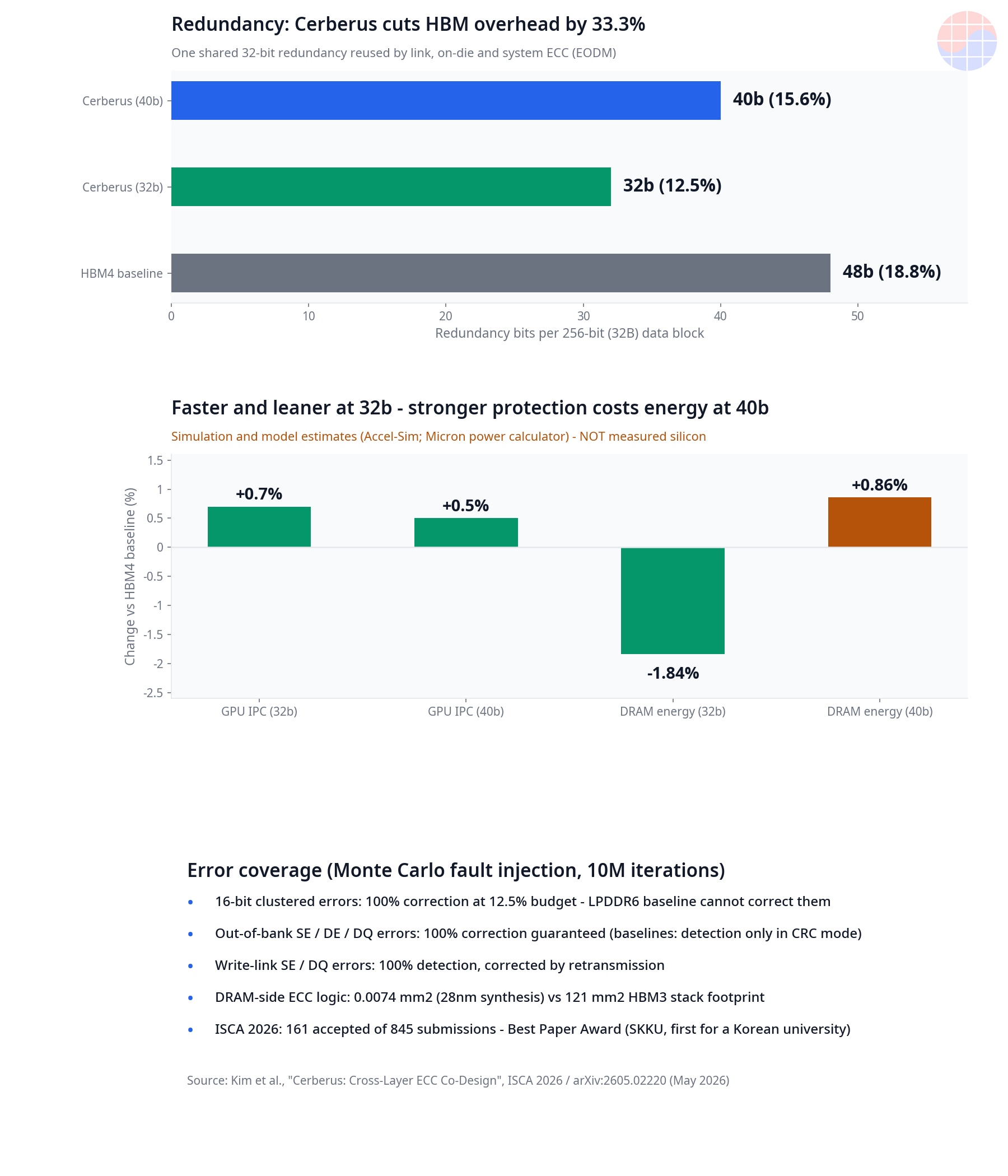
The headline is a reversed trade-off. Cerberus cuts redundancy from 48 bits to 32 bits versus the HBM4 baseline (−33.3%), yet in single-location tests it corrects 16-bit clustered errors at 100% within the same 12.5% budget where the LPDDR6 baseline cannot correct them. On the out-bank read path it guarantees 100% correction of single, double, and DQ errors, where CRC-mode baselines only detect. On the write link it detects single and DQ errors at 100% and corrects them by retransmission. In multi-location scenarios — errors striking two or three locations at once — Cerberus sustains near-100% correction where layered baselines fail on peripheral double errors. A 40-bit variant (15.6% redundancy) trades budget back for still stronger detection.
Result 2 — Performance and energy
Collapsing three encoders into one shortens the path. In Accel-Sim, GPU IPC improves by a 0.7% geomean for Cerberus (32b) and 0.5% for Cerberus (40b) versus HBM4, with synthesized S-ECC added latency of 0.85ns for the 32b configuration and the modified on-die decoder latency reduced from 5ns to 2ns. Modeled DRAM energy falls by 1.84% on average for the 32b configuration, while the 40b configuration pays +0.86% for its stronger protection. Area is negligible where it matters: the two in-DRAM decoders total 14,693 NAND2 equivalents (0.0074mm² at 28nm) against a 121mm² HBM3 stack footprint, and even the processor-side encoder plus S-ECC decoder total 127,583 NAND2 equivalents — with the S-ECC decoder itself at 62,669µm².
Limits — what we still do not know
The limits are equally clear. First, the injected fault patterns are derived from field-study literature, not from measured HBM4 silicon, so real defect distributions may differ. Second, the energy figures borrow HBM2E current values — they are estimates, not measurements. Third, deployment needs standardization or a co-design partner: Cerberus changes the ECC matrices on both the controller and the DRAM, so it cannot drop into a commodity JEDEC HBM part. The paper aims precisely at the setting where that is possible — custom HBM, where host and memory vendor design together.1
Chase's Take: Reliability Is the Next HBM Battleground
The industrial significance is the direction, not just the technique. HBM competition is expanding from bandwidth and stack height into reliability and yield. At AI training clusters of tens of thousands of accelerators, a single memory error that slips through as silent data corruption can poison an entire run — the cost model for ECC is changing from insurance to infrastructure. That is exactly the world custom HBM is being built for, and Cerberus only works in that world: cross-layer optimization is available exclusively to customers who co-design the host SoC and the memory.
For Samsung and SK hynix this cuts both ways. A 33.3% redundancy reduction is die area and cost, and preserved error concealment is vendor-friendly. But matrix-level co-design means deeper engineering engagement with each customer's SoC team — the memory vendor's job shifts from component supply toward design partnership. For EDA, ECC matrix co-design and bounded-fault verification are candidate additions to signoff flows, and fault-injection-based reliability verification is already a growing line item in memory design.
Keep the claim sized correctly: this is a conference paper, not a product roadmap announcement. But ISCA choosing it for a Best Paper Award signals that the architecture community now treats memory reliability as a first-class design variable alongside bandwidth. The thing to watch next is whether shared-redundancy structures like EODM start appearing in follow-on research and vendor standardization discussions.
Implications
- Memory vendors (Samsung, SK hynix): cross-layer ECC co-design is a credible custom-HBM differentiator — redundancy savings map to cost, and preserved concealment maps to customer trust.
- AI accelerator and SoC architects: memory reliability is becoming a host-memory co-design variable, not a component spec. ECC budget allocation moves into early architecture decisions.
- EDA and verification engineers: expect growing demand for fault-injection reliability verification and bounded-fault formal checks — reliability verification is expanding into territory adjacent to STA and signoff.
- Hyperscalers: this work gives a concrete basis for quantifying SDC cost at scale and for deciding whether custom HBM requirements should include ECC co-design.
FAQ
Was Cerberus validated on a real chip?
No. Reliability was evaluated with 10 million Monte Carlo fault-injection iterations, performance with the Accel-Sim simulator, area with UMC 28nm logic synthesis, and energy with a current-model estimate. There are no measured silicon results; all figures are simulation- or model-based.
What exactly does the 33.3% redundancy reduction mean?
In the paper's HBM4 configuration, total redundancy per 256-bit (32B) data block falls from 48 bits (18.8%) to Cerberus's 32 bits (12.5%). It is possible because the three ECC layers share one 32-bit redundancy — encoded once by the controller — instead of each provisioning its own.
Can this be applied to today's HBM4 or LPDDR6 products?
Not directly. It requires changing the ECC encoder and decoder structures on both the memory controller and the DRAM. The paper therefore targets co-design scenarios such as custom HBM rather than commodity JEDEC parts, and no JEDEC standardization activity has been announced.
Why did it win Best Paper at ISCA 2026?
Per the conference's official announcement, Cerberus is one of two ISCA 2026 Best Paper Award winners (845 submissions, 161 accepted). It tackles a structural problem — duplication, coverage gaps, and miscorrection interference across three independently evolved ECC layers — and shows lower redundancy with higher reliability through matrix-level co-design. According to SKKU, it is the first ISCA Best Paper Award for a Korean university.
For your own papers: If you are drafting a paper of your own, an academic writing tool such as Paperpal can help polish the English manuscript before submission. Use code PAP20 for 20% off. Purchases through this link may generate a commission.
Sources
- Paper: Junhwan Kim, Seunghyun Kim, Yesin Ryu, Saeid Gorgin, and Jungrae Kim, "Cerberus: Cross-Layer ECC Co-Design for Robust and Efficient Memory Protection", ISCA 2026 (53rd IEEE/ACM International Symposium on Computer Architecture, June 27–July 1, 2026, Raleigh, NC), arXiv:2605.02220 (submitted May 4, 2026; v2 May 14, 2026)
- Conference: ISCA 2026 official site (iscaconf.org) — Best Paper Awards announced June 30, 2026; 845 submissions, 161 accepted
- University release: Sungkyunkwan University via Newswise (July 23, 2026) — first ISCA Best Paper Award for a Korean university
- Figure verification: arXiv HTML full text (Tables I–VI, Sections V–VI) checked directly — redundancy 48b to 32b, IPC +0.7%, energy −1.84%/+0.86%, area 0.0074mm²
1 Evidence note: every quantitative figure in this article comes from the paper's simulation, fault-injection, synthesis, or model estimates — not measured silicon. The "first for a Korean university" framing is SKKU's, via its release.
📩 Subscribe to VLSI Korea
Get our daily semiconductor deep-dives delivered to your inbox first. Free to subscribe.