VLSI Korea
Positron AI Deep Dive: The $5 Billion Valuation and the Memory-First Inference Chip Bet
Why is Positron AI worth $5 billion? The $875M Series C of September 2026, 50+ Atlas racks at Oracle, and the LPDDR5X memory-first Asimov design — and what must be true for the price to hold.


30-Second Summary
Positron AI is valued at $5 billion because investors are buying a specific claim: AI inference is limited by memory, not by compute, and a chip built around cheap LPDDR5X memory can serve large models at lower cost per token and lower power than a GPU built around scarce HBM. The valuation is not a rumor. Positron announced an $875 million Series C and Series C-1 financing on September 10, 2026, at a $5 billion post-money valuation. That is about 4.7 times the $1.06 billion post-money valuation of its $230 million Series B in February 2026, only seven months earlier. In Korean won, $5 billion is about 7 trillion won at 1,400 won per dollar, the exchange rate used throughout this article.
The company already ships a product. More than 50 racks of Atlas, its first-generation inference system, are deployed at Oracle Cloud Infrastructure, where partner Parasail runs an inference service on that capacity. Named Atlas production customers also include Jump Trading and i3d.net. The product that is supposed to justify most of the $5 billion, however, has not shipped. Asimov, a custom ASIC on TSMC N3P, is scheduled to tape out at the end of 2026 and reach production in the second half of 2027. Its headline efficiency figures come from cycle-accurate simulation, not from production silicon.
That split is the whole story. Atlas proves Positron can build, deploy and operate inference hardware in a real data center. Asimov is the bet that the same team can turn a memory-first architecture — 288GB to 2,304GB of LPDDR5X per chip, more than 90% realized memory bandwidth as a design target, about 400W per chip, and no dependence on HBM or CoWoS — into a business large enough to support a $5 billion private valuation. If Asimov lands on time and the simulated tokens-per-dollar advantage survives contact with real workloads, the price can look early. If tape-out, yield, qualification or software adoption slips, the price has very little current revenue underneath it: Positron has not published a revenue or annualized run-rate figure.
| Item | Detail |
|---|---|
| Founded | 2023 — headquartered in Reno, Nevada |
| Latest round | Series C and Series C-1, September 10, 2026 — $875 million at a $5 billion post-money valuation |
| Previous round | Series B, February 2026 — $230 million at a $1.06 billion post-money valuation |
| Total disclosed funding | About $1.18 billion |
| Shipping product | Atlas, an FPGA-based inference system — more than 50 racks deployed at Oracle Cloud Infrastructure |
| Next chip | Asimov, a custom ASIC on TSMC N3P — tape-out planned for the end of 2026, production in the second half of 2027 |
| Asimov design targets | 288GB–2,304GB of LPDDR5X per chip, 2.76 TB/s of realizable memory bandwidth, about 400W per chip |
Background: A Three-Year-Old Company Built Only for Inference
Positron AI was founded in 2023 and is headquartered in Reno, Nevada. It was co-founded by Thomas Sohmers, its chief technology officer, and Edward Kmett, its chief scientist, both of whom had previously worked at another AI inference startup, Groq. Mitesh Agrawal, previously chief operating officer and head of cloud at Lambda, joined as chief executive officer to scale commercial operations. The founding team came from inference, and the chief executive came from selling and operating AI compute.
Positron does not try to train frontier models. Training is a compute-density contest dominated by large GPU clusters and a mature software stack. Inference — running a trained model for users, agents, copilots, search, trading and media generation — runs continuously, is paid for per token, and is set by three tightening constraints: memory capacity, memory bandwidth and power.
Memory capacity decides which models fit and how much context and key-value cache a system can hold. Memory bandwidth decides how fast tokens can be generated. Power decides how much capacity a data center can actually turn on: a facility earns money from tokens delivered inside its power envelope, not from peak FLOPS it cannot power.
Atlas was designed to reach the market before Positron spent years and hundreds of millions of dollars on a custom ASIC. Atlas is an FPGA-based inference system, fabricated in the United States, delivered as an appliance that customers can deploy without rebuilding their software workflow around a new chip. Positron brought Atlas to market in roughly 18 months and has described the system as air-cooled and suited to conventional rack power envelopes. Atlas gave Positron paying deployments, operating data and customer feedback before its custom silicon existed.
The funding history shows how quickly the market repriced that evidence. Positron raised $23.5 million in seed funding, then a $51.6 million Series A in July 2025, then the $230 million Series B in February 2026 at a post-money valuation above $1 billion, and then the $875 million Series C and Series C-1 in September 2026 at $5 billion post-money. Total disclosed funding is roughly $1.18 billion. The September round was split into a $375 million Series C at a $3.5 billion pre-money valuation and a Series C-1 of up to $500 million. It was co-led by NEA, Atreides Management, Valor Equity Partners, Andra Capital, SemiAnalysis Capital and Jim Clark, with Qatar Investment Authority, Cisco Investments and Naver Ventures among additional backers.
Business Deep Dive: What Positron Actually Sells
The product ladder: Atlas today, Asimov and Titan next
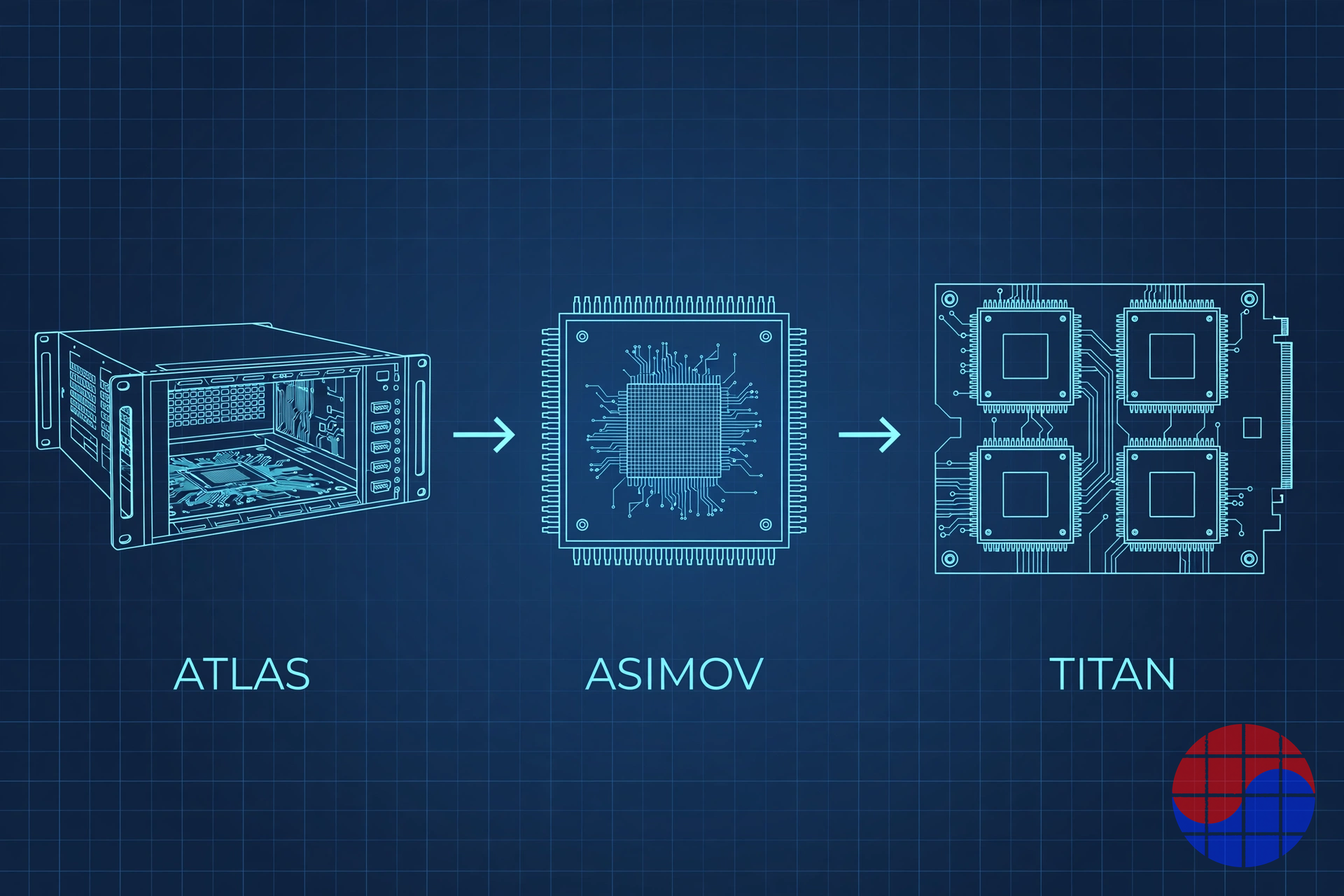
Positron sells inference systems, not a bare chip roadmap. Atlas is the shipping first generation. Asimov is the next-generation custom ASIC. Titan is the system built around Asimov, with four to eight Asimov chips per node. Positron says Titan is designed for models exceeding 16 trillion parameters and context windows beyond 10 million tokens in a single node. Those are system-design targets for very large, long-context and agentic workloads, not a claim that every customer needs that scale today.
The business model follows the hardware. Positron sells or supplies complete inference capacity — systems that a cloud provider, neocloud, trading firm or hosting operator can put into production — rather than asking customers to integrate a component and build the rest themselves. The Oracle deployment illustrates the model: Atlas racks sit inside Oracle Cloud Infrastructure, and Parasail uses that capacity for its inference service. Jump Trading is instructive in a different way. It first used Atlas as a customer and then co-led the Series B. A customer moving from deployment to investor is not proof of a large revenue base, but it is a stronger signal than a logo on a slide, because the investor had direct operating exposure to the product.
The memory-first architecture, in engineering terms
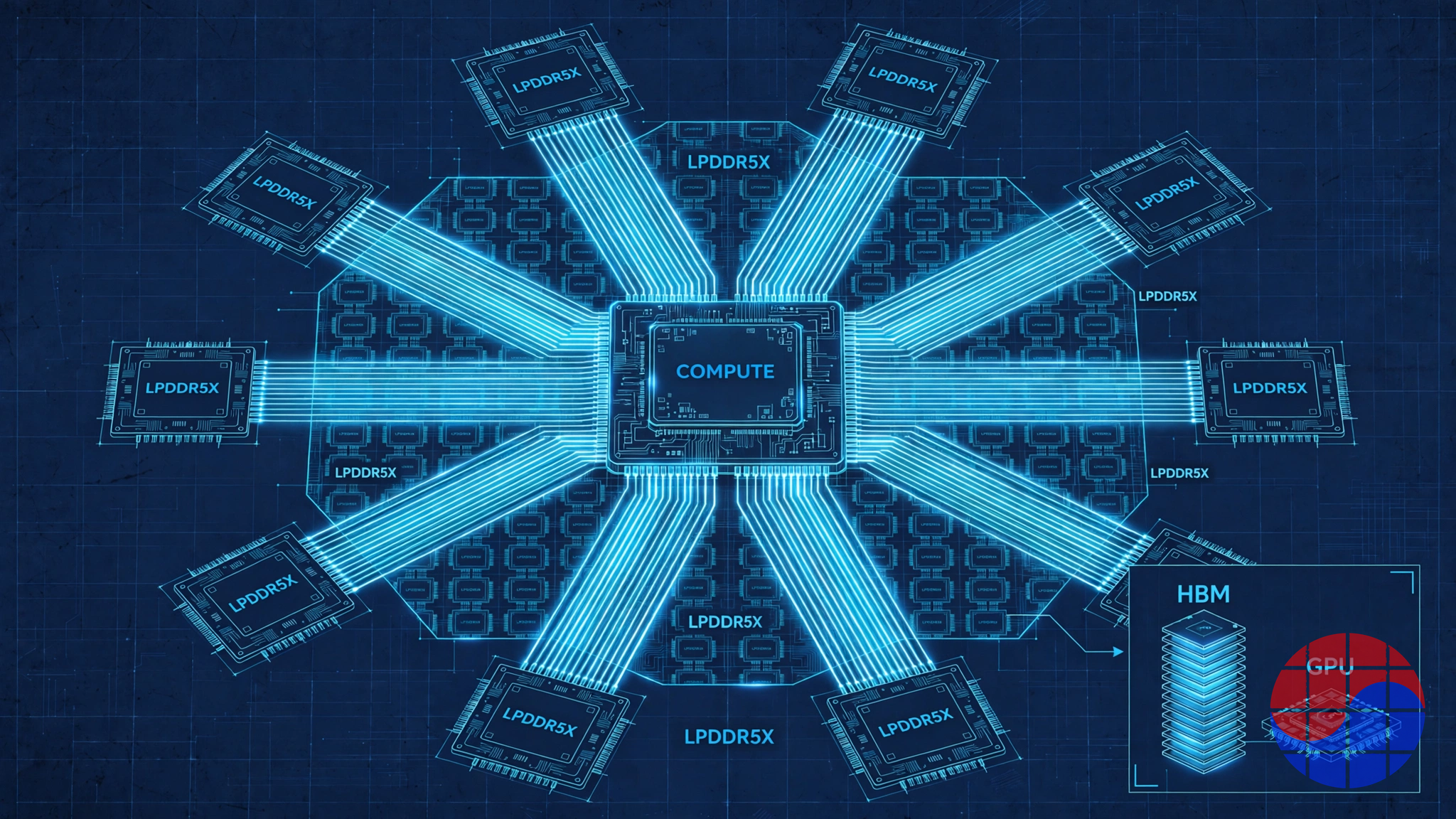
Most AI accelerators start from compute and attach the fastest memory available. That memory is HBM, stacked DRAM placed close to the processor and delivered through advanced packaging such as CoWoS. HBM offers very high peak bandwidth, but it is expensive, capacity-limited per package and exposed to a concentrated supply chain. Positron reverses the design order. It starts from the observation that transformer inference is often memory-bound: the system spends much of its time moving weights, activations and key-value cache, not performing arithmetic at peak rate.
Asimov therefore uses commodity LPDDR5X memory — the class of memory used in phones and laptops — instead of HBM. The trade-off is explicit. LPDDR5X has far lower bandwidth per pin than HBM, so Positron must aggregate many channels and keep them busy. In return, it can attach far more capacity per chip, avoid the HBM and CoWoS bottlenecks, and build on a deeper, cheaper memory supply base. Published Asimov targets include 288GB to 2,304GB of memory per chip, 2.76 TB/s of realizable memory bandwidth, PCIe Gen6 and CXL support, and a power envelope of about 400W with air-cooling support. To connect that much LPDDR, Positron uses a chiplet-based memory fan-out approach, including the Weaver gearbox chiplet developed with Credo.
The central technical claim is utilization. Positron says its memory-first systems can realize more than 90% of available memory bandwidth, and Atlas has been described at up to 93% utilization. GPU inference workloads, by contrast, are commonly described as realizing a much smaller share of peak HBM bandwidth in real serving conditions. This distinction is why a simple peak-bandwidth comparison misleads. A GPU can advertise a much larger peak number and still deliver less useful bandwidth on a given model if access patterns, batching and cache behavior leave that peak unreachable. Positron's argument is not that LPDDR is faster than HBM. It is that a balanced architecture can extract more of a smaller, cheaper bandwidth pool while holding far more model and context in memory.
Power: the claim, and its evidence level
Positron claims Atlas delivers about three times the compute per watt of an Nvidia H100, and in some descriptions more than 70% higher token throughput with roughly two-thirds less power than comparable Hopper systems. For Asimov, the company has claimed five times more tokens per watt than Nvidia's upcoming Rubin GPU in its core workloads, and simulation-based comparisons for Titan have been presented as high as 26 times more tokens per dollar than a GB300 NVL72 system at a specified per-user token rate. Treat these numbers at two different evidence levels. Atlas is shipping, but its comparisons remain company-reported and have not been settled by a single independently published benchmark accepted across the industry. Asimov has not taped out, so its figures are simulation-derived design targets. Neither category should be written as measured fact.
The power argument is still commercially coherent even after that discount. Existing data centers contain large amounts of air-cooled capacity built for lower rack densities. A system that can be deployed without a liquid-cooling rebuild widens the addressable installed base. It also changes the unit of competition from chip peak performance to tokens delivered per megawatt already available in a building. That is the metric a power-constrained operator actually buys.
What $5 billion must assume
A $5 billion post-money valuation after raising $875 million means new investors paid for future system revenue, not for cash on the balance sheet. On simple arithmetic, the $875 million is 17.5% of the $5 billion post-money figure, although the two-tranche structure and security terms mean that percentage is not an exact ownership calculation. The remaining value must come from Asimov and Titan converting into repeatable, high-volume system sales.
For that to work, at least five conditions need to hold together. First, Asimov must tape out at the end of 2026 without a major re-spin. Second, production in the second half of 2027 must achieve usable yield and system qualification at TSMC N3P. Third, the simulated memory-bandwidth utilization and tokens-per-watt advantage must appear on customer models, at production batch sizes and latency targets, not only on selected workloads. Fourth, customers must be able to run their models without a painful software migration; inference buyers pay for delivered tokens, not for architecture elegance. Fifth, Positron must manufacture and support systems at scale while LPDDR pricing and supply remain favorable enough to preserve its cost argument against HBM systems.
Revenue disclosure is the missing variable. Positron has said it expects strong revenue growth and its chief executive has described Atlas deals in the tens of millions of dollars, but the company has not published a revenue figure or run rate that would let an outside reader calculate a price-to-sales multiple. Any multiple quoted for Positron today would therefore be invented. The honest valuation statement is narrower and more useful: $5 billion is the negotiated price of the September 2026 securities, supported by a shipping Atlas business and a very large expectation for Asimov.
Chase's Take
My judgment is that the memory-first thesis is real, and the valuation is still ahead of the evidence. Those two statements do not contradict each other. Inference economics are shifting from raw compute toward memory capacity, realized bandwidth and power, especially as context windows, reasoning traces and key-value caches grow. Using LPDDR5X to escape the HBM and CoWoS queue is a genuine architectural and supply-chain idea, not a marketing relabel. Building Atlas on FPGAs first was also the right sequencing: Positron learned from production racks before committing its balance sheet to an N3P ASIC.
What $5 billion buys, however, is not the Atlas business as it exists in October 2026. It buys a successful Asimov launch in 2027, a Titan ramp after that, and enough customer switching to matter in a market where the incumbent's software ecosystem is the default. The schedule already deserves attention: in February 2026, production was discussed as early 2027; by the September financing, production was targeted for the second half of 2027. That may be a more precise plan rather than a delay, but for a pre-tape-out chip, time is risk. Every quarter of slippage gives GPU roadmaps, competing inference ASICs and custom hyperscaler silicon another quarter to close the efficiency gap.
The test I would watch is not another simulated tokens-per-dollar chart. It is three operating facts in sequence: Asimov tape-out announced on schedule, independent or customer-published measurements on production silicon, and repeat Titan orders from a customer who first paid for Atlas. If those three arrive, $5 billion will look like the price of admission. If the first slips, the valuation discussion changes immediately, because there is no disclosed revenue base to absorb the disappointment.
Implications
For data center operators, Positron is a reminder to benchmark inference purchases on realized tokens per dollar and per watt at their own context lengths and latency targets, not on peak FLOPS or peak bandwidth. Memory capacity per node also becomes a procurement variable as long-context and agentic workloads grow.
For the memory industry, Asimov is a demand signal outside the HBM path. A successful LPDDR5X inference platform at scale would enlarge the market for commodity DRAM in data centers and create a new design center around memory fan-out chiplets and CXL expansion. It would not replace HBM in training, but it would prove the inference tier can be segmented by memory economics.
For investors, the September round marks where late-2026 capital is concentrating: not on another training cluster, but on the cost of serving models. It also sets a diligence standard: ask whether a number came from shipping silicon or simulation, whether the customer paid and reordered, and whether the valuation works if production moves by two quarters.
FAQ
What is Positron AI's latest valuation and when was it set?
Positron AI announced an $875 million Series C and Series C-1 financing on September 10, 2026, at a $5 billion post-money valuation. The round followed a $230 million Series B in February 2026 at a $1.06 billion post-money valuation.
What does Positron AI sell today?
Positron sells Atlas, a first-generation FPGA-based AI inference system that is already deployed in more than 50 racks at Oracle Cloud Infrastructure. Named production customers include Jump Trading and i3d.net, and partner Parasail runs an inference service on the Oracle capacity.
How is Asimov different from a GPU that uses HBM?
Asimov is a memory-first ASIC that uses commodity LPDDR5X instead of HBM, targeting 288GB to 2,304GB of memory per chip, more than 90% realized memory bandwidth as a design goal, about 400W per chip, and no dependence on HBM or CoWoS supply. It is scheduled to tape out at the end of 2026 on TSMC N3P, with production in the second half of 2027.
Are Positron's efficiency claims independently verified?
No single independently published benchmark settles Positron's headline claims. Atlas comparisons such as about three times the compute per watt of an H100 are company-reported. Asimov figures, including five times the tokens per watt of Rubin in core workloads, are based on simulation before tape-out and should be treated as design targets.
Note: Valuation and funding figures are the company's announced September 10, 2026 financing terms; performance comparisons are company claims or simulation targets as identified in the text, and Positron has not published a revenue figure.
📩 Subscribe to VLSI Korea
Get our daily semiconductor deep-dives delivered to your inbox first. Free to subscribe.