VLSI Korea
Rebellions Deep Dive: Why Korea's AI Chip Startup Is Valued at $2.34 Billion — Rebel100, Sovereign AI and the IPO Path
Rebellions was valued at $2.34B in its March 2026 pre-IPO round — roughly 100x reported 2025 revenue. This deep dive dissects the price: sovereign AI demand, ATOM-Max production traction, Rebel100, and the 2027 IPO path.


30-Second Summary
Rebellions, South Korea's leading AI inference chip startup, was valued at approximately $2.34 billion in its March 2026 pre-IPO round — a company-confirmed figure, not a rumour. The round raised $400 million (KRW 640 billion in Korean reporting), led by Mirae Asset Financial Group and the Korea National Growth Fund, bringing total funding to $850 million. Against reported 2025 revenue of roughly KRW 32–35 billion (about $23–25 million at USD 1 = KRW 1,400), the price equals roughly 100x trailing sales. The market is not paying for what Rebellions sells today. It is paying for three things: (1) a sovereign AI demand pool governments fund directly, (2) production traction — its ATOM-Max NPU runs four commercial SK Telecom AI services at about 14 million requests a day — and (3) Rebel100, a chiplet-based second-generation platform moving into rack-scale systems ahead of a planned 2027 IPO. This deep dive takes that price apart.
Background
Rebellions was founded in September 2020 in Seongnam, South Korea, by CEO Sunghyun Park — an MIT PhD who previously worked at Intel, SpaceX and Morgan Stanley. It designs neural processing units (NPUs) for AI inference: running a trained model millions of times a day, where cost and power per token decide the economics.
Two structural decisions define the company. First, in December 2024 Rebellions completed its merger with Sapeon Korea, SK Telecom's AI chip unit. The merged entity was valued at about KRW 1.3 trillion (roughly $935 million), making it Korea's first AI semiconductor unicorn, with Park as sole CEO. The merger combined Sapeon's telecom deployment base with Rebellions' design team and removed its most direct domestic rival. Second, Rebellions built its investor list as a supply chain: the only Korean AI chip startup backed by both major telecom operators, SK Telecom and KT, and also by Samsung Electronics, SK hynix, Arm, Saudi Aramco's Wa'ed Ventures, Temasek's Pavilion Capital, DG Daiwa Ventures and Korelya Capital. Its chips are fabricated by Samsung Foundry — ATOM on 5nm, Rebel100 on SF4X 4nm — and its HBM comes from the same ecosystem its shareholders control.
The funding staircase is steep. The Series B in January 2024 raised $124 million led by KT, at a valuation near $658 million. The Series C in September 2025 raised $250 million at $1.4 billion, with Arm joining as a strategic investor — reported as Arm's first startup investment in Asia-Pacific. Six months later, the March 2026 pre-IPO round added $400 million at $2.34 billion: $650 million, more than 75% of all capital ever raised, arrived in a single six-month window. That is momentum — and also a claim about the future that has to be tested.
Business Deep Dive
1. The anatomy of the $2.34 billion price
Start with the one hard denominator available. Rebellions does not publish full financials, but Korean audit-report compilations put 2025 revenue at approximately KRW 32–35 billion, up about 3.4x year on year and roughly tenfold versus 2023, with an operating loss reflecting heavy R&D spending. At USD 1 = KRW 1,400, that is $23–25 million of revenue against a $2.34 billion valuation — roughly 95–100x trailing sales.
That is not a semiconductor multiple; it is an option price. Mature fabless companies trade at single-digit to low-teens sales multiples, and even high-growth AI silicon names rarely sustain more than 20–30x once revenue is material. So the correct question is not "is $2.34 billion expensive?" — on trailing numbers it obviously is. It is: what revenue trajectory makes $2.34 billion ordinary?
| Scenario (eventual steady multiple) | Revenue needed to support $2.34B | Multiple of 2025 revenue (~$24M) |
|---|---|---|
| 20x sales (premium growth fabless) | ~$117 million | ~5x |
| 10x sales (established AI silicon) | ~$234 million | ~10x |
| 8x sales (mature fabless) | ~$293 million | ~12x |
Rebellions needs roughly a fivefold revenue increase to look reasonably priced as a growth company, and tenfold to look reasonably priced as an established one. Demanding, but not fantastical: 2025 revenue grew about 3.4x in a single year, before the second-generation platform had shipped at scale. The valuation is a bet that this growth rate, or something near it, persists for two to three more years.
2. Sovereign AI: how real is the demand?
"Sovereign AI" is the demand thesis: governments that do not want their AI infrastructure to depend entirely on US GPUs will pay for a domestic alternative. For Rebellions this is not a slogan — it has a cash signature. Of the KRW 640 billion pre-IPO round, KRW 250 billion came from the Korea National Growth Fund and KRW 50 billion from the state-run Korea Development Bank. The Fund's investment was its first direct investment, made under the government's "K-Nvidia" initiative to build a globally competitive domestic AI chip company. Mirae Asset anchored with KRW 300 billion of private capital, and the government required NPU developers to secure significant private matching funds to qualify — Rebellions was reported as the first domestic peer to complete that requirement.
But precision matters. The government's KRW 250 billion is equity investment, not a purchase order. It proves the state wants Rebellions to exist and be financed; it does not prove the state will buy Rebel100 systems at scale. The clearest test — Korea's National AI Computing Center — went to a Samsung SDS-led consortium and is GPU-centred, and no domestic-NPU allocation for that centre has been disclosed. Sovereign demand also exists outside Korea: first-generation chips are deployed in Saudi Arabia, where Wa'ed Ventures is a shareholder and the company runs a Riyadh subsidiary, and a July 2025 Marvell partnership targets custom AI infrastructure for sovereign deployments across APAC and the Middle East. The honest reading: sovereign AI is a real, funded policy current, Rebellions is its designated Korean champion, but the conversion of policy into purchase orders is still mostly ahead of the company, not behind it.
3. Traction: what ATOM proved, and what Rebel100 must prove
The strongest evidence is operational, not financial. ATOM, the first-generation chip built on Samsung's 5nm process, entered mass production in 2023 and moved from pilots into production services. KT runs Rebellions hardware in its NPU-as-a-service cloud. The flagship deployment is SK Telecom: an ATOM-Max-based server entered commercial service in December 2025 for the A. call-summary service, and by September 2026 Rebellions NPUs were running four SK Telecom AI services — call summarization, streaming text-to-speech, the AI contact centre, and the Scam Vanguard fraud-detection service — processing about 14 million requests a day, over 4 billion tokens daily, on an NPU farm of hundreds of cards. ATOM-Max, the current data centre card, combines four ATOM dies with a PCIe controller for 128 TFLOPS of FP16 compute and up to 1,024 TOPS at INT4 within 350W. Running real telecom traffic, every day, for months, is the reference procurement teams actually check.
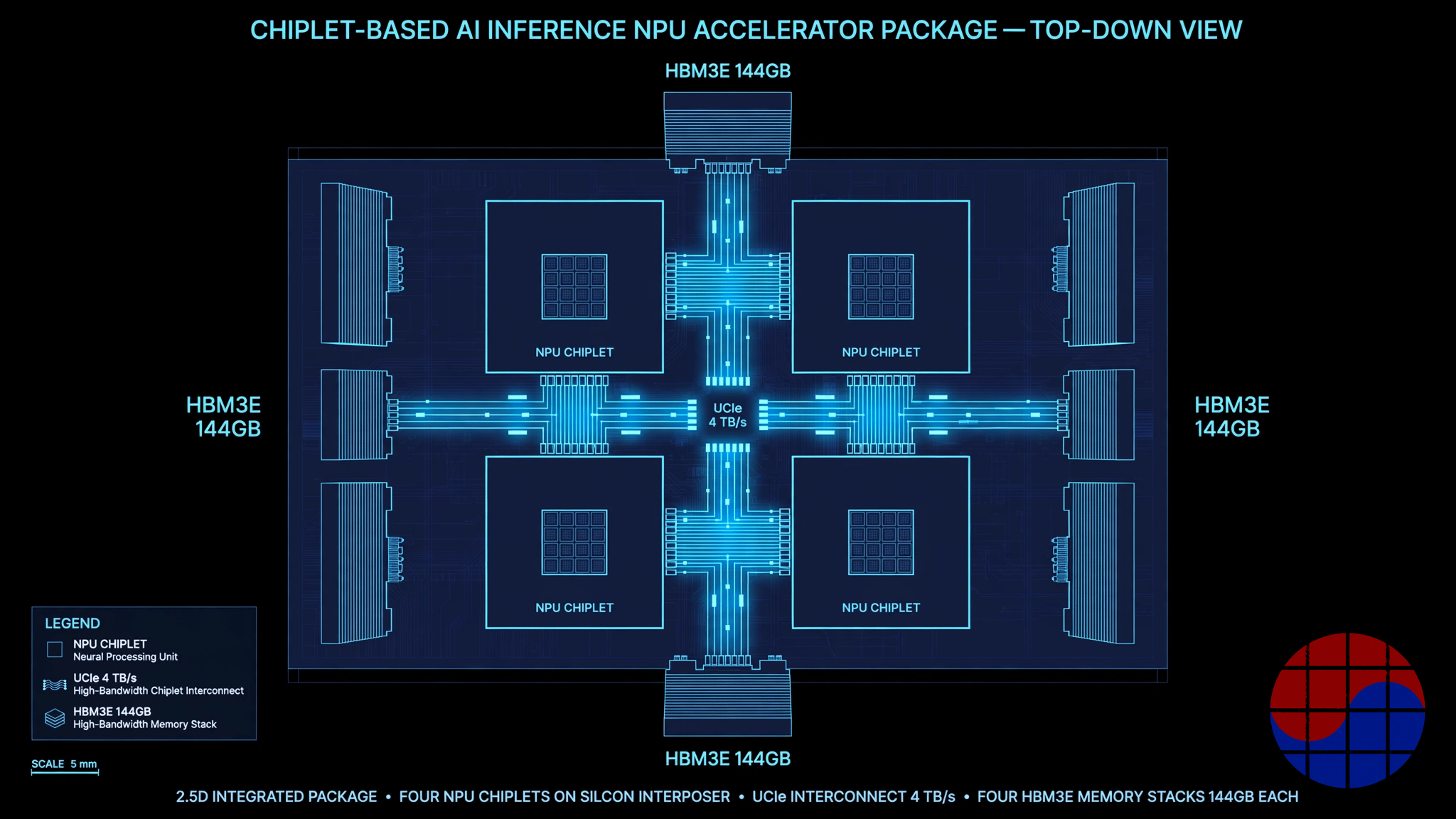
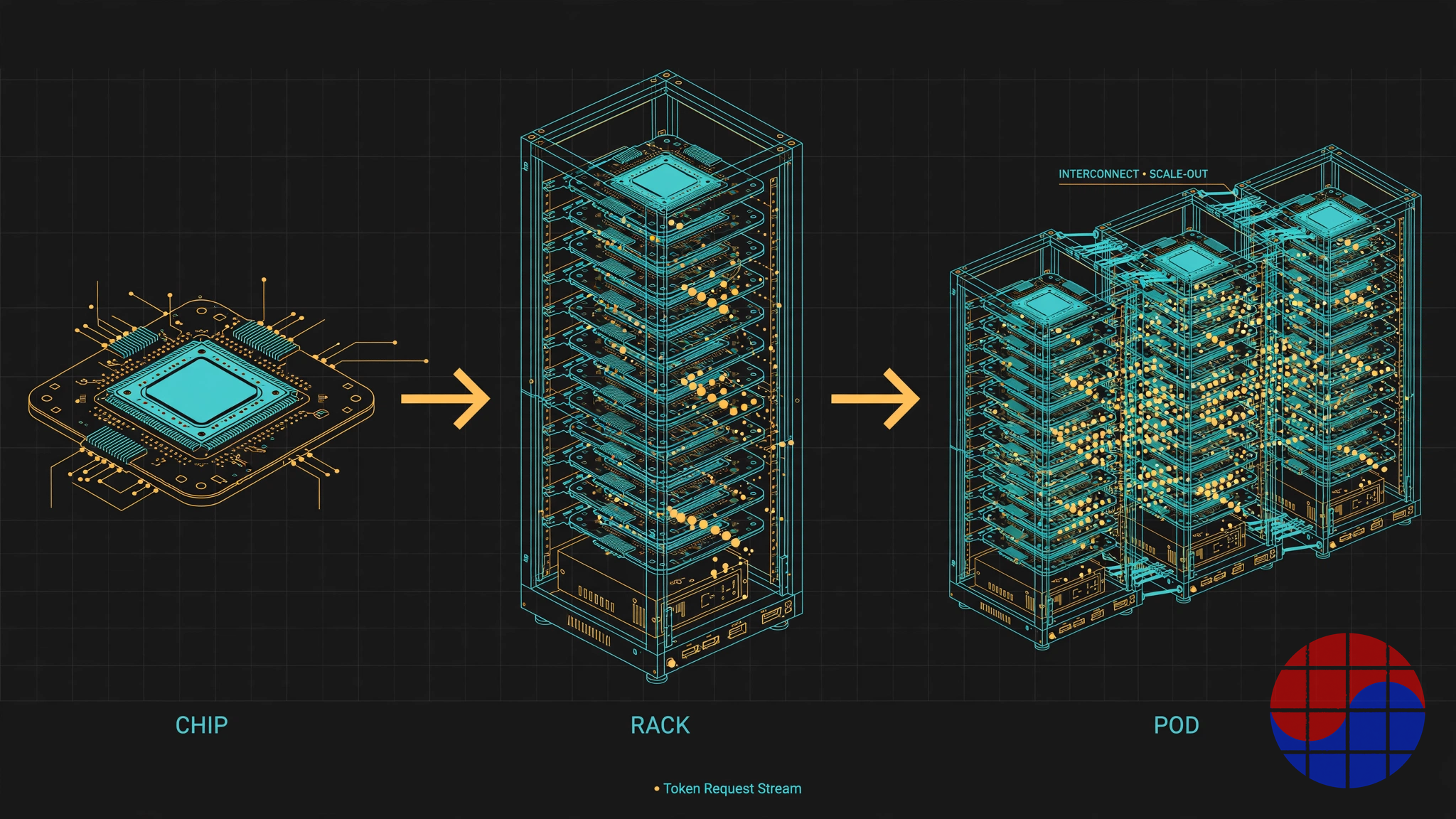
Rebel100 is the product the valuation actually prices. Launched as REBEL-Quad at Hot Chips 2025 and detailed in an ISSCC 2026 paper, it packages four NPU chiplets of about 320mm² each on Samsung's SF4X 4nm process with I-Cube S 2.5D packaging. It is the world's first AI accelerator to adopt UCIe-Advanced interconnect — 16Gbps links aggregating roughly 4 TB/s at about 11ns latency, so four dies behave as one processor. It carries 144GB of HBM3E (four 12-high 36GB stacks) at 4.8 TB/s bandwidth, and delivers 1 PFLOPS at FP16 and 2 PFLOPS at FP8, with dual PCIe Gen5 x16 host interfaces. In March 2026 the company wrapped it into systems: RebelRack, a production-ready rack of inference compute, and RebelPOD, which combines racks into clusters. The model shift matters as much as the silicon: Rebellions increasingly sells racks and pods — systems revenue per deployment — not bare chips.
What remains unproven is equally specific. Rebel100 is in proof-of-concept testing with global customers, including Meta according to Korean reporting, and Park has named large AI labs such as Meta and xAI as targets rather than the hyperscalers. No Rebel100 revenue, pricing or volume has been disclosed, and Park himself has named securing memory supply as a current challenge — pointed, for a product that needs four HBM3E stacks per package in a tight HBM market. The roadmap beyond it (REBEL-IO, REBEL-CPU, a Rebel100s variant clustering up to 256 sockets, and an Arm Neoverse CSS V3-based AI CPU chiplet platform on Samsung's 2nm GAA process) shows ambition. Ambition is not traction. The 2027 question is whether Rebel100 converts PoCs into disclosed, repeat orders.
4. The IPO path — and what it does to the price
The pre-IPO label is literal. Samsung Securities has been domestic lead underwriter since 2024, and JPMorgan was appointed global underwriter in 2026. In July 2026, Park said the company targets a KOSPI listing in Q1 or Q2 2027, with filing paperwork prepared by end-2026, timing dependent on market conditions; a later US listing via ADR — after talks with both the NYSE and Nasdaq — is also under consideration. September 2026 Korean press reports added a wrinkle: a KOSDAQ fast-track listing was also under review, so the board choice is not final.
For the valuation, the IPO cuts both ways. A successful 2027 listing at or above $2.34 billion validates the pre-IPO price. It also forces disclosure: audited revenue, customer concentration and Rebel100 order visibility become public documents, and the roughly 100x trailing multiple gets judged against each new quarter. If the listing slips, or prices below the pre-IPO mark, $2.34 billion retroactively becomes the peak of a private-market narrative rather than a stepping stone. Private valuations are set by the last willing buyer; public valuations are set every day.
5. Downside: what could make $2.34 billion wrong
Four risks are specific enough to name. First, customer concentration. The disclosed production base is two Korean telecom groups — who are also shareholders. Shareholder-customers are excellent references and poor proof of open-market demand. Second, the GPU gravity well. The sovereign pitch depends on buyers wanting a non-Nvidia option; if GPU supply normalises and pricing softens, second-sourcing urgency weakens, and the national computing centre's GPU-centred design shows which way default procurement leans. Third, HBM allocation. Rebel100's economics require volume HBM3E supply in a market where the largest buyers prepay for capacity; strategic shareholders help, but allocation is not ownership. Fourth, execution scale. Roughly 300 employees, planning to double, while scaling a new chip, building rack systems, entering the US market, and preparing an IPO — each a normal growth task; together, the actual risk.
One option cuts the other way: unconfirmed August 2026 reports described early-stage Nvidia–Rebellions talks covering partnership, investment or acquisition. Neither company has confirmed them, and the government's new position as a direct shareholder would complicate any foreign acquisition of a designated national champion. Treat it as reported optionality, not a floor under the price.
Chase's Take
The $2.34 billion price is best understood as a financing instrument, not a measurement. Korea decided it needs a national AI chip champion, and a champion that looks undercapitalised loses procurement arguments before they start. The National Growth Fund's first direct investment, Mirae Asset's anchor cheque, and the six-month, $650 million raise sequence were designed to make Rebellions look inevitable — and in infrastructure markets, looking inevitable is a genuine commercial asset, because buyers bet on vendors who will still exist in five years.
What I find credible is the unglamorous part: ATOM-Max running production telecom traffic at billions of tokens a day. Most AI chip startups die with a great Hot Chips paper and no production reference. Rebellions has the production reference, an architecturally serious second-generation chip — UCIe-Advanced in silicon, 144GB of HBM3E, a credible chiplet roadmap — and shareholders who control its foundry, its memory and its first customers. That combination is rare anywhere, and unique in Korea.
What I do not yet see is the number that would let me call $2.34 billion cheap: disclosed Rebel100 revenue. Until Rebel100 ships in volume to a customer who is not also a shareholder, the valuation rests on a 2025 revenue base of about $24 million and a policy tailwind. My verdict: the price is defensible as the cost of building a national champion with real silicon and real deployments — and becomes genuinely attractive only if the 2027 IPO prospectus shows Rebel100 revenue growing into the multiple. Watch three things: the filing's revenue mix, the first named non-shareholder Rebel100 customer, and any disclosed NPU allocation in government computing programmes. Those three data points, not another funding headline, will decide what this company is actually worth.
Implications
For Korea's semiconductor ecosystem, Rebellions tests whether a fabless champion can be assembled from domestic parts: Samsung Foundry wafers, SK hynix HBM, telecom anchor customers, state capital. If it works, the template extends to Korea's wider AI fabless sector; if it stalls, the lesson is that ecosystem assembly is no substitute for open-market demand.
For Samsung Foundry, Rebellions is a reference customer that matters beyond wafer volume: a 4nm chiplet design with HBM integration, plus a 2nm CPU chiplet programme in development, are exactly the advanced-node, advanced-packaging wins Samsung needs to show the market.
For buyers of inference infrastructure, there is now a non-GPU inference platform with production telecom references, an open software stack (vLLM, PyTorch, Triton, Kubernetes), and rack-scale products. For sovereign and regional deployments that will not standardise entirely on US GPUs, Rebellions belongs on the evaluation list — due diligence should focus on software maturity and HBM-backed delivery schedules.
For investors, the 2027 IPO will be the first priced, audited look at a pure-play Asian AI inference chip company. The pre-IPO round set the anchor at $2.34 billion; the prospectus will show how much of it is revenue, backlog, and policy.
Note: Valuation and round figures are company-announced (March 30, 2026); 2025 revenue is as reported from audit-report compilations and had not been published as full financial statements by the company as of writing. KRW conversions use USD 1 = KRW 1,400 unless a Korean-won figure was disclosed directly.
FAQ
Q1. What is Rebellions' latest valuation, and when was it set? Approximately $2.34 billion (about KRW 3.4 trillion in Korean reporting), set by the $400 million pre-IPO round announced on March 30, 2026, led by Mirae Asset Financial Group and the Korea National Growth Fund. Total funding reached $850 million.
Q2. What does Rebel100 (REBEL-Quad) offer? Rebellions' second-generation AI inference accelerator: four NPU chiplets on Samsung's 4nm SF4X process, the world's first UCIe-Advanced interconnect (~4 TB/s aggregate), 144GB of HBM3E at 4.8 TB/s bandwidth, 1 PFLOPS FP16 and 2 PFLOPS FP8 compute. It is sold as chips, and as RebelRack and RebelPOD rack-scale systems.
Q3. Is Rebellions actually selling chips, or is it still pre-revenue? It is selling. Reported 2025 revenue was roughly KRW 32–35 billion, ATOM entered mass production in 2023, and ATOM-Max NPUs run four commercial SK Telecom AI services at about 14 million requests (over 4 billion tokens) per day as of September 2026. Rebel100 revenue has not been disclosed.
Q4. When is the Rebellions IPO? The company targets a Korean listing in H1 2027 — Park pointed to Q1 or Q2 2027 in July 2026, with filings prepared by end-2026 and timing subject to market conditions. JPMorgan is global underwriter and Samsung Securities domestic lead; KOSPI versus KOSDAQ was still under review in September 2026 reports, and a later US ADR listing is under consideration.
📩 Subscribe to VLSI Korea
Get our daily semiconductor deep-dives delivered to your inbox first. Free to subscribe.