VLSI Korea
SambaNova Deep Dive: The Dataflow AI Chip, SambaStack Racks, and the $11 Billion Valuation
SambaNova closed a $1B Series F first close at an $11B post-money valuation in July 2026. A deep dive into its RDU dataflow architecture, the SambaStack rack business, JPMorganChase and SoftBank traction — and what must be true for the price to hold.


30-Second Summary. SambaNova Systems, a Palo Alto AI chip company built around its Reconfigurable Dataflow Unit (RDU), completed the first close of a $1 billion Series F on July 8, 2026, at an $11 billion post-money valuation (about ₩15.4 trillion at ₩1,400 per dollar). Five months earlier the same company had raised its Series E at a reported valuation near $2.2 billion, and in late 2025 it was reportedly in acquisition talks at roughly $1.6 billion including debt. The $11 billion price is therefore not a payment for today's revenue — reported at roughly $100 million a year in mid-2025 — but for three things: a dataflow architecture with a three-tier memory system designed for agentic inference, a turnkey rack business (SambaStack/SambaRack) that sells finished AI infrastructure instead of chips, and named traction with JPMorganChase, SoftBank, Intel and sovereign AI buyers in the Middle East. For the price to hold, SN50 shipments in the second half of 2026 must convert into revenue at a scale the company has never publicly shown.
Background: A Company the Market Repriced Three Times
SambaNova was founded in November 2017 in Palo Alto by Rodrigo Liang, a former Oracle and Sun Microsystems executive who ran SPARC processor development; Kunle Olukotun, the Stanford professor known as a pioneer of multicore processors; and Christopher Ré, a Stanford computer science professor. Lip-Bu Tan, who backed the company early through Walden International, serves as executive chairman. The founding thesis was architectural: GPUs execute instructions fetched and decoded by fixed cores, while a dataflow machine wires the computation graph of a model directly into the silicon, so data streams through processing stages instead of waiting on instruction scheduling.
The funding arc tells the valuation story in miniature. SambaNova raised a $56 million Series A in 2018, a $150 million Series B in 2019, and a $250 million Series C in February 2020 at a $2.5 billion post-money valuation. In April 2021, a $676 million Series D led by SoftBank Vision Fund 2 pushed the valuation to $5.1 billion — the peak of the first AI infrastructure cycle, before large language models had a production inference market to sell into.
Then came the long winter. Through 2025 the company explored a sale, and in December 2025 it was reported to be in advanced acquisition talks with Intel at roughly $1.6 billion including debt. Those talks stalled. One major investor marked its stake down about 17%, implying a value near $2.1–2.4 billion. The rescue arrived as partnership rather than acquisition: on February 24, 2026, SambaNova closed a Series E of more than $350 million led by Vista Equity Partners and Cambium Capital, with Intel Capital participating, at a reported post-money valuation around $2.2 billion. Intel simultaneously signed a multi-year strategic collaboration to build inference offerings on Intel Xeon infrastructure and take them to market jointly. Five months later, General Atlantic led the $1 billion Series F first close at $11 billion post-money, with Seligman Ventures, T. Rowe Price, Capital Group, BlackRock, Intel Capital, Vista Equity Partners and the Qatar Investment Authority (QIA) among the participants. Total capital raised now stands at roughly $2.5 billion.
| Round | Date | Amount | Post-money valuation | Lead |
|---|---|---|---|---|
| Series A | 2018 | $56M | — | — |
| Series B | 2019 | $150M | — | — |
| Series C | 2020-02 | $250M | $2.5B | — |
| Series D | 2021-04 | $676M | $5.1B | SoftBank Vision Fund 2 |
| Series E | 2026-02-24 | $350M+ | ~$2.2B | Vista Equity Partners, Cambium Capital |
| Series F (first close) | 2026-07-08 | $1B | $11B | General Atlantic |
Business Deep Dive
The chip: five generations of dataflow
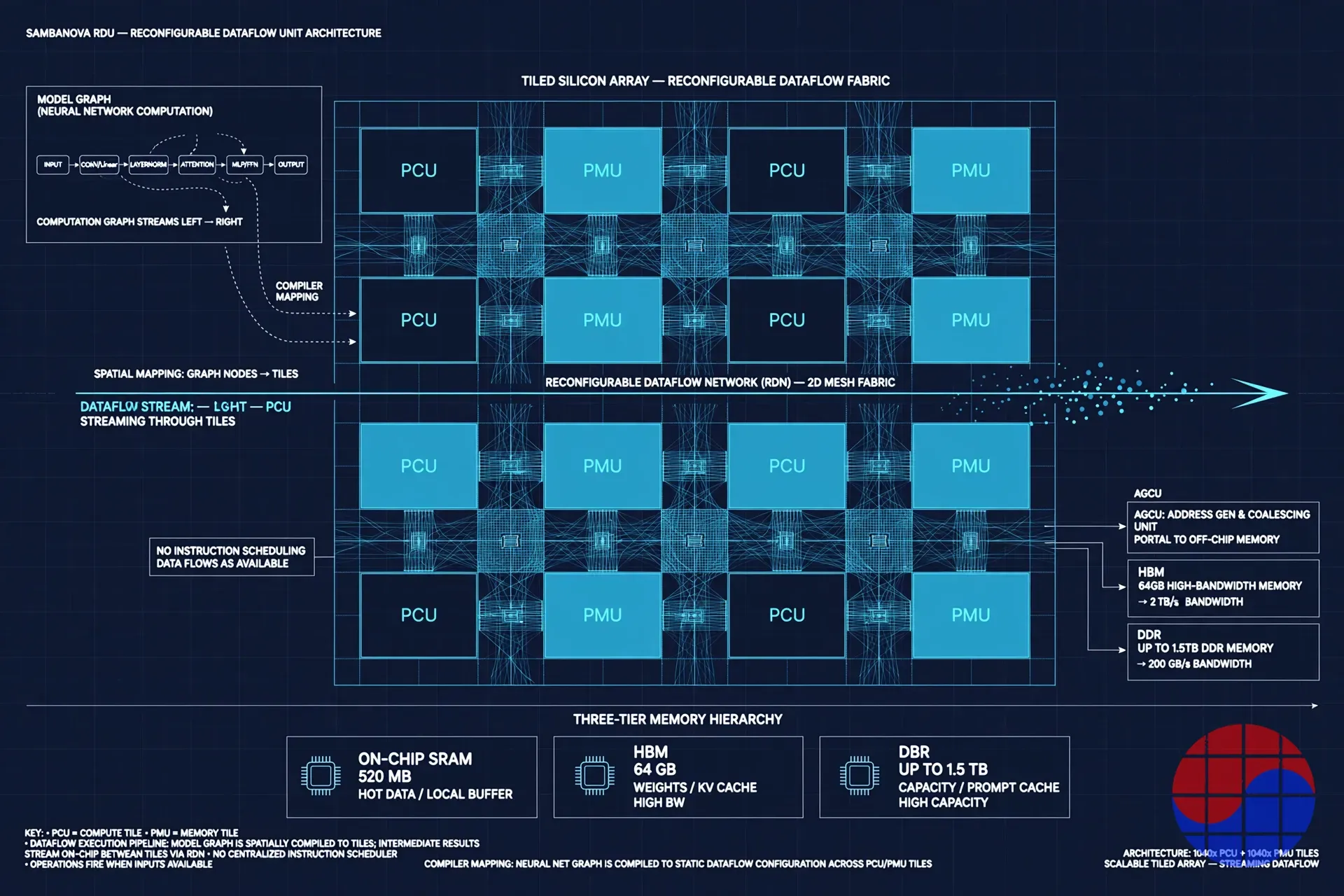
The RDU is a tiled array of Pattern Compute Units (PCUs) and Pattern Memory Units (PMUs) connected by a reconfigurable fabric. A compiler maps a model's graph onto the tiles, fusing operations so intermediate results never leave the chip. The commercial generations ran from the early SN10 and SN20, through the 7nm SN30, to the SN40L in 2023 — a TSMC 5nm part with 102 billion transistors, 1,040 PCUs and 1,040 PMUs delivering 638 BF16 TFLOPS. The fifth generation, SN50, was unveiled in February 2026: industry reporting puts it on TSMC's 3nm process as a dual-chiplet design with roughly double the compute units, 1.6 PFLOPS at BF16 and 3.2 PFLOPS at FP8, a 2.2 TB/s chip-to-chip interconnect, and the ability to link up to 256 accelerators into one shared-memory inference domain. Shipments begin in the second half of 2026.
The real product is the memory system
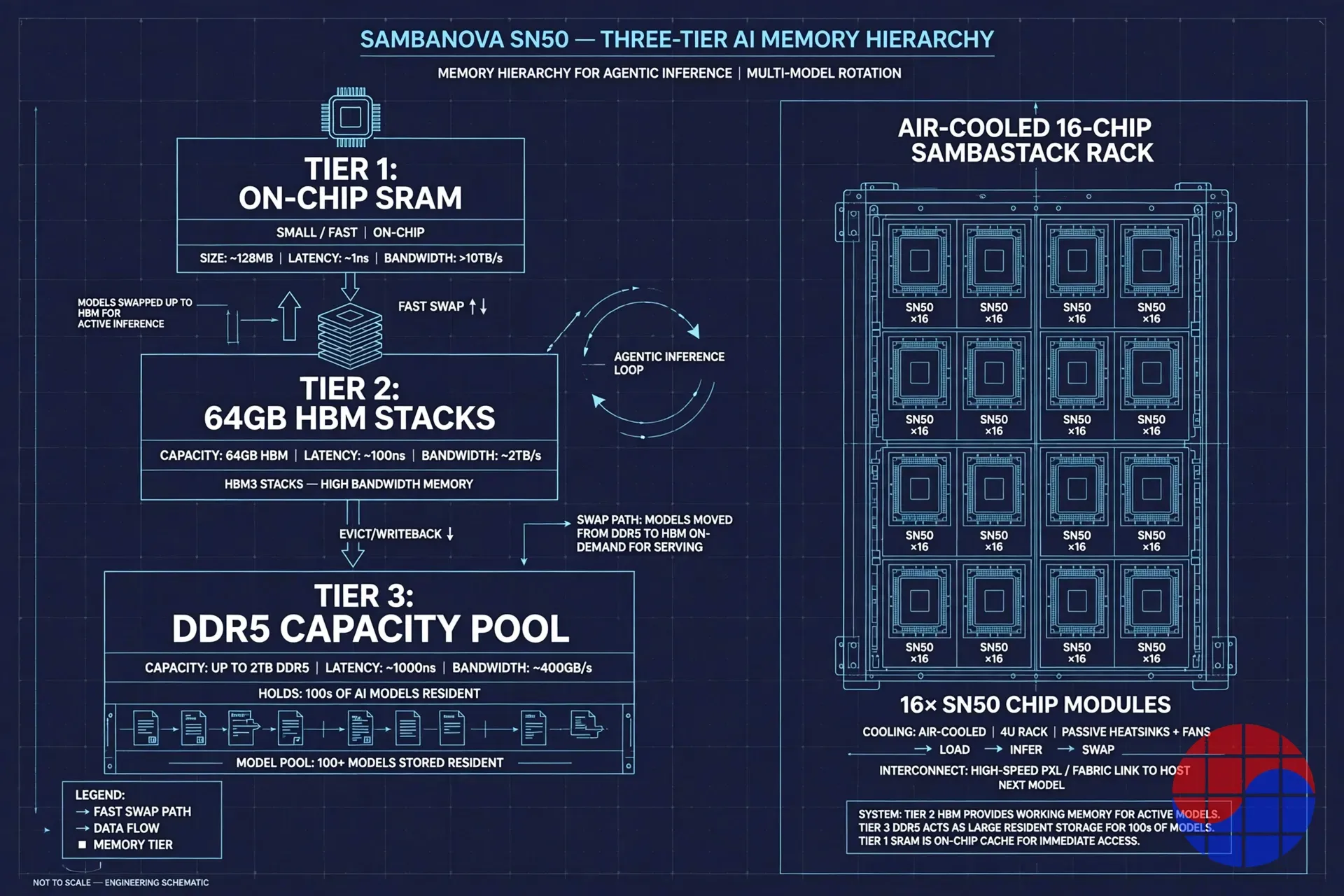
Every RDU carries a three-tier memory hierarchy, and this — not raw FLOPS — is the company's core argument. The SN40L combines 520 MB of on-chip SRAM, 64 GB of HBM, and up to 1.5 TB of directly attached DDR5; the SN50 keeps 64 GB of HBM and scales DDR5 to as much as 2 TB per chip. Models live in the DDR tier and are swapped into HBM at over 1.6 TB/s — the company cites under 0.01 seconds to switch to Llama 3.1 8B — so a single node can keep hundreds of models resident and serve them in rotation. That is exactly the access pattern of agentic AI, where one workflow calls a reasoning model, a coding model and a voice model in sequence. One deliberate choice stands out: the SN50 uses HBM2E, one generation behind the newest HBM. Management's stated logic is cost and supply — by not fighting GPU vendors for the latest HBM stacks, SambaNova keeps its bill of materials and its delivery schedule under its own control. HBM figures here are capacities in GB as published by the company; the architecture's capacity tier is DDR, not HBM.
SambaStack: selling the rack, not the chip
SambaNova does not sell accelerators the way a merchant silicon vendor does. The unit of commerce is SambaRack — a 16-chip, air-cooled rack (about 10 kW average draw for the SN40L generation, roughly 20 kW for SN50) — wrapped in SambaStack, the full software platform with orchestration, model bundles and enterprise integration. Customers buy it three ways: SambaStack installed on-premises or as a dedicated cloud, SambaCloud (API-based inference from SambaNova-operated data centers), and SambaManaged, a turnkey service that lets cloud and data center operators launch their own inference offering in about 90 days. This model changes the economics on both sides. The buyer skips the multi-quarter integration project that a bare GPU cluster demands — decisive for banks, governments and operators who have power and cooling in existing air-cooled halls but no CUDA engineering army. SambaNova, in return, captures the full stack margin — silicon, system, software and services — instead of a chip ASP, and locks the account into its compiler and orchestration layer.
Traction: the names are real, the numbers are not public
The customer evidence is specific at the top of the funnel. JPMorganChase selected SambaNova as its inference-infrastructure partner alongside the Series F, deploying SN40L and SN50 systems for secure on-premises inference — the kind of reference that sells to every other regulated bank. SoftBank is the first deployment partner for SN50 in its Japanese AI data centers. Intel is simultaneously investor, infrastructure partner and go-to-market channel. In Europe, OVHcloud built its Premium AI Endpoints on SambaRacks. The sovereign thread is equally concrete: SambaNova has announced roughly $140 million of investment in Saudi Arabia and a sovereign AI cloud with telecom operator stc, counts Saudi Aramco among its customers, took Saudi First Data money in the Series E, and added QIA in the Series F. What the company has not disclosed is current revenue: the last reported figure, roughly $100 million annually as of mid-2025, predates the SN50 cycle, and the company's statement of "record bookings and revenue" at the end of 2025 came without numbers.
What has to be true for $11 billion
Run the arithmetic. At the reported ~$100 million revenue base, $11 billion is more than 100x sales — a price that only forward volume can justify. Four conditions must hold. First, inference must keep taking budget share from training as agentic workloads multiply token volume; SambaNova's entire portfolio is priced on that shift. Second, SN50 must ship on schedule in H2 2026 and ramp — the Series F capital is explicitly earmarked to secure the supply chain, which management calls the binding constraint on fulfilling orders over the next 12 months. Third, sovereign and enterprise rack deals must convert from announcements into multi-rack, multi-year revenue, because a turnkey model with a handful of lighthouse customers is a project business, not a platform business. Fourth, the company needs revenue in the high hundreds of millions within roughly two years to make the entry price look like a growth multiple rather than a scarcity premium. The IPO the CEO says the company is strongly considering would then be the exit that validates the mark.
The downside case
The bear case is equally concrete. CUDA's software ecosystem remains the default, and every SambaNova win requires a customer to bet production workloads on a proprietary compiler. Hyperscalers are fielding their own inference silicon, and well-funded inference specialists compete for the same sovereign and neocloud budgets. On paper, the SN50's peak FLOPS and HBM bandwidth sit below the newest flagship GPUs — the company's answer is utilization and memory capacity, which only independent, apples-to-apples production benchmarks can settle, and those remain scarce. The model is also capital-hungry: $2.5 billion raised, a hardware cost base, and a supply chain that must be pre-funded before revenue lands. Finally, this exact asset was valued at $5.1 billion, then near $2.2 billion, then $11 billion inside five years. The volatility is itself information: the price is a negotiated private mark on a story, not a market-clearing quote.
Chase's Take
The honest way to read $11 billion is as the price of an option on the post-GPU inference stack, struck at the moment the market decided inference — not training — is where the durable money sits. What I find genuinely differentiated is not the dataflow architecture, which has been the pitch since 2017, but the alignment of three assets that rarely coexist in one challenger: a memory hierarchy designed for multi-model agentic serving, a turnkey rack that a bank or a ministry can actually buy, and a shareholder register — General Atlantic, Vista, Intel, QIA, SoftBank as a customer — that doubles as a distribution channel. The counterweight is that SambaNova has already lived one full hype cycle and one near-exit at $1.6 billion. Companies do get a second act in semiconductors when the workload changes underneath them, and agentic inference is a real workload change. But the burden of proof has moved from the chip to the income statement: SN50 revenue, disclosed or leaked, is the only datum that will matter in 2027.
Implications
- For the AI chip market: The Series F confirms that late-stage capital now prices inference specialists as infrastructure platforms, not component vendors — full-stack scope is the entry ticket.
- For sovereign AI buyers: Air-cooled, ~10–20 kW turnkey racks that hold data on-premises have become a purchasable category; SambaNova's Saudi and Japanese deployments are the reference cases.
- For enterprises: The JPMorganChase deployment gives regulated industries a peer precedent for non-GPU on-prem inference, weakening the "no one gets fired for buying GPUs" default.
- For investors: Watch SN50 shipment conversion and any revenue disclosure through 2027 — the $11 billion mark has no public financial anchor until then.
Note: SambaNova is privately held. Valuation figures are post-money marks from the company's announced financings (Series F first close, July 8, 2026); revenue is a reported figure, not an audited disclosure, and vendor performance comparisons are company claims unless independently benchmarked.
FAQ
Why is SambaNova valued at $11 billion?
The $11 billion is the post-money valuation of its Series F financing (first close of $1 billion, led by General Atlantic, announced July 8, 2026). It prices expected future inference infrastructure revenue — anchored by the SN50 chip, turnkey SambaStack racks, and customers such as JPMorganChase and SoftBank — rather than current reported revenue of roughly $100 million a year.
How is SambaNova's RDU different from a GPU?
A GPU executes a model's operations as scheduled instructions across fixed cores. SambaNova's Reconfigurable Dataflow Unit compiles the model graph onto a spatial array of compute and memory units, and pairs it with a three-tier memory system (SRAM, HBM, DDR) that keeps hundreds of models resident on one node and switches between them in milliseconds — a design aimed at multi-model agentic inference.
What is SambaStack?
SambaStack is SambaNova's turnkey AI platform: SambaRack systems (16 RDU chips, air-cooled) plus the full software stack for orchestration and model serving. It is sold as an on-premises or dedicated-cloud deployment, alongside SambaCloud (API inference) and SambaManaged (a managed offering for operators). Customers buy finished inference capacity, not bare chips.
Is SambaNova public, and what are the main risks?
No — SambaNova remains private, though its CEO has said an IPO is strongly considered. The main risks are CUDA ecosystem lock-in, competition from hyperscaler custom silicon and other inference chip startups, the capital intensity of a hardware business that has raised about $2.5 billion, and a valuation that moved from $5.1 billion (2021) to about $2.2 billion (early 2026) to $11 billion (July 2026) — a mark that requires rapid SN50 revenue growth to be validated.
📩 Subscribe to VLSI Korea
Get our daily semiconductor deep-dives delivered to your inbox first. Free to subscribe.