VLSI Korea
Micron Taiwan Strike Demands Explained: The 15% Profit-Sharing Fight and the 2026 Semiconductor Strike Map
Micron's Taiwan union is not on strike - it holds a strike mandate and a one-day walkout set for Oct 22. The demand: 15% of operating profit, shared permanently. Plus Samsung's 10.5% formula, SK hynix's 25-vote rejection, and TSMC's 30% bonus defense: the full 2026 chip strike map.


The 30-Second Summary
- Micron's Taiwan workforce is not on strike — yet. On October 7, 2026, the Taoyuan plant union won a strike-authorization vote, securing the legal right to strike. Its first actual action is a one-day solidarity strike announced for October 22, timed to the Taichung union's mediation session. No main strike date has been set, and as of October 20 no production disruption has been reported.
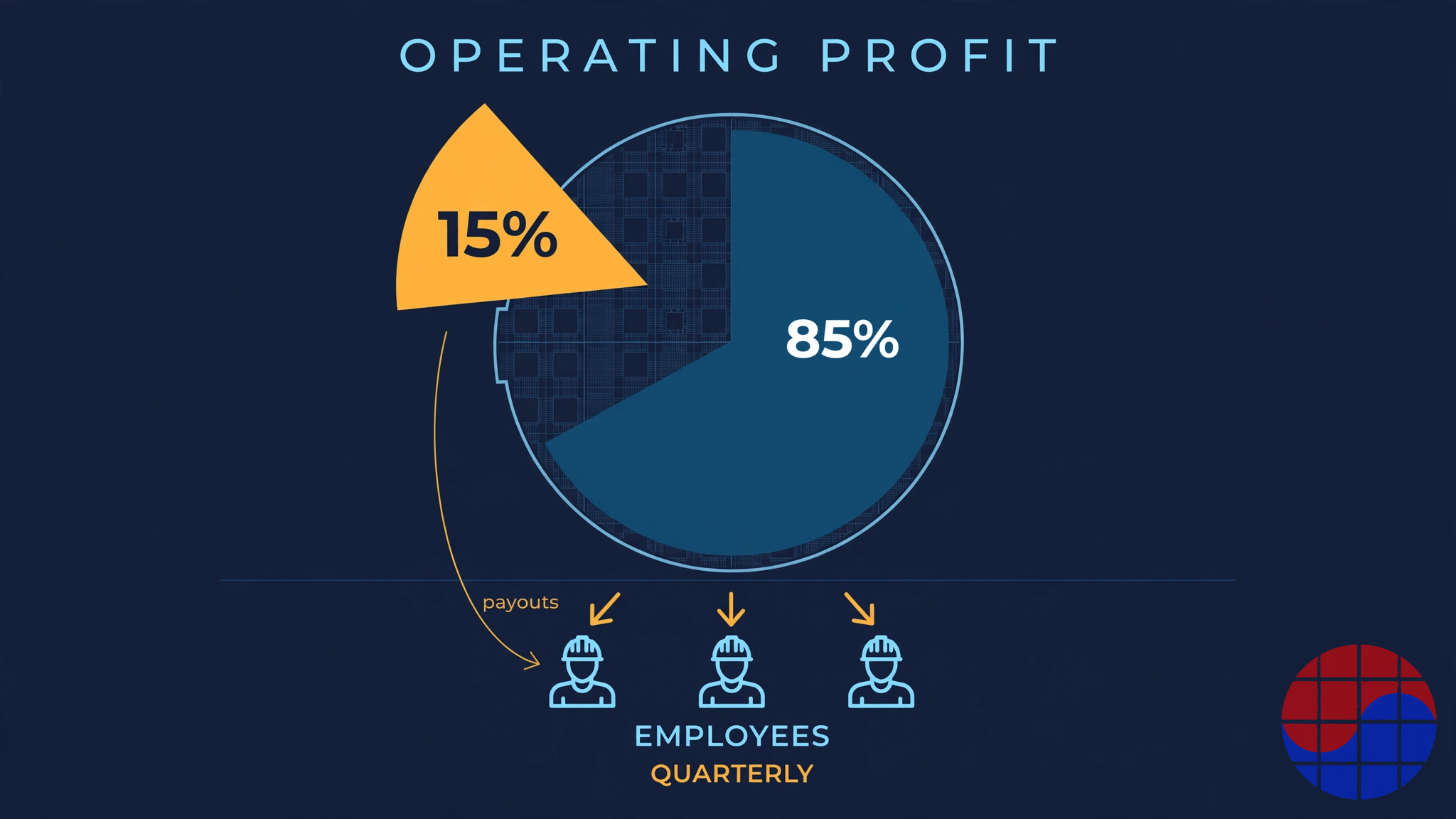
- The union's core demand is a formula, not a figure. From fiscal 2027, it wants 15% of operating profit permanently set aside as the employee bonus pool, paid quarterly. For fiscal 2026 it wants a one-time bonus on the same 15% basis — by the union's own estimate, roughly 83 months of pay per employee.
- 2026 is a turning point for chip-industry labor. Samsung Electronics' union won a bonus formula of 10.5% of divisional earnings with no cap, a day before an 18-day strike was to begin. SK hynix workers rejected a first deal by 25 votes over how profit-sharing is paid. At TSMC, talk of unionizing and striking forced the chairman to announce a 30% bonus increase in person.
- The common thread: with AI and HBM profits at record highs, workers across Asia's chip heartland stopped asking for discretionary bonuses and started demanding a verifiable percentage of profit, fixed in writing.
Micron Taiwan: What Is Actually Happening
The facts — a strike mandate and a one-day walkout, not a general strike
Micron employs about 15,000 people in Taiwan, its largest manufacturing hub, accounting for 50–60% of the company's total chip production. The Taoyuan site focuses on DRAM; Taichung hosts DRAM fabs and HBM advanced packaging. Micron has invested more than NT$1.6 trillion (about US$49.4 billion) in Taiwan.
Workers are organized in two plant-level unions, Taoyuan and Taichung, with roughly 12,000 members combined — over 80% of the workforce. The two unions coordinate joint demands.
The timeline: an internal union poll in August 2026 showed over 80% support for strike action. Mediation between Micron and the Taoyuan union broke down in September. The Taoyuan union then held a strike ballot from October 1 to 6 and announced the result on October 7: 2,012 of 2,258 eligible members voted, with 1,994 in favor, 14 against and 4 invalid — 99.1% of ballots cast, and 88.3% of all members. The vote secured the legal right to strike and to set up pickets, in what Taiwanese media described as the first strike authorization in the island's high-tech industry.
The union has deliberately left the main strike date open. Its chair has kept a "surprise strike," announced to members by text message, on the table, while applying pressure in stages. On October 19, about 2,000 workers joined a broader labor rally on Ketagalan Boulevard in Taipei; the Micron union stressed this was a rally, not a strike, and encouraged members to use annual leave. At that rally, the Taoyuan union announced a one-day solidarity strike on October 22, while the Taichung union holds its second mediation session that morning. If Taichung reaches a deal, the solidarity strike's purpose changes with it.
The government is involved. At the October 15 opening of Micron's new HBM advanced-packaging plant in Taichung, President Lai Ching-te publicly urged both sides to negotiate sincerely, and the labor ministry pressed Micron to table concrete, feasible proposals. Micron COO Manish Bhatia noted the new plant's entire 2027 output is already sold out — a reminder of the union's leverage at a plant that cannot make enough product.
The demands, in a table
| Demand | Detail | Notes |
|---|---|---|
| Permanent profit sharing | From FY2027, 15% of operating profit set aside as the employee bonus pool, paid quarterly | The point is a permanent system, not a one-off payment |
| One-time FY2026 bonus | 15% of FY2026 operating profit (about US$99.3 billion), i.e. roughly US$14.9 billion, paid as employee bonuses | Union estimate: about 83 months of pay per employee; the scope of who counts is disputed |
| Anti-free-rider clause | Restrict bonus eligibility for non-union members | Targets workers who would benefit without joining the action |
| No retaliation | A guarantee that union activity and strike participation bring no penalties | A precondition for exercising the strike right |
| Incentive-plan reform | Disclosure and overhaul of the annual incentive plan (IPP) formula | See "the war of numbers" below |
The stated demand is money, but what the union repeats is transparency and predictability. Micron's annual incentive plan (IPP) is discretionary: the company sets targets and payout ratios. The union says that structure cannot be trusted.
The war of numbers — 83 months versus 2.6 months
Two numbers define the dispute.
From the union's side: Micron's fiscal 2025 IPP achievement came in at 93.9%, and on that basis Taiwan employees' annual performance payout worked out to roughly 2.3 to 2.6 months of salary. The CEO's cash incentive over the same period equaled about 32.4 months of pay, and his 83,015 RSUs compare with an employee average of 207 shares — roughly 400 times more. The union frames this as a question of who captures the upside when the company wins.
From the company's side: the fiscal 2026 reward package includes a NT$1 million (US$32,100) cash bonus for eligible employees, and total fiscal 2026 compensation — salary, incentives and stock combined — amounts to 35 to 68 months of pay depending on the employee. The two sides are measuring different things: the union's "83 months" applies its demanded 15% formula to fiscal 2026 profit and divides by headcount, while the company's "35–68 months" is total annual compensation. The union rejected the package not mainly for its size, but because it is one-off and guarantees nothing about next year's rules.
The union's peer comparison has also been published: Samsung's chip division pays out 10.5% of divisional earnings; SK hynix's profit-sharing pool is 10% of operating profit; Macronix shares 15% of net profit; Nanya 6%; PSMC 5%; TSMC about 4.7%; Winbond 2% — while Micron sits around 2.2%. These are union-circulated figures, but they are plainly what mobilized the membership.
Impact on production and the stock
As of October 20, no strike-related production halt or customer delivery delay has been reported — no strike has actually taken place yet. The exposure is nonetheless real: Taoyuan is a DRAM site where even a short stoppage can affect yields, and the bigger variable is Taichung, where HBM packaging sits and 2027 output is sold out.
The stock moved on multiple factors. Micron shares fell about 16% over five sessions to October 14, with strike risk cited among the drivers alongside news about Chinese memory competition. The October 19 close near US$879 was about 28% below the record close of US$1,213.56 in late June — while Micron's fiscal 2026 revenue of about US$133 billion (up 256% year on year) and operating income of about US$99.3 billion are all-time highs.
The 2026 Global Semiconductor Strike Map
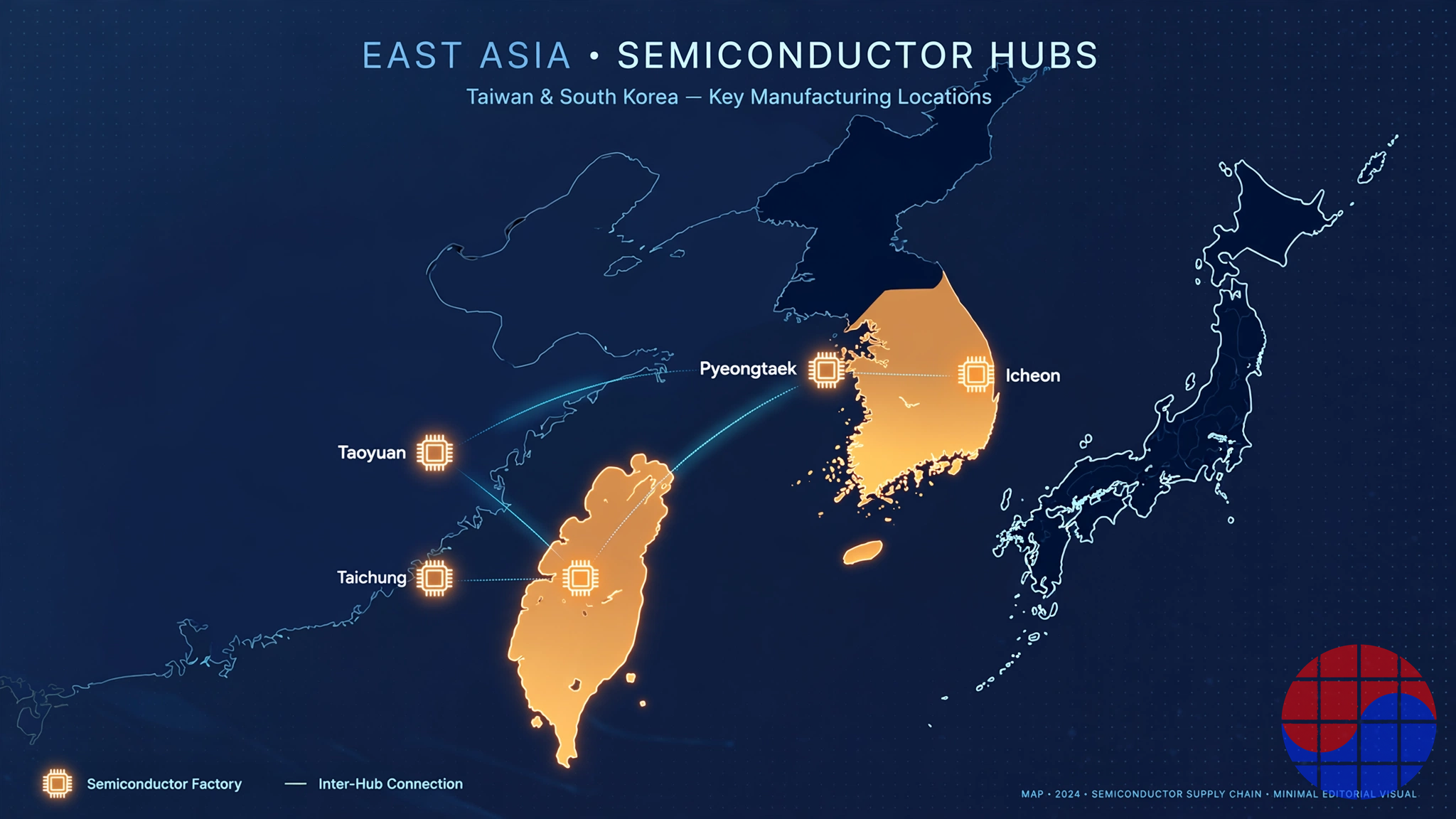
A full sweep of this year's chip-industry labor disputes produces a surprising result: no major semiconductor company has yet seen a production line stopped for an extended period in 2026. Instead, the rules of profit distribution have been rewritten at the stage just before a strike — strike resolutions, strike mandates, rejected deals. Four cases are verifiable, and their statuses are all different.
| Company | Region | Timing | Core demand | Status (as of Oct 20, 2026) |
|---|---|---|---|---|
| Micron | Taoyuan & Taichung, Taiwan | Sep–Oct 2026 | Permanent 15% operating-profit sharing; one-time FY2026 bonus | Strike mandate secured; one-day solidarity strike set for Oct 22; talks ongoing |
| Samsung Electronics | Pyeongtaek, Hwaseong, South Korea | Dec 2025–May 2026 | A formal bonus formula (union initially demanded 15% of operating profit) | Tentative deal a day before the strike; ratified May 27. 10.5% of DS earnings, uncapped |
| SK hynix | Icheon, Cheongju, South Korea | Aug–Sep 2026 | Keep the 10% profit-sharing pool; fight over the cash-versus-stock payout mix | First deal rejected by 25 votes; revised deal ratified Sep 16. No strike procedure |
| TSMC | Taiwan | May 2026 | Reverse a rumored ~15% bonus cut; raise compensation | No union exists. Chairman announced ~30% higher bonuses at a town hall; talk defused |
Samsung Electronics — the formula changed a day before the strike
Main bargaining began on December 16, 2025. On March 18, 2026 — the day of the annual shareholders' meeting — the union passed its second-ever general strike resolution in company history. Its opening demand was a bonus pool equal to 15% of operating profit. An 18-day general strike was scheduled to begin on May 21, with the union arguing that 18 days of stoppage would erase some 18 trillion won of operating profit.
The deal came on May 20, hours before the deadline. Its core: a new "special management performance bonus" for the Device Solutions (DS) chip division, funded at 10.5% of divisional earnings with no cap. Estimated payouts ran to about 600 million won per person in the memory business, about 470 million won in DS common organizations, and about 210 million won in foundry and System LSI. Members ratified the deal on May 27 with 73.7% of 62,616 voters in favor.
The aftermath matters too. The DX consumer-electronics division received only its existing bonus plus about 6 million won in shares, and the DS–DX compensation gap turned into an internal union conflict that resurfaced at a parliamentary audit on October 6. One formula redrew the company's internal fault lines.
SK hynix — the 25-vote rejection
SK hynix's 2026 dispute will be remembered not for a strike but for a rejected deal. The profit-sharing (PS) pool itself — 10% of operating profit — was not in question. The fight was over form: the company proposed changing PS from all-cash to 40% cash and 60% shares.
The first tentative deal failed ratification on August 25 by 25 votes: 7,535 against, 7,510 for. The revised deal set the default at 50% cash and 50% shares, added an option to shift the share portion in 10-percentage-point steps, and prepaid deferred portions. It passed on September 16 with 57.08% in favor (8,731 of 15,297 voters; 95.37% turnout). The lesson: workers now vote not only on how much they get, but on the form and the options attached.
TSMC — strike talk at a company with no union
TSMC has no union. Yet in May 2026, striking was openly discussed there. First-quarter net profit hit a record NT$572.5 billion, up 58% year on year — and then rumors spread that bonuses would be cut by about 15%. On employee forums, workers discussed forming a union, striking, and the 10.5% figure Samsung had just won.
Chairman C.C. Wei canceled a US trip and held a town hall. He announced this year's bonuses would be about 30% higher than last year and promised expanded 2027 raises for frontline and lower-ranked staff. No union was formed and no strike occurred. But at a company union-free since its 1987 founding, the fact that employees reached for the word "strike" marks the shift in Taiwan's chip labor climate.
A note on scope — the United States and Europe
In the interest of accuracy: we found no verified 2026 strike or strike authorization at a major US or European semiconductor company. In Germany, an industry-wide metal and electrical bargaining round opened in October 2026, with unions seeking a 5% raise and profit sharing at booming companies — but that is a sector-wide negotiation, not a chip-company dispute, and a peace obligation runs until October 31, so no warning strikes have occurred. The 2026 semiconductor strike map is, in fact, an Asian map — drawn in South Korea and Taiwan, where memory and HBM production is concentrated.
Why 2026?
First, profits became too large to leave distribution vague. Micron's fiscal 2026 operating income of about US$99.3 billion and record Korean memory profits turned "what percentage do we get?" from a slogan into arithmetic.
Second, benchmarks now travel across borders instantly. Samsung's 10.5% became the reference point in SK hynix's bargaining, appeared in TSMC employee discussions, and sits in the Micron union's comparison table. One company's settlement is the next union's opening position, at a speed that has no precedent.
Third, skilled labor's leverage peaked. HBM capacity is sold out into 2027 and every major maker is racing to build, so a walkout threat is strongest when demand is at its peak. The real stress test for these formulas comes when the memory cycle turns: a fixed percentage of a shrinking profit becomes a burden both sides will fight over.
Fourth, trust in discretionary bonuses collapsed. Micron's 93.9% IPP controversy is emblematic: when the company sets both the target and the achievement rate, employees suspect the bar was set low even in a record year. That is why this year's demands converge on the same thing — not "pay us more," but "fix the formula in writing." The heart of Samsung's settlement was not the money; it was the number 10.5% and the words "no cap."
Chase's Take
From a supply-chain seat, the story is not the strike. It is that profit-sharing formulas are being permanently wired into the memory cost structure. A claim on 10–15% of operating profit functions like a royalty on the AI boom. In good years both sides smile. In a downturn, these formulas collide head-on — which is why the first real walkout risk sits in the next downcycle, not this one.
For customers, near-term volume risk is small. The October 22 solidarity strike is a one-day signal, and even that is linked to the Taichung mediation outcome. The two indicators that matter: whether the Taichung union abandons mediation for a strike vote, and whether Taoyuan actually executes its threatened surprise strike.
For investors, labor is now an explicit variable in memory stocks. The five-day, 16% slide in Micron cannot be blamed on the strike alone, but if the 15% formula were won, at fiscal 2026 profit levels roughly US$14.9 billion a year would shift into labor cost — though that profit figure is itself a cyclical peak, so the formula's real cost will swing with the cycle.
The management lesson is simple. The moment a competitor publishes a formula, your discretionary bonus plan becomes a liability. Transparency is no longer a welfare policy; it is a retention tool for scarce engineers. As Samsung's 10.5% showed, once a number is public, it becomes the industry's floor.
Implications
- Supply chain: Near-term volume impact is limited, but the October 22 Taichung mediation — and whether the Taichung union moves to a strike vote — is the key variable for the fourth quarter. A surprise strike at Taoyuan could jolt DRAM spot prices briefly.
- Customers: With 2027 HBM output sold out, labor risk is now an item on procurement checklists, and one more argument for dual sourcing.
- Investors: Compensation at all three memory majors is converging toward formalized profit-sharing. Valuation models need an explicit line for it.
- Labor market: The first strike mandate in Taiwan's high-tech industry sets a precedent that reaches beyond Micron — the no-union assumption behind Taiwan's compensation model is being tested.
- Policy: When a labor ministry demands concrete proposals and a president personally urges negotiation, chip labor disputes have stopped being a private company matter.
FAQ
Q: Is Micron Taiwan actually on strike right now? A: No. The Taoyuan union secured the legal right to strike through a ballot concluded on October 7, 2026, and has announced a first, one-day solidarity strike for October 22, timed to the Taichung union's mediation session. No main strike date has been set, and no production halt had been reported as of October 20.
Q: What exactly is the Micron union demanding? A: Two things at the core: a permanent profit-sharing system paying 15% of operating profit into the employee bonus pool, quarterly, from fiscal 2027; and a one-time fiscal 2026 bonus on the same 15% basis, which the union estimates at about 83 months of pay per employee. The package also includes an anti-free-rider clause limiting benefits for non-members and a guarantee against retaliation for union activity.
Q: Has any 2026 semiconductor strike actually stopped production? A: Not among major companies, so far. Samsung Electronics settled a day before an 18-day strike was to start; SK hynix resolved its dispute through a re-vote on a revised deal without strike procedures; TSMC's dispute was defused at the discussion stage when management raised bonuses. If Micron's one-day solidarity strike goes ahead on October 22, it would be the first actual walkout at a major chipmaker this year.
Q: Does this threaten HBM or DRAM supply? A: Not yet. But with 50–60% of Micron's production in Taiwan and its 2027 HBM output already sold out, an escalation beyond symbolic action would matter. The next checkpoint is the outcome of the Taichung mediation on October 22.
Facts in this article were cross-checked against public reporting as of October 20, 2026. Union comparison figures and per-employee estimates are the claims of the respective parties and are labeled as such in the text.
📩 Subscribe to VLSI Korea
Get our daily semiconductor deep-dives delivered to your inbox first. Free to subscribe.