VLSI Korea
Startup Files #1: FuriosaAI — The AI Inference Chip Startup That Turned Down Meta's $800M
FuriosaAI rejected Meta's $800M offer in March 2025, became a unicorn with $246M raised, and began mass-producing its TSMC 5nm RNGD chip (FP8 512 TFLOPS, HBM3 48GB, 180W) in January 2026.


Let's start with the conclusion. FuriosaAI is a rare Korean AI chip startup that has proved in silicon why it had reason to turn down an $800M acquisition offer. Founded in Seoul in 2017, this fabless company reached a KRW 1 trillion valuation (unicorn) in July 2025 with $246M in cumulative funding, and began mass production of RNGD, its second-generation inference chip built on TSMC 5nm, in January 2026. After rejecting Meta's acquisition offer in March 2025, it has secured LG AI Research, Samsung SDS, and Equinix as customers and is moving toward an IPO in 2027–2028.
Company in a Nutshell
FuriosaAI is a fabless semiconductor startup headquartered in Seoul, founded in 2017. It designs NPUs dedicated solely to AI inference and outsources production to TSMC. It has an overseas base in Santa Clara, United States, and opened a Singapore subsidiary in September 2026.
- Founder and CEO June Paik — designed GPUs at AMD, returned to Korea in 2013, and led a small team developing new memory products at Samsung Electronics. Co-founder and CTO Hanjoon Kim is also from Samsung Electronics.
- CRO Jeehoon Kang — a KAIST professor (parallel systems) serves as chief research officer, and VP of Hardware Youngjin Cho is an SoC expert who was formerly a Corporate VP at Samsung Electronics.
- The company name comes from Furiosa, a character in the film Mad Max: Fury Road.
- CEO June Paik holds a 17.6% stake (based on public filings from mid-2025).
Core Technology
At the core of FuriosaAI is the TCP (Tensor Contraction Processor) architecture. It processes tensor contraction itself — not matrix multiplication (matmul) — as its native unit of computation. The idea has also been validated academically — two papers have been published: "TCP: A Tensor Contraction Processor for AI Workloads" (ISCA 2024) and "FuriosaAI RNGD: A Tensor Contraction Processor for Sustainable AI Computing" (Hot Chips 2024).
Why tensor contraction? The decoding stage of LLM inference is a memory-bound phase where memory bandwidth, not compute, is the bottleneck. How little data you move, and how efficiently you move it, determines tokens per watt. TCP is a design aimed squarely at that bottleneck.
Warboy (Generation 1, for Computer Vision)
Warboy is a data center computer vision inference accelerator built on the Samsung Foundry 14nm FinFET process (designed on SEMIFIVE's AI Inference SoC Platform). It reached first silicon in 2021, entered mass production in April 2023, and recorded one-shot silicon success.
- MLPerf Inference v1.1 (2021) — approximately 1.5x Nvidia T4 in object detection and image classification. It was the only startup to submit results with a silicon chip.
- MLPerf Inference Edge v2.0 (2022) — 2x performance improvement from compiler improvements alone on the same silicon. SSD-MobileNetV1 offline throughput of 8,762 vs. Nvidia A2 at 4,856 (approximately 1.8x).
- It was actually deployed in major Korean cloud data centers, and Kakao Enterprise tested it (reported in 2023).
RNGD ("Renegade", Generation 2, for LLM Inference)
This is the second-generation chip unveiled at Hot Chips (Stanford) in August 2024. It was co-developed with Taiwan's GUC (Global Unichip), runs at TSMC 5nm and 1.0GHz, and integrates two HBM stacks on a CoWoS-S interposer. According to the official developer documentation (developer.furiosa.ai), the key specifications are as follows.
| Item | RNGD |
|---|---|
| Process / Clock frequency | TSMC 5nm / 1.0GHz |
| BF16 / FP8 | 256 TFLOPS / 512 TFLOPS |
| INT8 / INT4 | 512 TOPS / 1024 TOPS |
| Memory | HBM3 48GB, 1.5TB/s (on-chip SRAM 256MB) |
| Interconnect | PCIe Gen5 x16 |
| TDP | 180W |
| Form factor | PCIe dual-slot, full-height 3/4 length, passive cooling |
| Virtualization / Security | Multi-instance 8, SR-IOV 8 VF, ECC, secure boot |
The product lineup consists of two offerings: the RNGD PCIe card and the NXT RNGD Server (launched in September 2025). The NXT server is a 4U server equipped with 8 cards, delivering 4 petaflops in FP8, with a total of 384GB of HBM3, total bandwidth of 12TB/s, and 3kW per server. Five of them can fit in a 15kW rack, whereas only one Nvidia DGX H100 (up to 10.2kW) fits in the same rack.
The software stack consists of a compiler, runtime, model compressor, profiler, and serving framework, is integrated with PyTorch 2.x, and supports TensorFlow Lite and ONNX. It also supports Kubernetes, container, and SR-IOV environments.
Mass production began in January 2026. The company received its first mass-production volume of 4,000 units from TSMC and began supplying customers in packaged and card form (TheElec, April 2026).
The third generation will be handled by the co-development partnership with Broadcom announced in May 2026. It is a chiplet-based rack-scale AI inference platform, with a 2nm compute die and HBM4/4E planned (reported by secondary sources).
Funding & Investors
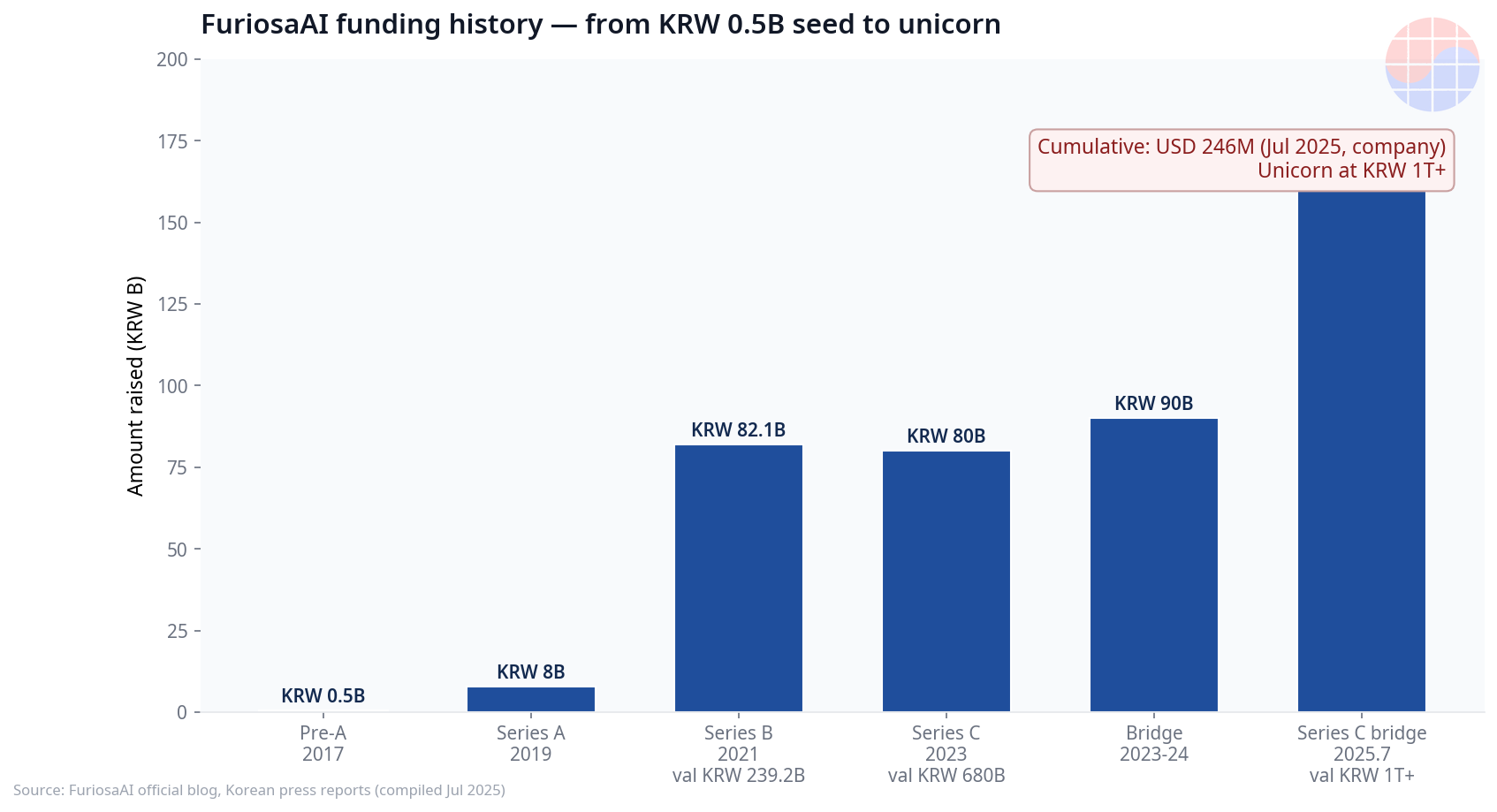
FuriosaAI's fundraising is a textbook case of phased scale-up over eight years. Based on the company's official announcements, cumulative funding is $246M (July 2025).
| Round | Timing | Amount | Key investors | Valuation |
|---|---|---|---|---|
| Pre-A | 2017 | ₩0.5B | Naver D2SF | — |
| Series A | 2019 | ₩8B | Industrial Bank of Korea, DSC Investment | — |
| Series B | 2021 | ₩82.1B | DSC Investment, IMM Investment | ₩239.2B |
| Series C | 2023 | approx. ₩80B | Mubadala, Qatar Investment Authority | approx. ₩680B |
| Bridge | 2023–24 | up to ₩90B | Industrial Bank of Korea | — |
| Series C bridge | 2025.7 | ₩170B (approx. $125M) | KDB (₩30B), Keistone (₩20B), PI Partners, Kakao Investment and approx. 40 investors in total | ₩1T+ (unicorn) |
With the July 2025 Series C bridge (₩170B, approx. $125M — KRW 170 billion, not "$170M"), its valuation exceeded KRW 1 trillion and it became a unicorn. It is currently raising a $300M–$500M pre-IPO / Series D (jointly advised by Morgan Stanley and Mirae Asset Securities, with an expected valuation of ₩2T–₩3T, reported by Bloomberg in January 2026). In May 2026, there were reports of a ₩800B direct investment from the National Growth Fund, but as of October 2026, whether it has closed has not been confirmed.
The Rejected $800M
Reports of Meta's acquisition talks first emerged in February 2025, and on March 24, 2025, FuriosaAI finally rejected the $800M (approx. KRW 1.1 trillion) offer (reported by Bloomberg). The reason the talks broke down was not price, but disagreement over business direction and organizational structure after an acquisition. Industry interpretation suggests Meta was aiming less at entering the AI semiconductor market itself than at securing a proven system and talent to develop custom chips for its own AI services. Four months after the rejection, the company became a unicorn, and six months later it began mass production.
Traction
FuriosaAI's customer list in 2025–2026 is unusually solid for an inference chip startup.
- LG AI Research (July 2025) — official supply agreement for RNGD for the EXAONE LLM. It was selected after months of evaluation and will be applied to the EXAONE 3.5 model and the enterprise AI agent ChatExaone. Based on company announcements, it delivers 2.25x inference performance per watt versus GPU-based solutions and 3.75x the token generation in a rack at the same power.
- Samsung SDS (October 2026) — NPU-as-a-Service (the first in Korea) offering RNGD on Samsung Cloud Platform. It has deployed RNGD at the Dongtan IDC and provides on-demand instances in units of 1/2/4/8 cards (supply began in July 2026).
- Equinix Lisbon (July 2026) — the first commercial RNGD deployment in Europe. It built an RNGD-based AI inference hub at the Lisbon LS2 data center.
- Stockholm 15MW project (August 2026) — building a 15MW AI inference data center together with Velox and I/ONX HPC. Phase 1, 2MW (operating in early 2027), will use 1,800 RNGD units, with more than 8,800 units to be deployed at full expansion.
- Kakao 'AI for Everyone' consortium (August 2026) — participating in the Kakao-led consortium for a project selected by the Ministry of Science and ICT.
- Aramco — testing and sampling RNGD (reported in December 2024). A bridgehead for expansion into the Middle East.
Public benchmark figures (company-reported, not independently verified) are as follows: up to 3x inference performance per watt versus Nvidia H100, 7.4x concurrent user throughput at the same power versus RTX Pro 6000 (Renegade Summit, March 2026), approximately 40% reduction in data center TCO, and 2,000–3,000 TPS per card for Llama 3.1 8B.
Moat Analysis — VLSI's View
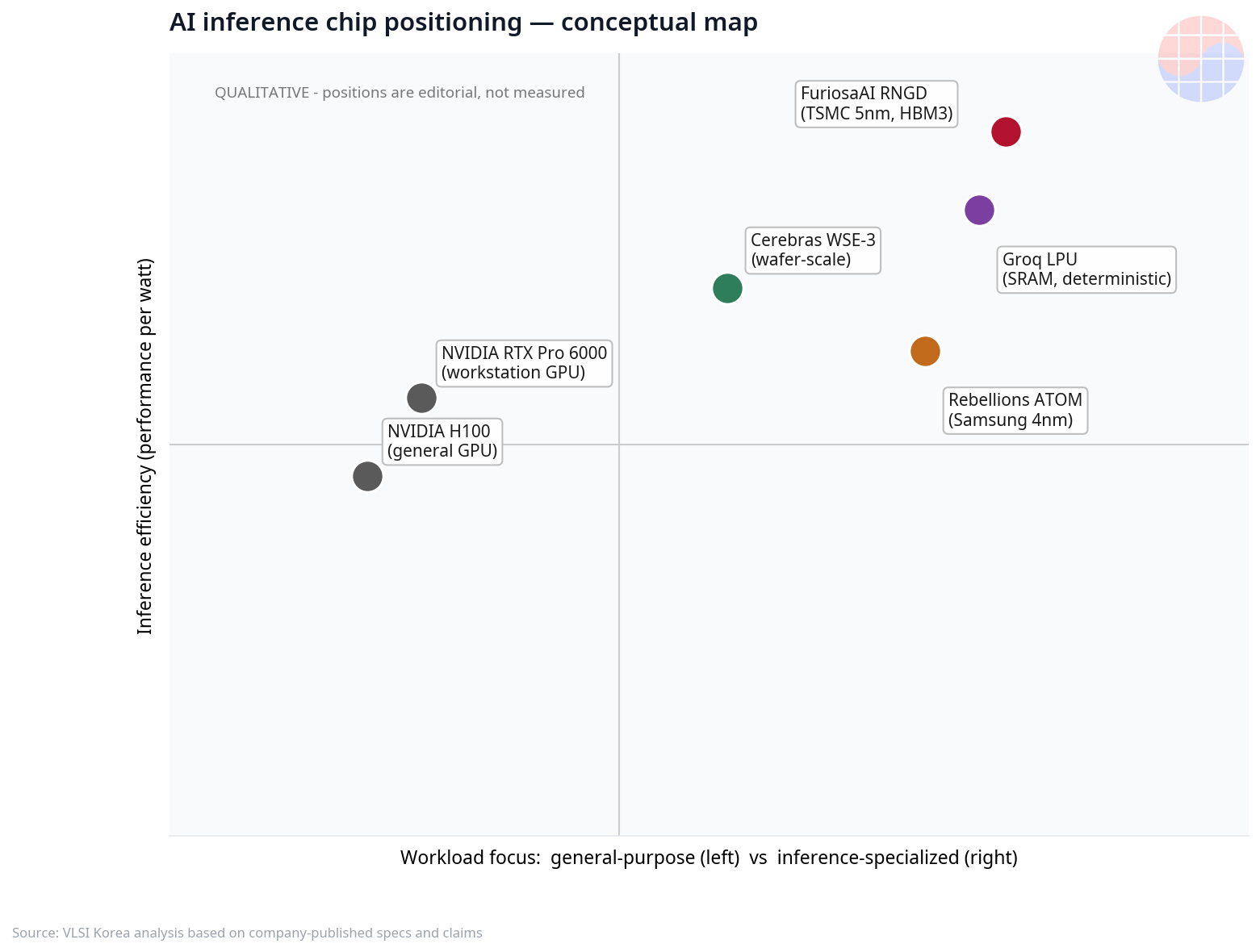
Moat 1 — The academic foundation of the architecture. TCP is not a marketing slogan but an architecture validated in an ISCA 2024 paper. The starting point of the design is the judgment that the battleground of the inference market is not training, but the memory-bound decoding stage. Unlike Groq, which chose an SRAM-centric deterministic path, FuriosaAI chose the practical path of putting a 70B-class model on a single card with HBM3 48GB. Both paths are valid, but the HBM path looks in the same direction as the memory expansion roadmap of existing data centers.
Moat 2 — Software proved by the compiler. At MLPerf 2022, it extracted 2x performance from the same Warboy silicon through compiler improvements alone. Inference is a software-defined race, and this company has shown in numbers that its software team works as hard as its hardware team. From an STA and timing perspective, timing closure for a CoWoS-S interposer and HBM3 PHY (1.5TB/s) at TSMC 5nm and 1.0GHz is no easy tape-out. Warboy's one-shot silicon success and the co-development of RNGD with GUC are evidence of execution.
Moat 3 — The economics of tokens per watt. RNGD's TDP is 180W, compared with H100's 350W. CEO June Paik said at the Renegade Summit (March 2026) that "by 2030, global AI data centers will add 100GW, and 70% of that will be for inference." Inference is a game of tokens per watt, and in an era when power infrastructure is the bottleneck, a 180W card changes the freedom of rack design.
Risk — Revenue must catch up with valuation. Revenue in 2024 was ₩3B, and net loss was ₩152.2B (public filings, cited by Bloomberg). A ₩1T+ valuation is a bet on future revenue. Nvidia's CUDA and supply chain moat remains intact, and customers are also concentrated in a small number, including LG and Samsung SDS. The closing of the $300M–$500M pre-IPO round is also unconfirmed. In Korea, a two-player structure with Rebellions is taking shape — Rebellions uses Samsung 4nm, has received investment from Samsung and SK, and is targeting a KOSPI listing in the first half of 2027. However, the inference market is more likely to become a market segmented by workload than a winner-takes-all market.
Chase's Take. The reason I follow this company is not the nerve to reject $800M. It is the execution to become a unicorn four months after rejecting it, and to receive mass-production volume from TSMC six months later. FuriosaAI has passed in silicon the point where many AI chip startups stop at presentations. There are three indicators to watch going forward: whether the 8,800 units for Stockholm convert into actual recurring revenue, whether the pre-IPO round closes, and whether quarterly revenue gets on track before the 2027–2028 IPO. If all three align, the $800M rejection becomes legend; if even one goes wrong, it becomes an expensive lesson.
Verdict
A rare case that proved in silicon the technical basis to reject Meta's $800M — what it needs now is revenue.
FAQ
What kind of company is FuriosaAI?
It is an NPU fabless company dedicated to AI inference, founded in Seoul in 2017. Led by founder and CEO June Paik (formerly AMD and Samsung Electronics), its core architecture is the Tensor Contraction Processor (TCP). In July 2025, it became a unicorn (valuation of KRW 1 trillion or more) with $246M in cumulative funding.
What are the key specifications of the RNGD chip?
It is a second-generation inference chip based on TSMC 5nm and 1.0GHz, supporting FP8 512 TFLOPS, INT8 512 TOPS, INT4 1024 TOPS, HBM3 48GB (1.5TB/s), TDP 180W, and PCIe Gen5. It was unveiled at Hot Chips in August 2024 and began mass production in January 2026.
Why did it reject Meta's $800M acquisition offer?
It finally rejected the offer on March 24, 2025 (reported by Bloomberg). The reason the talks broke down was not price, but disagreement over business direction and organizational structure after an acquisition. Since then, the company has followed an independent growth path, becoming a unicorn and beginning mass production.
What is its funding status and IPO plan?
As of July 2025, it had raised $246M cumulatively, and it is currently raising a $300M–$500M pre-IPO / Series D (expected valuation ₩2T–₩3T). Its IPO target is 2027–2028.
Limitations of the evidence: The performance per watt, TCO, and concurrent user comparison figures in this article are based on announcements by the company or its customer (LG AI Research) and have not been independently verified. As of 2026-10-18, whether the 2026 pre-IPO round and the National Growth Fund investment have closed has not been confirmed.
Key sources: FuriosaAI official blog (Series C bridge announcement) · FuriosaAI developer documentation (RNGD specifications) · Pulse (unicorn report) · Korea Herald (Renegade Summit) · Data Center Dynamics (Samsung SDS NPUaaS) · TheElec (mass-production volume)