VLSI Korea
Tensordyne Deep Dive: The LNS Inference Chip That Turns Multiplication Into Addition, and What the $1B Price Really Is
Tensordyne's Napier chip bets on LNS math to remake inference costs. Its $176M raised checks out, but the ~$1B valuation rests on a secondary-market estimate and the company's own number — and every performance figure is still simulation.


30-Second Summary
Tensordyne is a US–German AI chip startup betting that a logarithmic number system (LNS) — turning multiplication into addition — can cut the cost of AI inference. Founded in 2017 as Recogni to build automotive vision chips, it rebranded to Tensordyne in September 2025 and pivoted to data center inference. Its first data center chip, Napier (TDN), announced on June 15, 2026, has taped out on TSMC 3nm and is in wafer fabrication. On its own simulations, the company claims 13x the throughput (tokens per second) and 17x the energy efficiency (tokens per watt) of an Nvidia GB300 NVL72 rack. Total funding of roughly $176 million (about KRW 246.4 billion at KRW 1,400 per dollar) is cross-confirmed across multiple reports. The roughly $1 billion valuation is a different matter: it is not a post-money value disclosed in any primary funding round. It rests on a secondary-market platform estimate (about $992 million) combined with the company's own estimate, and it has not been independently verified. This article asks one question: how should you read the price of a company with this little verified information?
Background — From Automotive Vision to Data Center Inference
Tensordyne began in September 2017 as Recogni. Its co-founders are R.K. Anand (Chief Product Officer) and Gilles Backhus (Head of AI), with Emily Stuart also listed as a co-founder. Anand built his career at Sun Microsystems and Juniper Networks; Backhus, a Technical University of Munich graduate, worked on full-duplex wireless research at Stanford. Their shared background is signal processing and communications rather than processors per se — a thread that reappears in the company's cell-based network-on-chip and low-latency fabric design.
The original Recogni targeted vision inference for autonomous vehicles. In December 2020 it introduced Scorpio, a 1 PFLOP-class vision inference product claiming sub-25W power and sub-10ms latency. But automotive silicon has long design-to-revenue cycles and volumes that cannot compare with data centers. Around the arrival of CEO Marc Bolitho — a former ZF Group executive who joined in July 2022 — the company began shifting its center of gravity toward generative AI inference.
The funding history is comparatively well documented. A $25 million Series A in 2019 and a $48.9 million Series B in 2021 were followed on February 20, 2024 by a $102 million Series C co-led by Celesta Capital and GreatPoint Ventures, with existing investors Mayfield, DNS Capital and BMW i Ventures joined by Pledge Ventures and Tasaru Mobility Investments, a subsidiary of Saudi Arabia's Public Investment Fund, plus debt from HSBC Innovation Banking. The company did not disclose a valuation for the Series C. Later extension rounds appear in databases without disclosed amounts. The company rebranded to Tensordyne in September 2025, unveiled Napier in June 2026, and says a Series D is in preparation. It is headquartered in Sunnyvale, California (earlier listed as San Jose), with an office in Munich, and reports put headcount at roughly 120–150.
One caveat frames everything that follows. Almost everything public about this company comes from company announcements, a company whitepaper and executive interviews. As of October 2026 there is no independent benchmark, no named production customer case study and no audited revenue figure in the public record. Every performance number in this article must be read with that premise.
Business Deep Dive — The Substance of the LNS Bet
The core idea: multiplication becomes addition
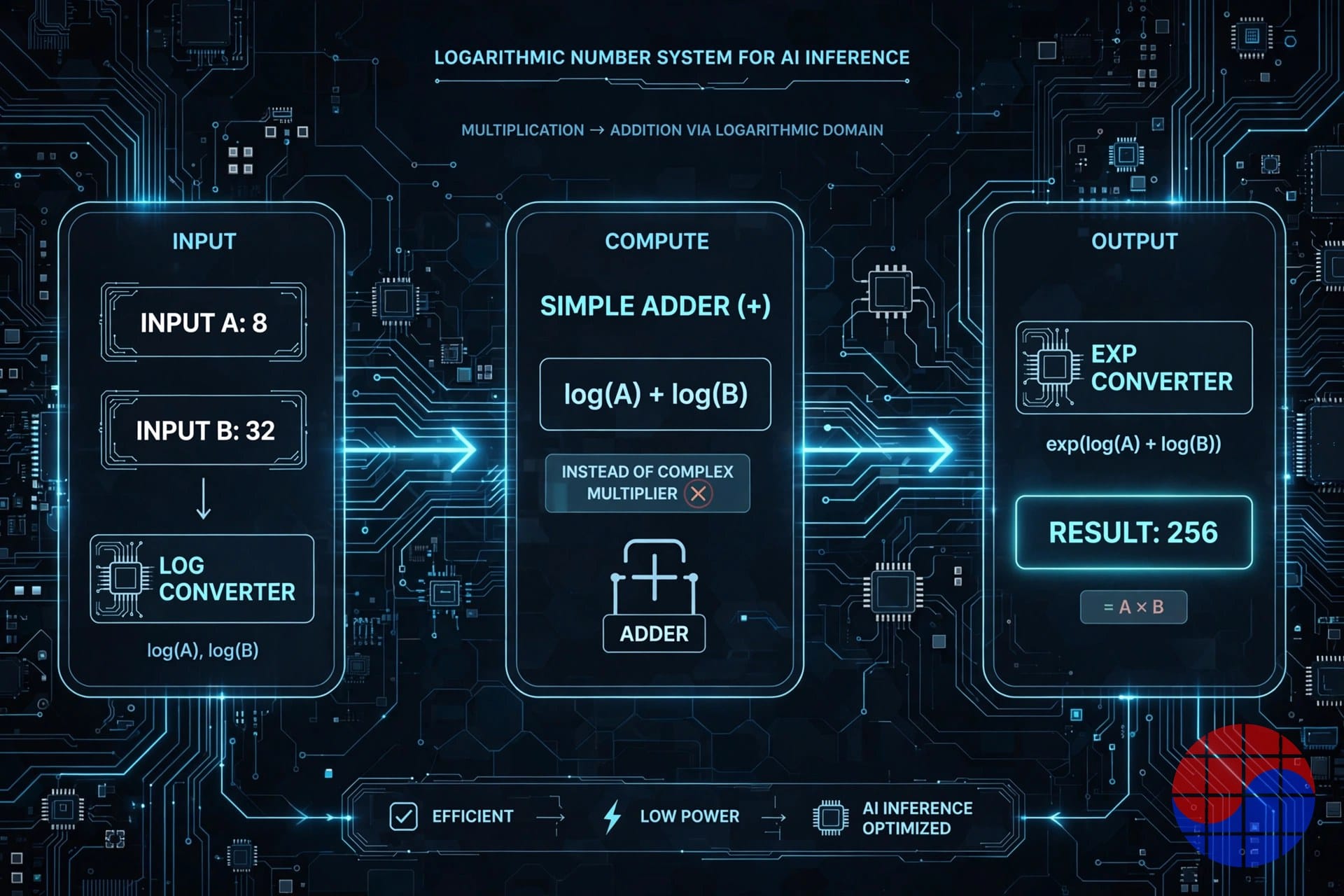
Neural network inference is dominated by matrix multiplication — endless multiply-accumulate operations. A floating-point multiplier costs far more silicon area and energy than an adder. LNS routes around it: since log(A×B) = log(A) + log(B), converting numbers into the log domain once turns multiplication into addition. It is the same principle behind the logarithm tables John Napier published in 1614 to ease astronomical calculation, and the chip's name honors him. Tensordyne calls the gain the "zeroth scaling law" — a benefit that sits underneath every other design decision.
The circuit-level numbers the company presents are striking: where a conventional 16-bit floating-point multiply costs about 1.1 pJ and 1,640 µm², its logarithmic version allegedly does the same work in about 0.05 pJ and 67 µm² — roughly 22x less energy and 25x less area. At system level, however, the claimed gains shrink to roughly 3x compute area and 5x compute power in the company's own whitepaper summary. That gap between circuit math and system math is the first clue in reading this bet: the multiplier is not the only bottleneck.
Why LNS never went mainstream in four decades
LNS is not new. It has been studied for decades without ever being productized in dedicated hardware, for three reasons. First, addition in the log domain is hard: accumulating multiply results requires an expensive approximation function (the Gaussian logarithm). Second, conversion between the linear and log domains costs time and precision, especially near zero and when accumulating many small values. Third, much of inference is memory-bound rather than compute-bound — cheaper multiplication does nothing for the cost of fetching data from HBM.
Tensordyne's IP claim sits exactly on the first point. Its proprietary number system, Pareto (TDN Math), is said to rest on an efficient approximation for log-domain addition and its hardware implementation. The company says models run without retraining or calibration, and that it has validated accuracy through bit-accurate emulation across language, mixture-of-experts, image, audio and video models, with a software stack that hides the conversion and supports PyTorch and Triton. If true, the largest historical barrier has been crossed. But the evidence so far is internal emulation, not measured silicon.
The Napier chip and the TDN72 system
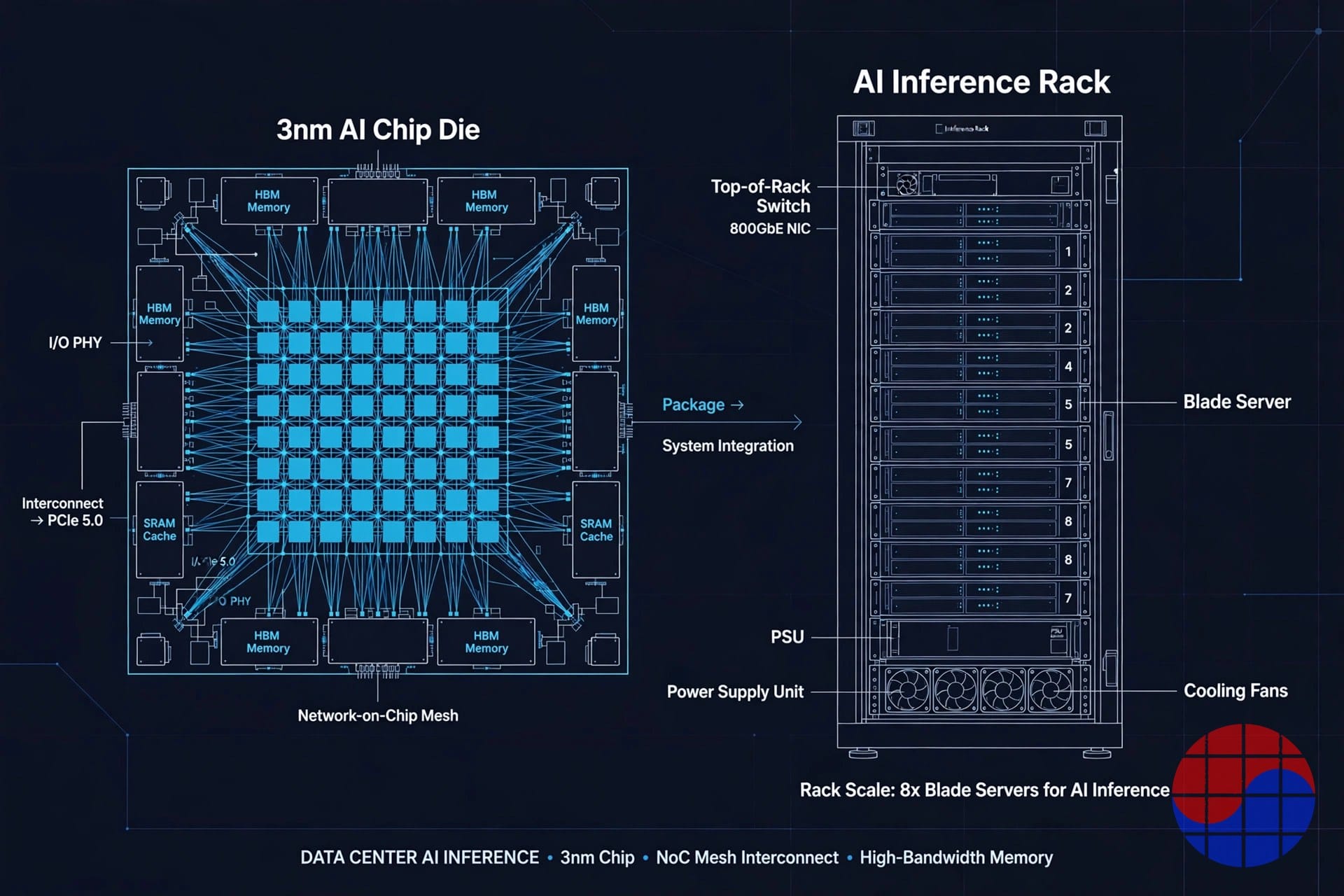
The verifiable hardware specifications are as follows. The Napier (TDN AIP) processor is built on TSMC 3nm with 138 billion transistors, a 300W package power, 2.11 PFLOPS of dense FP8 compute, 256MB of SRAM and 144GB of HBM3e. It has 48 compute cores, with RISC-V cores handling in-loop work such as MoE routing. The TDN LINK scale-up fabric claims sub-1-microsecond single-hop latency and ties 72 chips into one pod.
| Item | Napier (company figures) |
|---|---|
| Process | TSMC 3nm, taped out, in wafer fabrication |
| Compute | 2.11 PFLOPS dense FP8, 300W |
| Memory | 144GB HBM3e, 256MB SRAM |
| TDN72 pod (72 chips) | 30kW, air-cooled, 10.4TB HBM |
| Full rack (4 pods, 288 chips) | 608 PFLOPS FP8, 42TB HBM, 120kW, air-cooled |
The partner roster is one of the company's few hard signals. Broadcom co-designed the silicon, TSMC manufactures it, and HPE Juniper supplies the scale-up chassis and fabric; Juniper is also an investor. A 3nm tape-out costs tens of millions of dollars and requires passing the diligence of an ASIC partner like Broadcom — indirect but real evidence of the ability and funding to build actual silicon.
The performance claims, and what they are
The headline claim, on a DeepSeek-R1 workload, is 363,000 tokens per second per rack against 27,400 for an Nvidia GB300 NVL72 rack — 13x. Per megawatt, the company cites 3 million tokens per second against 183,000 — 17x. On a 2-trillion-parameter MoE model, it says one of its racks does the work of a nine-rack competing combination, delivering 1,300 tokens per second per user at about $11 per million tokens versus about $150. Every one of these figures comes from company modeling and simulation. Some baseline figures were drawn from public benchmark data, but there is no measured Tensordyne silicon result. The chips are only now coming out of the fab: a development cloud is promised for late 2026, beta systems for Q1 2027, and production shipments for the second half of 2027 (some reports say Q2).
Customer signals: an LOI is not revenue
The commercial signal amounts to "more than $200 million in forecasted demand." The company says more than a dozen firms have signed letters of intent to evaluate beta systems, and two infrastructure providers have been named as showing interest. An LOI, however, is not a binding purchase order, and no paying production customer or revenue figure has been disclosed. Historically, LOI-to-revenue conversion for AI chip startups is low. Read this signal as interest, not as confirmed demand.
Chase's Take — Why Does the Market Price It This Way?
So where does "about $1 billion" come from? Cross-checking shows it is not a price set by a new investment round. The company disclosed no valuation even at its large February 2024 Series C. The closest public number is a secondary trading platform's implied valuation of about $992 million as of October 2026. A secondary-market estimate is a reference price derived from a handful of trades and quotes — not a price an institutional investor signed after diligence. Layer the company's own estimate, floated ahead of a Series D, on top of that, and you get "about $1B." Distinguishing these two very different kinds of numbers is the starting point for reading this company.
In won terms, that is roughly KRW 1.4 trillion (at KRW 1,400 per dollar) — about 5.7x the roughly KRW 246.4 billion the company has raised. For a company at or near pre-revenue to carry that price, the market is effectively betting on three things at once: that the LNS accuracy barrier really has been crossed; that even half the simulated advantage, if measured, changes inference cost structure; and that by the 2027 ship date the inference market will be far larger, with power as the central purchasing criterion. If any one of the three fails, the price gets reset quickly.
To be fair, the bet is not baseless. Power and cooling genuinely are a rising share of inference cost, and an air-cooled 120kW rack is a real attraction for existing data centers facing liquid-cooling retrofits. The Broadcom–TSMC–HPE Juniper combination is not what a paper company assembles. The downside is equally clear: unmeasured performance, a pre-revenue commercial stage, and an incumbent that does not stand still. When Napier ships in late 2027, the competing rack will also have moved a generation. The 13x gap is less "tomorrow's rack versus today's rack" than "our future rack versus their current rack."
My read: Tensordyne is a bet that changing the number system changes the slope of inference cost itself — a bet that, if verified, reshapes industry structure. But as of October 2026, the evidence for that bet is simulation, not silicon. The price should therefore be read as an option price, not a technology price: an asset close to binary, whose value steps sharply up or down the moment measured data arrives. There is no need to take the $1 billion at face value, and no basis to dismiss it as fabrication either. It is a reference price to hold while waiting for two things: what institutions actually sign in the Series D, and what third parties measure when the development cloud opens in late 2026.
Implications — What to Watch
For investors: three checkpoints. (1) The actual post-money valuation of the Series D and who leads it. (2) Independent measurements from the late-2026 development cloud — above all tokens per watt and whether model accuracy holds. (3) Whether LOIs convert into paid betas and production contracts. Until those land, $1 billion is an expectation the market has priced, not a verified value.
For the industry: whatever Tensordyne's fate, the question it raises survives. The fact that an attempt to shake a 40-year floating-point convention at the number-system level has reached a 3nm tape-out with top-tier partners shows the axis of inference competition moving from "a bigger GPU" to "a cheaper token." The contest over number formats and quantization will continue with or without LNS.
For Korean semiconductors: each Napier chip carries 144GB of HBM3e; a full rack carries 42TB. If inference-only ASICs like this begin shipping in volume, HBM demand widens from a single GPU customer base to many ASIC vendors — an opportunity for customer diversification, and a burden as each ASIC brings its own memory specification and qualification process.
Note on source limits: company information in this article was cross-checked against public company announcements, whitepaper summaries, press interviews and transaction databases available as of October 19, 2026. All performance figures are company claims and have not been independently verified; the valuation is not a disclosed primary-round figure. Revenue, customer and order figures that could not be confirmed were left out.
FAQ
Is Tensordyne's $1 billion valuation a confirmed figure?
No. The company has never disclosed a valuation for any round, including the 2024 Series C. The roughly $1 billion rests on a secondary trading platform estimate (about $992 million, October 2026) and the company's own estimate. That is a different kind of number from a post-money valuation set by institutional investors in a primary round. The Series D disclosure is the event that can confirm or reset it.
Why is LNS only reaching silicon now?
The principle is old, but log-domain addition and conversion precision were the barriers. Multiplication becomes cheap addition, yet accumulating the products and handling values near zero stayed expensive and imprecise. Tensordyne claims its Pareto number system's approximation crosses that barrier — but the evidence is internal emulation, and measured silicon results have not been published.
Can the 13x and 17x performance claims be trusted?
For now they should be treated strictly as company simulation results. Both figures come from company modeling on a DeepSeek-R1 workload, and with chips still in fabrication there is no independent measurement. Third-party numbers from the development cloud promised for late 2026 are the first real checkpoint.
When can customers buy Tensordyne systems?
On the company's schedule: a development cloud in late 2026, beta systems in Q1 2027 and production shipments in the second half of 2027. The commercial evidence so far is limited to the company's statements of 12-plus evaluation LOIs and more than $200 million in forecasted demand; no binding production contract or revenue has been disclosed.
📩 Subscribe to VLSI Korea
Get our daily semiconductor deep-dives delivered to your inbox first. Free to subscribe.