VLSI Korea
Tenstorrent at a $6.2 Billion Valuation: Jim Keller's Open RISC-V AI Chip Bet, Explained
Tenstorrent closed a $1.5 billion Series E at a $6.2 billion post-money valuation on October 19, 2026. Blackhole and Galaxy traction, the TT-Ascalon RISC-V CPU IP licensed by Samsung and LG, and the Korea connection — an anatomy of why the market pays this price.


On October 19, 2026, Tenstorrent announced it had closed a $1.5 billion Series E at a $6.2 billion post-money valuation — up from $2.6 billion in December 2024, in under two years. Why does the market pay this price? The answer is not a single chip. It is an option on an open architecture: a company that sells a RISC-V CPU and AI cores in the same breath.
30-Second Summary
- Latest valuation: Tenstorrent closed its $1.5 billion Series E on October 19, 2026 at a $6.2 billion post-money valuation (about KRW 8.68 trillion at KRW 1,400 per dollar). Trace Capital and Innovation X led the round, joined by ARK Invest, Fidelity, Morgan Stanley, SanDisk and T. Rowe Price, among others.
- Previous round: The December 2024 Series D raised more than $693 million at a $2 billion pre-money and roughly $2.6 billion post-money valuation, led by Samsung Securities and AFW Partners, with Bezos Expeditions, LG Electronics and Hyundai Motor Group participating. The "$2.7 billion" figure often quoted for that round is an approximation of the same post-money value.
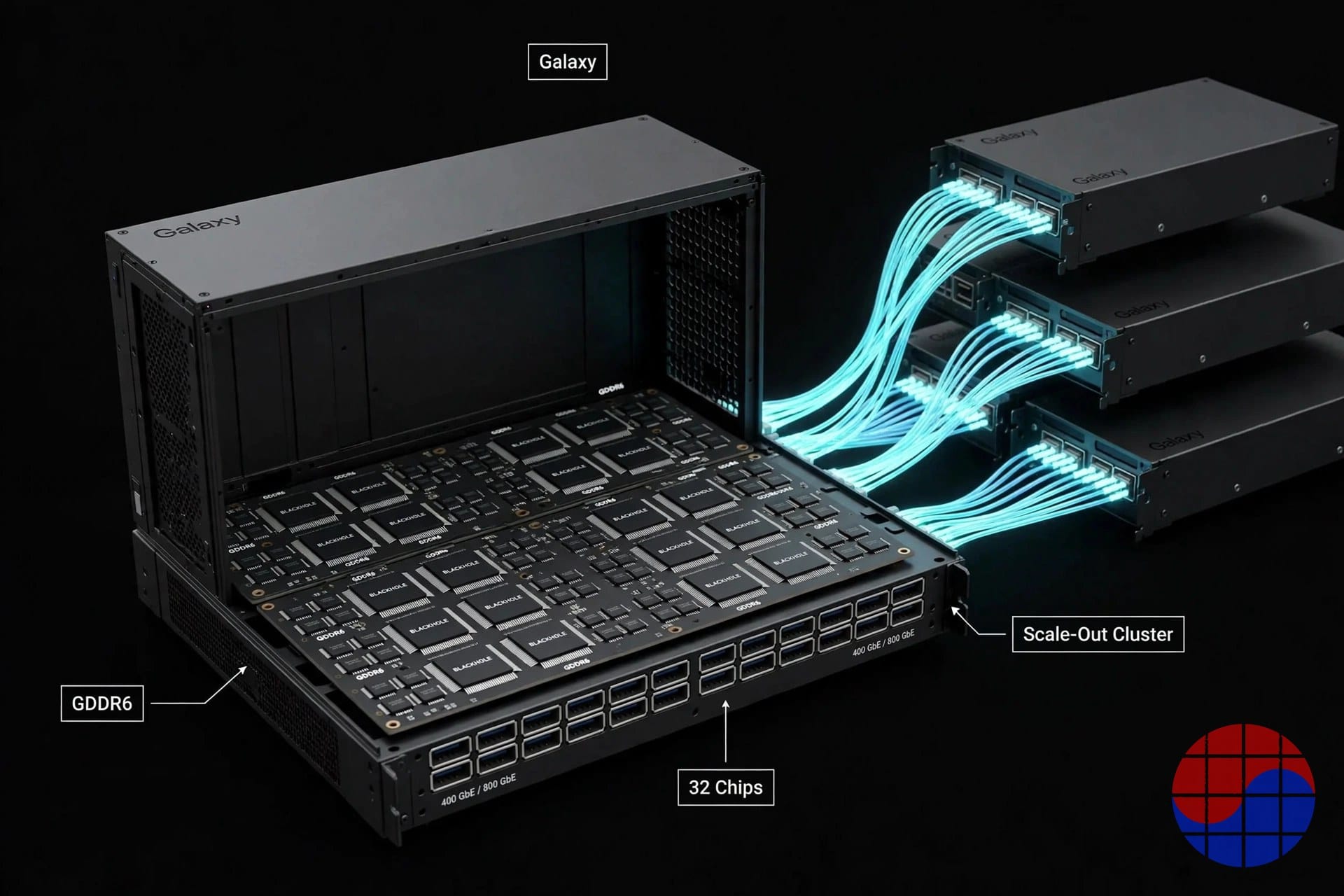
- What it sells: Three things — Blackhole AI accelerator cards (from $999 for the p100a), Galaxy Blackhole servers packing 32 chips (from $110,000, 23 PFLOPS of Block FP8), and IP licenses for the TT-Ascalon RISC-V CPU and Tensix AI cores. Samsung and LG are licensing customers.
- What the price really is: $6.2 billion is not a price on current revenue. Revenue is undisclosed, and reported cumulative contracts stood at roughly $150 million as of late 2024. The price pays for the probability that an open stack — RISC-V, open chiplets, open-source software — becomes a real second ecosystem, and for the execution record of Jim Keller's team.
- What must hold: A Galaxy production ramp, IP licensing that turns into recurring revenue, a maturing software stack, and an open IPO path — all four at once. If one slips, the downside starts with the software ecosystem gap.
Summary table: Tenstorrent at a glance
| Item | Detail |
|---|---|
| Founded | 2016, Toronto — CEO Jim Keller |
| Series C (May 2021) | $200M raised, ~$1B valuation |
| Convertible note (Aug 2023) | $100M (Hyundai $30M, Kia $20M, Samsung Catalyst $50M) |
| Series D (Dec 2024) | $693M+ raised, ~$2.6B post-money |
| Series E (Oct 19, 2026) | $1.5B raised, $6.2B post-money |
| Cumulative funding | ~$2.68B |
| Blackhole p100a | 120 Tensix cores, 180 MB SRAM, 28 GB GDDR6, 300W, $999 |
| Galaxy Blackhole | 32 chips, 23 PFLOPS Block FP8, from $110,000 |
| IP licensing | TT-Ascalon RISC-V CPU + Tensix cores (Samsung, LG) |
| Cumulative contracts (reported, late 2024) | ~$150M |
Background
Tenstorrent was founded in Toronto in 2016 by Ljubisa Bajic, Milos Trajkovic and Ivan Hamer. Headquarters now sit in Santa Clara, with offices in Austin, Toronto, Belgrade, Tokyo and Bangalore, and a workforce reported at roughly 1,000 people. The person who moved the company to the center of the market is Jim Keller — the architect behind Apple's A4/A5, AMD's Zen line and Tesla's Full Self-Driving chip. Keller joined as CTO in 2020 and later became CEO.
The funding history tracks the ecosystem bet precisely. In May 2021, a Series C raised $200 million at a valuation of about $1 billion, led by Fidelity. In August 2023 came a $100 million convertible note built from strategic money: $30 million from Hyundai, $20 million from Kia and $50 million from Samsung's Catalyst Fund. The December 2024 Series D closed more than $693 million at roughly $2.6 billion post-money. Then, on October 19, 2026, the $1.5 billion Series E closed at $6.2 billion post-money, taking cumulative funding to about $2.68 billion. A reported November 2025 discussion of an $800 million raise at a $3.2 billion pre-money valuation is best read as superseded by this Series E.
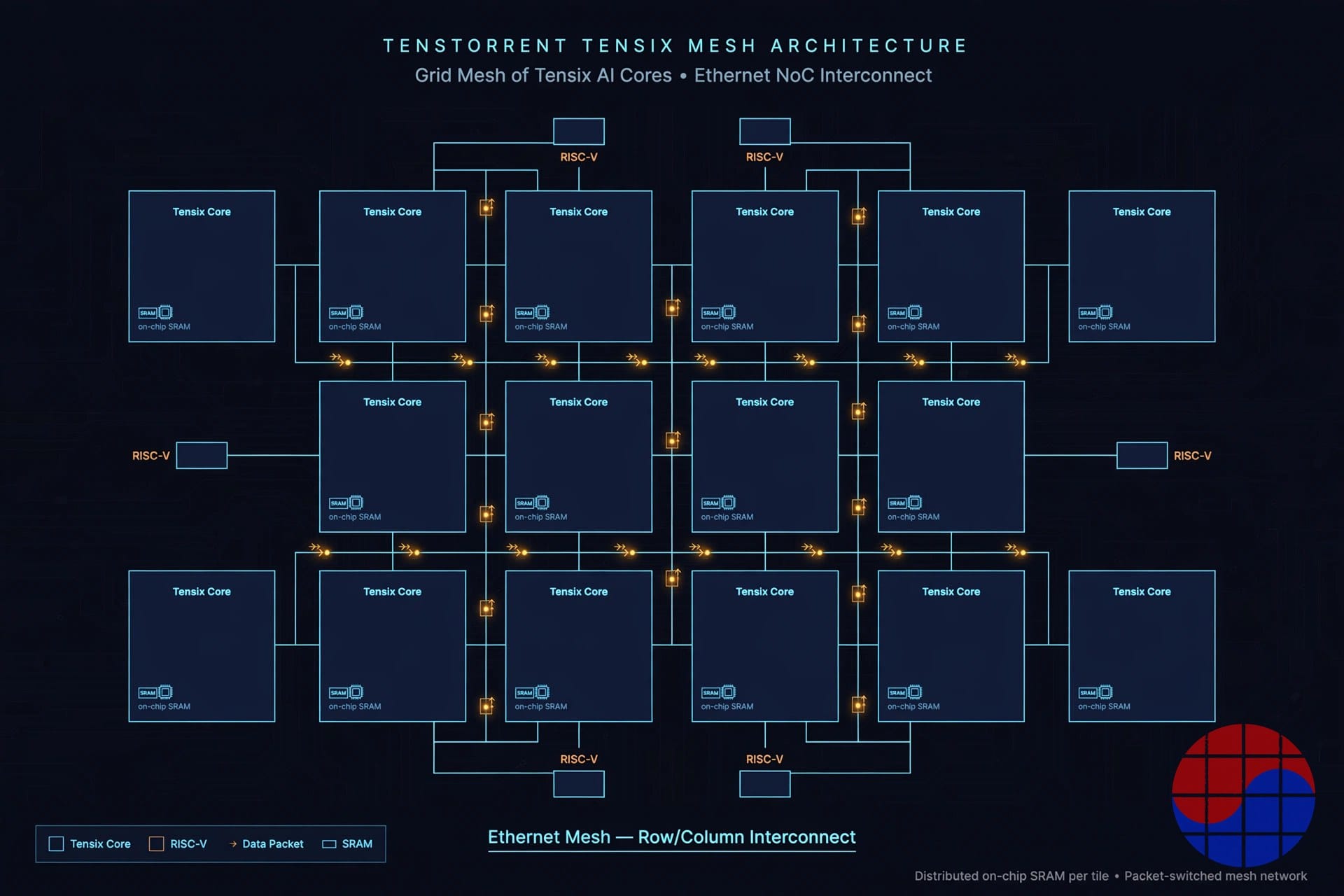
Keller's technical line has been consistent. Against an AI computing market hardened around a proprietary instruction set and a closed software stack, he counters with royalty-free RISC-V and open-source software. He has said publicly that you cannot beat NVIDIA if you use HBM, because NVIDIA buys the most HBM and holds the cost advantage. Tenstorrent chips therefore use GDDR6 instead of HBM, and attack tokens-per-dollar with large on-chip SRAM and Ethernet scale-out.
Business Deep Dive
Anatomy of the Valuation: From $2.6 Billion to $6.2 Billion
Three materials explain a 2.4x re-rating in 22 months. First, the product crossed from samples to orderable systems. Galaxy Blackhole reached general availability on April 28, 2026: 32 Blackhole chips delivering 23 PFLOPS of Block FP8 compute, 6.2 GB of on-chip SRAM at 2.9 PB/s, 1 TB of DRAM at 16 TB/s, and up to 56 800G Ethernet ports, starting at $110,000, with a four-system supercluster from $440,000. Second, customers started getting names. Third, the CPU IP business began to look like a business of its own. Add reported 2026 acquisition interest from Intel and Qualcomm above $5 billion (reported; not confirmed by the company), and the market layered strategic scarcity on top.
The nature of the number still needs to be stated plainly. $6.2 billion is not an earnings multiple. Revenue is private, and the last contract figure in public reporting was about $150 million as of December 2024. This valuation prepays the equity value of becoming the winner of the alternative ecosystem. The heavy presence of public-market investors — ARK Invest, T. Rowe Price, Morgan Stanley — in the Series E reads as positioning for an IPO, and Keller himself has said investors are keen on that path.
Products and Traction: Blackhole and Galaxy
Blackhole is the Tensix-core AI accelerator line. The p100a PCIe card delivers 120 Tensix cores, 16 big RISC-V cores, 180 MB of SRAM and 28 GB of GDDR6 (448 GB/s) at 300W for $999. The p150 variants carry 32 GB of GDDR6 (512 GB/s) and four 800G QSFP-DD ports at $1,299–$1,399. The liquid-cooled TT-QuietBox (Blackhole) workstation sells for $11,999. There is also a passage that shows execution risk honestly: the p150 launched at 140 cores and 210 MB of SRAM, but a February 2026 firmware release unified all units at 120 cores and 180 MB. The company cites yield and software standardization, with a claimed 1–2% performance effect. A hardware company lowering a shipped spec is unusual, and it signals that volume yield management is still a work in progress.
The production and customer signals are nonetheless a different quality from the previous generation. Sixteen Galaxy systems are already installed at Equinix's Ashburn data center as part of its Distributed AI Hub. India's Turiyam announced a first phase of up to 32 Galaxies. AI neocloud Cirrascale and ai& — the Japanese company founded by former Tenstorrent executive David Bennett — are customers, and ai& is described as the largest deployment, with 120+ systems referenced in launch coverage. Keller has said the largest single order after the TT-Deploy event was a 96-Galaxy cluster (3,072 Blackhole chips) headed outside the United States. Financial-services demand for low-latency on-premise inference recurs in company briefings. Absolute scale remains incomparable to the big GPU vendors, but the move from demo hardware to installed infrastructure is exactly what a Series E is supposed to fund.
The Second Engine: RISC-V CPU and IP Licensing
This is where Tenstorrent separates from most AI chip startups. It does not sell accelerators alone. TT-Ascalon is a 64-bit out-of-order superscalar RISC-V CPU built to the RVA23 profile, with 8-wide decode and dual 256-bit vector datapaths. Performance figures cited by the company and industry coverage put it near 21 SPECint2006/GHz — Neoverse V3 and Zen 5 territory, by the company's account. TT-Ascalon S, announced June 30, 2026, shrinks the footprint to roughly half at about 140% of the performance per mm², targeting branch-heavy agentic AI control flow as well as high-efficiency server, networking and storage SoCs.
The commercially decisive fact is the licensee list. Series E materials name Samsung and LG as customers licensing TT-Ascalon and Tensix cores. Keller has said he is meeting hyperscaler CEOs to push CPU IP deals, and that one hyperscaler is evaluating the AI IP for a smaller chip. IP licensing is annuity-like revenue — high margin, no fab capacity, no inventory. A meaningful share of the $6.2 billion is a bet that this second engine converts from storyline to signed, recurring contracts. The open chiplet strategy — selling chiplets separately and letting them attach to other vendors' silicon — points the same way: licensing markets only open when a customer can drop Ascalon into its own SoC without adopting the whole stack.
The Korea Connection: Capital, Customers and Foundry in One Country
Tenstorrent's Korea connection is the most underpriced axis of this story. Start with capital. The Series D was led by Samsung Securities, co-led by Korea's AFW Partners — whose managing director said positive feedback from Korean partners such as LG was a reason to invest. The 2023 convertible note was built by Hyundai, Kia and Samsung's Catalyst Fund, and the Series D register added Samsung Electronics, LG Electronics and Hyundai Motor Group side by side.
The business ties are equally concrete. LG Electronics has co-developed RISC-V and AI chips with Tenstorrent since 2023 (consumer SoCs such as smart TVs) and is now a named IP licensing customer. Hyundai Motor Group said in 2023 that future Hyundai, Kia and Genesis vehicles would use Tenstorrent designs. On manufacturing, production moved from GlobalFoundries to TSMC and Samsung Foundry, with 2nm design work underway and talks with Japan's Rapidus also reported. Korea is, in short, the only country-level cluster that supplies Tenstorrent with money, demand and production at the same time.
What Must Be True for $6.2 Billion
- Galaxy must move from installations to repeat shipments. Orders of 96-Galaxy scale need to recur quarterly and convert into reorders before system revenue can carry the valuation.
- IP licensing must land a headline deal. One hyperscaler-scale Ascalon license, after Samsung and LG, would re-rate the business model itself. If deals stay "in discussion," the second engine remains a narrative.
- Software must cross from project to platform. TT-Forge, TT-Metalium, TT-NN and TT-LLK are open source, but bringing a model up today is still close to a TT-Metal engineering project. Developer self-service begins only when model coverage and automation pass a threshold.
- The two-year cadence must not slip. In a market where the leader refreshes yearly, a two-year product cadence is a capital-efficiency choice — but one delay becomes a four-year gap.
The Downside
The largest risk is the software ecosystem. No AI chip startup has yet won on hardware specifications and price alone. The gap to CUDA in developer habits, debugging tools and model coverage is real, and capital alone cannot close it. Second is execution speed: the p150 core-count reduction showed the reality of yield management, and the GDDR6 strategy carries a structural limit in decode workloads bound by memory bandwidth — the company routes around it with large SRAM and Ethernet scale-out, but the detour narrows when the working set does not fit in SRAM. Third is the valuation itself. With revenue undisclosed, $6.2 billion is a price on expectations; if the IPO window closes or a headline IP deal slips, the next round's terms become the test.
Chase's Take
My view: the "NVIDIA challenger" frame hides Tenstorrent's real asset. In accelerators, Tenstorrent is still a challenger. In RISC-V CPU IP, the story is different. As frustration with Arm licensing grows, the number of places a hyperscaler, an electronics giant or an automaker can buy a modifiable, high-performance RISC-V core is genuinely small. The moment Ascalon made that short list, Tenstorrent started being priced as platform equity rather than as a chip vendor. The $6.2 billion is money placed precisely on that point.
For Korean readers, one more layer is visible. Samsung Securities leading the round, Samsung Electronics and LG Electronics investing and licensing, Hyundai Motor Group on the register — Korea's large corporates have collectively bought an insurance policy for the open-architecture era, with capital and demand supplied together. If Samsung Foundry chiplet volume follows, the position becomes a strategic asset worth more than its financial return. The flip question is this: more than half of $6.2 billion rests on IP deals and an IPO that have not happened yet. Over the next twelve months, watch not for product launches but for one named, large licensing contract and for Galaxy reorder news. If both arrive, this price will look cheap. If they do not, it will look expensive.
Implications
- AI chip startups: The late-round valuation grammar is becoming a triangle — accelerator, CPU IP, open software. Single-chip performance races alone no longer earn Series E prices.
- Arm and x86 camps: High-performance RISC-V, standardized under RVA23, has started appearing as leverage in licensing negotiations. Royalty structures themselves are entering a pressure zone.
- Korean corporates: Samsung, LG and Hyundai hold a rare combined position of financial investment plus business collaboration. Whether licensing converts into adopted products decides the Korean side of the return.
- Foundries: As chiplet partitioning spreads, demand for neutral foundry capacity grows. TSMC, Samsung Foundry and Rapidus are settling into direct competition for the same customers.
- Investors: Private AI hardware is priced on ecosystem-winner probability times strategic scarcity, not on revenue. Tenstorrent's next verification event will be a contract announcement, not an earnings print.
FAQ
What is Tenstorrent's latest valuation?
$6.2 billion post-money (about KRW 8.68 trillion at KRW 1,400 per dollar), as of the Series E closing announced on October 19, 2026. The round raised $1.5 billion and was led by Trace Capital and Innovation X. The previous round, the December 2024 Series D, was roughly $2.6 billion post-money.
What does Tenstorrent sell?
Three product lines: AI accelerator cards based on Blackhole (p100a from $999), Galaxy Blackhole servers combining 32 chips (from $110,000), and IP licenses for the TT-Ascalon RISC-V CPU and Tensix AI cores. Its software stack (TT-Forge, TT-Metalium and others) is open source.
How is Tenstorrent connected to South Korea?
Samsung Securities led the Series D, and Samsung Electronics, LG Electronics and Hyundai Motor Group are investors. Samsung and LG license TT-Ascalon and Tensix IP, and Hyundai Motor Group has said future vehicles will use Tenstorrent designs. Manufacturing uses TSMC and Samsung Foundry.
What is the biggest risk behind the $6.2 billion valuation?
The software ecosystem gap. Independent of hardware price-performance, if model porting and developer tooling do not approach CUDA-level maturity, both Galaxy shipments and IP adoption slow down. Undisclosed revenue is itself a reminder that this price is paid for expectations.
Note: Valuation and financing terms were cross-checked against the company's announcement and reporting dated October 19, 2026. As a private company, Tenstorrent does not disclose revenue and certain other financials. Korean won figures use KRW 1,400 per U.S. dollar.
📩 Subscribe to VLSI Korea
Get our daily semiconductor deep-dives delivered to your inbox first. Free to subscribe.