VLSI Korea
TSMC Q3 2026 Earnings (2nm, HBM, CoWoS) — 18 Facts
TSMC Q3 2026 revenue of US$46.72B, net income up 68.7%, 2nm at 8% of wafer revenue and Q4 guidance of US$52.3-54.3B — 18 facts verified from the official release and earnings call.


Bottom line: TSMC's third quarter of 2026 proved in numbers what management said in words — AI demand still far exceeds supply. Revenue beat the top of the company's own guidance, and 2nm reached 8% of wafer revenue in its first year of volume production.
First, the check: what do these numbers actually confirm?
One recurring argument in the semiconductor industry is that AI capital spending is running ahead of real demand. TSMC's Q3 2026 results, released on October 15, 2026, are the hardest data available to test that argument: TSMC is the company that actually manufactures the AI accelerators, and without real orders, this revenue and these margins do not happen. At the same time, management itself sounded a caution on consumer and price-sensitive segments for 2027. The 18 facts below are drawn only from TSMC's official release and the same-day earnings call.
| Metric | Q3 2026 | Year over year |
|---|---|---|
| Revenue | NT$1,494.24B (US$46.72B) | +50.9% in NT$ |
| Net income | NT$763.06B | +68.7% |
| EPS | NT$29.43 (US$4.60 per ADR) | +68.7% |
| Gross margin | 66.4% | +6.9 pp (59.5% to 66.4%) |
| Operating margin | 58.7% | +8.1 pp (50.6% to 58.7%) |
| HPC share of revenue | 68% | — |
The 18 facts
1. Revenue beat the top of TSMC's own guidance by US$0.92 billion
Third-quarter revenue was US$46.72 billion, above the US$44.6–45.8 billion range the company had guided. In NT dollars, revenue was NT$1,494.24 billion, up 50.9% year over year and 17.6% sequentially. (Source: TSMC official release, Oct 15, 2026)
2. Net income rose 68.7% year over year
Net income reached NT$763.06 billion, up from NT$452.30 billion a year earlier and up 8.0% sequentially. Profit grew faster than revenue (+50.9%), showing that the shift toward advanced nodes flows directly into profitability. (Source: TSMC official release)
3. EPS was NT$29.43, or US$4.60 per ADR
Diluted EPS was NT$29.43, up 68.7% year over year, equal to US$4.60 per ADR unit. Return on equity was 45.5%. (Source: TSMC official release and Q3 management report)
4. Operating income was NT$876.45 billion, up 75.0%
Income from operations was NT$876,445 million, up 75.0% year over year. The 58.7% operating margin landed above the top of the range the company had guided. (Source: TSMC official release, income statement)
5. Gross margin was 66.4% — and the 2nm ramp took 1.3 points off it
Gross margin of 66.4% sat inside the 65–67% guidance range but fell 1.3 percentage points from 67.7% in Q2. Management attributed the decline primarily to the initial 2nm production ramp. Net profit margin was 51.1%. (Source: TSMC official release; earnings call)
6. 2nm reached 8% of wafer revenue, up from 3% in one quarter
Shipments of 2nm accounted for 8% of total wafer revenue, more than doubling its share from 3% in Q2. The node, which entered high-volume manufacturing in Q4 2025, is becoming a revenue engine unusually fast. (Source: TSMC official release; management report)
7. 3nm is still the largest node at 33% of wafer revenue
By technology, 3nm contributed 33% of wafer revenue, 5nm 28%, and 7nm 10%. The two leading nodes, 2nm and 3nm together, account for 41% of wafer revenue. (Source: TSMC official release)
8. Advanced technologies are 79% of wafer revenue
Technologies of 7nm and below made up 79% of wafer revenue. TSMC's revenue structure has effectively been rebuilt around leading-edge processes; mature nodes are no longer the growth story. (Source: TSMC official release)
9. HPC grew to 68% of total revenue
High-performance computing revenue rose 22% sequentially and accounted for 68% of total revenue. The platform that includes AI accelerators is now, by a wide margin, TSMC's largest business. (Source: TSMC earnings call, CFO presentation)
10. Smartphones were 21% — growing, but shrinking as a share
Smartphone revenue rose 10% sequentially but represented 21% of the total. IoT rose 5% to 4%, automotive rose 23% to 4%, and DCE fell 12% to 1%. The share decline is relative: HPC is simply growing faster. (Source: TSMC earnings call)
11. Q3 capex was US$13.84 billion; the nine-month total is US$40.64 billion
Capital expenditures were US$13.84 billion (NT$443 billion) in Q3, bringing the first nine months of 2026 to US$40.64 billion. The company reiterated its 2026 capex budget of US$60–64 billion. (Source: TSMC management report; earnings call)
12. Cash and marketable securities reached NT$4 trillion
TSMC ended the quarter with cash and marketable securities of NT$4 trillion, about US$126 billion. Operating cash flow was about NT$920 billion in Q3 and free cash flow was NT$476.56 billion — heavy investment and a growing cash pile at the same time. (Source: TSMC earnings call, CFO presentation)
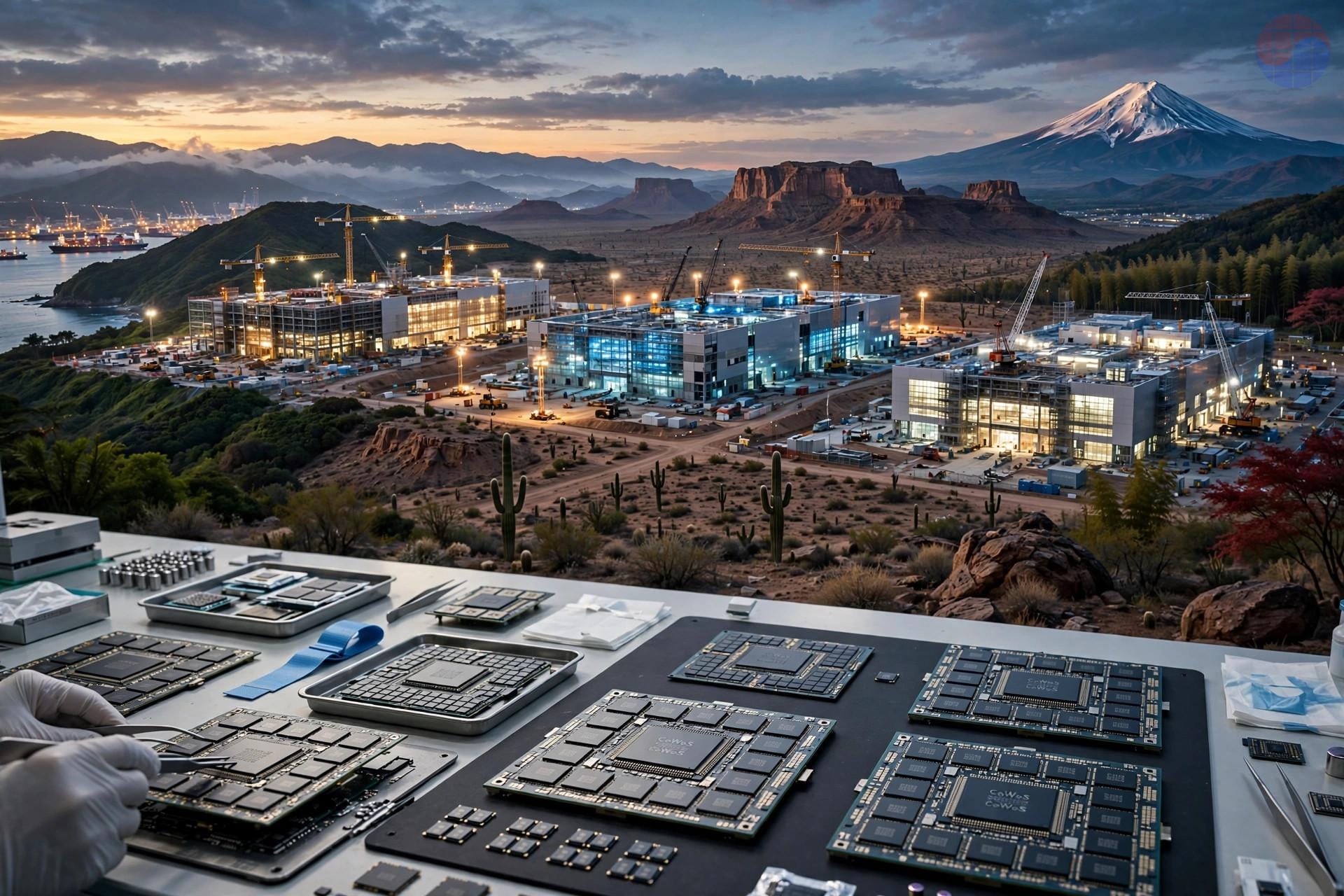
13. Q4 guidance: revenue of US$52.3–54.3 billion
Management guided fourth-quarter revenue to between US$52.3 billion and US$54.3 billion, about 14% sequential growth at the midpoint. Gross margin guidance is 65–67% and operating margin 56.5–58.5%, on an exchange-rate assumption of NT$31.8 per US dollar. (Source: TSMC official release)
14. Full-year 2026 revenue growth guidance was raised to about 44%
Chairman and CEO C.C. Wei raised the full-year outlook to around 44% growth in US dollar terms, up from "slightly above 40%" a quarter earlier, citing continued strength in leading-edge demand. (Source: TSMC earnings call, Oct 15, 2026)
15. Management said demand is still far above its capability to supply
In Q&A, Wei repeated that demand is still far above what TSMC can supply today and that the company is working hard to narrow the gap. TSMC said it goes one step further than customer forecasts: it checks customers' customers, US data-center build-out progress, and power supply. (Source: TSMC earnings call)
16. The new demand drivers named were agentic AI and open-source models
Management said rising adoption of agentic AI, as the industry moves from chatbots to AI assistants, plus broad adoption of open-source AI models, is creating additional demand for leading-edge silicon. Agentic AI CPUs and networking chips were named as further drivers. (Source: TSMC earnings call)
17. About 20 fabs are under construction worldwide at the same time
TSMC is building 13 leading-edge and advanced packaging fabs in Taiwan and another five to six overseas. Annual capacity of the N2 family will more than double in 2027, and A14 is on track for risk production in 2027 and volume production in 2028. For 3nm, the added Tainan fab targets the first half of 2028, Arizona's second fab the third quarter of 2027, and Japan's second fab 2028. (Source: TSMC earnings call)
18. The caution came on the same day: 2027 planning will be prudent
Wei said consumer and price-sensitive segments are being challenged by rising component prices and macroeconomic uncertainty, so TSMC is being prudent in its 2027 business planning. On packaging, CoWoS remains customers' number-one choice, 5x reticle-size production is under way, and an interposer collaboration with GlobalFoundries was confirmed as a way to ease the back-end shortage. Record results and an explicit caution, delivered on the same day, are the accurate picture of this quarter. (Source: TSMC earnings call)
What the 18 facts add up to
- Demand verification: Revenue, the HPC mix, and the raised guidance point the same way. On TSMC's own checks, real demand for AI accelerators exceeds its supply capability at least through the end of 2026.
- Margin quality: Even with the 2nm ramp diluting gross margin, operating margin held at 58.7%. This is a business absorbing the cost of its next node while it earns.
- What to watch next: Whether Q4 revenue reaches the guidance midpoint of about US$53.3 billion, whether 2nm reaches a double-digit share of wafer revenue, and the size of the 2027 capex budget in January.
Frequently asked questions
Q. What were TSMC's Q3 2026 revenue and net income? A. Revenue was NT$1,494.24 billion (US$46.72 billion), up 50.9% year over year in NT dollars, and net income was NT$763.06 billion, up 68.7%. EPS was NT$29.43 (US$4.60 per ADR). (TSMC official release, Oct 15, 2026)
Q. How much of TSMC's revenue is 2nm? A. 2nm was 8% of wafer revenue in Q3 2026, up from 3% in Q2. 3nm was 33%, and advanced technologies of 7nm and below were 79% in total.
Q. What is TSMC's Q4 2026 guidance? A. Revenue of US$52.3–54.3 billion, gross margin of 65–67%, and operating margin of 56.5–58.5%. Full-year 2026 revenue growth guidance was raised to about 44% in US dollar terms.
Q. Did TSMC really say AI demand exceeds supply? A. Yes. On the October 15, 2026 earnings call, C.C. Wei repeated that demand is still far above TSMC's current capability to supply, and said the conclusion rests on TSMC's own checks of data-center build-outs and power supply, not only on customer forecasts.
Sources
- TSMC official release, "TSMC Reports Third Quarter EPS of NT$29.43" (Oct 15, 2026): https://pr.tsmc.com/system/files/newspdf/attachment/70d8a93214795fa88f83fb47e0e45e7b0435e52b/3Q26%20%28E%29_with%20gudiance_final_wmn.pdf
- TSMC 3Q26 earnings conference call transcript (Oct 15, 2026; full text via SemiWiki, cross-checked against the Motley Fool transcript)
- TSMC Q3 2026 management report figures (capex, ROE, cash flow)
This article is for information only and is not investment advice. Figures are as announced by TSMC on October 15, 2026.
📩 Subscribe to VLSI Korea
Get our daily semiconductor deep-dives delivered to your inbox first. Free to subscribe.