VLSI Korea
Unconventional AI: How a Startup With No Chip Reached a $4.5B Valuation
Two months after founding, with no chip and no revenue, Unconventional AI raised $475M at a reported $4.5B valuation. Investors priced a founder, a team and an option on physics-based computing — not a product. We take the price apart: the science, the skeptics and the seven assumptions it rests on.


30-Second Summary
- Unconventional AI announced on December 8, 2025 that it had raised a $475 million seed round at a reported $4.5 billion valuation — roughly two months after founding, with no chip, no product, and no revenue. At 1,400 KRW per dollar, $4.5 billion is about 6.3 trillion KRW; the round is about 665 billion KRW.
- The round was co-led by Andreessen Horowitz and Lightspeed Venture Partners, with participation from Lux Capital, DCVC, Databricks, and Jeff Bezos. CEO Naveen Rao invested $10 million of his own money on the same terms. The $475 million is the first portion of a planned raise of up to $1 billion.
- The company is building an analog, physics-based computer for AI: instead of simulating neural networks on digital chips, it wants the physics of silicon — a fabric of coupled oscillators — to do the computing directly, targeting roughly 1,000x lower energy than today's hardware. Its reference point is the human brain, which runs on about 20 watts.
- What exists today is a simulation, not silicon. Its first model, Un-0 (June 2026), generates images with a simulated system of coupled oscillators and reaches FID 6.74 on ImageNet 64x64 — competitive with early conventional generators — but it was trained and run on conventional B200 GPUs. No physical chip has been shown.
- The $4.5 billion is therefore not a price on a product. It is a price on a founder with two exits (Nervana to Intel, MosaicML to Databricks for $1.3 billion), a four-person founding team spanning MIT, Stanford, and production analog design, and an option on the possibility that digital computing's energy wall forces a new substrate. This deep dive takes that price apart.
Background: A Seed Round With Nothing to Ship
Seed rounds are supposed to buy a prototype. Unconventional AI's seed round bought a research program — and priced it like a late-stage company.
The company surfaced in September 2025, when Naveen Rao hinted on X that he was co-founding a company to build a computer with "brain-scale efficiency." Two months later, on December 8, 2025, Rao and his three co-founders announced the raise and the thesis: the AI industry is running into an energy wall it cannot engineer its way past with digital chips alone.
The founders are the first line of the valuation. Rao trained as an electrical engineer at Duke and worked as a computer architect at Sun Microsystems, then left engineering for a PhD in computational neuroscience at Brown — studying how the brain turns sensory input into action on about 20 watts. After neuromorphic research at Qualcomm, he co-founded Nervana Systems in 2014, building deep-learning hardware designed around the workload rather than adapted from graphics; Intel acquired it in 2016 for a reported price around $400 million, and Rao ran Intel's AI products group. In 2021 he co-founded MosaicML, which made large-model training cheaper; Databricks acquired it in 2023 for $1.3 billion, and Rao became Databricks' VP of AI. Two exits, roughly $1.7 billion in combined reported value, both built on one obsession: AI's cost is a hardware problem.
Around him: Michael Carbin, an MIT associate professor working on programming systems for new substrates, and a MosaicML co-founder; Sara Achour, a Stanford assistant professor working on compilers and physically grounded computation; and MeeLan Lee, an analog circuit designer formerly at Google, Qualcomm, and Intel — the team member who has actually built analog silicon in production. The composition is deliberate: one repeat-exit CEO, two theorists who map software to physical dynamics, one practitioner who knows where analog designs go to die.
The problem statement is simple and, so far, empirically true. AI capability has scaled with compute, and compute has scaled with power; data centers are now planned around power availability rather than around chips. Rao's framing: "AI is intrinsically linked to hardware, and hardware is intrinsically linked to power. We can't scale beyond a certain number of inferences per unit time because of the energy problem. We can't produce that much more energy in the next 10 years." The company claims demand growth hits the linear growth of energy supply within three to four years. Whether or not that timeline is exact, the direction is not controversial: energy per inference is now a first-order cost and a first-order constraint.
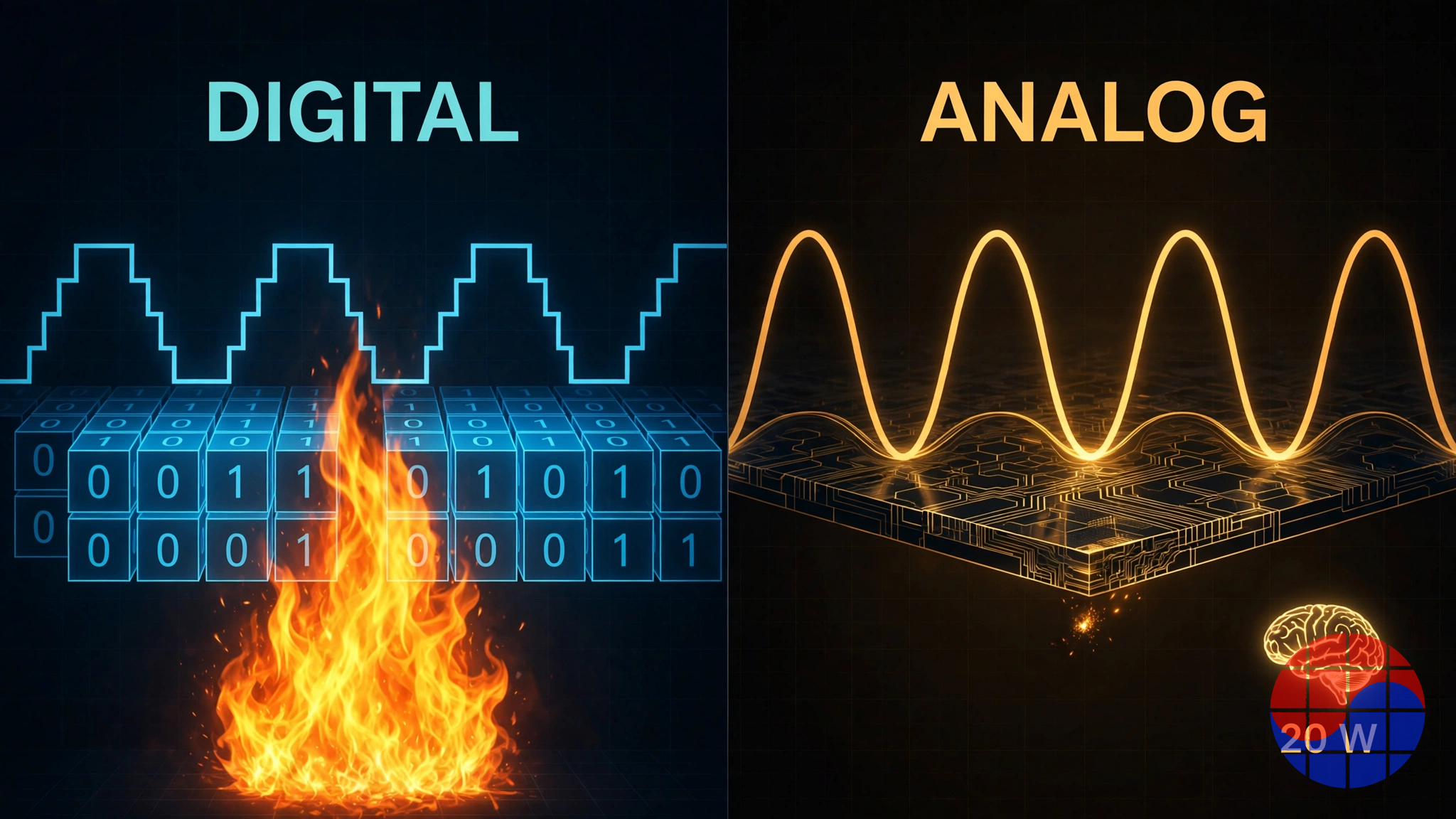
The proposal is to abandon the abstraction that has dominated computing for 80 years. Digital computers represent everything as numbers and simulate dynamics step by step, at enormous energy cost. Natural learning systems never did that. "Natural learning systems never used numerics," Rao says. "They didn't simulate the dynamics of learning. They use the intrinsic physics of whatever substrate they're on to build a learning system. We believe we can recapitulate that behavior in silicon."
Business Deep Dive
1. The Deal Math
Start with the arithmetic, because the arithmetic is the story. A $475 million primary round at a $4.5 billion post-money valuation means new investors bought roughly 10.6% of the company, and the pre-money valuation — the price of the idea, the team, and nothing else — was about $4.03 billion. That is roughly three times what Databricks paid for MosaicML, a company with a product, customers, and revenue, in 2023.
The structure matters as much as the size. The $475 million is the first portion of a raise that could reach $1 billion; earlier reports had the company targeting a $5 billion valuation for that larger round. A tranched raise is a milestone machine: the first close prices the vision, the second will price whatever the vision has produced by then. Rao's own $10 million, on the same terms as the institutions, is small (about 2% of the round) but symbolically load-bearing — it converts "the founder believes" from a pitch line into a balance-sheet fact. What investors underwrote is not a discounted cash flow — there are no cash flows. It is a probability-weighted option: a small probability that this team founds the post-GPU substrate, multiplied by the value of owning a meaningful share of AI compute if it does, plus a floor from the team's demonstrated ability to be acquired.
2. The Science: Let Physics Do the Computing
The technical bet has three layers. First, analog instead of digital. An analog circuit represents quantities as continuous voltages and currents rather than bits. For the operations AI actually performs — vast multiply-accumulates, dynamics, sampling from distributions — a physical system can often be the computation instead of simulating it. Rao's example is the wind tunnel: engineers still build wind tunnels because a physical model of airflow computes what digital fluid dynamics approximates expensively. The claim is that a neural network is closer to a wind tunnel than to a spreadsheet — a stochastic, distributed dynamical system — and forcing it onto a deterministic, precise numerical substrate wastes most of the energy budget on an abstraction the workload never asked for.
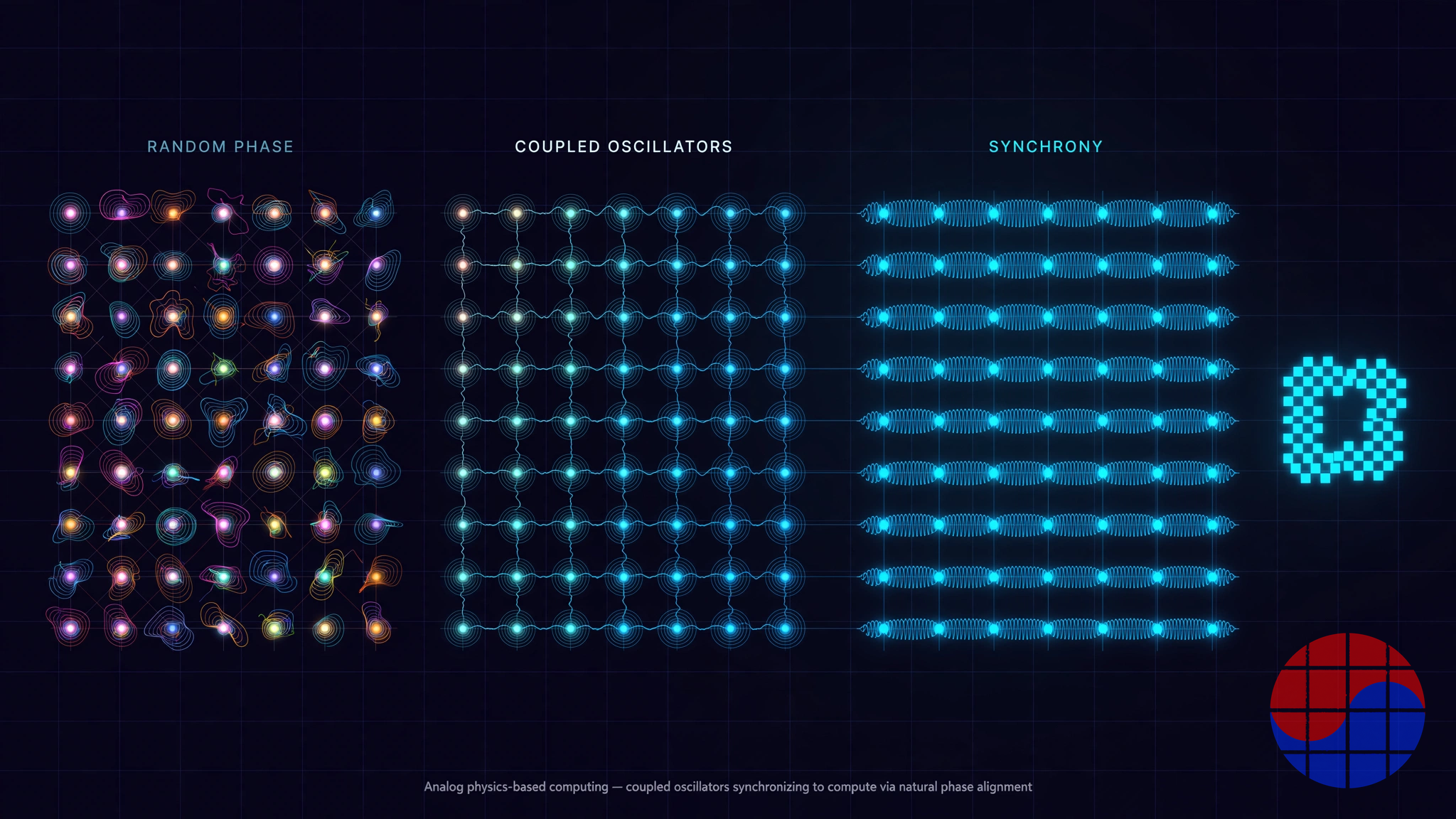
Second, coupled oscillators as the primitive. The company's first public artifact, Un-0, makes the claim concrete. Un-0 is an image generator whose compute engine is a large population of coupled oscillators, modeled on the Kuramoto model — the mathematics of how rhythmic units (metronomes on a shared table, fireflies, pacemaker cells) pull each other into synchrony. Each oscillator has a phase; the learnable parameters are the coupling strengths between every pair of oscillators and each oscillator's natural frequency. To generate an image, the system starts from random phases, a small conditioning group biases the population toward a requested class, the physics evolves, and the final phase pattern is decoded into pixels. The decoder is under 13% of the model's parameters, and the company's ablations indicate the oscillators themselves do useful computation rather than decorating a conventional generator.
Third, co-design — "neural co-evolution." Model and hardware are designed together: memory stays physically close to computation, physical state is reused over time instead of reloading billions of parameters per token, and hardware imperfections are something the model learns rather than something engineering eliminates. Noise is the clearest example: generative AI begins from randomness anyway, and a network trained on a specific substrate can learn that substrate's variations. Energy digital chips spend forcing perfect uniformity is, in this telling, simply not spent.
The efficiency target follows from thermodynamics, not a benchmark: the company argues the gap between where digital AI hardware operates and what is physically possible is roughly three orders of magnitude — hence ~1,000x. Be precise about that number's status: it is an estimate of a theoretical gap, not a measurement, and it has not been demonstrated on hardware. Un-0's results — FID 6.74 on ImageNet 64x64 with 16,384 oscillators and 322 million parameters, in the range of early conventional generators when they appeared — validate the learning claim (a physical dynamical system can be trained to do a real generative task at moderate scale), not the efficiency claim, since Un-0 itself ran on B200 GPUs.
3. What Exists Today: A Simulation and a Five-Year Clock
The inventory is short: a launch post and a technical blog with open weights, training code, and ablation code for Un-0 — a genuinely open research artifact. There is no chip and no published tape-out date. Rao has said the next several years are for "trying out a number of ideas and prototypes and coming up with the exact paradigm" that scales, has described a roughly five-year horizon to build the chip, has said the company will partner with TSMC, and has called the first prototype "probably one of the larger, maybe the largest analog chip people have ever built." The eventual product is a systems play — silicon plus the full inference stack, ultimately competing as a compute provider — not a component sale.
Between here and there sits the oldest problem in analog computing, which Rao himself names: analog computers are among the first computers, they are inherently efficient, and they lost to digital because of manufacturing variability — they could not be scaled up. Every device differs slightly; temperature shifts and process variation introduce errors that compound. Digital won precisely because it is indifferent to that mess. The company's entire scientific wager is that this 80-year-old verdict can be reversed for neural workloads, because neural networks tolerate — and can be trained around — exactly the variations that made analog unusable for artillery tables and accounting.
4. The Skeptic's Case
The honest counter-argument has four parts. Precision and conversion overhead: analog computation is noisy, noise compounds, and converting between analog and digital domains — ADCs and DACs at every boundary — can consume much of the energy the analog core saved. Any efficiency claim not measured wall-plug, end-to-end, on a real workload should be discounted; the 1,000x is currently a projection about a substrate that does not exist. Programmability: a GPU's moat is that the same silicon trains a model on Monday and serves another on Tuesday; analog systems embed computation in physical structure and are rigid. The company's answer — a software interface to the physics, from founders who specialize in compilers — is plausible on paper and unproven in practice, and AI hardware history is littered with faster chips that lost to CUDA's flexibility. Scaling: 16,384 simulated oscillators generating 64x64 images is a research result; production inference needs equivalent dynamics at language-model scale, manufactured with variation training can absorb, at yields a foundry will sign for. The field is not empty either — Mythic has shipped analog processors for edge inference, and a Peking University team reported an RRAM-based analog matrix-computing system in late 2025 with large claimed efficiency gains over GPUs. The moving baseline: digital efficiency is not static. Rao himself noted at Databricks that AI cost per unit of capability was falling about 4x per year — ten times faster than Moore's law. A substrate arriving in five years competes with five years of compounded digital efficiency, on cost per token, against a mature software ecosystem. The 1,000x target is, in part, an acknowledgment of exactly that.
5. What Must Be True for $4.5 Billion
Strip the price to its load-bearing assumptions:
| # | Assumption | Status today |
|---|---|---|
| 1 | Energy becomes the binding constraint on AI growth within the decade | Direction widely accepted; the company's 3–4 year timeline is its own claim |
| 2 | A coupled-oscillator / analog substrate can be trained to do real AI workloads | Shown in simulation at image-generation scale (Un-0, FID 6.74) |
| 3 | The approach scales from 16K oscillators and images to LLM-scale inference | Unproven — the central scientific risk |
| 4 | Analog variability can be absorbed by training at manufacturing scale (TSMC) | Unproven — the central engineering risk |
| 5 | End-to-end efficiency (including conversion) beats digital by a large multiple | Claimed ~1,000x theoretical; 0x demonstrated on hardware |
| 6 | A software stack makes the substrate programmable enough for customers | Founders' expertise fits; nothing shipped |
| 7 | Hyperscalers will qualify a non-digital substrate for production inference | No disclosed customers or design wins |
Read the table as a funnel. Assumptions 1 and 2 are what investors could underwrite in December 2025 with reasonable confidence. Assumptions 3 through 5 are where the $4.5 billion actually lives — binary, correlated (all three are facets of "does physics scale"), and years from resolution. Assumption 7 is the business risk stacked on the science risk: even a working substrate must displace the most entrenched supply chain in technology.
The return math is power-law math. A fund does not need Unconventional to be likely; it needs the success-branch payoff to be enormous and the entry ownership meaningful. If a new substrate captures even a low-single-digit share of AI inference spending at software-like margins, the company is worth tens to hundreds of billions — the incumbent it would partially displace is valued in the trillions. Against that payoff, $475 million for ~10.6% is a priced option whose strike is time: it expires if the physics does not scale before the money, or the industry's patience, runs out. The planned second tranche toward $1 billion is the renewal date — priced on whatever prototype evidence exists by then, and the single most informative future data point about this company.
6. The Downside: What the Floor Is Made Of
Downside analysis for a pre-product company is usually one word — zero — but here the floor has some structure. The team floor: Rao's last two companies were acquired for a reported ~$400 million and $1.3 billion, and this team would, in a failure scenario, still be acquirable — though at post-seed valuations far below $4.5 billion, cold comfort to the seed investors' return math even if it softens absolute loss. The IP floor: open-sourced model work builds reputation and hiring gravity more than defensible IP; the defensible layer, if any, will be hardware and the compiler stack, neither of which exists yet. The cash floor: $475 million is years of runway, which cuts both ways — it removes financing risk for exploration and removes the discipline financing risk imposes. The realistic bad outcome is not a sudden collapse but a slow one: prototypes that work at small scale, efficiency that shrinks at system level, and a 2030s world in which the company is a respected research lab with an expensive cap table.
Chase's Take
Strip away the physics and look at the transaction. A $475 million seed at $4.5 billion, two months after founding, is not really a valuation of Unconventional AI. It is a valuation of a category claim: that the 80-year reign of digital abstraction is ending because energy, not transistors, is now the scarce resource. Investors were not buying a chip. They were buying the right to be early if the substrate of computing changes — and they paid a founder premium to the one person whose biography reads like preparation for exactly this bet: the engineer who became a neuroscientist, built workload-specific hardware before it was fashionable, sold it, then sold the efficiency software layer too.
The price decomposes into three parts, in descending order. The largest is the option on a substrate change, priced off the size of AI inference rather than anything the company has built. The second is the team — genuinely scarce: very few groups combine production analog design, compiler theory for physical systems, and a CEO with two exits in AI efficiency. The third, and smallest, is the science so far: Un-0 is a credible research milestone — trained oscillators doing real generative work, openly published — and it is also, measured against the claim, three orders of magnitude of simulation away from evidence. FID 6.74 on 64x64 images tells you the learning works. It says nothing yet about whether physics ships.
The detail I keep coming back to is the tranche. Rao did not take $1 billion at once; the first $475 million is explicitly a first portion. That is either confidence ("we will be worth more when the second close prices") or discipline ("prove the paradigm before you price the company") — from a founder who has sold two companies, I read it as both, and as the tell for how to follow this company. Do not watch valuation headlines. Watch three things: whether the second tranche closes, at what price, and on the back of what artifact; whether the oscillator program escapes image generation into a language-model-scale demonstration, even in simulation; and whether a physical prototype appears with wall-plug efficiency numbers attached. Until the third happens, every efficiency figure from this company — including the 1,000x — is a statement about thermodynamics, not about a product.
For the industry, the deeper signal is where the bottleneck moved. A decade ago the scarce thing was FLOPS. Then it was memory bandwidth — the HBM era. Unconventional AI is a $475 million argument that the next scarce thing is joules, and that when joules bind hard enough, the industry will tolerate re-opening questions it closed in the 1940s: non-numerical computing, physics as the algorithm, hardware that is trained rather than programmed. Even if this company fails, that argument is now funded at a scale that guarantees imitators, papers, and prototypes. Prices like this are how an industry announces that a research direction has become a strategy.
The correct prior for "$4.5 billion, no chip" is not "bubble" and not "vision." It is "unpriced risk, deliberately." The investors know exactly how many of the seven assumptions above are unproven — they signed anyway, because the one scenario in which they all hold is worth more than the other six cost. The rest of us get to watch a clean experiment: the best-capitalized test ever run of whether the brain's way of computing can be rebuilt in silicon — worth following precisely, milestone by milestone, in public, with the numbers attached.
Implications
For investors. Treat the position as a binary option with a visible renewal date. The data points that re-price this company are, in order: (1) the second tranche toward $1 billion — its price and timing are the market's updated probability estimate; (2) a language-model-scale demonstration of the oscillator approach, even simulated; (3) first silicon with end-to-end (wall-plug) efficiency data; (4) any disclosed hyperscaler evaluation. Absent those, mark the thesis, not the headline valuation. The comparable risk is not other AI chip startups with products and purchase orders; it is research-stage substrate bets, where timelines slip in years, not quarters.
For semiconductor strategists. The founding team's composition is the strategy signal: compilers and programming systems sit beside analog circuits because the historical killer of alternative substrates was the software interface, not the device physics. The monitoring item is not Unconventional's FID scores — it is whether its software-interface-to-physics approach attracts the theorists and compiler engineers who would make a non-digital substrate programmable. Talent flow will show the paradigm's credibility before benchmarks do.
For data-center and energy planners. Do not put a 1,000x efficiency factor in any capacity plan. The company's own timeline is years of prototyping, and digital efficiency compounds in the meantime. What the round validates — at the level of capital allocation, not engineering — is that energy per inference is now priced as a strategic constraint by the largest AI investors. Plans that assume inference demand can grow without an energy answer are the ones this $475 million was raised to bet against.
For researchers. Un-0's open release — weights, training code, ablations — makes the oscillator approach falsifiable in public, which is exactly how a substrate claim should be tested. The checkable questions: scaling of quality versus oscillator count against the conventional frontier, robustness of learned couplings to device variation, and the size of conversion overhead in any physical implementation. Progress on those three, in that order, is the scientific scoreboard.
FAQ
Does Unconventional AI have a chip? No. As of its latest public milestone (Un-0, June 2026), the company's demonstrated system is a software simulation of coupled oscillators run on conventional GPUs. A physical analog chip is in development, with the company describing a multi-year prototyping program and a TSMC partnership, but no silicon has been shown and no tape-out date has been published.
Why is a company with no product valued at $4.5 billion? The reported $4.5 billion is a seed-stage post-money valuation from December 2025, not a market price for a product. It prices three things: a founding team with two prior exits (Nervana, reported around $400 million to Intel; MosaicML, $1.3 billion to Databricks), scarce combined expertise in analog design and compiler theory, and an option on a new computing substrate if AI's energy constraint forces one. Investors bought roughly 10.6% of the company for $475 million.
What is the coupled-oscillator approach, in plain terms? Instead of computing with digital switches that simulate a neural network step by step, the company wants networks of physical oscillators — circuits that rhythmically cycle, like metronomes — whose mutual synchronization performs the computation. The learnable parameters are the coupling strengths between oscillators. The physics settling into a synchronized pattern is the inference, which is why the company believes it can use far less energy than simulating the same dynamics numerically.
What should we watch next? Three milestones, in order of information value: the closing and pricing of the planned second tranche toward a $1 billion total raise; a demonstration of the approach on a language-model-scale task (Un-0 covers image generation); and first physical silicon with end-to-end efficiency measurements. Until the last of these, the ~1,000x efficiency figure remains a theoretical estimate, not a demonstrated result.
Note on sources and status: Valuation, round size, and investor composition are as reported at the December 8, 2025 announcement and are stated as reported figures; the company is private and its terms are not independently audited. Technical results (Un-0) are the company's own published figures from its June 2026 release. Currency conversion uses 1 USD = 1,400 KRW throughout.
📩 Subscribe to VLSI Korea
Get our daily semiconductor deep-dives delivered to your inbox first. Free to subscribe.