VLSI Korea
Can two 512GB DIMMs replace eight 128GB modules?
Equal capacity does not guarantee equal throughput. To evaluate dense DDR5, separate storage space, populated memory channels and energy per completed job.


Equal capacity does not guarantee equal throughput. To evaluate dense DDR5, separate storage space, populated memory channels and energy per completed job.
Remove eight 128GB modules from a server and install two 512GB modules: the sum on the capacity labels is unchanged. Six modules disappear and slots become available. Yet a database scan may take longer if the change also removes independent paths between memory and the CPU.
Micron’s September 15 announcement makes this a timely question. The company demonstrated a 512GB DDR5 RDIMM on multiple server platforms and described validation toward speeds up to 9,200MT/s. Volume production is planned for the second half of 2027. This does not establish that an arbitrary server available today supports that module or speed. An RDIMM is a type of server memory module. Micron announcement
Dense modules address an obvious problem: fitting more data in memory when no slots remain. Consolidating modules after capacity is already sufficient poses a different question. Removing a second module from one channel is not equivalent to leaving an entire channel empty. Which connection disappears matters.
Stacking storage does not multiply the CPU’s wires
Distinguish four levels. A die is the silicon that stores data. A package contains dies and connects them to a board. A DIMM is the long module carrying multiple packages. A memory channel is a data path connecting the CPU’s memory controller to those modules.
Micron describes vertically stacked DRAM dies linked by through-silicon vias, or TSVs. This increases storage within a given footprint. It does not multiply the module’s external data wires by the number of stacked dies. Internal access and external delivery consume different resources. The announcement does not establish Micron’s exact die count or internal layout.
A DDR5 RDIMM has two independent subchannels, each carrying 32 useful data bits, with error-correction bits in addition. Our model combines the two into one 64-bit CPU memory channel. Counting error-correction bits as application payload would inflate bandwidth. Always specify whether “channel” means the CPU channel or a DDR5 subchannel. Rambus architecture
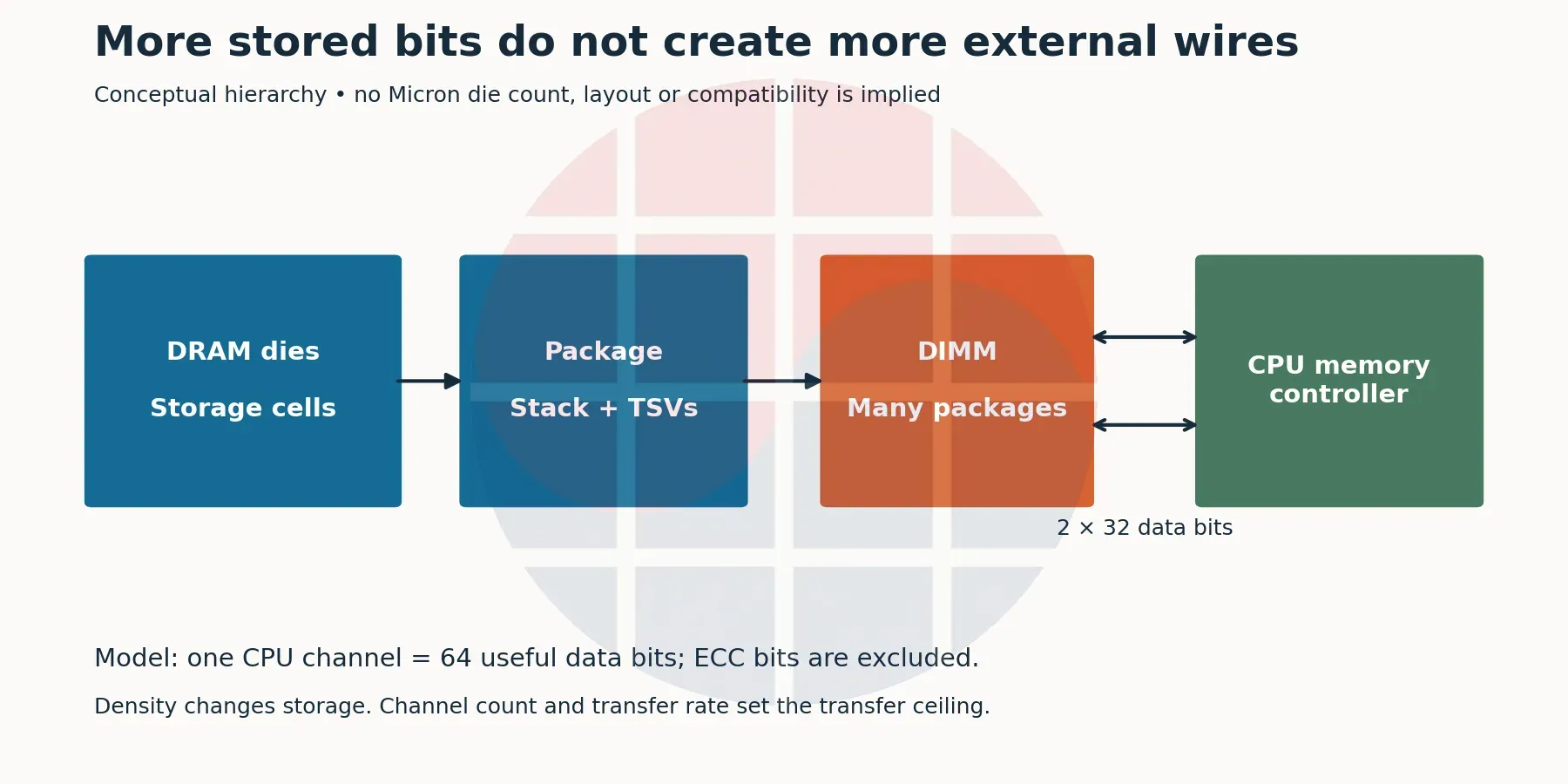
Internal storage resources can overlap operations and reduce idle time on a connection. Better utilization is nevertheless different from a wider external path. A denser module is not inherently slower, and four times the capacity does not establish four times the bandwidth. Operating rate and populated channels have to be considered together.
Put equal capacity behind different numbers of channels
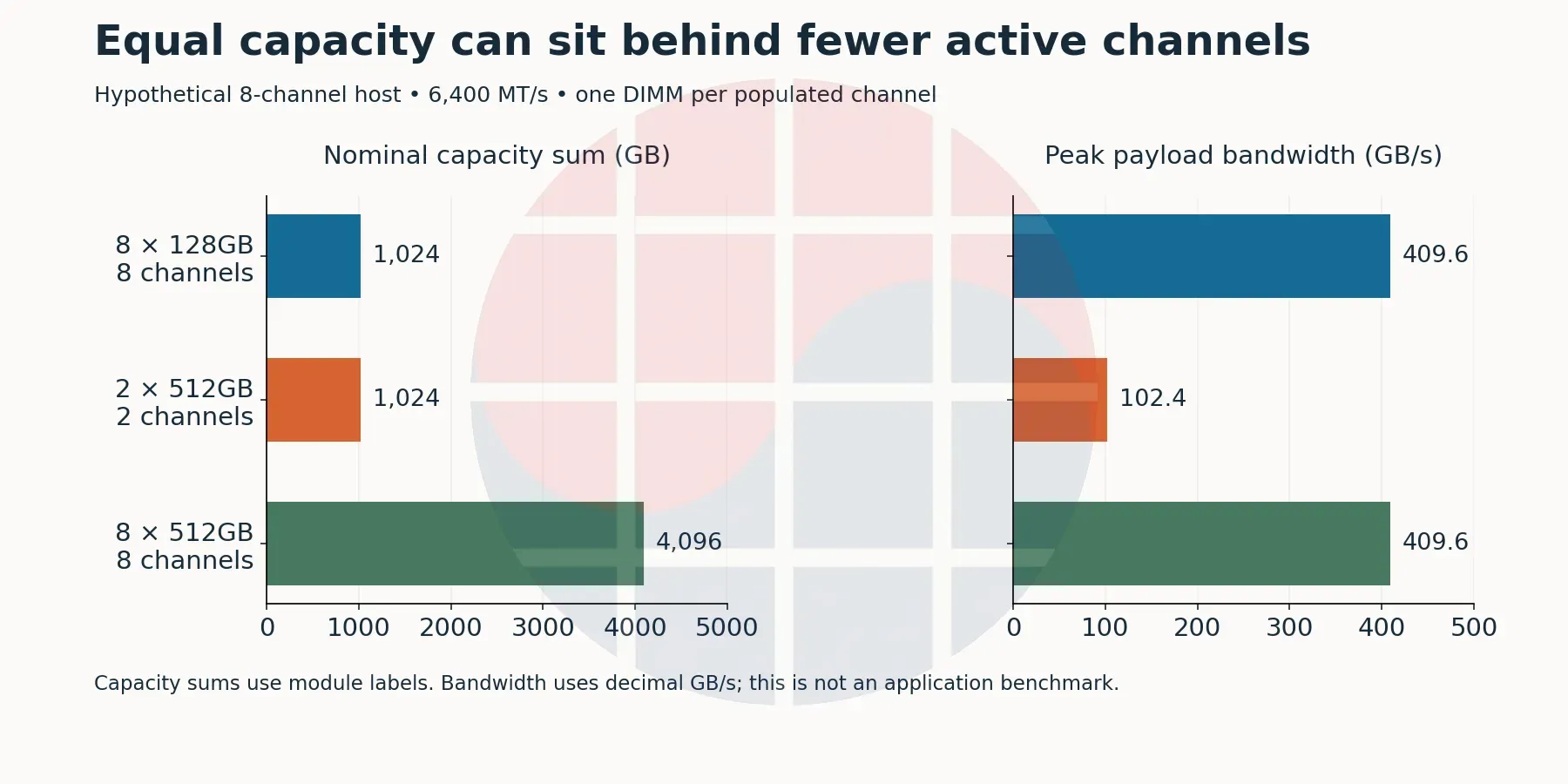
Consider a hypothetical eight-channel server. Configuration A uses one 128GB DIMM on every channel. Configuration B uses one 512GB DIMM on just two channels, leaving six empty. Both sum to 1,024GB in nominal module labels. This is not a claim that a named processor supports 512GB DIMMs.
Assume the same 6,400MT/s rate for both. MT/s already counts transfers, so no further factor of two belongs in the calculation. A 64-bit payload is 8 bytes: one channel can theoretically transfer 6,400×10⁶×8 bytes/s, or 51.2GB/s. Bandwidth here uses decimal 10⁹ bytes/s. We are not converting nominal DRAM capacity labels into the binary units displayed by an operating system.
Eight channels therefore provide 409.6GB/s of theoretical payload bandwidth; two provide 102.4GB/s. Equal capacity sits behind a fourfold difference in the transfer ceiling. Populate all eight channels with 512GB modules instead and nominal capacity becomes 4,096GB while the same model retains 409.6GB/s. Empty channels, rather than density itself, cause the modeled loss.
| Configuration | Populated channels | Nominal capacity sum | Peak payload bandwidth |
|---|---|---|---|
| 8 × 128GB | 8 | 1,024GB | 409.6GB/s |
| 2 × 512GB | 2 | 1,024GB | 102.4GB/s |
| 8 × 512GB | 8 | 4,096GB | 409.6GB/s |
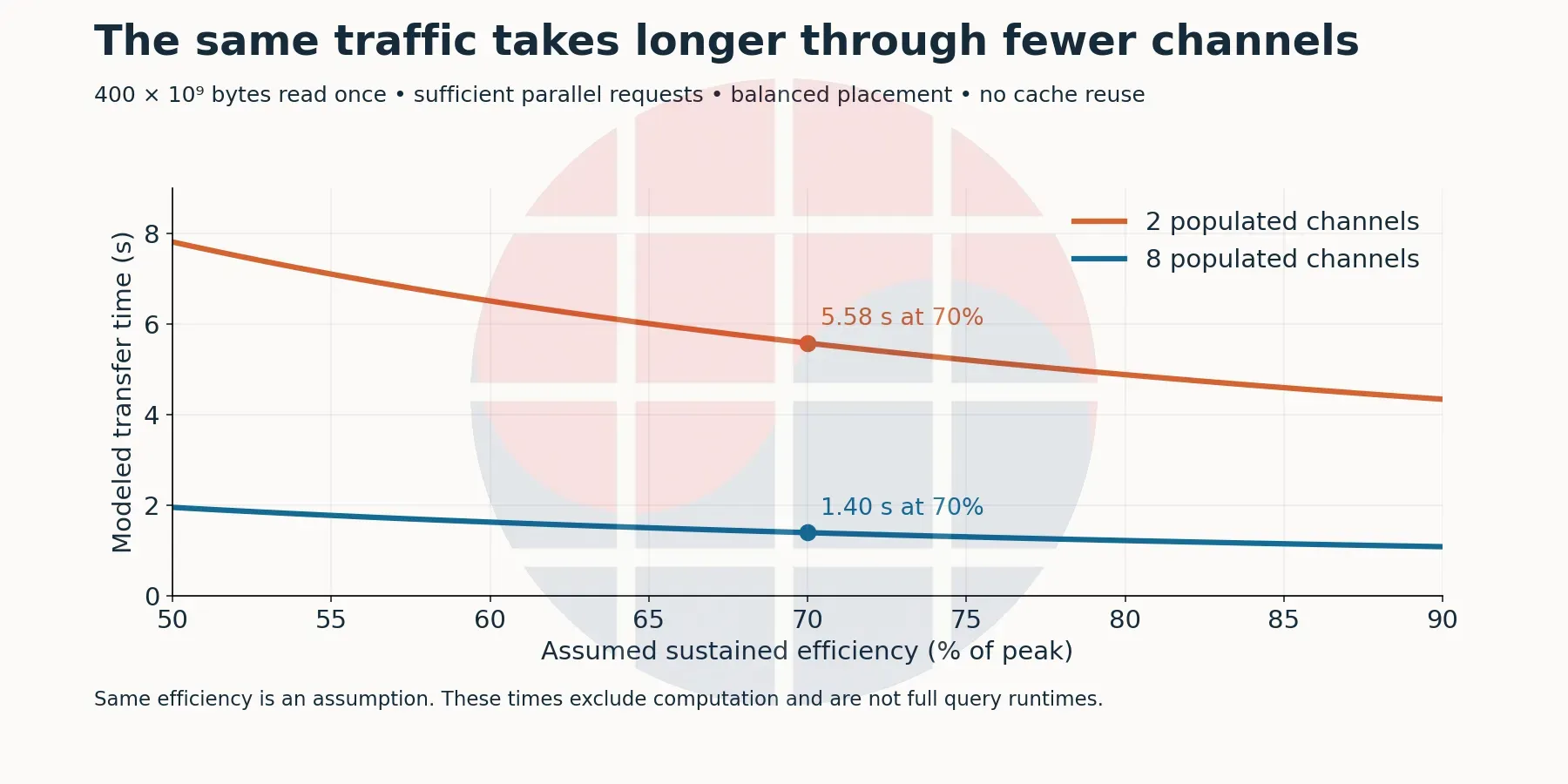
Real memory does not sustain its theoretical maximum continuously. Commands, read/write changes and refresh consume time. Suppose sustained delivery reaches 70% of the ceiling in each configuration. This is an arbitrary sensitivity assumption, not a measured efficiency. Sustained bandwidth becomes about 286.7GB/s and 71.7GB/s.
Now read 400×10⁹ bytes once, without cache reuse, using enough independent requests and distributing data evenly over populated channels. The modeled transfer takes about 1.40 seconds or 5.58 seconds. Neither value is a complete query runtime. At 50% efficiency in both cases the times become 1.95 and 7.81 seconds; at 90%, 1.09 and 4.34 seconds.
Equal efficiency also requires investigation: module organization and controller behavior can produce different utilization. The model’s purpose is to identify the measurement that matters. For traffic-heavy work, lost channel width belongs beside saved modules in the comparison. A quotation matching only total capacity and purchase price can conceal that trade-off.
Four times the bandwidth is not four times the application speed
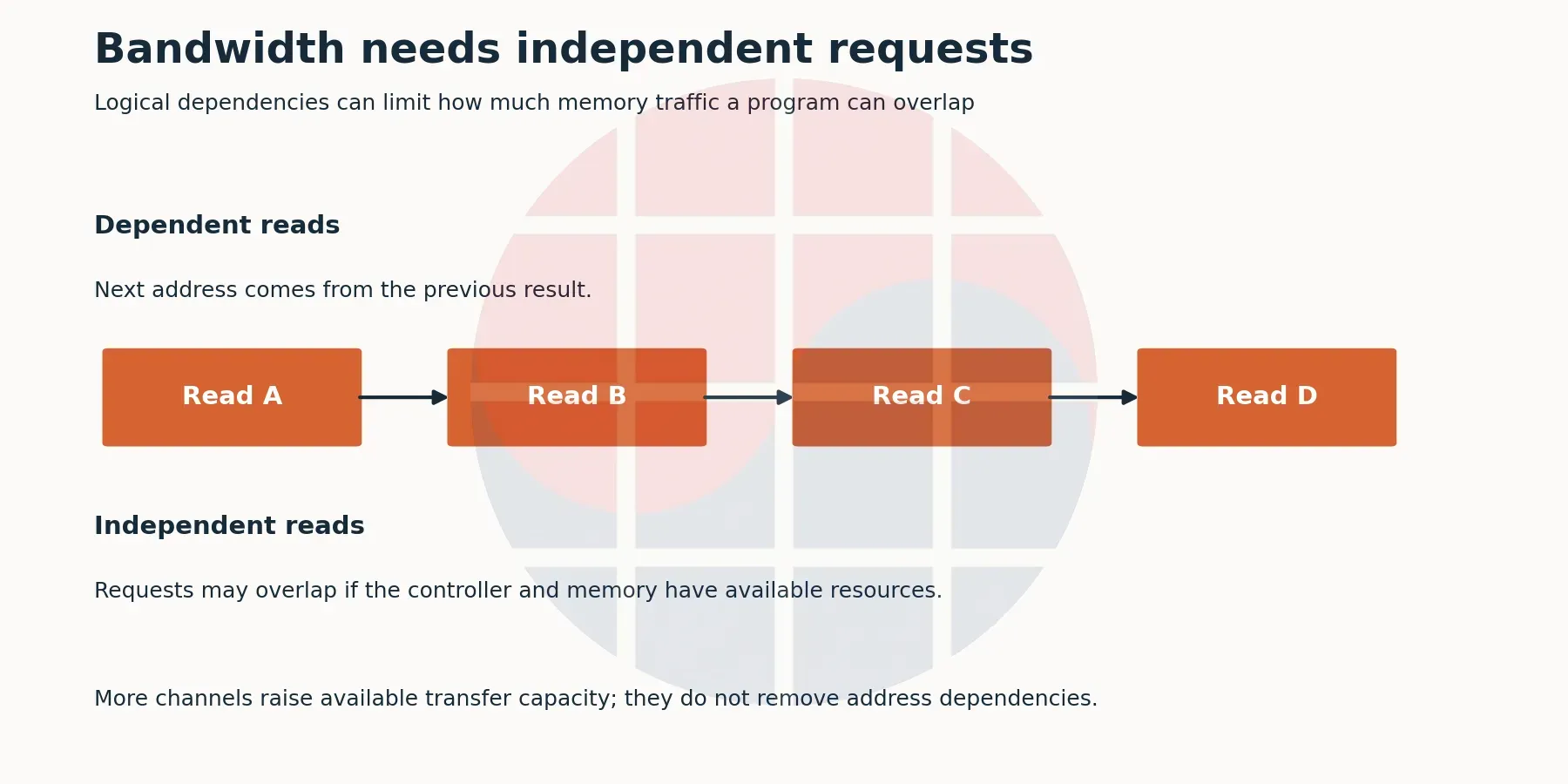
The model is most informative for sustained large transfers with enough independent requests. A different workload may need one read to finish before it can discover the next address. Response latency can then dominate. Eight paths are of limited use if the program can issue only one dependent request at a time.
Frequently reused data may remain in the CPU’s cache, a small, fast storage layer. Few requests then reach external memory. Computation can also dominate runtime. AMD notes that some compute-intensive workloads gain little from extra capacity or bandwidth after minimum memory needs are met. Filling every channel is therefore not a universal purchasing rule. AMD memory-sizing guidance
The opposite effect can be larger still: dense modules may keep a dataset entirely in memory that previously spilled to storage. Capacity was the first bottleneck in that case. Mixing such a result with a capacity-sufficient comparison obscures which change produced the benefit.
First establish whether the working dataset exceeds available memory. Then ask whether data resident in memory moves quickly enough. Neither answer is permanent. Dataset size, concurrent users and virtual-machine counts can turn a previously sufficient resource into a constraint.
Lower module power is not automatically lower energy per job
Micron compares 16.0W for one 512GB module with 44.2W for four 128GB modules. The arithmetic reduction in module operating power is about 63.8%. The announcement’s footnote does not supply a complete equal-throughput, channel-population or whole-server comparison. Those power figures must not be inserted into our separate eight-versus-two-channel model.
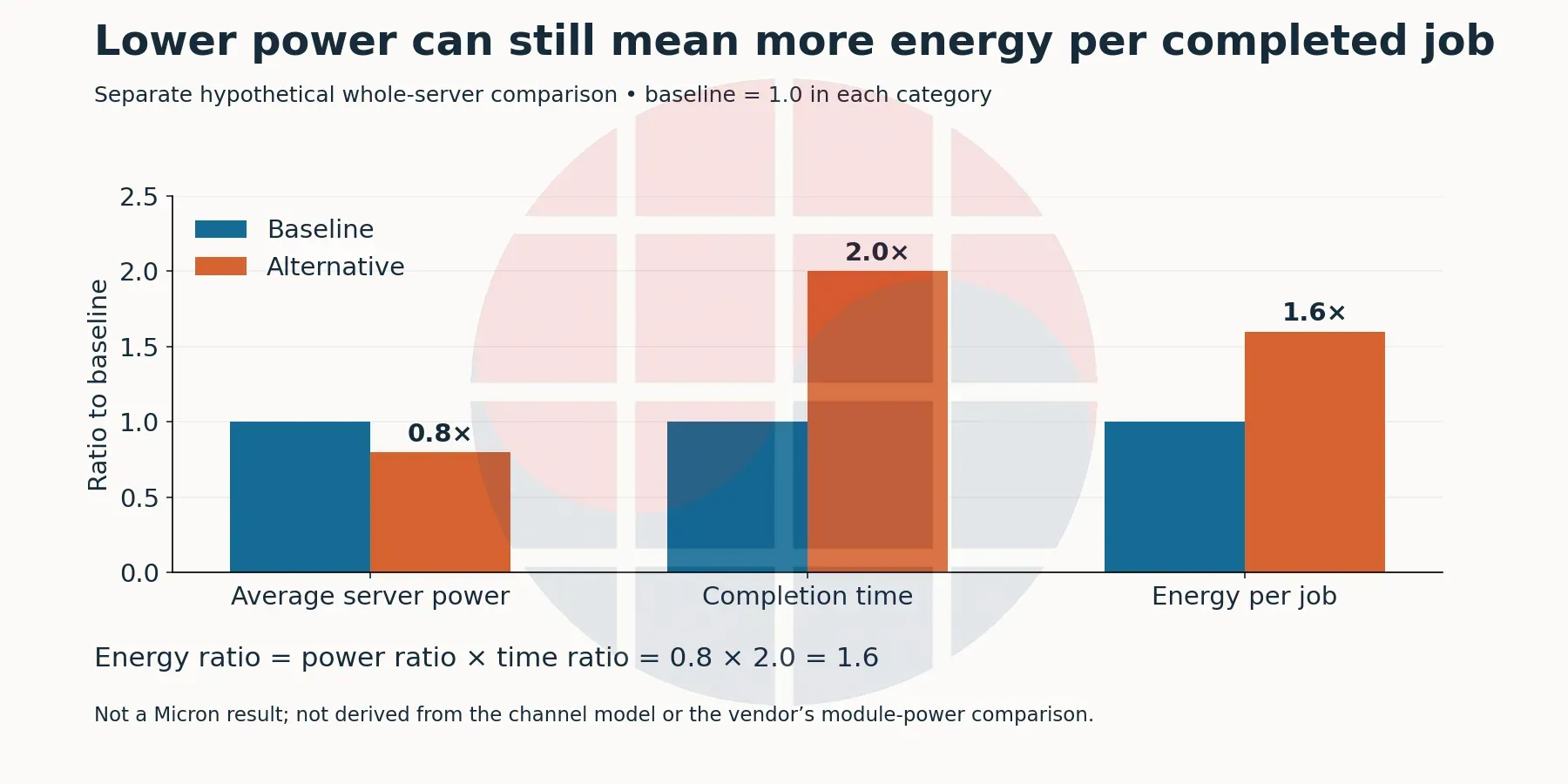
Power is the rate of energy use; job energy accumulates over completion time. In a separate hypothetical system comparison, 20% lower whole-server power combined with twice the runtime produces 1.6 times the energy for the same work. This illustrates the distinction; it is not a Micron product result.
CPUs, fans, power supplies and storage also consume energy. A module-level saving is not the same percentage saving for a whole server. Measure module watts alongside the time and server energy required for an identical query batch. If a lower-power configuration misses response-time targets and requires more servers, its fleet-level result can differ from its per-server result.
Check empty channels before empty slots
Two DIMM slots do not necessarily mean two independent channels. Two DIMMs per channel, or 2DPC, adds capacity while sharing the channel. One DIMM on each of two independent channels provides two external paths. Counting slots alone confuses the two arrangements.
Supported speeds and population order depend on the CPU, server and module. Lenovo’s guidance distinguishes channels from DIMMs per channel for its named platforms. The practical action is to consult the intended server’s population table and validated components, rather than copy another generation’s rules. Lenovo population guidance
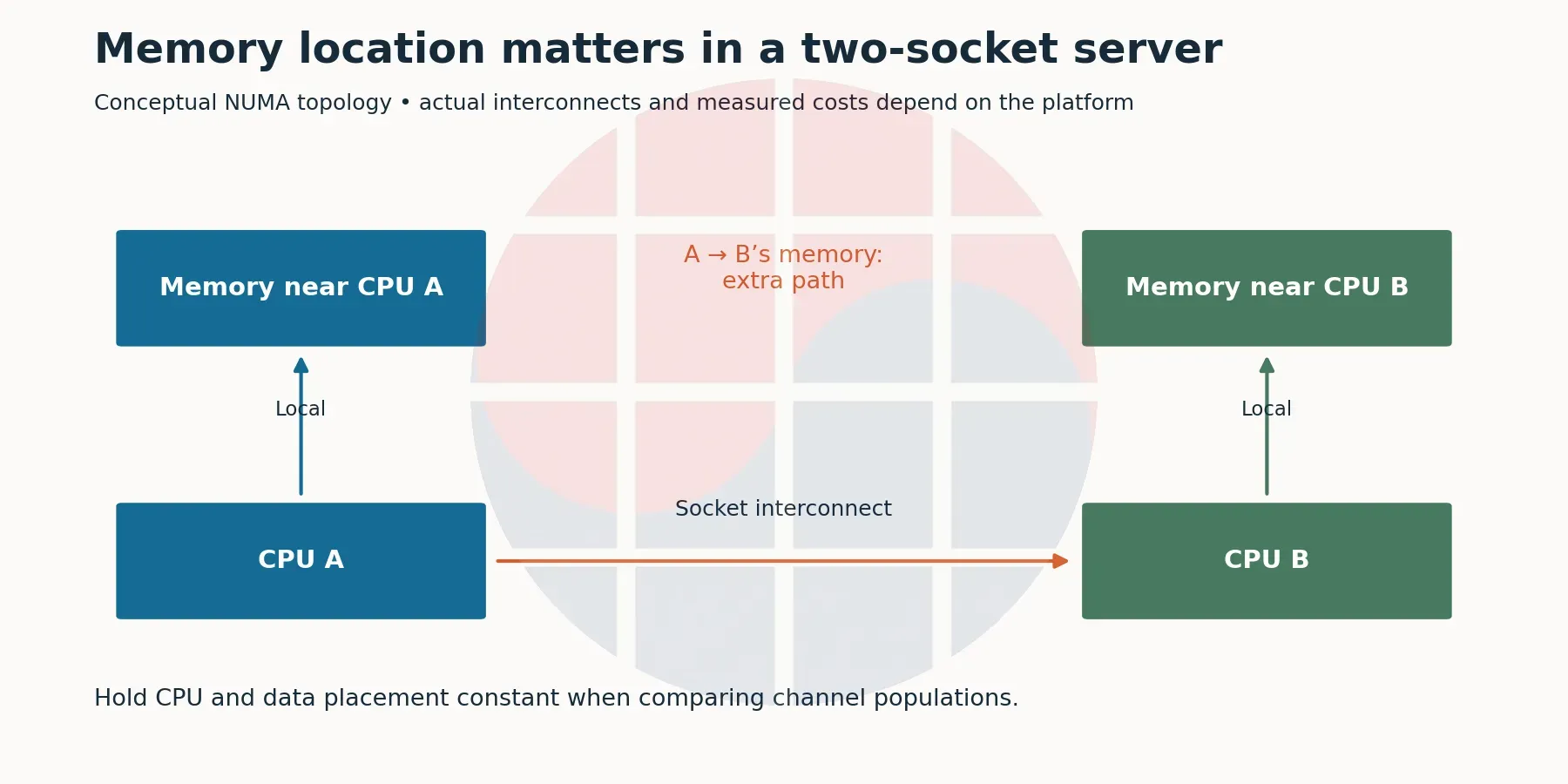
In a two-socket server, the location of memory relative to the executing CPU also matters. Accessing the other socket’s memory can add a path. This location-dependent access cost is NUMA. Changing placement while comparing channel counts makes causality harder to isolate. Start with the same program, data and placement conditions.
Measure in two layers. First characterize memory bandwidth and response latency under load. Intel’s Memory Latency Checker provides measurements of these kinds. Then compare application throughput, latency and energy per completion. We did not run MLC or benchmark a server for this article. A microbenchmark helps explain application behavior; it does not replace the application measurement. Intel MLC documentation
What makes dense memory valuable?
If channels and slots are already occupied and capacity is still insufficient, denser modules provide a way to retain more data in the existing server. Their value may come from avoiding additional servers, sockets and data movement. If capacity is ample and computation dominates, the same module may offer much less value.
Higher storage density requires DRAM and stacking or packaging capability. Faster delivery requires controllers, interfaces, board design and platform qualification. Progress in one does not erase the other’s limits. As more dies fit into a package, extracting their data and handling heat become the next questions. The announcement alone cannot quantify a manufacturer’s yield or cost advantage.
Two 512GB modules cannot be evaluated as replacements for eight 128GB modules by summing capacity alone. Preserve enough storage for the workload and enough populated paths to serve it. Measured throughput and latency may justify removing modules. Until that evidence exists, write the populated-channel count beside the 512GB label.
Disclosure
This article is provided for informational purposes only and does not constitute a recommendation to buy or sell any security. Figures and factual statements are based on publicly available sources, including company filings, news reports, and market research, and may contain errors in the source material or in the preparation of this article. The author may own shares in companies mentioned. All investment decisions and their outcomes are the reader's responsibility.