VLSI Korea
The ABF Substrate Crunch: The Hidden Bottleneck Behind AI Accelerator Supply
The real bottleneck in AI accelerator supply is not chips but ABF substrates. A data-driven look at Unimicron's NT$53.7B expansion and TWD 10.09B Hukou acquisition, SEMCO's KRW 6.78T bet, Ibiden's 2.5x plan, what the 11.6%-to-24.8% margin surge signals, and where Korea's substrate cluster stands.


The ABF Substrate Crunch: The Hidden Bottleneck Behind AI Accelerator Supply
30-Second Summary
The first thing to run out in the AI accelerator supply chain is not fab capacity or HBM. It is the ABF substrate. Unimicron, the world's largest substrate maker, raised 2026 CAPEX from NT$34 billion to over NT$53.7 billion (August 2026) and on 2026-09-30 announced the TWD 10.09 billion acquisition of Bridgestone Taiwan's Hukou factory site. Ibiden's CEO publicly says customer inquiries already exceed expansion plans, and Samsung Electro-Mechanics announced a KRW 6.78 trillion bet on 2026-09-28. The conclusion: substrates have moved from "component" to "bottleneck," and the AI boom's anxiety lives in substrates, not chips.
Background: Why Substrates Are the Problem
What an ABF substrate is
An AI accelerator is not a single chip. A GPU die sits next to HBM stacks in 2.5D packaging, joined by networking and power-management chips into one giant package. The package substrate is the bridge connecting that package to the motherboard, redistributing thousands of signals between chips and the outside world.
The de facto standard dielectric for high-performance computing substrates is ABF film, developed by Ajinomoto for fine-line circuitry. Multilayer substrates built with it are called ABF substrates; flip-chip ball grid arrays (FC-BGA) are the representative product. This is a different world from BT (bismaleimide triazine) substrates used in lower-layer-count, lower-cost products.
ABF vs BT: why the high end belongs to ABF
The substrate market splits by specification. BT substrates serve memory and mobile APs — fewer layers, slower signals. ABF substrates serve high-performance computing, networking, and AI accelerators. ABF film's fine-via processing and low-dielectric properties make it effectively mandatory for the thousands of I/Os and high-speed SerDes links an AI accelerator demands. Switching is hard: converting a BT line to ABF requires different equipment and processes. When Unimicron lists "conversion of legacy BT lines to ABF" as a 2027 capacity lever, it admits existing ABF lines have no slack — having to repurpose spare BT capacity shows how tight ABF is.
How an FC-BGA is made
ABF film is laminated onto a core, vias are laser-drilled, circuits are plated — repeated layer by layer. One defective layer scraps the whole stack, so yields are acutely sensitive to layer count. Add fine pitch, and exposure precision, plating uniformity, and inspection must all be best-in-class. Building the factory is the easy part; dialing in yield is the hard part, routinely taking months after production starts. Behind every "mass production in H2 2027" hides a yield ramp-up period.
Why bigger chips make substrates the bottleneck
Three structural forces are at work. First, chips are getting bigger. Chiplet architectures exceeding the reticle limit and large AI accelerator packages increase substrate area — more material per substrate, fewer units per panel. Area growth is capacity shrinkage. Second, layer counts are rising. More routing layers for high-speed signals and thousands of I/Os, with difficulty rising exponentially — and since one bad layer kills the whole substrate, yield falls as layers rise. Yield is effective capacity. Third, pitch is shrinking. Tighter bump spacing demands ever-finer process control, and only a handful of suppliers can do it at volume. Fine-pitch yield is a moat money cannot buy.
The 2021–2022 déjà vu
This is not the first time. During the 2021–2022 semiconductor shortage, ABF scarcity was an open bottleneck for PCs and servers. Expansions followed, the 2023 correction brought relief, and now the AI accelerator wave has recreated the crunch — except demand now concentrates in the highest-difficulty segment: high layer counts, large areas, fine pitch. Same name, higher stakes.
Deep Dive: The Crunch in Numbers
Unimicron: margins tell the story
Unimicron's H1 2026 results read like a thermometer for the substrate market. Revenue reached TWD 45.822 billion, up 30.8% year on year; net income hit TWD 6.843 billion, up 42.55%. Profit is growing faster than revenue — operating leverage is kicking in, which in a fixed-cost-heavy industry means utilization is near its ceiling.
Margins matter more. Q2 2026 gross margin hit 24.8%, more than double the 11.6% of Q4 2024 — in eighteen months — while ABF's revenue share climbed to 52%.
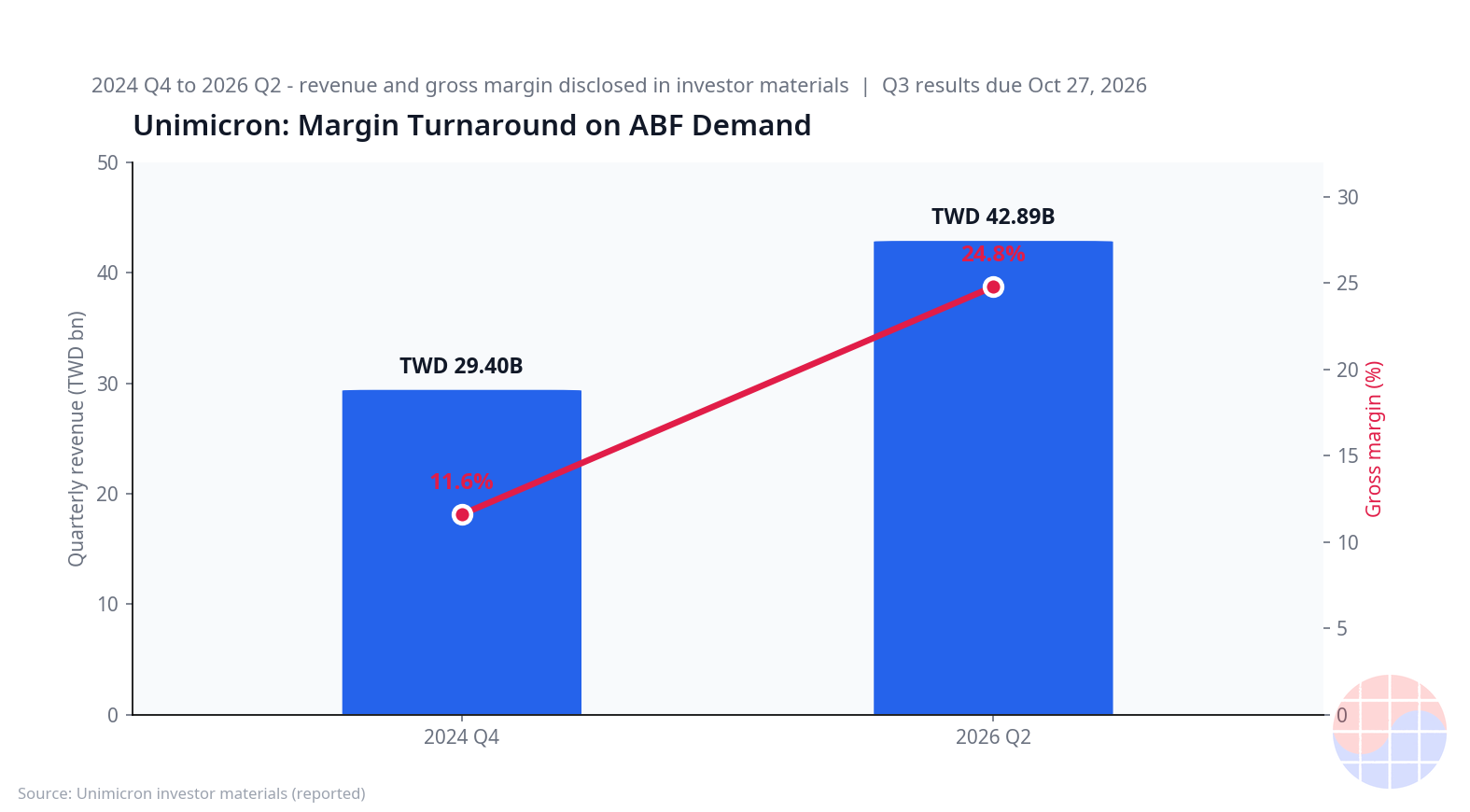
A gross margin doubling from 11.6% to 24.8% in eighteen months is the textbook signature of a seller's market. When demand exceeds supply, prices rise and prices stick to margins. For customers it means one thing — fail to secure ABF lines, fail to ship.
The NT$53.7 billion expansion and the Hukou deal
In August 2026 Unimicron raised its 2026 CAPEX guidance from NT$34 billion to over NT$53.7 billion (per an August 2026 industry report as cited in coverage) — roughly a 58% increase, with 80–85% directed at ABF. The target: 30–40% more ABF capacity by 2027, via the new Hukou site, optimization of existing lines, and conversion of legacy BT equipment to ABF.
The Hukou acquisition is the centerpiece. Announced 2026-09-30, it covers Bridgestone Taiwan's Hukou site and factories for TWD 10.09 billion: 19 land parcels, 14 factory buildings, 63,048 square meters. A tire company's idle site becomes an AI substrate fab, explicitly for long-term high-performance substrate demand. At roughly 19% of the raised NT$53.7 billion annual CAPEX guidance, it is a single deal with real weight — and real downside if the bet misfires.
In the same vein, the Guangfu second plant targets mass production in H2 2027, and co-packaged optics (CPO) substrates are already shipping to multiple customers (as of August 2026) — a down payment on the next bottleneck after AI accelerators.
The three-country build-out race
The other evidence for the crunch is the synchronized betting by rivals in Korea, Japan, and Taiwan.
Samsung Electro-Mechanics (SEMCO) announced on 2026-09-28 a KRW 6.78 trillion (about $4.99B) investment in AI package substrates — among the largest single bets in industry history — alongside a framework of KRW 8 trillion for Sejong and KRW 15 trillion for Busan through 2040. The number shows substrates have moved out of MLCC's shadow to the front of SEMCO's portfolio.
Ibiden will invest ¥500 billion (about $3.2B) over three fiscal years starting FY2026, targeting roughly 2.5x current capacity by FY2028. Most strikingly, Ibiden's CEO has publicly said customer inquiries for expansion already exceed the plan — inquiries for not-yet-built capacity outrunning the plan means the market's demand outlook runs ahead of suppliers' build-outs. A CEO saying this on the record is unusual, and a measure of the market's heat.
LG Innotek is expanding its FC-BGA plant in Haiphong, Vietnam, targeting completion in May 2027 (FC-BGA, FC-CSP, RF-SiP) — cost competitiveness and geopolitical diversification at once.
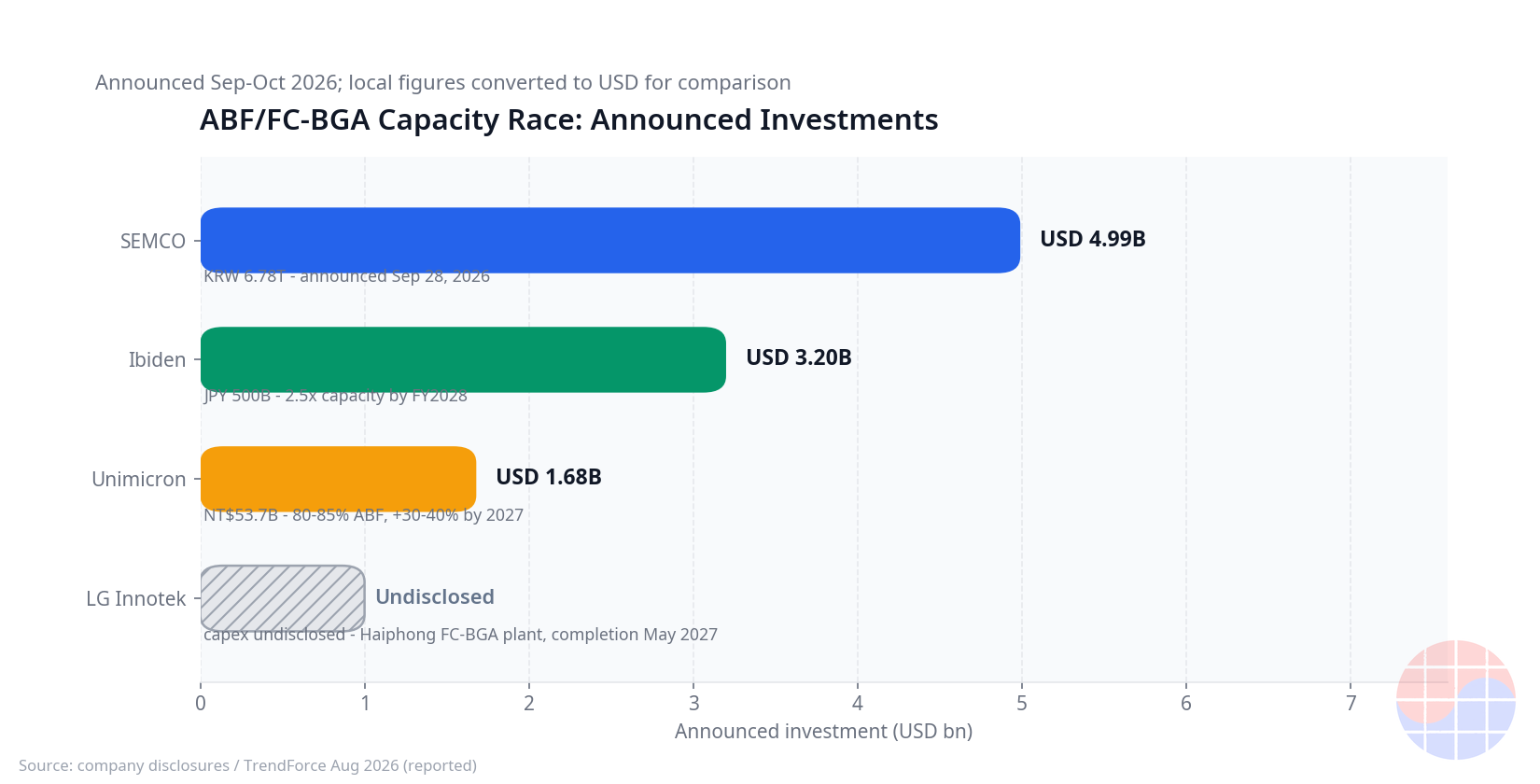
Line the announcements up and one pattern emerges: completions cluster in H2 2027 through 2028. From 2026-10-17, the industry must survive at least another year on existing capacity — that window is the crunch at its peak. Fabs do not appear on announcement: cleanrooms, tools, and yield learning curves normally take two to three years, and the gap between announcement and ramp defines how long the shortage lasts.
Four builders at a glance
| Company | Investment | Target | Timeline | Footprint and notes |
|---|---|---|---|---|
| Unimicron | NT$53.7B+ 2026 CAPEX, 80–85% to ABF | +30–40% ABF capacity by 2027 | Guangfu Plant 2: H2 2027 mass production | Hukou site (TWD 10.09B) + BT-to-ABF conversion; CPO substrates already shipping |
| Samsung Electro-Mechanics | KRW 6.78T (~$4.99B) | Large-scale AI package substrate expansion | Phased (framework through 2040) | KRW 8T Sejong / KRW 15T Busan framework; domestic onshoring |
| Ibiden | ¥500B (~$3.2B) over 3 fiscal years | ~2.5x current capacity | By FY2028 | CEO: inquiries already exceed plan — demand outlook raised |
| LG Innotek | Undisclosed | FC-BGA plant expansion | May 2027 completion | Haiphong, Vietnam; FC-BGA/FC-CSP/RF-SiP; cost and geopolitical diversification |
All four cite demand as the reason; they differ in footprint strategy — Unimicron and Ibiden expand existing hubs, SEMCO onshores domestically, LG Innotek diversifies to Vietnam. Same crunch, different arithmetic.
Anatomy of the bottleneck: why money alone cannot fix it
Three structural reasons keep this shortage from clearing quickly. First, concentration at the material layer: the supply structure for ABF film is even more oligopolistic than substrates themselves. If film supply seizes, substrate capacity is moot — behind the substrate build-out race sits a film procurement race. Second, yield is capacity: nameplate and shippable capacity differ for high-layer-count, fine-pitch substrates, and new lines need months post-startup to stabilize yields — announced capacity numbers should never be taken at face value. Third, the qualification wall: AI accelerator substrates must pass demanding customer qualifications, typically over a year for new suppliers. When incumbents are sold out, customers can only wait — and waiting converts into supplier pricing power.
Verification and counterpoints: the other side of the bet
Two risks deserve equal weight.
First, the Hukou disclosure mentions no customer prepayments, capacity allocations, or supply contracts. TWD 10.09 billion is a self-funded bet: if demand does not arrive on schedule, Unimicron alone absorbs the idle-capacity risk. The shortage's biggest beneficiary could become its biggest victim if the outlook proves wrong — an expansion without prepayments is conviction and gamble at once.
Second, in August 2026 Unimicron was searched by prosecutors over origin-laundering allegations. The company stated the disputed products are conventional PCBs unrelated to substrates; as of 2026-10-17 the investigation is ongoing. Not a direct supply disruption, but worth watching through the lens of large customers' supply-chain due diligence as US export controls and origin-transparency demands tighten.
Chase's Take: Substrates Have Become a Capital Game
Four lenses on the situation.
First, industry structure. A margin doubling from 11.6% to 24.8% in eighteen months documents a power shift: substrates used to absorb set makers' price-down pressure, and now suppliers control capacity allocation. The 52% ABF share is evidence of pricing power, not product-mix trivia. Where substitutes are absent and switching costs are high, suppliers set prices — substrates have entered that territory.
Second, strategy. The Hukou deal is a textbook capacity-preemption play: in oligopolistic markets, whoever builds first takes the volume. Turning a tire company's idle site into a substrate fab shows how fierce Taiwan's fab-site land grab has become. But TWD 10.09 billion of self-funded commitment with no mentioned prepayments or supply contracts cuts both ways — demand conviction, and balance-sheet exposure if demand bends. The 2026-10-27 Q3 earnings call is the next checkpoint: numbers on CPO customer counts and the ABF order backlog would confirm the bet's substance.
Third, the Korean cluster. Daeduck Electronics, Korea Circuit, and Simmtech are traditional substrate powers, but their presence in high-layer-count FC-BGA for AI accelerators still trails Taiwan and Japan. SEMCO's KRW 6.78 trillion and LG Innotek's Haiphong expansion are the large-corporation catch-up. Korea's opportunity is clear: big-ticket corporate bets plus the equipment-and-materials ecosystem behind them. So is the bottleneck: dependence on foreign sources for core materials like ABF film, and fine-pitch high-layer-count yields. Without the film, substrate capacity still shakes the cost structure. Korea's next task is not capacity quantity but specification height — whether the highest-spec substrates AI accelerators demand can be mass-produced domestically and stably.
Fourth, the next bottleneck. Unimicron already shipping CPO substrates to multiple customers (as of August 2026) points beyond the current crunch: if AI accelerator substrates are today's bottleneck, CPO substrates are the leading candidate for the next one. Winners of today's build-out race take pole position in the next — the industry has entered continuous specification competition, not one-off cycles.
The single most important business implication: as supply-chain power shifts from chip designers to substrate makers, system companies must secure substrate capacity the way they secure HBM. Long-term agreements and prepayment structures are likely coming to substrates. Whoever moves first owns 2027.
Implications: What It Means for Investors and Operators
For investors, the earnings leverage of substrate makers deserves attention: 24.8% margin may be a waypoint, not a peak, with capacity sold out and new supply over a year away. The next checkpoint is Unimicron's Q3 earnings on 2026-10-27 — do ABF mix and margins hold, and how fast does CAPEX execute post-Hukou? Risks: the self-funded bet's balance-sheet weight and the ongoing origin investigation since August 2026. Also worth separating price-driven (more sustainable) from mix-driven (bounded) margin expansion.
For operators — anyone building AI servers and accelerators — dual-sourcing substrates and reserving capacity should start now. Finished chip designs ship nothing without substrates. With a tight market expected through H2 2027, locking long-term supply agreements within 2026 is advantageous. For fabless companies, engaging substrate suppliers from the early design stage is becoming mandatory.
For Korea's equipment and materials ecosystem, the build-outs promise spillover demand. SEMCO's KRW 6.78 trillion, LG Innotek's Haiphong expansion, and Unimicron's NT$53.7 billion all convert into tool orders — exposure, plating, and inspection equipment plus copper-clad laminate (CCL) materials form the first beneficiary layer. At the policy level, localizing core materials like ABF film and supporting high-layer-count substrate technology remain supply-chain security tasks.
Scenario outlook
The base case is easing from H2 2027 into 2028, as announced expansions clear yield ramp-up. The bull case: CPO acceleration adds optical-package substrate demand, keeping the market tight into 2028. The bear case: AI infrastructure investment cools and pre-built capacity becomes a burden, with self-funded bets like Hukou tested first. In all three, Unimicron's 2026-10-27 Q3 results and H1 2027 expansion progress are the branching points.
FAQ
Q1. Why did ABF substrates suddenly become the bottleneck? Chips got bigger (chiplets beyond the reticle limit, large packages), layer counts rose, and pitches shrank — sending manufacturing difficulty soaring. Expansions take two to three years from ground-breaking to stable yields, and as of 2026-10-17 major new capacity clusters in H2 2027–2028. It echoes 2021–2022, except demand now concentrates in the highest-spec segment.
Q2. Why does Unimicron's Hukou acquisition matter? The TWD 10.09 billion deal announced 2026-09-30 is the centerpiece of the plan to grow ABF capacity 30–40% by 2027 — 19 parcels, 14 factory buildings, 63,048 square meters, roughly 19% of the raised NT$53.7 billion annual CAPEX guidance. But the disclosure mentions no customer prepayments, allocations, or supply contracts, making it a self-funded risk.
Q3. What does it mean for Korean companies? With SEMCO's KRW 6.78 trillion announcement on 2026-09-28 and LG Innotek's Haiphong FC-BGA expansion, Korea has fully entered the AI substrate race. Combined with incumbents Daeduck Electronics, Korea Circuit, and Simmtech, the Korean cluster's standing rises — but dependence on foreign core materials like ABF film and fine-pitch high-layer-count yields remain bottlenecks. Korea's task is specification height, not capacity quantity.
Q4. When does the shortage end? Unimicron's Guangfu Plant 2 (H2 2027), LG Innotek's Haiphong expansion (May 2027), and Ibiden's 2.5x capacity (FY2028) point to easing from H2 2027–2028, with tightness likely until then. Factoring yield ramp-up, full relief could arrive later than announced capacity suggests.
This analysis is based on corporate disclosures and reporting available as of 2026-10-17 and is not investment advice.
Sources
- Samsung Electro-Mechanics KRW 6.78T investment (2026-09-28): https://www.techtimes.com/articles/328150/20260928/samsung-electro-mechanics-commits-5-billion-ai-chip-substrates-record-bet-hits-upstream-wall.htm
- Structural analysis of the ABF bottleneck (2026-10): https://techsoda.substack.com/p/dr-change-column-15-as-chips-get
- Unimicron Hukou acquisition disclosure coverage (2026-09-30): https://www.ad-hoc-news.de/boerse/news/corporate-news/unimicron-bought-hukou-sites-unimicron-stock-sits-11-62-percent-below-its/70298283