VLSI Korea
The Semiconductor Bear Case, Scored in Numbers: Negative FCF, USD 825B in Commitments, Power That Never Arrives
The bear case is not about demand. It is about funding and power: Meta's first negative FCF, USD 825 billion in commitments, and data centers stalled without electricity. Six pillars scored in numbers, the overreach marked, and the five conditions that would confirm it.


Start with the conclusion: the current semiconductor bear case is not a story about AI demand collapsing. Every piece of evidence the bears are putting forward sits on the funding and power side. The buyer's cash flow fell behind its spending for the first time, the commitments it has signed grew by USD 125 billion in a single quarter, and a data center with chips contracted has stalled because there is no electricity to plug them into. On October 22, 2026, as the SOX fell -5.40% intraday and all 32 US semiconductor stocks we track declined, the market was not re-rating demand. It was re-rating sustainability. This article scores the six pillars of the bear case in numbers, then marks where the bears overreach, and finally lists the conditions that would actually confirm the bear case.
Pillar 1 — The buyer's cash runs dry first: Meta
The hardest evidence the bears have is Meta's Q3 2026 cash flow. Operating cash flow from the advertising business was USD 32.79 billion. Capital expenditure, including finance-lease principal payments, was USD 34.91 billion. Free cash flow was therefore negative USD 2.12 billion — the first negative FCF quarter since Meta's 2012 IPO. A year earlier, FCF was positive USD 10.63 billion.
| Item | Figure | Source |
|---|---|---|
| Q3 operating cash flow | USD 32.79B | Meta Q3 earnings |
| Q3 capex (incl. finance-lease principal) | USD 34.91B | Meta Q3 earnings |
| Q3 free cash flow | USD -2.12B (first negative since IPO) | Meta Q3 earnings |
| Total future commitments (10-Q) | ~USD 825B (from ~USD 700B in July, +USD 125B in 3 months) | Meta 10-Q, Bloomberg |
| Commitment breakdown | Uncommenced leases USD 355.7B (through 2036) + non-cancellable contracts USD 454.5B + contingent cloud USD 14.7B | Meta 10-Q, Bloomberg |
| Meta 5-year CDS | ~119.3bp, a record high (+8.9bp in a day) | ICE data, Bloomberg |
| Long-term debt | USD 58.7B (end-2025) → USD 80.9B | Meta filings |
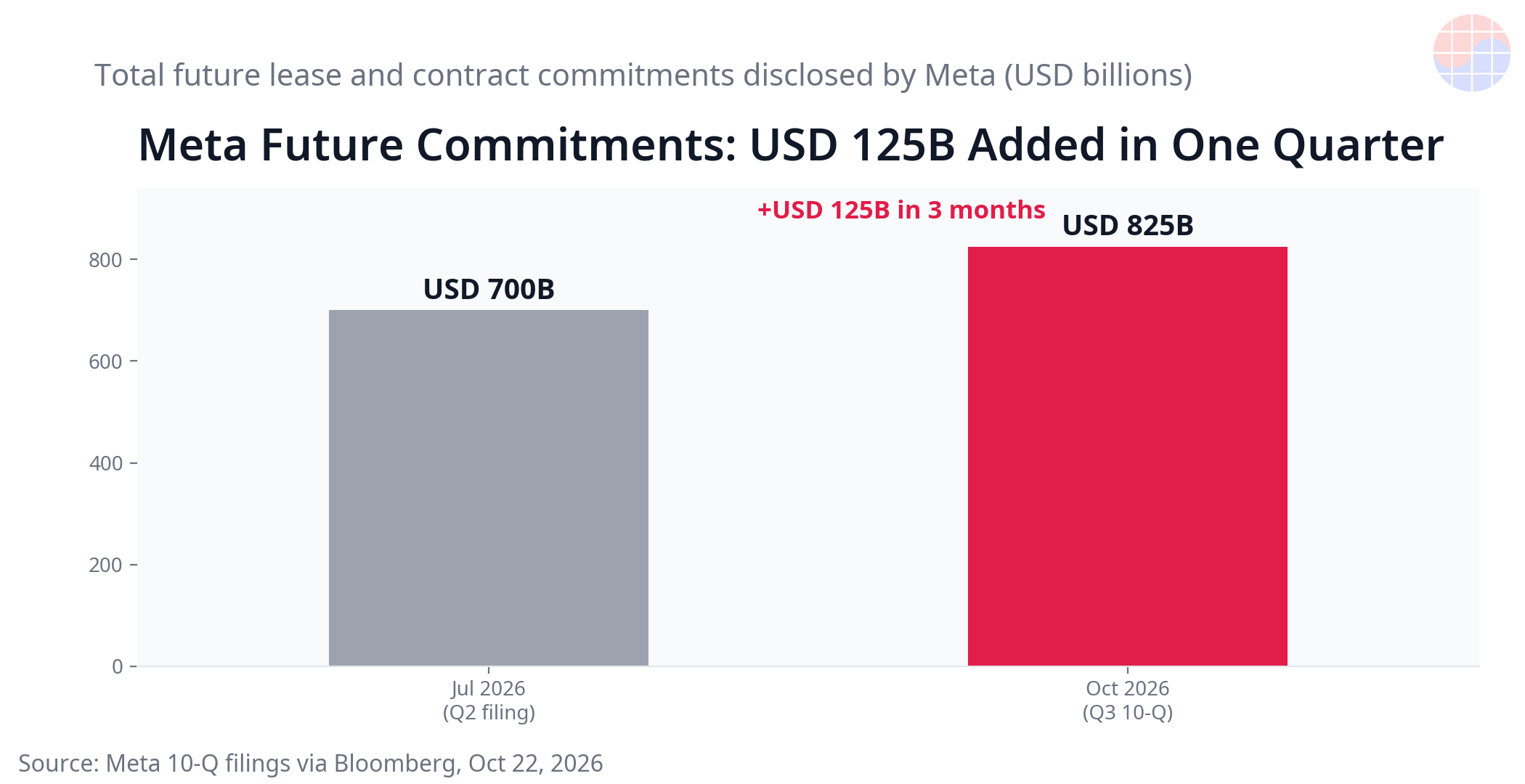
Meta's future lease and contract commitments grew by USD 125 billion in three months. The October total of USD 825 billion consists of USD 355.7 billion in uncommenced leases, USD 454.5 billion in non-cancellable contracts and USD 14.7 billion in contingent cloud commitments. Source: Meta 10-Q via Bloomberg
What matters more than the figures is how the funding model changed. Meta bought back no shares this quarter, and it announced a new non-voting Class C share class that can be used for future financing. The bear reading: "Even the most cash-generative company in the industry can no longer fund the AI build-out from operating cash alone. It has moved to off-balance-sheet commitments and the capital markets." The bond market moved before the stock market on this — Meta's 5-year CDS hit a record — and that is what gives the argument weight.
Pillar 2 — The second wallet wobbles: the neoclouds
After the hyperscalers, the next layer of bulk GPU buyers is the new generation of AI clouds — the neoclouds. Three cracks appeared in that layer at the same time.
- Nscale (UK): Microsoft withdrew as anchor tenant at the Loughton site in Essex after grid connection slipped into the 2030s. The site was to host 23,040 Nvidia GB300 GPUs. Nscale is targeting a USD 30 billion New York listing valuation; investors are indicating USD 16–19 billion. Bloomberg reported that Nvidia CEO Jensen Huang, at GTC Berlin, urged Nscale to "work around the clock" to fix the delays.
- Firmus (Australia): Withdrew its ASX listing, which was meant to raise USD 5 billion, after institutional demand failed to appear even at a reduced price. Nvidia is now reportedly in talks to invest more — a structure kept alive by Nvidia's wallet rather than the public market, in the bears' telling.
- DayOne (Singapore): Reported to be considering a delay or a smaller US listing. This remains at the "under consideration" stage.
Neocloud order books rest on a simple structure: borrow to buy GPUs, repay from long-term contracts. If the IPO window closes, that funding loop slows all at once. The bear case treats neocloud demand not as organic demand but as demand manufactured by credit.
Pillar 3 — The physical ceiling: chips without power
Loughton is not a demand story. It is a story about where the bottleneck has moved. The site existed, the GPU contract existed — but with grid connection pushed into the 2030s, the anchor customer left.
Using Jensen Huang's own conversion figures, a 1GW AI factory costs roughly USD 50 billion to build and can generate about USD 40 billion a year in revenue. At that scale, one month of delay defers revenue in the billions. The structural bear claim is precise: "The bottleneck has moved from chip supply to power, grids and permitting. However many chips are fabricated, the realized pace of chip demand is now set by the power grid."
Pillar 4 — Equipment and China: the Lam Research paradox
Lam Research's September quarter was a record: revenue of USD 8.22 billion (+54% year on year) and a non-GAAP operating margin of 40.2%, above 40% for the first time in the company's history. The stock still fell -9.6% in a day, because the market prices the next quarter, not the last one.
| Item | Figure |
|---|---|
| September-quarter revenue | USD 8.22B (+54% YoY), operating margin 40.2% (first time above 40%) |
| December-quarter guidance | Revenue USD 8.6B ±0.4B — below the whisper number of ~USD 8.9B |
| CFO comment | Guidance "would have been higher" without supply constraints; some shipments push into the March quarter |
| China revenue share | 35% in the September quarter → guided "meaningfully down" in December |
The bears then add export-control risk. The Information reported that Israeli security firm Lava, by tracking Nvidia DCGM Exporter monitoring endpoints left exposed on the internet without authentication, identified 32 export-controlled B300 GPUs on IP addresses linked to state-owned China Telecom. The volume is trivial. The direction is the point: "If diversion is found again just as China's revenue share rolls over, further US restrictions will reprice the China exposure of both equipment and chip names."
📩 Following this story?
Get the follow-up analysis — earnings, reports and HBM supply — in your inbox daily at 10:30 KST. Subscribe free →
Pillar 5 — The first deceleration signals on the demand side
- Tesla's capex cut: Tesla lowered its full-year capital expenditure target from USD 25 billion to USD 20 billion. The bear reading: one of the most aggressive buyers has slowed down.
- Circular-financing doubts: Nvidia and Tesla were reported to be investing about USD 2.8 billion in Samsung Electro-Mechanics FC-BGA capacity. Doubts about a structure in which the chip supplier funds customers and partners, and that money returns as chip orders, were already building. We dissected that loop in the AI circular investment loop: whose revenue is it anyway?
The bears frame these not as a demand collapse but as a question about the quality of demand: how much is organic, how much is built on credit, and how much is funded by the supplier itself.
Pillar 6 — Positioning and price: it was already expensive, already crowded
The final pillar is not fundamentals but market structure. Per XTB, hedge-fund global short exposure sits at a five-year high, and the Nasdaq had just fallen -5.5% the previous week, its worst week since April 2025. The one-line summary of this earnings season is "decent is not enough": good results without a guidance raise get sold.
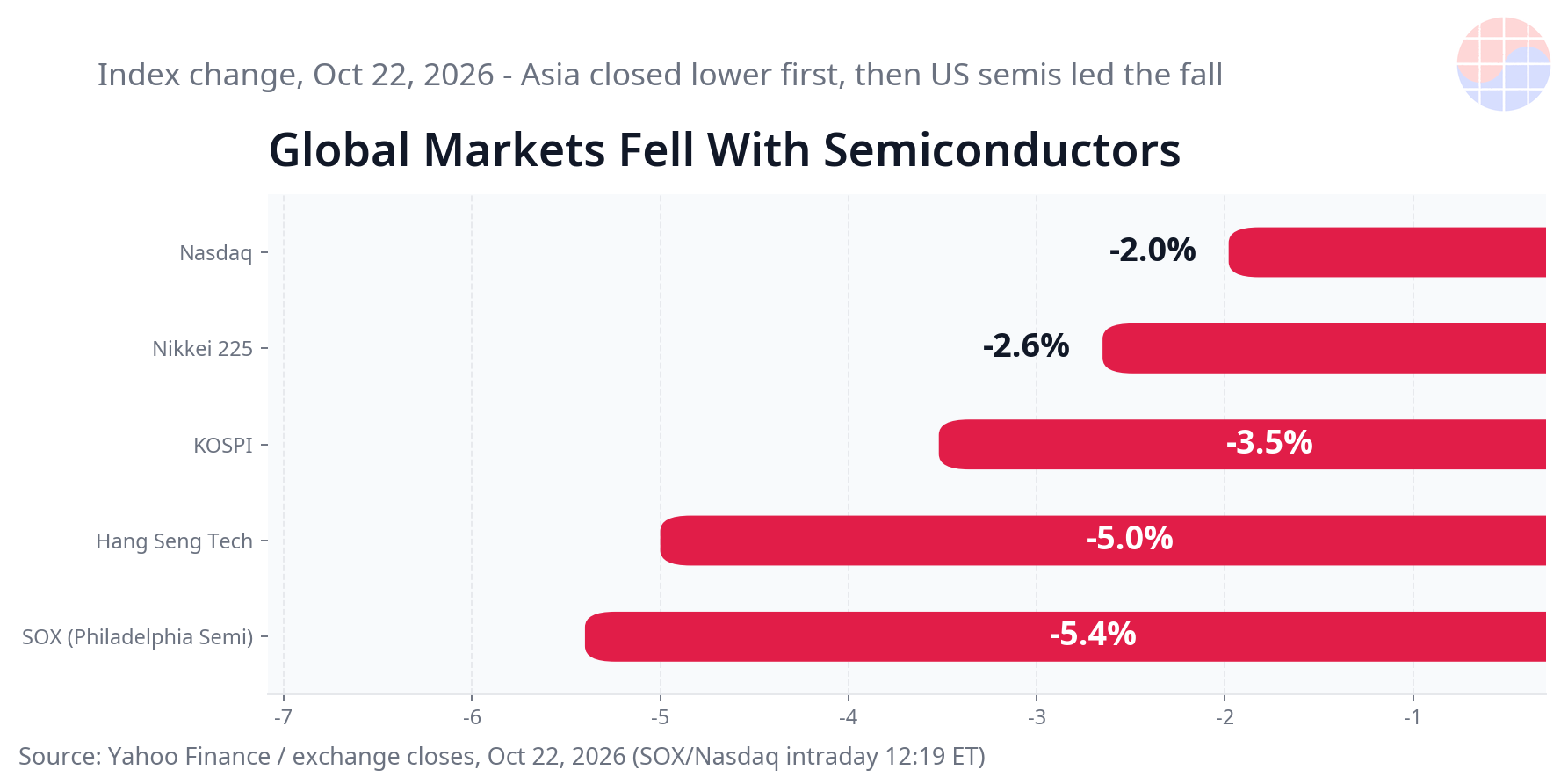
On October 22, 2026, global indices moved in one direction from Asia to the US. Source: Yahoo Finance, market closes and US intraday snapshot
| Indicator | October 22 |
|---|---|
| SOX (US intraday) | -5.40% |
| US semiconductor stocks tracked | All 32 down, 16 of them by -5% or more |
| KOSPI | -3.52% (Samsung Electronics -4.03%, SK hynix -5.49%) |
| China CSI 300 | -20.2% from its June peak, bear market confirmed; China semiconductor index -3.6% |
| Brent crude | USD 111.64 (+2.59%) after the drone attack on a Saudi oil field |
The oil spike is the bear case's macro amplifier. If the inflation and rate path wobble, long-duration growth stocks — priced on distant cash flows — get re-discounted first. The stock-by-stock breakdown of that night is in why semiconductor stocks fell: the full list of reasons.
Where the bears overreach
The evidence is real. But at each step from evidence to conclusion, the bear case adds a layer of exaggeration. Scored honestly:
- Meta's cash: Meta is not running out of money. It holds USD 82.45 billion in cash and marketable securities, Q3 revenue grew +26% to USD 64.6 billion, and Q4 guidance is USD 73–76 billion. The accurate sentence is not "cash depletion" but "the first quarter in which the pace of spending overtook the pace of cash generation." One quarter of inversion needs a second quarter to become a trend.
- Lam is supply, not demand: As Bank of America put it, Lam's guidance cap is "supply constrained, not demand constrained." Equipment shipments delayed by parts shortages cannot, by themselves, evidence collapsing demand.
- Tesla's capex is a deferral reading: JPMorgan and StoneX read Tesla's cut as spending pushed into 2027–2028 for robotaxis, Optimus and Terafab. A deferral and a cancellation are different events.
- Nscale is a single site: Microsoft withdrew from Loughton only, and both companies state the partnership continues. Loughton is a part of Nscale's USD 103.4 billion backlog, not the whole of it. "The biggest customer left" inflates a site-level fact into a company-level one.
- The B300 count is 32: An IP-address association does not establish physical ownership or location. Thirty-two chips are symbolically large and, as supply volume, negligible.
Chase's Take — Narratives move late; measurements move first. What is genuinely new in this bear case is not opinion but three measurable quantities: the speed at which commitments are growing (+USD 125 billion in one quarter), the power-connection queue (sites exist, the grid arrives in the 2030s), and equipment shipment deferrals (caused by parts, not by missing orders). All three can be counted directly on the supply side. Rather than deciding whether to believe the bear case, track which way those three numbers move next quarter. When the numbers turn, the narrative follows on its own.
What would confirm the bear case — a checklist
The bear case is still a hypothesis. It becomes a trend only when the conditions below are actually observed. Status as of October 23, 2026:
| Confirmation condition | Why it matters | Status now |
|---|---|---|
| Other hyperscalers' FCF also turns negative | One company's inversion becomes an industry-wide funding limit | Not yet — confirmed at Meta only |
| A major buyer (Meta, Microsoft, peers) actually cuts capex guidance | When the spending plan itself — not just commitments — rolls over, chip orders fall directly | Not yet — Meta's commitments are still rising |
| A large neocloud default or another anchor-contract termination | The moment credit-built demand converts into cancelled demand | In progress — the IPO window is closing; no large default yet |
| The word "demand" appears in Lam / Applied Materials guidance as a constraint | If the constraint flips from supply to demand, the cycle call itself changes | Not yet — only supply constraints are stated |
| SOX breaks this sell-off's low and hyperscaler CDS spreads widen further | When stocks and credit point the same way at once, it is a re-rating, not a correction | In progress — Meta CDS at a record; SOX low not yet broken |
Of the five conditions, none is confirmed. Two are in progress, three have not happened. So the strongest honest form of the bear case today is one sentence: "Funding and power constraints have begun to act as a speed limit on demand." The next sentence belongs to this checklist.
Frequently asked questions
What is the core claim of the semiconductor bear case?
Not a demand collapse. It is a claim about sustainability: the buyer's cash flow (Meta's first negative FCF), ballooning future commitments (USD 825 billion), data centers stalled for lack of power, and a wobbling neocloud funding layer.
Why does Meta's negative FCF matter for chip stocks?
Meta is one of the largest buyers of AI chips. Its quarterly capex (USD 34.91 billion) exceeded its operating cash flow (USD 32.79 billion) for the first time — the first measurement suggesting that buyer funding capacity can become the speed limit on chip demand.
Does Lam Research's share price fall mean demand has rolled over?
No. Both the company and Bank of America attribute the constraint to supply (parts). A demand problem would require demand softness to be stated directly in future guidance, which has not happened.
How can I tell whether the bear case is being confirmed?
Watch five conditions: other hyperscalers' FCF turning negative, an actual capex guidance cut by a major buyer, a large neocloud default, the word "demand" appearing as a constraint in equipment guidance, and a SOX break of the sell-off low with wider CDS spreads. As of October 23, 2026, none is confirmed.
📩 Missed today's analysis? Get tomorrow's in your inbox
Daily Silicon at 10:30 KST plus earnings and analyst-report breakdowns, first. Samsung Electronics, SK hynix, TSMC and HBM supply, read by practicing engineers. Join 300+ subscribers.
Subscribe free →
Free · No spam · Unsubscribe anytime