VLSI Korea
Why Semiconductor Stocks Are Falling: SOX -5.4% and 7 Reasons (Lam, Meta, Tesla, Power)
SOX -5.40% and all 32 tracked US semiconductor stocks fell. Seven reasons with numbers: Lam guidance, Tesla's capex cut, Meta's first FCF deficit, oil, Korean flows, power-grid delays and positioning.


🆓 Free article · Anyone can read this article for free
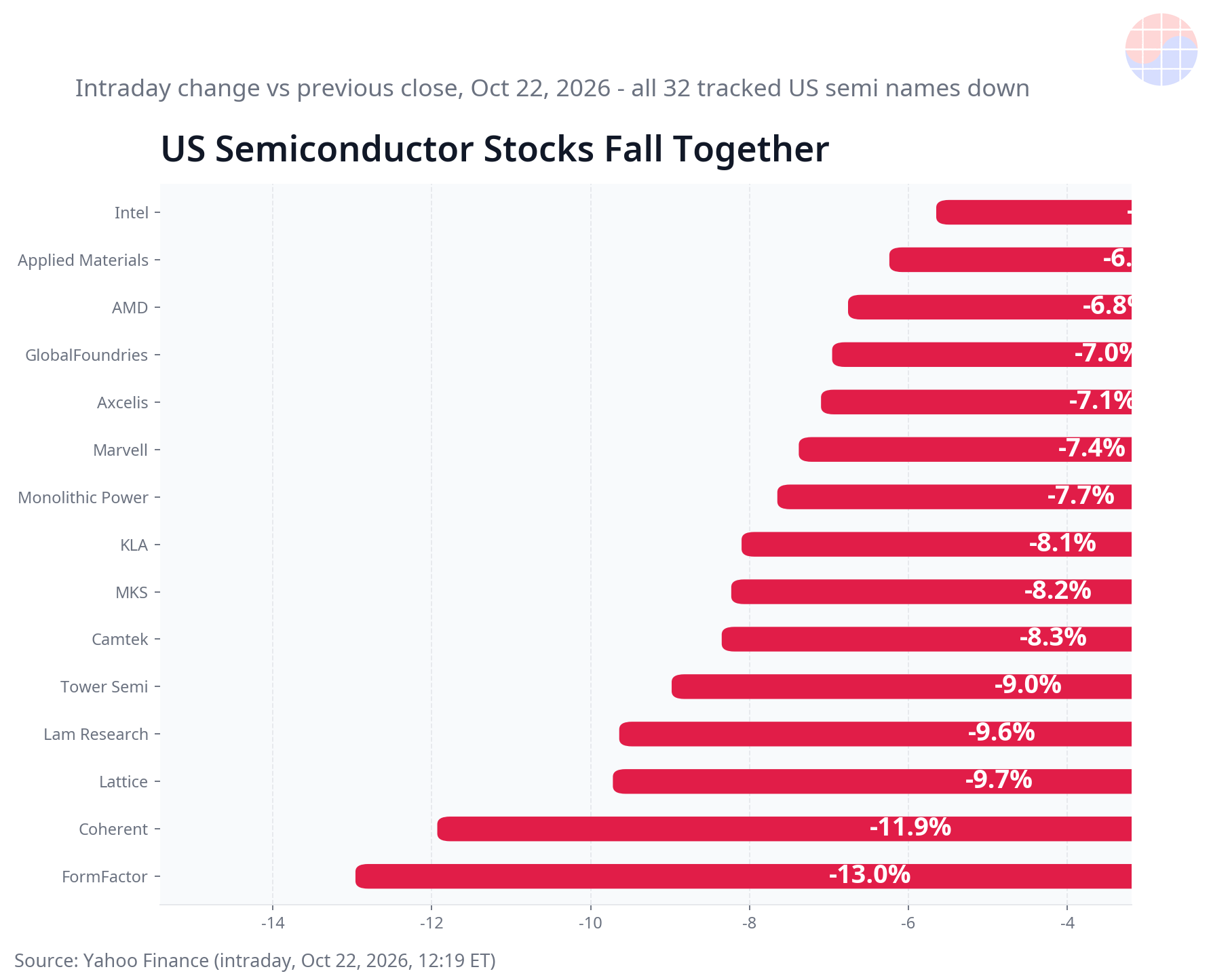
The selloff is not an AI demand break. At 12:19 ET on October 22, 2026 (01:19 KST, October 23), the Philadelphia Semiconductor Index (SOX) was down -5.40% and SOXX was down -5.39%. All 32 tracked US semiconductor stocks fell, and 16 fell more than -5%. Six pressures landed at once on expensive valuations: Lam Research guidance, a Tesla capex cut, Meta's cash-flow deficit, higher oil, the end of Korean buyback support, and power-grid delays.
Key facts: indices and leading decliners
| Item | Move | Basis |
|---|---|---|
| SOX | -5.40% (11,505.56 to 10,883.97) | Intraday, Oct 22 |
| SOXX / Nasdaq / S&P 500 | -5.39% / -1.98% / -1.01% | Intraday, Oct 22 |
| Worst decliners | FormFactor -12.96%, Coherent -11.93%, Lattice -9.72%, Lam Research -9.64% | Calculated from Yahoo Finance daily bars |
| Large caps | KLA -8.10%, AMD -6.76%, Applied Materials -6.24%, Intel -5.65%, ASML -5.05%, Micron -4.88%, TSMC ADR -4.41%, NVIDIA -3.99%, Broadcom -3.79% | Intraday, Oct 22 |
| Meta / Tesla | Meta -5.96%, Tesla -1.28% intraday | Intraday, Oct 22 |
Reason 1: Lam Research — record results, flat guidance
Lam was the trigger. Revenue of USD 8.22B beat consensus of USD 8.14-8.18B, EPS was USD 2.20 and revenue grew +54% year on year, but December-quarter guidance of USD 8.6B plus or minus USD 0.4B only matched consensus. CFO Doug Bettinger said near-term supply chain constraints kept guidance from being higher and some shipments slipped into March. China was 35% of September-quarter revenue and is guided to fall meaningfully in December.
Bank of America drew the key line: this is a supply constraint, not a demand constraint. Still, Morgan Stanley cut its target to USD 339 and Needham cut to USD 290. As Deutsche Bank and Jefferies noted, for a market used to beat-and-raise, the absence of a real raise is itself a reason to sell.
Reason 2: Tesla cut its capex target by 20%
Tesla lowered its annual capex target from USD 25B to USD 20B (-20%), with the CFO citing efficient capital deployment. MarketWatch named it one of the two big reasons for the day. The counterpoint matters: JPMorgan and StoneX read the cut as a deferral into 2027-2028 for robotaxi, Optimus and Terafab spending — a schedule shift, not vanished demand.
Reason 3: Meta — first quarterly FCF deficit since the 2012 IPO
The heaviest numbers came from Meta. Q3 operating cash flow was USD 32.79B, but capex including finance-lease principal payments reached USD 34.91B, leaving free cash flow at USD -2.12B — the first quarterly FCF deficit since the 2012 IPO, per Dow Jones Market Data via FXStreet.
Before the US open on October 22, Bloomberg's read of the 10-Q put total future commitments at about USD 825B, up from about USD 700B in July: USD 355.7B of uncommenced leases running to 2036, USD 454.5B of non-cancellable contracts and USD 14.7B of conditional cloud commitments. Meta's 5-year CDS jumped about 8.9bp to a record near 119.3bp. Credit markets have started pricing the spending pace, too.
Balance is required. Meta holds USD 82.45B in cash and marketable securities, and Q3 revenue grew +26% to USD 64.6B. This is not distress; spending is simply growing faster than cash generation. Daishin Securities analyst Kyungmin Lee noted that both Meta and Tesla beat expectations yet failed to ease AI profitability concerns, and XTB pointed out that Meta, which does not sell compute externally, has the hardest ROI story to prove.
Reason 4: Oil and the Middle East pushed discount rates back up
A drone attack on a Saudi oil field killed two people, Dhahran-area airport facilities were hit, and the US State Department moved some diplomatic families. Brent rose +2.59% to USD 111.64, near a five-month high, and WTI reached USD 99.39. Inflation and rate-hike fears returned, the VIX moved above 18, and the Fed is in its blackout period before the October 27-28 meeting, with a December hike now discussed. For high-multiple tech, a higher discount rate is immediate valuation pressure.
Reason 5: Asia fell first, and Korea's buyback floor expired
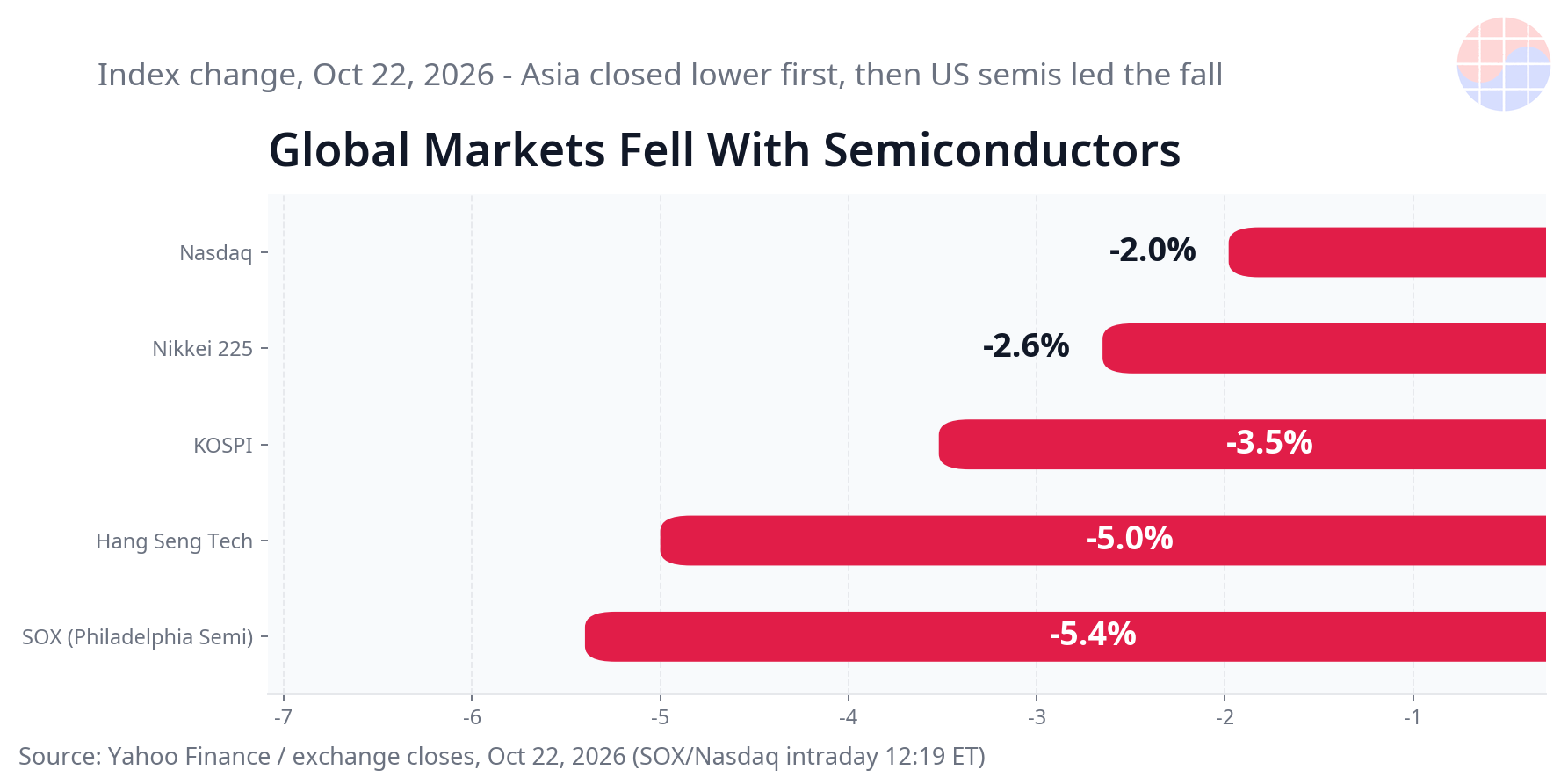
The KOSPI closed -3.52% at 5,533.77 on October 22, erasing the prior day's +3.29% rebound in one session. The KOSDAQ fell -3.62%, Samsung Electronics fell -4.03% to KRW 214,500 and SK hynix fell -5.49% to KRW 1,223,000, with large net selling by foreigners and institutions (Aju Business Daily put foreign net selling near KRW 399.1B and institutions near KRW 683.5B).
Per Daishin Securities, SK hynix's roughly KRW 40 trillion buyback ended October 21 and Samsung Electronics' roughly KRW 15 trillion buyback ended October 6. The floor was gone when profit-taking arrived. The Bank of Korea held rates at 3.0% on October 22 but left the door open to further hikes, which Aju Business Daily flagged as added pressure. Japan's Nikkei 225 fell -2.65%, Kioxia -6.77% and SoftBank -6.86%. China's CSI 300 fell -1.8% to 4,036.30, now -20.2% from its June 22 high and in bear-market territory; the CSI Semiconductor index fell -3.6%, CSI AI -3.3%, ChiNext -4.4%, Hang Seng -3% and Hang Seng Tech -5%.
Related reading
- Why Nobody Can Forecast Semiconductor Prices — The Structural Reasons…
- Lam Research Earnings in 7 Facts: Record Revenue, Falling Stock (WFE, HBM)
- The Semiconductor Bear Case, Scored in Numbers: Negative FCF, USD 825B…
- Market Bulletin: The 800-Volt Rewire — AI Data Centers Are Rebuilding…
- Weekly Silicon: Record Profit, Falling Stocks — The Market Now Asks…
📩 Following this story?
Get the follow-up analysis — earnings, reports and HBM supply — in your inbox daily at 10:30 KST. Subscribe free →
Reason 6: Power grids are now setting the AI schedule — the neocloud crack
The newest pressure is power. Microsoft withdrew as anchor tenant at Nscale's Loughton site in Essex, UK, after grid connection slipped into the 2030s. The site was planned for 23,040 NVIDIA GB300 units, per Bloomberg reporting.
Precision matters here. Microsoft says this is a single-site decision and the partnership continues. Nscale's backlog is USD 103.4B and Microsoft is about 42% of it, but Loughton is only part of that backlog. Investors still marked the story down: Nscale targets a USD 30B IPO valuation while investors have indicated USD 16-19B, per reports. Jensen Huang's Berlin GTC remark urging Nscale to work around the clock (Bloomberg) underlined the same point: power and construction now set the AI timetable. In Australia, Firmus withdrew its ASX IPO earlier this month, shelving a USD 5B raise. Demand without power does not produce a data center.
Reason 7: Circular-financing doubts, crowded shorts, and a B300 regulatory flashpoint
Reports in Maeil Business Newspaper that NVIDIA and Tesla would invest USD 2.8B in facilities including a Samsung Electro-Mechanics FC-BGA plant revived circular-financing suspicion — AI companies funding each other's demand (TipRanks). Per XTB, hedge-fund global short exposure sits at a five-year high, and last week's -5.5% Nasdaq drop was the largest weekly fall since April 2025. XTB's core point is the right frame: there was no single catalyst. Five-plus pressures landed on expensive valuations at the same time.
Regulation added a short flashpoint. The Information reported on October 22 that Israeli security firm Lava identified 32 NVIDIA B300 units via an unauthenticated, exposed NVIDIA DCGM Exporter on a China Telecom-linked IP address. An IP association alone does not prove physical ownership or location, and that caveat matters. Even so, it was enough to revive export-control tightening concerns.
Is AI demand broken? No — this is a multiple reset
- Lam still sees 2027 wafer fab equipment spending above USD 200B. A supply constraint is not a demand constraint.
- Tesla's capex cut has a credible deferral reading: spending moved right, it did not disappear.
- If Lam's China mix falls, ex-China revenue still computes to double-digit growth (TIKR analysis).
- Meta revenue is growing +26% with USD 82.45B in cash and securities. The question is payback timing, not survival.
The conclusion is a multiple and positioning adjustment plus confirmed supply constraints and power-schedule reality — not an AI demand collapse.
Next checkpoints
- Intel earnings: reported as due after the US close on October 22 — the first test for equipment names.
- KLA earnings: October 28. SK hynix Q3 call: October 28, 09:00 KST. Samsung Electronics confirmed Q3 results and call: October 29, 10:00 KST.
- FOMC: October 27-28. Oil and the rate path decide how fast multiples recover.
Frequently asked questions
Why did semiconductor stocks all fall on October 22-23, 2026?
Lam's flat guidance, Tesla's -20% capex cut, Meta's first quarterly FCF deficit, an oil spike, the expiry of Korean buybacks and power-grid delays landed at once. The SOX fell -5.40% intraday and all 32 tracked US semiconductor stocks declined.
Has AI demand peaked?
No. Lam guides to 2027 wafer fab equipment spending above USD 200B, and Bank of America classifies the Lam issue as supply, not demand. The move is a valuation and positioning reset.
Why does Meta's FCF deficit hit chip stocks?
Meta's Q3 FCF was USD -2.12B, its first quarterly deficit since the 2012 IPO, and total commitments rose to about USD 825B. If the largest buyers' payback stretches out, valuations across GPUs, memory and equipment are repriced together.
What are the next catalysts?
Intel earnings due after the October 22 close, KLA on October 28, the SK hynix call on October 28, Samsung Electronics results on October 29, and the FOMC on October 27-28.
Korean edition: Korean article
📩 Missed today's analysis? Get tomorrow's in your inbox
Daily Silicon at 10:30 KST plus earnings and analyst-report breakdowns, first. Samsung Electronics, SK hynix, TSMC and HBM supply, read by practicing engineers. Join 300+ subscribers.
Subscribe free →
Free · No spam · Unsubscribe anytime