VLSI Korea
Lam Research Earnings in 7 Facts: Record Revenue, Falling Stock (WFE, HBM)
Lam Research posted record revenue of USD 8.22B, yet the stock fell 6.82% after hours because December guidance barely cleared consensus. Seven facts on the print, the 40.2% operating margin, and the 2027 WFE outlook above USD 200B.


Record numbers were not enough: the market judged the guidance, not the quarter, and priced Lam Research as a late-cycle stock.
30-Second Summary
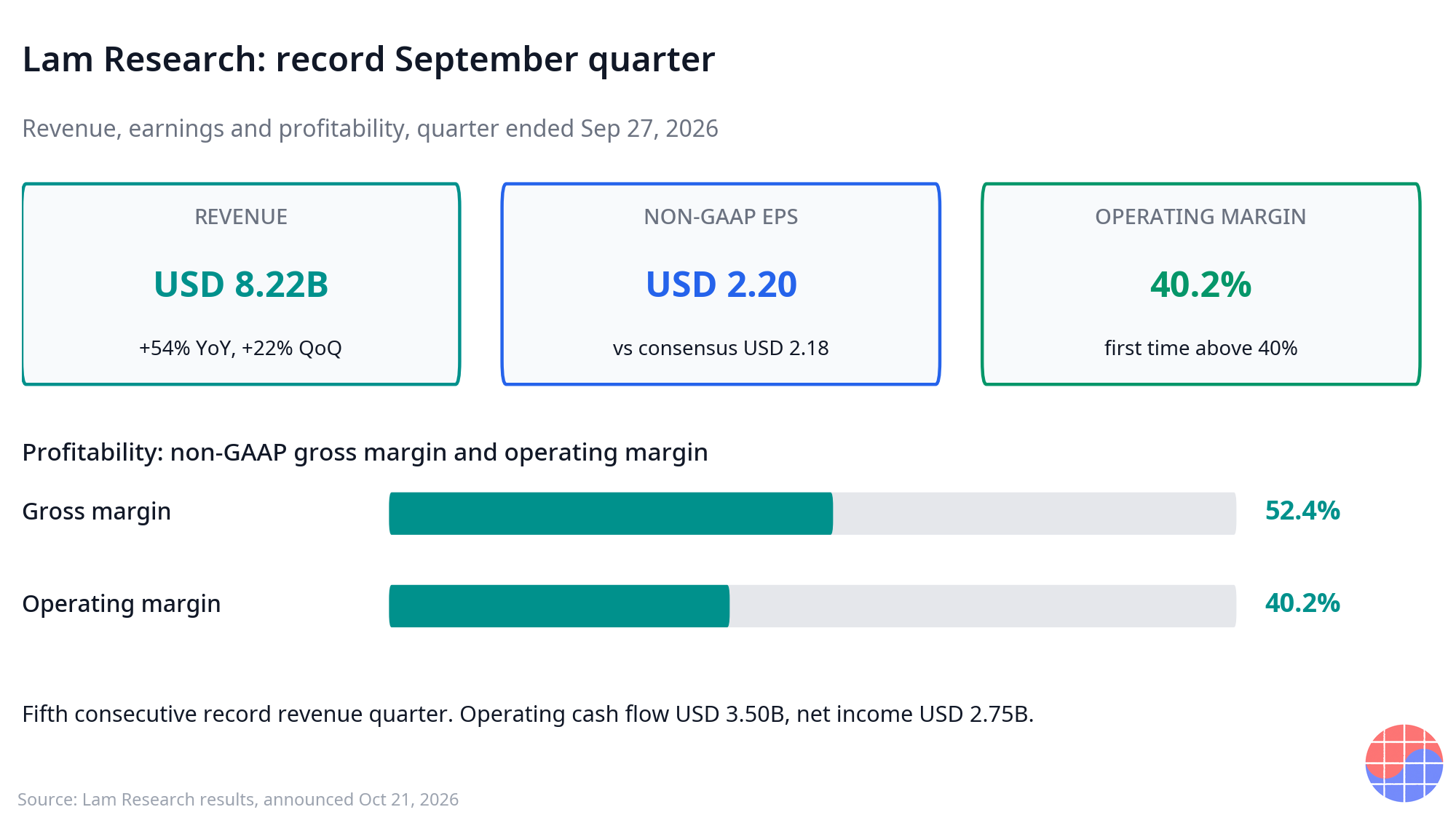
- Lam Research reported record revenue of USD 8.22 billion for the September quarter, announced on October 21, 2026 — up 22% from the prior quarter and 54% from a year earlier, the fifth consecutive record quarter.
- Profitability set records too. Non-GAAP gross margin reached 52.4% and non-GAAP operating margin reached 40.2%, above 40% for the first time, with non-GAAP EPS of USD 2.20.
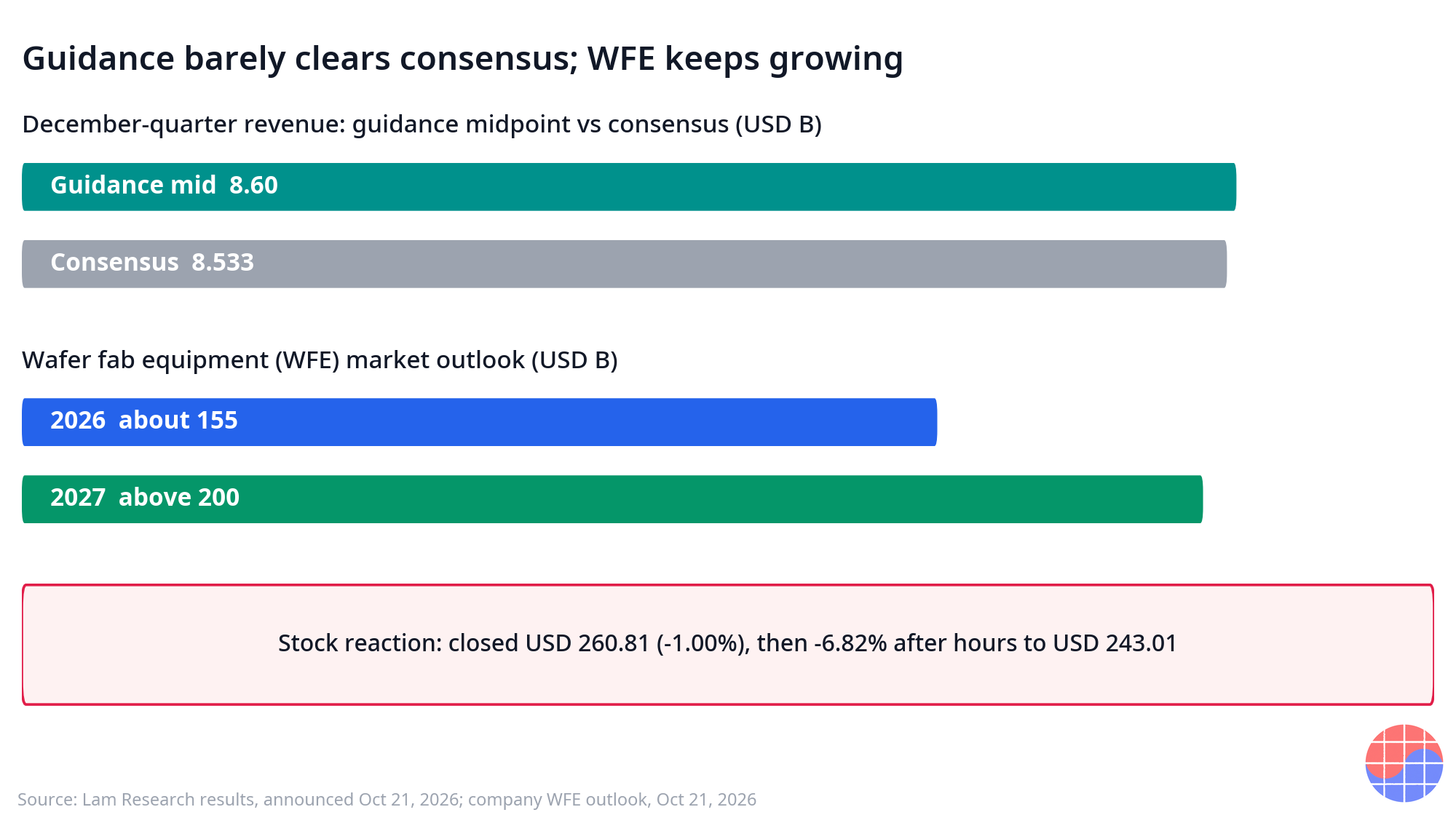
- The stock still fell. Shares closed at USD 260.81 (-1.00%) and dropped a further 6.82% after hours to USD 243.01, because December-quarter guidance — revenue of USD 8.60 billion at the midpoint — cleared consensus of USD 8.533 billion only narrowly.
- The cycle signal points the other way. Lam Research put the 2026 wafer fab equipment (WFE) market in the mid-USD 150 billion range and gave a preliminary 2027 view above USD 200 billion, led by DRAM, leading-edge foundry and logic, and then NAND.
- Korea matters in this print. Korea accounted for 20% of revenue, second only to China at 35% — a direct read on Samsung Electronics and SK hynix equipment spending.
The 7 Facts
1. Revenue hit a record USD 8.22 billion — the fifth record quarter in a row
Revenue of USD 8.22 billion rose 22% quarter on quarter and 54% year on year, an all-time high and the fifth consecutive quarterly revenue record. (Source: Lam Research results for the quarter ended September 27, 2026, announced October 21, 2026.) A fifth straight record means this is no longer a single strong quarter; it is a sustained expansion in which each quarter's shipments reset the company's ceiling.
2. Earnings beat consensus — but only slightly
Non-GAAP EPS was USD 2.20 (GAAP EPS USD 2.19), modestly above consensus of about USD 2.18, while revenue of USD 8.22 billion came in just above the consensus range of roughly USD 8.14–8.18 billion. (Source: company results, October 21, 2026; consensus as reported the same day.) The beat was real but thin — and thin beats are exactly what a stock priced for perfection cannot live on.
3. Operating margin crossed 40% for the first time
Non-GAAP gross margin was 52.4% and non-GAAP operating margin was 40.2%, the first time operating margin has exceeded 40%. Operating cash flow was USD 3.50 billion and net income was USD 2.75 billion. (Source: company results, October 21, 2026.) At this scale, a 40%-plus operating margin means record revenue is converting into record cash, not just record shipments.
4. December guidance landed almost exactly on consensus
Guidance for the December quarter is revenue of USD 8.60 billion plus or minus USD 0.40 billion, gross margin of 52.5%, operating margin of 40.5%, and EPS of USD 2.33 plus or minus USD 0.15. The revenue midpoint of USD 8.60 billion sits only slightly above consensus of USD 8.533 billion. (Source: company guidance, October 21, 2026.) In a beat-and-raise market, "slightly above" reads as "no raise" — this is the fact the stock actually traded on.
5. The stock fell anyway: -1.00% in the session, -6.82% after hours
Lam Research shares closed the regular session at USD 260.81, down 1.00%, and fell a further 6.82% in after-hours trading to USD 243.01. Ahead of the print, one major bank had cut its price target from USD 355 to USD 315 on late-cycle valuation concerns, while another raised its target to USD 375. (Source: market reports, October 21, 2026.) The split among analysts is the story: the same numbers support both a late-cycle warning and a higher target, depending on how much of the cycle investors believe is already priced in.
6. WFE is headed above USD 200 billion in 2027, led by memory
Lam Research put 2026 WFE spending in the mid-USD 150 billion range and gave a preliminary 2027 outlook above USD 200 billion, with DRAM leading, followed by leading-edge foundry and logic, and then NAND. Memory represented 46% of systems revenue in the September quarter; NAND revenue rose roughly 40% quarter on quarter, and both DRAM and foundry revenue set records. (Source: company commentary, October 21, 2026.) A USD 200 billion-plus WFE year would be the industry's largest equipment year on record — and management chose this earnings call to say it out loud.
7. Asia funds the cycle, and parts shortages are already pushing shipments out
Revenue by region was China 35%, Korea 20%, Taiwan 18%, Japan 9%, and the United States 8%. Management also said component shortages will constrain some December-quarter shipments, deferring them into the March quarter. (Source: company results and commentary, October 21, 2026.) Two signals hide in this fact: Korea at 20% ties Lam's growth directly to Korean memory capex, and a shortage-driven deferral means part of December's "soft" guide is timing, not demand.
Background
What Lam Research sells, and why its print leads the cycle
Lam Research is a wafer fab equipment maker whose core strength is etch and deposition — the process steps that pattern and build the layers of a chip. In memory, those steps multiply with every generation: each added layer in 3D NAND and each new DRAM node requires more etch and deposition passes per wafer. That is why Lam's results are read as one of the earliest hard reads on the equipment cycle. Memory makers and foundries order tools quarters before the chips those tools produce reach the market, so an equipment maker's order book and guidance describe the industry's capex intentions earlier than almost any other earnings report.
The September quarter sits at a specific point in that cycle. AI data center build-outs have pulled HBM and DRAM demand forward, leading-edge logic capacity is being added for AI accelerators, and NAND — the laggard of the memory complex — is recovering. Lam's fact pattern maps onto all three: record DRAM revenue, record foundry revenue, memory at 46% of systems revenue, and NAND revenue up roughly 40% quarter on quarter. The quarter is best read as a synchronized upturn across the equipment maker's three biggest end markets at once.
The setup going into the print
Expectations were the problem. When a stock has already risen on a cycle story, the earnings question changes from "was the quarter good?" to "was the quarter good enough to justify what is already priced in — and does guidance raise the ceiling again?" Lam's quarter cleared the first bar easily: records on revenue, margin, and cash flow, with a small beat on both revenue and EPS. The guidance bar is where the print became a valuation test. A midpoint of USD 8.60 billion against consensus of USD 8.533 billion is a difference of less than 1% — inside the noise band of the guidance range itself (plus or minus USD 0.40 billion). The market's after-hours verdict, a 6.82% drop to USD 243.01, was a judgment about that gap, not about the September quarter.
Business Deep Dive
The quarter in numbers
| Metric (September quarter, 2026) | Result | Reference point |
|---|---|---|
| Revenue | USD 8.22B | +22% QoQ, +54% YoY, all-time record |
| Non-GAAP EPS | USD 2.20 | Consensus about USD 2.18 |
| GAAP EPS | USD 2.19 | — |
| Non-GAAP gross margin | 52.4% | — |
| Non-GAAP operating margin | 40.2% | First time above 40% |
| Operating cash flow | USD 3.50B | — |
| Net income | USD 2.75B | — |
Source: Lam Research results for the quarter ended September 27, 2026, announced October 21, 2026.
Read the table as two stories. The first is operating leverage: revenue up 54% year on year arrived with a 52.4% gross margin and a 40.2% operating margin, so growth is falling to the bottom line at an unusually high rate. The second is cash conversion: USD 3.50 billion of operating cash flow on USD 8.22 billion of revenue is the signature of a company shipping into customers who are paying promptly because they need the tools. Neither story is a demand story in doubt — which is precisely why the stock's fall has to be explained by expectations, not operations.
Guidance vs. consensus: the 1% that moved the stock
| December quarter | Guidance | Consensus |
|---|---|---|
| Revenue | USD 8.60B ± 0.40B | USD 8.533B |
| Gross margin | 52.5% | — |
| Operating margin | 40.5% | — |
| EPS | USD 2.33 ± 0.15 | — |
Source: company guidance and reported consensus, October 21, 2026.
The arithmetic is unforgiving. Guidance implies continued sequential growth — from USD 8.22 billion to a midpoint of USD 8.60 billion — with margins guided slightly higher again (gross margin 52.5%, operating margin 40.5%). By any normal standard this is a strong outlook. The market's complaint is relative: at a late-cycle multiple, investors had positioned for a clearer raise, and the midpoint's roughly USD 0.07 billion edge over consensus did not supply one. Management's disclosure that component shortages will defer some December shipments into the March quarter matters here — it frames part of the guidance conservatism as a supply timing issue with a named destination quarter, rather than a demand shortfall. Whether the market credits that framing is the difference between a one-day valuation reset and a longer de-rating.
The WFE outlook is the real headline
The most consequential numbers in the release are not Lam's own. They are the market numbers: WFE of roughly the mid-USD 150 billion range in 2026, and a preliminary view above USD 200 billion in 2027.
| WFE outlook | Company view |
|---|---|
| 2026 | Mid-USD 150B range (about USD 155B) |
| 2027 (preliminary) | Above USD 200B |
| 2027 growth order | DRAM first, then leading-edge foundry/logic, then NAND |
Source: Lam Research commentary, October 21, 2026.
Equipment makers do not publish market outlooks casually; the number anchors customers' budget conversations and competitors' planning. A preliminary 2027 figure above USD 200 billion, stated in October 2026, is an official signal that the equipment upcycle is expected to extend and steepen — with memory, and DRAM in particular, doing the pulling. For the memory complex, that ordering matters: DRAM leading WFE growth means the HBM and advanced DRAM capacity race is expected to consume the largest share of the industry's largest-ever equipment budget. NAND's place in the sequence — third, but named — combined with NAND revenue already up roughly 40% quarter on quarter at Lam, marks the recovery of the last lagging segment.
Regional mix: Korea is the second engine
| Region | Share of September-quarter revenue |
|---|---|
| China | 35% |
| Korea | 20% |
| Taiwan | 18% |
| Japan | 9% |
| United States | 8% |
Source: Lam Research results, October 21, 2026. Listed regions sum to 90%; the remainder is other regions.
Korea's 20% share is the line Korean investors should read first. Lam's Korean revenue is, in substance, a proxy for Samsung Electronics and SK hynix equipment intake — the etch and deposition tools that build HBM stacks, advanced DRAM, and NAND layers. A quarter in which Korea is the second-largest revenue region, memory is 46% of systems revenue, and DRAM revenue sets a record is a quarter in which Korean memory capex is running hot. The regional table also frames the risks: with China at 35%, the largest single exposure remains the region most affected by export-control policy, and any tightening there lands on the biggest slice of the revenue base first.
The analyst split frames the valuation debate
The pre-earnings target changes capture the debate in miniature. One major bank cut its target from USD 355 to USD 315 explicitly on late-cycle valuation — not on the quarter, which had not even printed yet — while another raised its target to USD 375. A USD 60 spread between two institutional views, set before the numbers were known, tells investors the disagreement is about the multiple and the cycle's age, not about Lam's execution. The after-hours drop suggests the late-cycle camp won the first round. The WFE outlook above USD 200 billion for 2027 is the bull camp's counter-argument, and it will be tested by the memory makers' own earnings and capex commentary in the days that follow.
Chase's Take
The lazy reading of this print is "great quarter, stock down, market is irrational." The correct reading is that earnings season's first verdict on equipment stocks was never about demand. It was about what investors had already paid for demand.
Look at the sequence. Five consecutive record quarters. A 54% year-on-year revenue increase. An operating margin above 40% for the first time. USD 3.50 billion of operating cash flow. If the market were pricing the present, the stock would have risen. It fell 6.82% after hours because the market is pricing the distance between guidance and hope — and in late-cycle conditions, hope is set at "raise," not at "meet." A midpoint less than 1% above consensus is, in that regime, a miss in disguise.
But notice what the valuation argument has to ignore. Management used this call to put a preliminary number on 2027 WFE: above USD 200 billion, led by DRAM. Equipment cycles do not usually end while the largest equipment maker is raising the out-year market view and disclosing that parts shortages — not orders — are what limit the current quarter's shipments. The shortage deferral into the March quarter is the quiet detail in this release: constrained companies guide on supply; weakening companies guide on demand. Lam guided on supply.
The synthesis is a timing argument, not a direction argument. The stock can be expensive and the cycle can still be extending. Both were true on October 21. The next data points that adjudicate between them are already scheduled: Samsung Electronics and SK hynix report on October 28–29, and their capex and HBM commentary will either validate Lam's USD 200 billion-plus WFE framing or expose it as optimism. Korea's 20% revenue share makes those two reports, in effect, Lam's own forward guidance by proxy.
Implications
- For equipment investors: The debate has moved from demand to valuation. Track the guidance-to-consensus gap and the March-quarter recovery of deferred shipments, not headline records — records are now the base case.
- For memory watchers: Lam's WFE ordering — DRAM first, NAND named third, NAND revenue already up roughly 40% quarter on quarter — is an early confirmation that the memory capex cycle broadens in 2027. Samsung Electronics (October 29) and SK hynix (October 28) earnings are the immediate cross-check.
- For Korean supply-chain readers: Korea at 20% of Lam's revenue ties domestic equipment, parts, and materials suppliers directly to the strongest leg of the WFE cycle. Korean memory capex is the transmission channel.
- For the cycle debate: A preliminary 2027 WFE view above USD 200 billion is the equipment industry's own extension signal. If memory makers' capex plans corroborate it, the late-cycle valuation case weakens; if they trim, Lam's guidance framing gets repriced again.
- For Lam Research itself: The task is converting a supply-constrained December into a visibly stronger March, and keeping operating margin above the 40% line it just crossed — the level the market will now treat as the new normal.
FAQ
Why did Lam Research stock fall after record earnings?
Because guidance, not the quarter, set the price. December-quarter revenue guidance of USD 8.60 billion at the midpoint cleared consensus of USD 8.533 billion only slightly, which investors read as no meaningful raise for a stock carrying late-cycle valuation. Shares closed at USD 260.81 (-1.00%) on October 21, 2026 and fell 6.82% after hours to USD 243.01, despite record revenue of USD 8.22 billion and EPS of USD 2.20.
What did Lam Research guide for the December quarter?
Revenue of USD 8.60 billion plus or minus USD 0.40 billion, non-GAAP gross margin of 52.5%, non-GAAP operating margin of 40.5%, and EPS of USD 2.33 plus or minus USD 0.15, per company guidance on October 21, 2026. Management also said component shortages will defer some December shipments into the March quarter.
What is Lam Research's WFE outlook for 2026 and 2027?
Lam Research put the 2026 wafer fab equipment market in the mid-USD 150 billion range and gave a preliminary 2027 outlook above USD 200 billion, with DRAM leading, followed by leading-edge foundry and logic, and then NAND (company commentary, October 21, 2026). Memory was 46% of systems revenue in the September quarter.
How much of Lam Research's revenue comes from Korea?
20% in the September quarter of 2026, second only to China at 35%, ahead of Taiwan (18%), Japan (9%), and the United States (8%), per company results announced October 21, 2026. The Korean share largely reflects equipment spending by Samsung Electronics and SK hynix.
Sources: Lam Research results for the quarter ended September 27, 2026 (announced October 21, 2026); earnings-day market and consensus report (October 21, 2026). This article is analysis, not investment advice.
📩 Subscribe to VLSI Korea
Get our daily semiconductor deep-dives delivered to your inbox first. Free to subscribe.