VLSI Korea
Anthropic's S-1, Decoded for the Semiconductor Market: Inside the $80.7B Loss and the $518B Compute Commitment
Of Anthropic's $80.7B first-half net loss, about $72B is a non-cash mark. The real story is at least $518B of compute commitments. We convert them into gigawatts, accelerators and HBM bits, and map who supplies them.


The 30-Second Summary
- Anthropic's draft S-1 shows a first-half 2026 net loss of $80.7 billion. Roughly $72 billion of that is a non-cash accounting charge driven by the rising fair value of convertible financing instruments. It is not cash out the door, and it grows precisely because the company's valuation rose.
- The cash picture is different. First-half revenue reached $16.3 billion, up from $1.1 billion a year earlier, and compute and infrastructure spending of nearly $9 billion in six months already exceeded the $7.3 billion spent in all of 2025.
- The number that matters for semiconductors is the commitment stack: at least $518 billion of cloud, compute and infrastructure spending over the coming decade, with roughly 80% reported as non-cancelable. Depending on what is counted, reported tallies run from about $450 billion in signed cloud contracts to more than $600 billion all-in, and up to $750 billion including deals still under negotiation.
- Most of that money does not buy merchant GPUs. It buys custom ASICs: up to 5 GW of AWS Trainium, more than 1 GW of Google TPU capacity in 2026 plus 3.5 GW from 2027, and roughly 1 GW of Nvidia systems via Azure.
- Every platform in the mix runs on HBM supplied largely by Samsung Electronics and SK hynix. We estimate Anthropic's program alone implies cumulative HBM demand of roughly 8 to 13 billion Gb (estimate; conversion table below).
Anatomy of the $80.7 Billion Loss: A Loss That Is Not Cash

On October 20, the Wall Street Journal and Reuters published figures from Anthropic's draft S-1. The headline net loss of $80.7 billion for the first half of 2026 is more than six times the $13 billion loss of a year earlier. Read naively, it is the largest "loss" in AI. Read correctly, it is mostly an artifact of success.
| First half 2026 | Amount | Nature |
|---|---|---|
| Net loss (GAAP) | $80.7B | The headline figure |
| Fair-value remeasurement of convertible instruments | ~$72B | Non-cash accounting charge |
| Loss excluding the non-cash charge | ~$8.7B | Reflects actual operations |
| Revenue | $16.3B | Up from $1.1B in H1 2025 |
| Cash spending on compute and infrastructure | ~$9B | vs $2.3B in H1 2025; $7.3B for all of 2025 |
The mechanism is straightforward. Anthropic funded its buildout partly with convertible financing instruments. When the company's valuation rises, the shares those instruments will convert into become more valuable, and accounting rules book the increase as a loss. The same dynamic ran through 2025: a net loss of about $42 billion, of which roughly $34 billion was the same remeasurement charge, against an operating loss of about $8.06 billion. At the IPO, the instruments convert into equity and most of this charge disappears.
For semiconductor readers, two other numbers deserve the attention. First, the velocity of cash compute spending: roughly $9 billion in one half, four times the year-ago pace and already above the entire 2025 spend. Second, unit economics. At an October 14 investor meeting, Anthropic reportedly presented third-quarter revenue of $16.8 billion, up 45% from $11.5 billion in Q2, an adjusted operating margin of 11%, and $1.70 of revenue for every dollar spent on compute. Those are company-presented figures, but they describe the first frontier lab whose compute engine runs near adjusted profitability.
The $518 Billion Commitment: What, to Whom, and How Binding
Reuters reported the floor: at least $518 billion over a decade. Other outlets printed different totals. The differences are not errors; they are different boundaries around the same contract stack.
| Reported frame | Amount | What it counts |
|---|---|---|
| Signed cloud agreements (WSJ frame) | ~$450B | Cloud compute contracts with Google, Amazon and Microsoft, mostly non-cancelable |
| Minimum total commitments (Reuters frame) | At least $518B | The floor for all cloud, compute and infrastructure obligations over a decade |
| All components tallied | $600B+ | Adds up to $86B of Nvidia chips via neoclouds and $160B+ of Broadcom-facilitated Google chips |
| Including deals under negotiation | Up to $750B | The ceiling scenario if unsigned agreements are added |
By counterparty, reported components include about $111.1 billion to Google, $110 billion to Amazon, $31.4 billion to Microsoft and $161.2 billion routed through Broadcom. These sub-totals overlap and do not sum cleanly to any single headline, which is exactly why the totals diverge across reports. Two facts are consistent everywhere: roughly 80% of the obligations are non-cancelable, and the spending is back-loaded, weighted toward 2027 and beyond.
The financing structure matters as much as the total. Broadcom is not only the co-designer of the Google TPUs Anthropic is buying; it is also a lender, with a facility of up to $42 billion to finance Anthropic's chip leases. In early October, a bank group began raising roughly $60 billion around the program — a $42 billion senior secured tranche and an $18 billion subordinated tranche led by Blackstone. An Apollo, Blackstone and Fluidstack platform anchored its first $35 billion transaction on more than 1 GW of Anthropic capacity. A chip supplier that also finances its customer's purchases mirrors the vendor-financing debate around Nvidia, and Anthropic itself flags Broadcom's dual role as a "potential conflict of interest" in the filing.
Converting Commitments into Silicon: Gigawatts, Accelerators, HBM
The cleanest bridge from dollars to wafers is power. The industry's working rule of thumb prices a gigawatt of AI compute at roughly $50 billion. Divide $518 billion by that unit cost and you get about 10 GW — which matches, almost exactly, the sum of the capacity Anthropic has actually contracted.
| Platform | Contracted capacity (ceiling) | Timing | Notes |
|---|---|---|---|
| AWS Trainium (Trn2/3/4) | Up to 5 GW | ~1 GW online by end-2026, then phased | Project Rainier scales from ~500K chips to over 1M |
| Google TPU (Broadcom co-developed) | 1 GW+ in 2026, +3.5 GW from 2027 | Full ramp from 2027 | Up to 1M TPUs; Broadcom development deal runs to 2031 |
| Microsoft Azure (Nvidia systems) | ~1 GW scale | Phased | Azure compute commitment of ~$31.4B |
| Anthropic's own US data centers | $50B investment program | Announced Nov 2025 | Third-party developers such as Fluidstack in parallel |
| Total | ~10.5 GW nameplate ceiling | Through ~2031 | Cross-checks against the dollar total at ~$50B/GW |
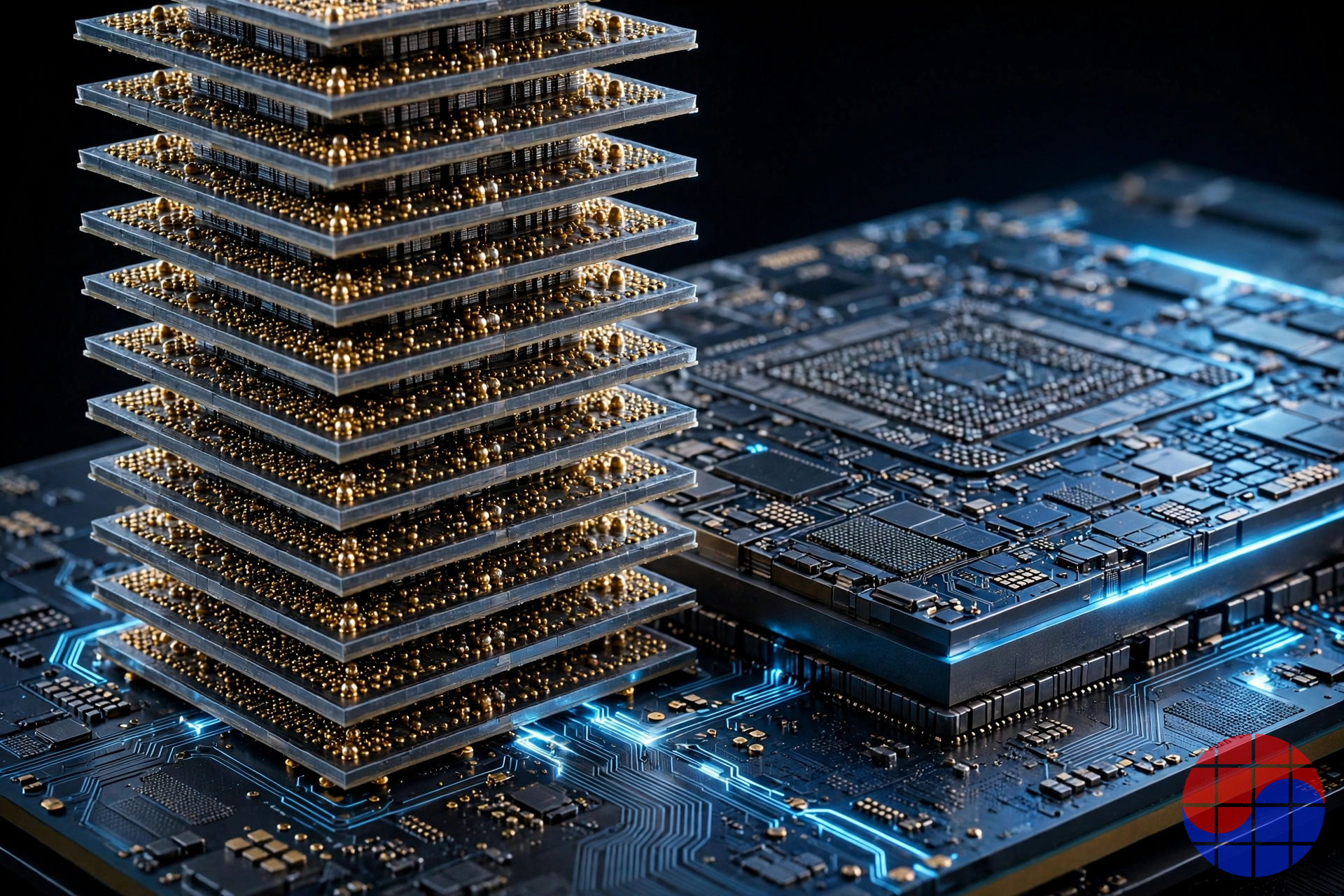
Unit conversion requires assumptions, so here they are. First, accelerator density of 600,000 to 800,000 sockets per GW, including rack power and cooling overhead. Second, blended HBM per socket of 1,150 to 1,550 Gb, mixing Trainium2 at 96GB (768 Gb), Trainium3 at 144GB (1,152 Gb), TPU Ironwood at 192GB (1,536 Gb) and GB300-class systems at 288GB (2,304 Gb). Third, HBM consumes two to three times more wafer capacity per bit than commodity DRAM — the industry's trade-off ratio, reflecting TSV processing, larger dies, a base die and lower yields.
| Conversion (cumulative, whole program) | Estimate range | Basis |
|---|---|---|
| Accelerator sockets | ~6.3M–8.4M | 10.5 GW × 600K–800K per GW |
| HBM demand | ~8B–13B Gb | Blended 1,150–1,550 Gb per socket |
| DRAM wafer-equivalent consumption | ~1.5M–3.0M wafers | HBM bits at a 2–3x trade-off ratio |
| Advanced logic wafers (accelerator dies) | ~200K–330K | Die area and yield assumptions |
Scale check: the cumulative HBM estimate equals roughly one to three months of the two Korean makers' combined DRAM wafer capacity, and in peak build-out years a single customer would account for a single-digit percentage of global HBM bit demand. Provided the contracts convert into powered capacity on schedule, that demand lands in the HBM camp regardless of which accelerator architecture wins share inside Anthropic.
Who Supplies It: The Chip Mix and Korea's Seat at the Table
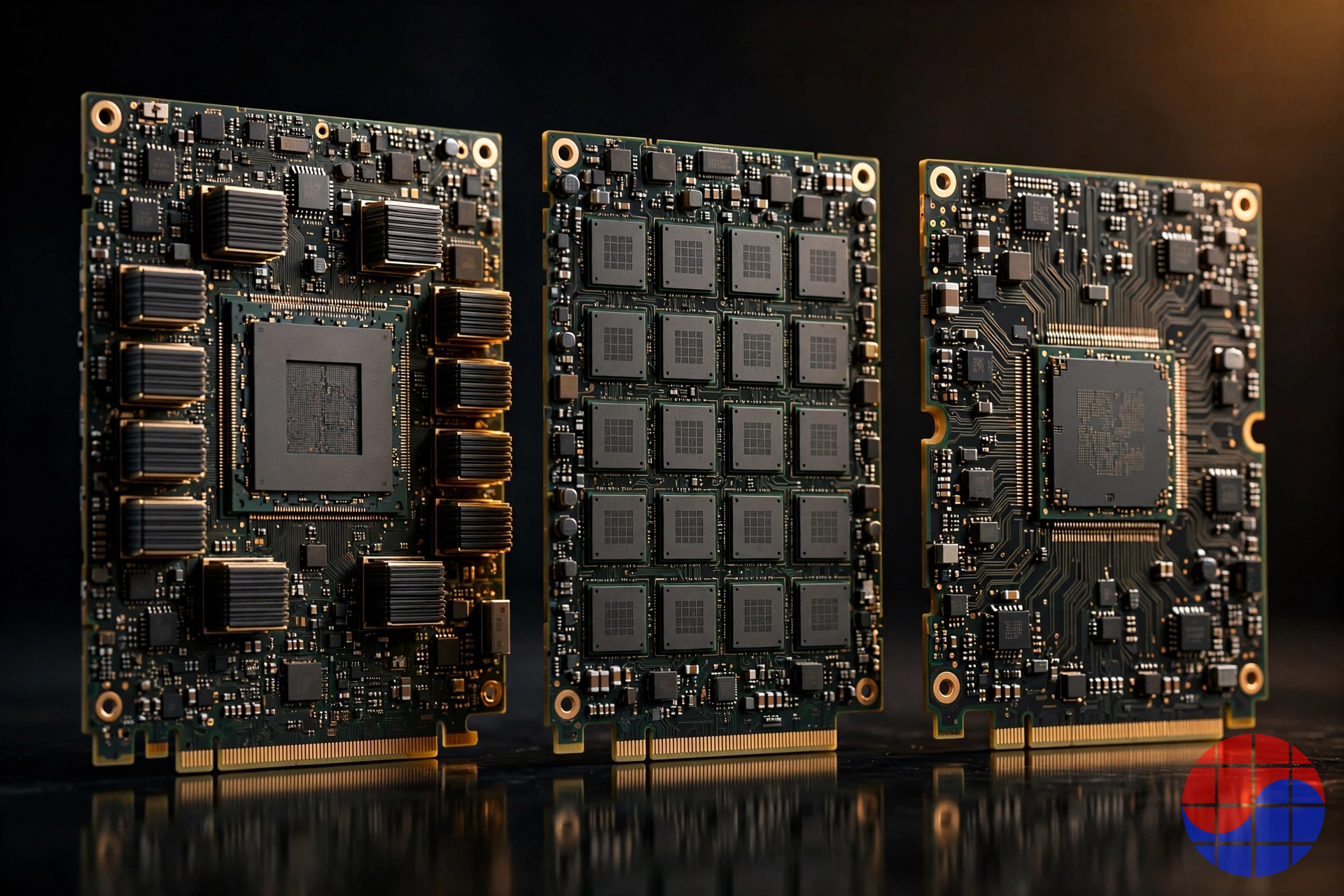
Anthropic's chip mix is the most diversified in the industry. AWS Trainium is the primary training platform. Google TPUs, in use since 2023, are the second pillar. Nvidia GPUs form the third, arriving through Azure and through neoclouds. On a capacity basis, most incremental gigawatts go to the two ASIC families; the merchant GPU's marginal share keeps shrinking.
The connective tissue of the custom-silicon side is Broadcom. Google's TPUs are co-developed with Broadcom, a relationship now locked in by a long-term agreement running to 2031. Anthropic is expected to become Broadcom's largest compute customer in 2027, and Broadcom's reported AI semiconductor revenue trajectory — about $115 billion in fiscal 2027 and $230 billion in fiscal 2028 — is substantially a derivative of this demand. Amazon's Trainium is designed in-house at Annapurna. Marvell is not a direct Anthropic axis, but it is exposed to the same custom-silicon and networking buildout across neoclouds and hyperscalers.
For Korea, the key property of this demand is that it is platform-neutral at the memory layer. Ironwood's HBM is led by SK hynix with Samsung supplying; Trainium systems carry Korean HBM; GB300-class Nvidia systems are led by SK hynix followed by Samsung and Micron. Whichever platform wins Anthropic's internal race, Korean memory volume holds or grows. Broadcom's AI revenue trajectory also translates directly into leading-edge foundry and CoWoS packaging wafer demand at TSMC. Samsung's foundry is not a direct beneficiary of this stack, and that distinction is worth keeping cold and clear: the winnings concentrate in memory and packaging, not logic foundry.
The S-1 also records the concentration on the other side of the ledger: about 25% of 2025 revenue came from two customers, and roughly half of sales flowed through cloud partners. Demand concentration upstream becomes supply-chain concentration downstream.
The Sustainability Debate: OpenAI, Precedents, and the Fine Print
| Anthropic | OpenAI (reported estimates) | |
|---|---|---|
| Total commitments | At least $518B; $600B+ all-in | ~$1.15 trillion for 2025–2035 (estimated) |
| Contracted capacity | ~10.5 GW nameplate ceiling | ~26 GW (10 GW Nvidia, 6 GW AMD, 10 GW Broadcom custom) |
| Chip mix | Trainium 5 GW + TPU ~4.5 GW + Nvidia ~1 GW | GPU-centric plus Broadcom custom ASICs |
| Funding structure | Hyperscaler leases + Broadcom financing + $50B own data centers | Stargate joint ventures, Oracle, neoclouds |
| Revenue trajectory | $4.6B in 2025 to $16.8B in Q3 2026 alone | Undisclosed; commitment-to-revenue multiple judged higher |
The downside precedents are real. In 2025, Microsoft was reported by analysts to have scaled back or paused roughly 2 GW of data center leases in the US and Europe — proof that even mega-contracts get resized when demand forecasts move. The more direct tell sits in Broadcom's own disclosure: consumption of the expanded capacity is "dependent on Anthropic's continued commercial success." The conditionality is written into the paperwork. Add the acceleration clauses in the Broadcom financing — defaults can make a substantial portion of lease obligations immediately due — and the conservative way to read the stack is to take the non-cancelable ~80%, not the $518 billion headline, as the floor.
The bull case rests on the revenue curve: quarterly revenue rising from roughly $4.7 billion in Q1 2026 to $11.6 billion in Q2 and $16.8 billion in Q3, claimed adjusted profitability, and an IPO whose proceeds are themselves the funding mechanism for the commitment stack. Sustainability, in the end, is not a semiconductor question. It is the single question of whether Anthropic's revenue curve keeps bending upward past 2028.
Chase's Take
First, the $80.7 billion loss is the accounting shadow of success, not a measure of failure. The charge grows as the valuation grows and largely evaporates at the IPO. Anyone reading semiconductor demand should track the $9 billion half-year cash compute spend and its growth rate, not the loss line.
Second, the $518 billion is not a purchase order; it is an option book with a thick floor. The non-cancelable portion alone exceeds $400 billion. The correct way to use the number in demand scenarios: the ceiling is $750 billion including unsigned deals, the floor is the non-cancelable core.
Third, the mix matters more than the total. Around 90% of incremental capacity goes to Trainium and TPU. At the margin, merchant GPUs lose share while custom ASICs, their design partner Broadcom, and the one component common to every platform — HBM — take it. For Korean semiconductors, Anthropic is a demand engine that runs independently of Nvidia's fortunes.
Fourth, the real systemic risk is not silicon but credit. A supplier that is also a lender, hyperscalers that are simultaneously customers and shareholders, neoclouds intermediating the cash — the financial structure of AI infrastructure is becoming a closed loop. If it ever wobbles, the first signals will appear in financing terms, not in earnings reports.
FAQ
Q: Is the $80.7 billion first-half net loss all real cash loss? A: No. About $72 billion is a non-cash accounting charge from the rising fair value of convertible financing instruments, which grows as Anthropic's valuation rises. Excluding it, the loss was about $8.7 billion, and actual cash spending on compute and infrastructure was roughly $9 billion in the half.
Q: Is the full $518 billion a firm, unavoidable obligation? A: It is a reported minimum, and about 80% of the obligations are reported to be non-cancelable. Reported components include about $111.1 billion to Google, $110 billion to Amazon, $31.4 billion to Microsoft and $161.2 billion routed through Broadcom. Tallies differ by boundary: about $450 billion counting only signed cloud contracts, and up to $750 billion including deals still under negotiation.
Q: Which chips does this commitment actually buy? A: By capacity, up to 5 GW of AWS Trainium, more than 1 GW of Google TPU capacity in 2026 plus 3.5 GW from 2027, and roughly 1 GW of Nvidia systems through Azure — around 10.5 GW in total, with the large majority in custom ASICs. Every platform carries HBM.
Q: What does this mean for Samsung Electronics and SK hynix? A: All three platforms use Korean HBM as a core component, so HBM demand materializes regardless of which platform wins inside Anthropic. On the assumptions set out above, cumulative HBM demand is an estimated 8 to 13 billion Gb, and in peak years a single customer could represent a single-digit share of global HBM bit demand. The logic wafers, however, go to TSMC, so the benefit concentrates in memory rather than foundry.
Q: Could the commitments be scaled back or canceled? A: Yes. Microsoft reportedly scaled back about 2 GW of data center leases in 2025, and Broadcom's own disclosure conditions Anthropic's capacity consumption on the company's "continued commercial success." That is why the non-cancelable portion, not the headline total, is the conservative floor for demand planning.
Figures are cross-checked against WSJ and Reuters reporting on the draft S-1 and against company disclosures and announcements. Volume conversions are VLSI Korea estimates based on the stated assumptions. The S-1 remains a draft that has not yet been filed publicly with the SEC, and final figures may differ.
📩 Subscribe to VLSI Korea
Get our daily semiconductor deep-dives delivered to your inbox first. Free to subscribe.