VLSI Korea
Weekly Silicon: Record Profit, Falling Stocks — The Market Now Asks About Financing, Not Demand
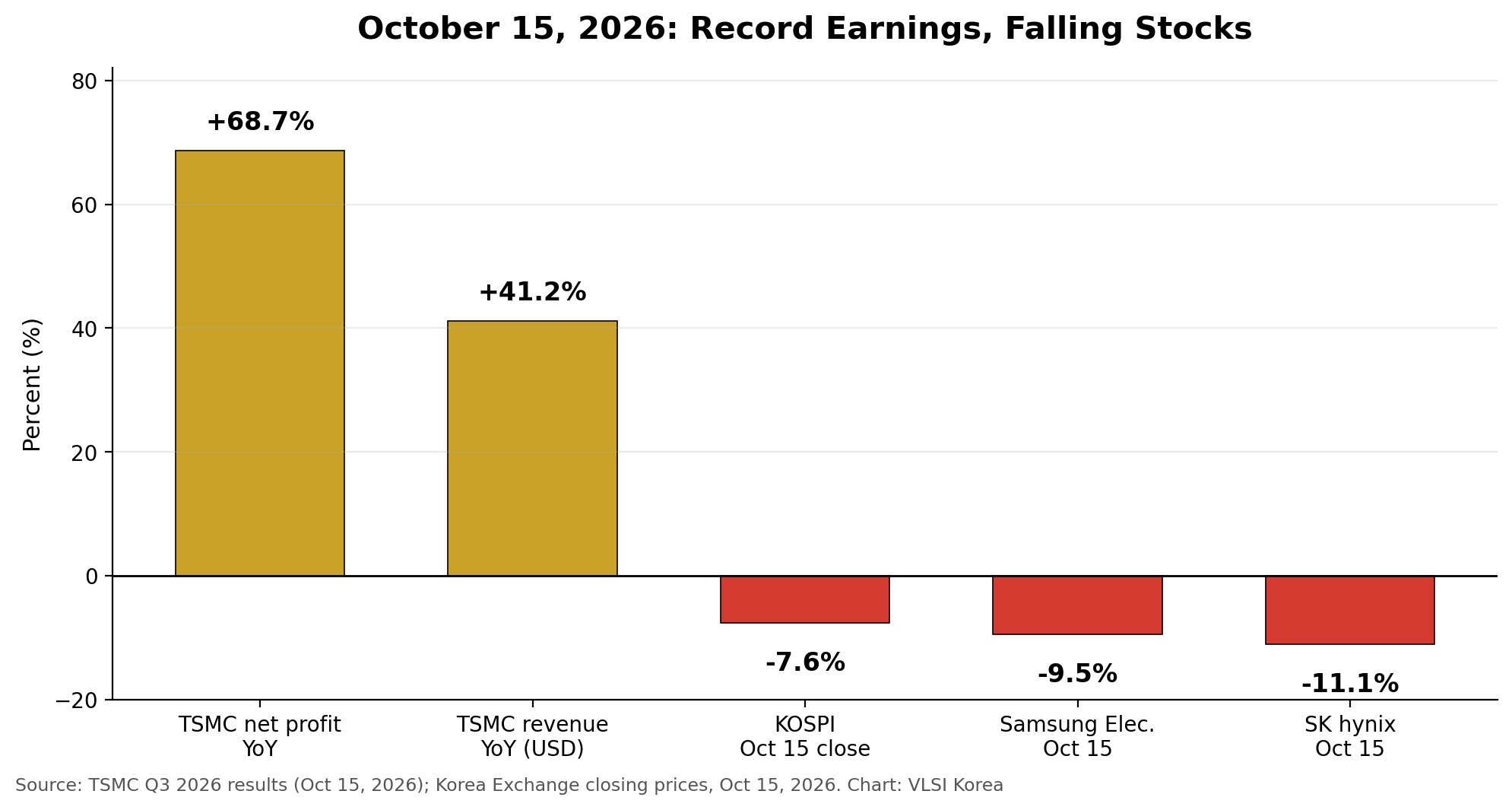
TSMC net profit rose 68.7% to a sixth straight record, yet the KOSPI fell 7.57% with a circuit breaker on October 15, 2026. The market now prices financing sustainability, not AI demand.


The conclusion first: the week of October 13–19, 2026 proved that AI semiconductor demand is not the question anymore. TSMC posted its sixth consecutive record quarter on October 15 — net profit up 68.7% year over year — and chip stocks fell anyway. On the same day, the KOSPI triggered a circuit breaker and closed down 7.57%. The market has stopped asking whether AI demand is real. It now asks who pays for the buildout, and at what cost of capital. That shift — from a demand debate to a financing debate — is the single most important semiconductor story of the week.
The Week the Question Changed
For three years, every semiconductor selloff carried the same footnote: perhaps AI demand is a bubble. The earnings released on October 15, 2026 removed that footnote. TSMC's third-quarter revenue reached NT$1,494.24 billion (US$46.72 billion), up 50.9% year over year in NT dollar terms. Net profit reached NT$763.1 billion, up 68.7%. Gross margin was 66.4% and operating margin 58.7%. Management raised full-year 2026 revenue growth to about 44% and guided fourth-quarter revenue to US$52.3–54.3 billion. CEO C.C. Wei said demand remains far above the company's capability to supply.
And yet the tape went the other way. The KOSPI closed at 5,554.22, down 7.57%, after a circuit breaker halted trading at 12:38 KST. Samsung Electronics fell 9.48% to KRW 210,000. SK hynix fell 11.06% to KRW 1,262,000. When record earnings and a market halt land on the same day, the earnings are not what the market is pricing.
Verification Point 1: The Numbers Were Not the Problem
TSMC's business mix shows a leading-edge cycle still accelerating, not maturing. The 3nm process contributed 33% of wafer revenue in Q3 2026. The 2nm process, in its early ramp, already contributed 8%. High-performance computing reached 68% of total revenue. The company reiterated a 2026 capital expenditure budget of US$60–64 billion and said capital spending from 2026 to 2028 will be significantly higher than in the previous three years.
| TSMC Q3 2026 (announced Oct 15) | Figure |
| Revenue | NT$1,494.24B / US$46.72B (+50.9% YoY in NT$) |
| Net profit | NT$763.1B (+68.7% YoY, sixth straight record) |
| Gross / operating margin | 66.4% / 58.7% |
| Wafer revenue mix | 3nm 33%, 2nm 8%, HPC 68% of revenue |
| Q4 guidance / FY growth | US$52.3–54.3B / about +44% for 2026 |
| 2026 capex budget | US$60–64B reiterated |
A demand problem does not produce these figures. A supply shortage does — and Wei's comment that demand exceeds supply capability confirms which side of the market is constrained.
Verification Point 2: The Selling Was About the Price of Money
Three facts locate the selloff in financing, not fundamentals. First, foreign investors net-sold KRW 3.6241 trillion of Korean shares on October 15 alone, and KRW 17.8 trillion between October 1 and October 15 — a flow concentrated in the two memory names that anchor the index. Second, US September consumer prices rose 3.7% year over year, above forecast, reviving the possibility that rates stay higher for longer. AI infrastructure is the most rate-sensitive capex program in the world: it is financed years before it returns cash. Third, the valuation print is extreme. As of October 14, the 12-month forward PER of Samsung Electronics was 3.61x and SK hynix was 3.22x — five-year lows against a customary range of 8–9x.
Forward PERs near 3x do not say the market expects weak demand next quarter. They say the market refuses to capitalize AI earnings at a normal multiple because it doubts how long the spending behind those earnings can be financed. In a financing debate, the discount rate beats the demand debate — every time.
Verification Point 3: Samsung Handed Its Rival the Base Die
The week's second structural signal arrived on October 18, when Reuters, citing the Seoul Economic Daily, reported that Samsung Electronics will use TSMC's 3nm process to produce base dies for NVIDIA's next-generation custom HBM, known as NVHBM. It would be the first Samsung–TSMC cooperation at the HBM manufacturing stage. According to the report, NVIDIA asked Samsung, SK hynix and Micron to use the TSMC process for NVHBM base dies, with sixth-generation (1c) DRAM for the core dies. Samsung has not confirmed the report; it reportedly plans to keep its in-house turnkey model for standard HBM and for other customers, and is assessing its own foundry as a fallback if TSMC capacity falls short.
Read past the rivalry headline and the engineering logic is clear. NVIDIA states that NVHBM, which moves its custom memory controller into the base die, offers up to 30% greater memory bandwidth, 15% lower HBM power consumption and up to 25% more area on the XPU compute die versus standard HBM4E. A common base-die implementation across three suppliers cuts qualification work and supply risk for the buyer. When the largest customer standardizes the logic layer of memory, standardization outranks vertical-integration pride — even for an IDM that owns both a memory division and a foundry. The base die is becoming a logic product, and logic products gravitate to the strongest logic process.
Verification Point 4: HBM Is Eating the DRAM Wafer Budget
The capacity backdrop tightens the story. HBM is expected to consume nearly 30% of DRAM producers' wafer capacity in 2027, up from about 20% currently, according to remarks by Samsung Executive Vice President Kim Taewoo on September 29, reported by Reuters. Every wafer point that moves to HBM leaves conventional DRAM tighter, supports memory pricing, and raises the capital intensity of the whole memory industry. That is precisely why the financing question matters more each quarter: the buildout is getting bigger at the same moment the market is charging more to fund it.
What to Watch Next Week
- Samsung Electronics and SK hynix earnings (late October): HBM revenue disclosure and 2027 capex language will test whether the 3x forward PERs are fear or foresight.
- Hyperscaler capex guidance: any trim in AI infrastructure budgets would confirm the financing thesis; another raise would challenge it.
- US rates and inflation follow-through: the September CPI print of +3.7% set the week's tone; the policy response sets next week's discount rate.
- NVHBM confirmation: whether Samsung, SK hynix or Micron confirm or deny the reported TSMC base-die arrangement.
- Chinese DRAM progress: CXMT's advancing capability claims were part of the week's selling pressure and remain a live variable for commodity DRAM pricing.
Frequently Asked Questions
Why did chip stocks fall when TSMC posted record profit?
Because the market is pricing financing sustainability, not demand. TSMC's Q3 2026 net profit rose 68.7% to NT$763.1 billion on October 15, 2026, but concerns over AI infrastructure funding costs and a hot US inflation print (+3.7% YoY in September) compressed valuations the same day.
How far did the KOSPI fall on October 15, 2026?
The KOSPI closed at 5,554.22, down 7.57%, after a circuit breaker at 12:38 KST. Samsung Electronics fell 9.48% and SK hynix fell 11.06%. Foreign investors net-sold KRW 3.6241 trillion that day.
What is NVHBM and why would Samsung use TSMC's 3nm process for it?
NVHBM is NVIDIA's custom HBM design that integrates NVIDIA's memory controller into the base die. Reuters reported on October 18, 2026, citing the Seoul Economic Daily, that NVIDIA asked all three memory suppliers to use TSMC's 3nm process for NVHBM base dies to standardize implementation. NVIDIA claims up to 30% more bandwidth and 15% lower HBM power versus standard HBM4E. The report is not confirmed by Samsung.
How much DRAM capacity will HBM consume in 2027?
Nearly 30% of DRAM wafer capacity in 2027, up from about 20% currently, according to Samsung Executive Vice President Kim Taewoo's remarks on September 29, 2026, reported by Reuters.
Disclosure
This article is informational analysis, not investment advice. Figures are drawn from TSMC's Q3 2026 results announced on October 15, 2026, Korea Exchange market data for October 15, 2026, and reports dated October 18, 2026, as noted in the text. Data as of October 19, 2026. The NVHBM base-die arrangement is a reported plan, not a confirmed company announcement.
📩 Subscribe to VLSI Korea
Get our daily semiconductor deep-dives delivered to your inbox first. Free to subscribe.