VLSI Korea
Power Is the New Moat: Inside the AI Data Center Electricity Bottleneck
The AI bottleneck moved from chips to electricity: 945 TWh of data centre demand by 2030, a 2,285 GW US interconnection queue, 144-week transformer lead times - and the Korean equipment makers collecting the premium.


Power Is the New Moat: Inside the AI Data Center Electricity Bottleneck
TL;DR
The bottleneck in AI infrastructure has moved from chips to electricity. Global data centre power consumption rises from 415 TWh in 2024 to roughly 945 TWh by 2030 (International Energy Agency, Apr 10, 2025). In the United States, 2,285 GW of generation and storage projects sit in grid interconnection queues (data released Apr 7, 2026), and large power transformer lead times have stretched from about 100 weeks in 2022 to 128–144 weeks. Chips can be bought with money; power can only be bought with time. Korea's three power-equipment makers are the ones collecting the price of that time: HD Hyundai Electric reported a record USD 6.9 billion order backlog at end-Q2 2026, and Hyosung Heavy Industries held KRW 11.8 trillion of heavy-industry backlog at end-H1 2026.
| Item | Figure (as stated in the text) |
|---|---|
| Global data centre electricity use | 415 TWh in 2024 → about 945 TWh in 2030 |
| US interconnection queue (solar, storage and natural gas) | 2,285 GW |
| Large power transformer lead time | About 100 weeks in 2022 → 128–144 weeks |
| HD Hyundai Electric order backlog (end-Q2 2026) | USD 6.9 billion |
| Hyosung Heavy Industries heavy-industry backlog (end-H1 2026) | KRW 11.8 trillion |
| LS ELECTRIC new orders (Jan–Sep 2026) | About KRW 5.4 trillion |
Background: Bottlenecks Move
The AI data centre race was long told as a fight for GPUs. Through 2025, the language on earnings calls changed: the repeated words became power, interconnection, and lead time. The demand curve explains why. According to the IEA's "Energy and AI" report (Apr 10, 2025), global data centre electricity consumption grows from about 415 TWh in 2024 — roughly 1.5% of global electricity use — to about 945 TWh in 2030. US data centre consumption reaches about 425 TWh by 2030, up more than 130%, accounting for close to half of the growth in total US electricity demand.
Supply cannot follow that slope. Power plants, transmission lines, transformers, and switchgear all move slower than demand. Lawrence Berkeley National Laboratory's "Queued Up 2026" release (Apr 7, 2026) puts the US interconnection queue at 2,040 GW of generation plus 750 GW of storage at end-2025, with solar, storage, and natural gas — the mix most directly tied to AI loads — totaling 2,285 GW. Only about 23 GW of queued capacity reached commercial operation during 2025. The queue has become a multi-year line.
Deep Dive 1: Demand — What 945 TWh Actually Means
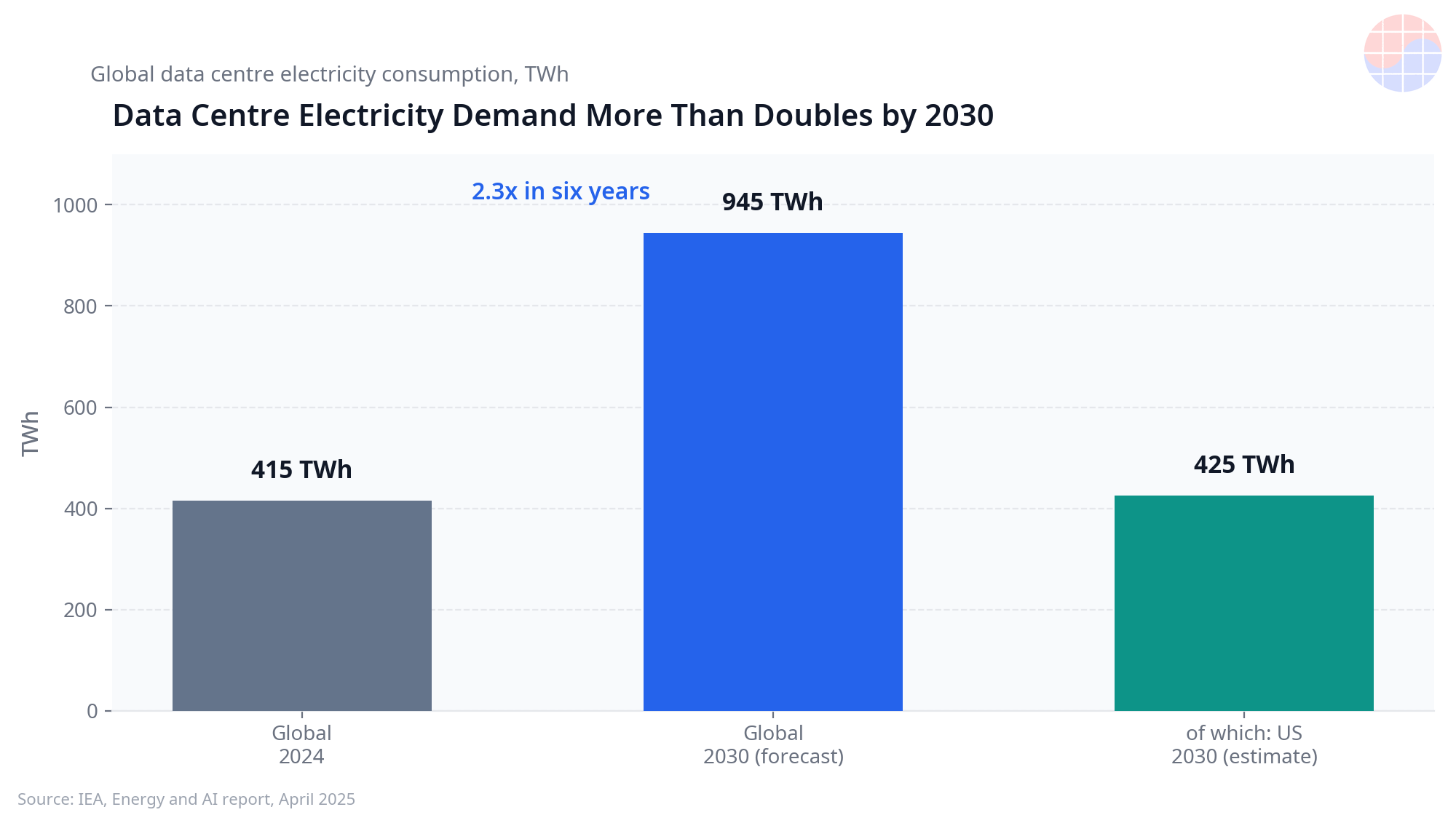
945 TWh is approximately the annual electricity consumption of Japan. AI is the centre of the increase: per the same IEA report, renewables and natural gas do most of the near-term work, while nuclear — including SMRs — contributes meaningfully only after 2030. That makes gas and grid equipment the short-term release valve.
The character of demand is changing too. Legacy data centre loads were relatively flat; AI training clusters ramp thousands of accelerators up and down together. For utilities, "how it is used" now matters as much as "how much," which pulls demand for transformers, breakers, and reactive-power equipment along with raw megawatts. Building a data centre is no longer mainly a construction and server problem. It is the problem of safely attaching a power-plant-sized load to the grid.
Deep Dive 2: Supply — 144-Week Transformers and a Turbine Slot War
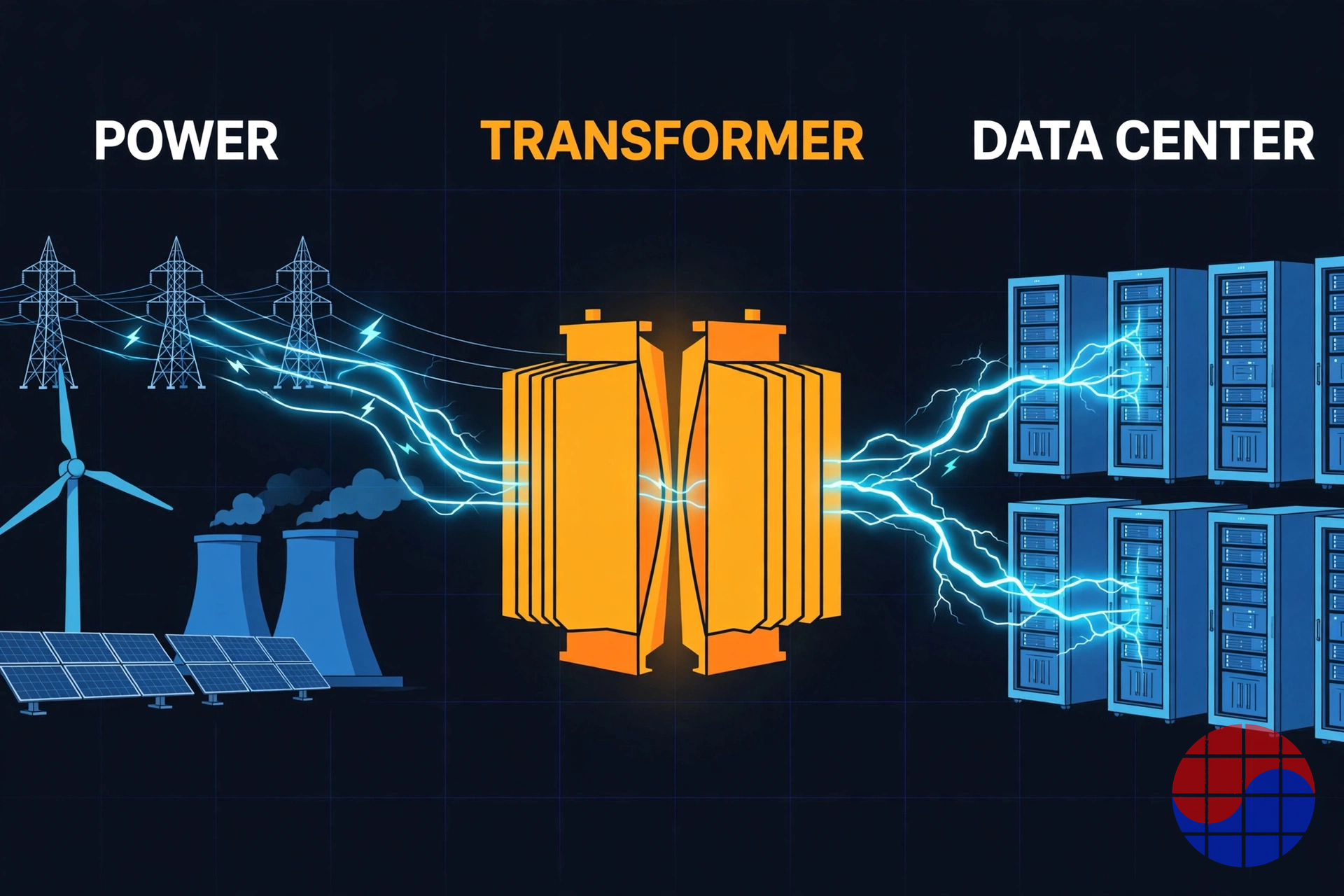
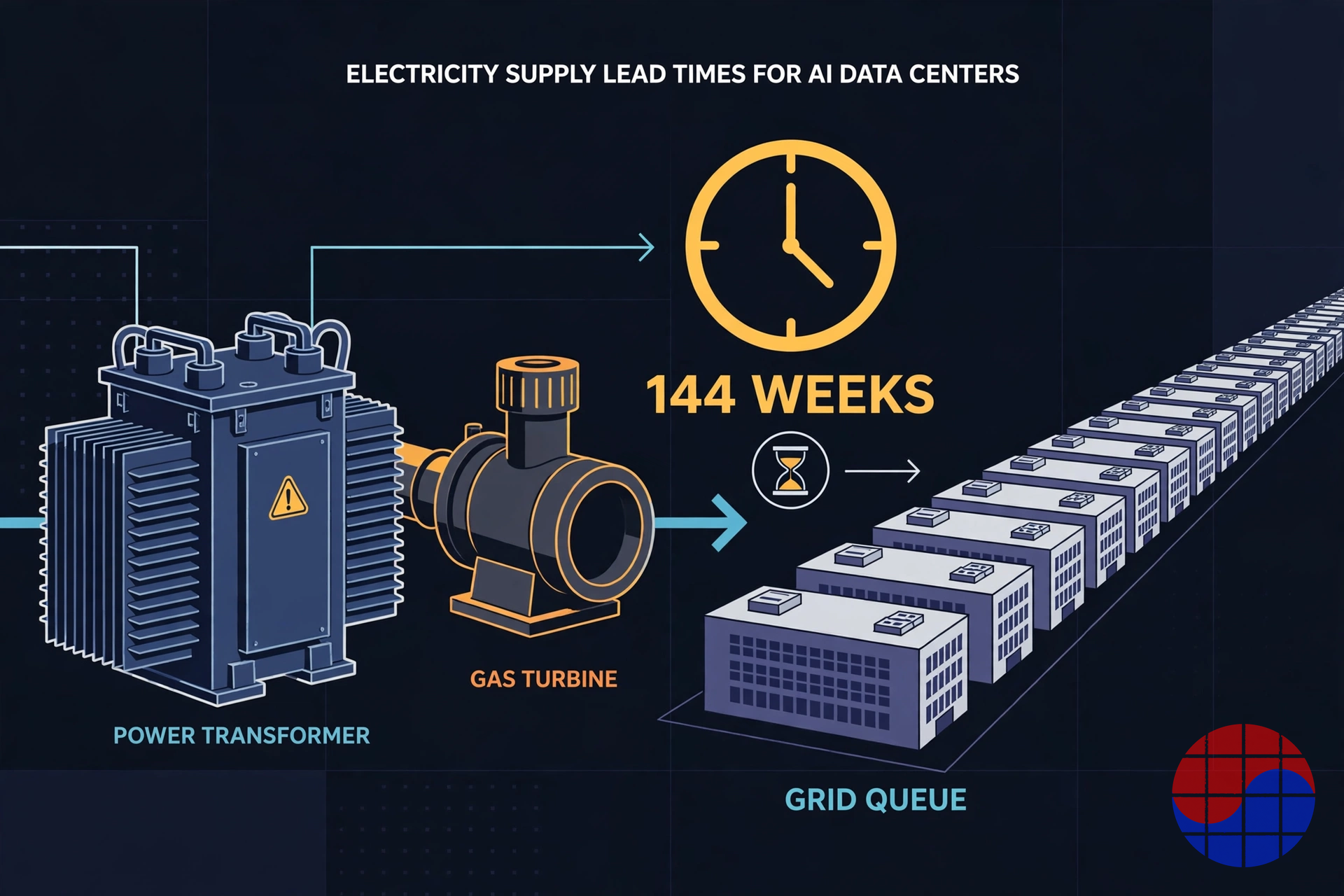
The emblem of the supply bottleneck is the transformer. Industry surveys published in 2026 put average large-transformer lead times at 128–144 weeks, versus about 100 weeks in 2022, with generator step-up units reported at 180 weeks or more. Switchgear lead times are reported up to roughly 90 weeks. Against a typical data centre build of 18–24 months, the transformer order is now the critical path of the entire project.
Generation is no easier. GE Vernova said at its Q1 2026 results (Apr 22, 2026) that its large gas turbine backlog and slot reservations stood at 83 GW at quarter-end, on a path to 100 GW during 2026. Turbine slots for 2029–2030 delivery are already contested. On the nuclear side, the 20-year power purchase agreement between Constellation and Meta (announced Jun 3, 2025) covering 1,121 MW from an Illinois plant is the symbolic event: an AI buyer contracting an entire existing nuclear plant. Firm, carbon-free power has become a scarce asset in itself.
Deep Dive 3: Korea's Power-Equipment Three — Collecting the Bottleneck Premium
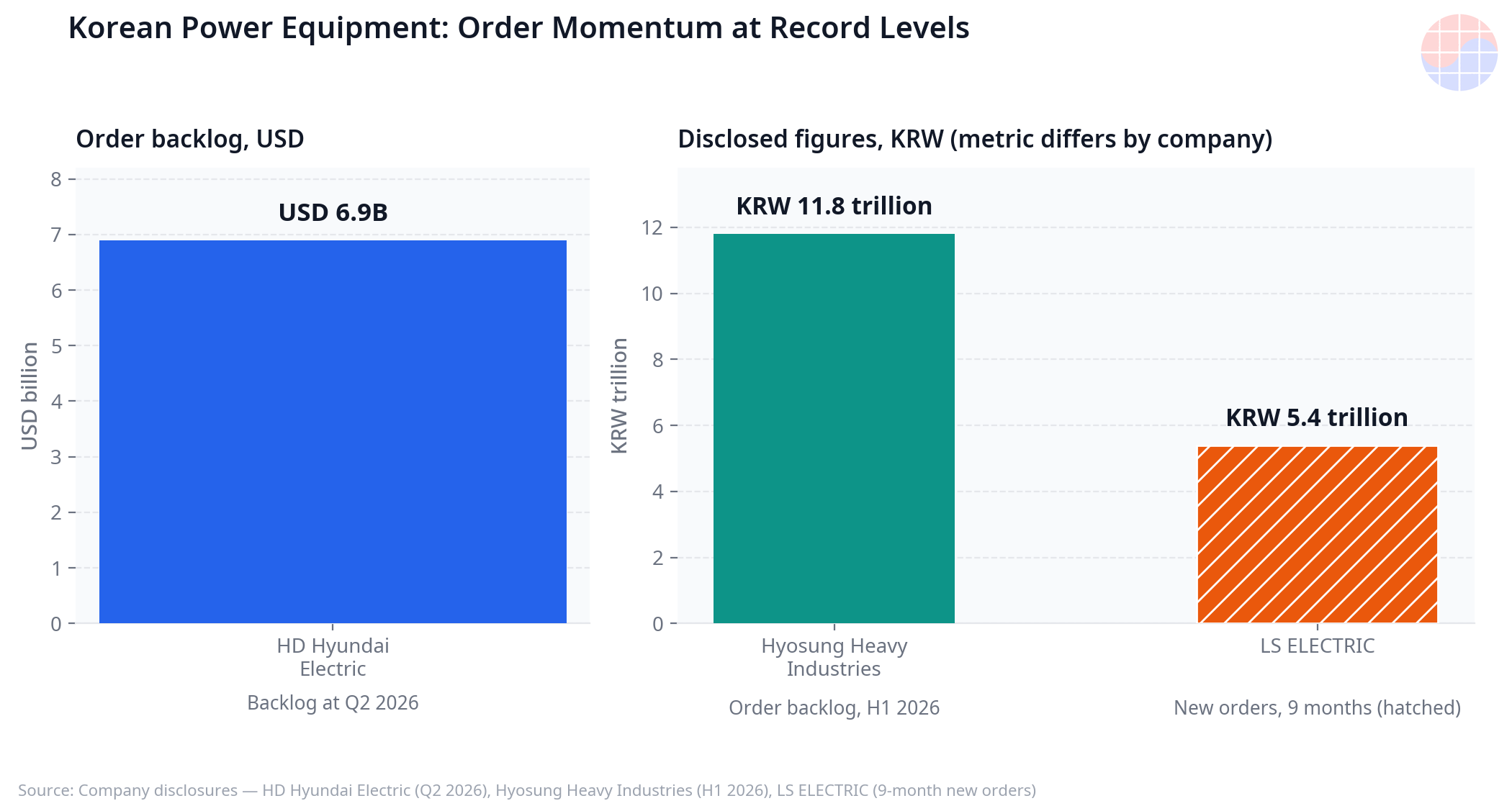
The beneficiaries of this bottleneck are geographically dispersed, but Korean manufacturers stand out. North American transformer supply is structurally short, and domestic US capacity alone cannot meet demand. The three Korean makers' 2026 numbers tell the story:
- HD Hyundai Electric: Q2 2026 revenue of KRW 1.147 trillion (+18.9% YoY) and operating profit of KRW 337.2 billion (+47.2%, a 29.4% margin), per its Jul 24, 2026 disclosure. Order backlog hit a record USD 6.9 billion. Its Alabama transformer plant expansion targets operation within 2026.
- Hyosung Heavy Industries: Heavy-industry order backlog reached KRW 11.8 trillion at end-H1 2026 (regulatory filings, Aug 2026), and its Memphis high-voltage transformer plant, once the 2026 expansion completes, is reported to be among the largest production capacities in the US.
- LS ELECTRIC: New orders of about KRW 5.4 trillion in Jan–Sep 2026 already exceeded the company's full-year guidance of KRW 5 trillion (Q3 2026 report), driven by North American big-tech data centre power infrastructure. A Texas production-base investment was also disclosed in H1 2026.
All three share the same shift: from "made in Korea, sold to America" to "made in America, sold to America." Transformers are heavy, fragile, and specified grid by grid. Local capacity and certification track records are the entry barrier — and once equipment enters a grid, multi-decade replacement cycles turn the installed base into the next order pipeline.
Deep Dive 4: Korea's Home Grid Faces the Same Equation
The same equation operates inside Korea. Data centre load concentrated in the capital region meets limited transmission headroom, and since the grid-impact assessment regime took effect with the Distributed Energy Act in 2024, connection reviews for new facilities have become stricter. Passing an assessment, however, is not a connection date. The bottleneck Korean operators feel is the same one US hyperscalers feel: grid headroom is not free, and it becomes an asset of whoever secures it first.
This is also where the three Korean makers' domestic position re-enters the picture. As domestic grid investment expands, delivery records for high-voltage transformers and switchgear proven in North America function as credibility assets at home. The bottleneck premium earned in export markets meets domestic grid modernization demand. Domestic grid work, being largely public procurement, carries a different margin structure than North American private demand — but as a stabilizer of volume, the two markets complement each other.
Chase's Take
Reading this as a temporary supply shortage is a mistake, for three structural reasons. First, the contracting structure of demand has changed. Hyperscalers no longer buy power spot: 20-year PPAs, whole-plant nuclear contracts, and turbine slot reservations turn electricity into a secured asset. Second, supply's time constant is long. A fab takes two to three years; transmission takes years in permitting alone, and transformer capacity is bound to skilled labour and core-steel supply. Third, the bottleneck is distributed. Fixing generation without transmission, or transmission without substations, fixes nothing.
The investor question is who holds pricing power over the bottleneck. In the GPU era it sat with designers and foundries. In the power era it sits with whoever can shorten lead times — equipment makers that already hold backlog and local capacity. HD Hyundai Electric's 29.4% operating margin in Q2 2026, far above manufacturing averages, shows the premium already flowing into prices. The risks are equally clear: a data centre capex slowdown pressures backlog, and competitor expansions can erode the premium. But the interconnection queue is a problem of sequence, not price — and sequence cannot be undercut.
Implications
- Hyperscalers: Power procurement now decides site strategy. When grid connection dates set opening dates, the power team is effectively the strategy team.
- Equipment makers: Backlog quality matters — cancellation terms, price-adjustment clauses, and local-production share separate equal-looking backlogs. For Korea's three, North American localization speed is the valuation.
- Korea's grid at home: Domestic data centres hit the same wall. A grid-impact assessment regime took effect with the Distributed Energy Act in 2024, but passing assessment is not a connection guarantee. Whether the bottleneck premium earned abroad gets recycled into domestic grid investment is the next question.
- Investors: The definition of an "AI beneficiary" keeps widening. Following the bottleneck's path — chips, servers, power — keeps finding high profit growth where market attention is still low.
Figures are based on the cited institutional and company disclosures (dates in text); projections depend on each source's assumptions.
FAQ
Q1. How fast is AI data centre power demand growing? Per the IEA (Apr 10, 2025), global data centre electricity consumption rises from about 415 TWh in 2024 to about 945 TWh in 2030. The US grows more than 130% over the same period, to about 425 TWh.
Q2. Why are transformers the bottleneck? Large-transformer lead times stretched from about 100 weeks in 2022 to 128–144 weeks (industry surveys published in 2026) — longer than a typical 18–24-month data centre build, making the transformer the project's critical path.
Q3. What is the evidence for Korean equipment makers? HD Hyundai Electric disclosed a record USD 6.9 billion backlog and a 29.4% operating margin in Q2 2026; Hyosung Heavy Industries held KRW 11.8 trillion of heavy-industry backlog at end-H1 2026; LS ELECTRIC booked about KRW 5.4 trillion of new orders in Jan–Sep 2026.
Q4. When does the bottleneck ease? Not soon, on current evidence. The US interconnection queue held 2,040 GW of generation at end-2025 (released Apr 7, 2026), and gas turbine slots are contested into 2029–2030 deliveries. Most observers place meaningful relief after 2028.
Sources
- IEA, "Energy and AI" (Apr 10, 2025): https://www.iea.org/reports/energy-and-ai
- LBNL, "Queued Up 2026" (Apr 7, 2026): https://emp.lbl.gov/queues
- HD Hyundai Electric Q2 2026 disclosure (Jul 24, 2026): https://www.hd-hyundaielectric.com
- Hyosung Heavy Industries regulatory filings (Aug 2026): https://dart.fss.or.kr
- LS ELECTRIC Q3 2026 report: https://www.ls-electric.com
- GE Vernova Q1 2026 results (Apr 22, 2026): https://www.gevernova.com
- Constellation–Meta 20-year PPA (Jun 3, 2025): https://www.constellationenergy.com
📩 Subscribe to VLSI Korea
Get our daily semiconductor deep-dives delivered to your inbox first. Free to subscribe.