VLSI Korea
The AI Phone Era: Qualcomm's 'End of Apps' Bet and What It Means for Memory
Qualcomm's CEO declared the agentic age on Sep 23, 2026: the 20-year app era is ending as AI agents act on your behalf. A 100B-parameter on-device phone targets 2028 — but memory bandwidth and power walls stand in the way. What the LPDDR6 race means for memory.


The AI Phone Era: Qualcomm's 'End of Apps' Bet and What It Means for Memory
30-Second Summary
- Bottom line: On September 23, 2026 (Hawaii local time), Qualcomm CEO Cristiano Amon declared at the Snapdragon Summit 2026 keynote that smartphones are shifting from a phone-centric model to an agentic model, stating "We are just at the beginning of the agentic age." The 20-year era of "opening apps one by one" is ending, he argued, giving way to an era where AI agents act on the user's behalf.
- In an interview on October 10, 2026, Amon said "some AI companies are developing their own smartphones" — phones designed to run 100B-parameter models continuously in the background, targeting a 2028 launch. OpenAI is reportedly the furthest along, with a concrete supply-chain picture emerging: a custom MediaTek Dimensity 9600 on TSMC's N2P process, Luxshare for assembly, and Sunny Optical for cameras.
- The key implication is memory. The agent era means always-on background operation, and always-on means residency in memory. Servers get there with HBM; phones get there through an LPDDR5X-to-LPDDR6 race in capacity and bandwidth. On-device AI becomes a new axis of memory demand.
- But verification is needed. Running 100B-parameter models on-device hits the physical walls of memory bandwidth, power, and thermals. As the math below shows, today's LPDDR5X phones cannot deliver usable speeds. The gap between agent demos and shipping products must be kept in view.
Background
September 23, 2026, Maui, Hawaii. The message of Qualcomm CEO Cristiano Amon's Snapdragon Summit 2026 keynote compresses into one sentence: smartphones are moving "from a phone-centric model to an agentic model." "We are just at the beginning of the agentic age." "AI is the new UI." At the same event, Qualcomm unveiled its next-generation flagship mobile platforms, the Snapdragon 8 Elite Gen 6 and Snapdragon 8 Elite Gen 6 Extreme.
Amon's definition of an agent is precise: software that understands the user's intent and context, reasons, plans, remembers — and then acts on the user's behalf. As he put it, "the last 20 years were a model of opening apps one by one." The claim is that tapping app icons one at a time gives way to AI handling things on its own. On privacy, he drew a clear line: user permission is critical, and the final decision always rests with the user.
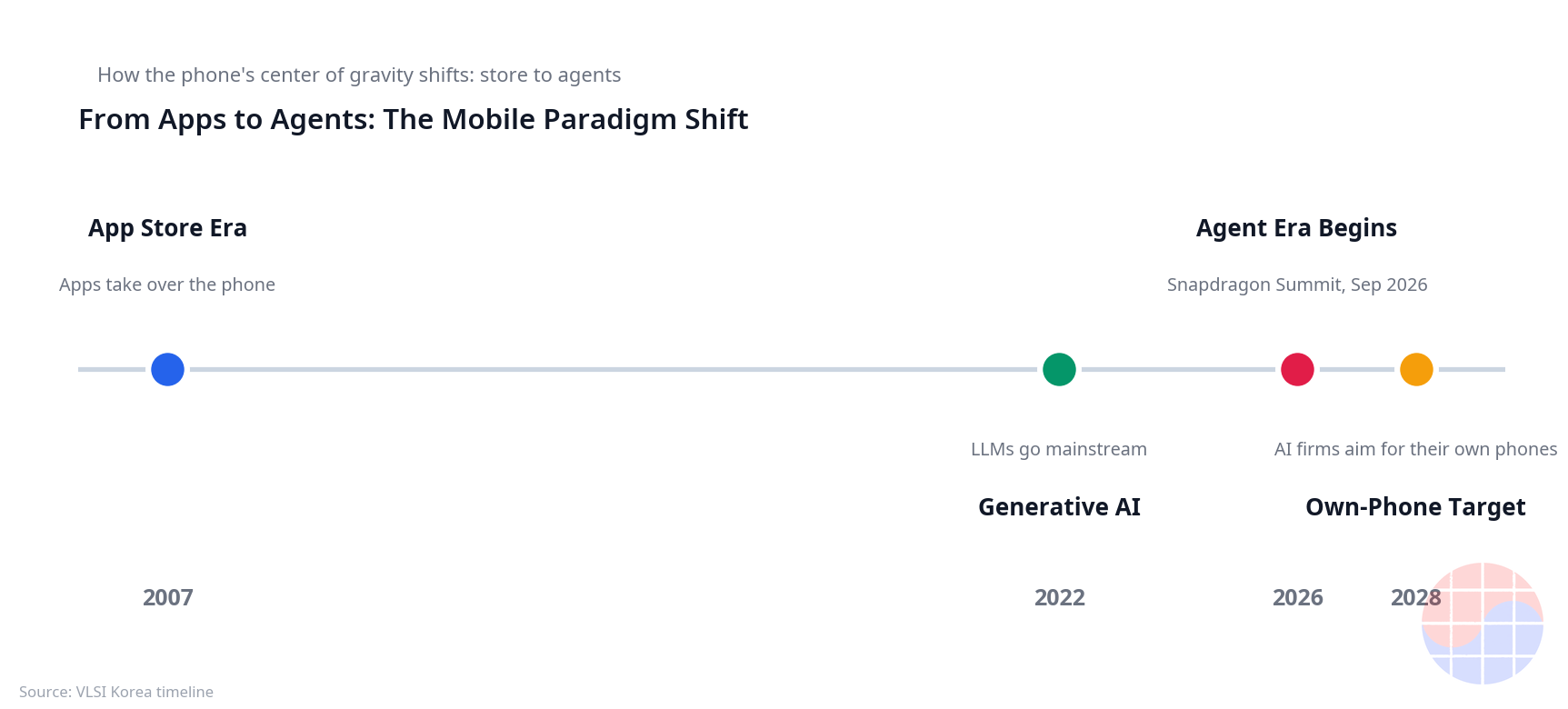
This declaration matters because it is coupled to hardware. For an agent to "act on your behalf," the phone must continuously understand the user's context — and continuous understanding means continuous compute. Whether that compute lives in the cloud or on-device decides how the industry's map gets redrawn. Qualcomm's bet is explicit: on-device.
Deep Dive
1. AI companies' own smartphones — the road to 2028
On October 10, 2026, Amon went one step further in a Fireside Alpha interview: "some AI companies are developing their own smartphones." The spec is concrete: phones that keep running a 100B-parameter model in the background, targeting launch in 2028.
OpenAI is reportedly the furthest ahead. According to Ming-Chi Kuo of TF International Securities, the outlines of an OpenAI phone look like this: a custom MediaTek Dimensity 9600 built on TSMC's N2P process, Luxshare handling assembly, Sunny Optical winning the camera module orders. A dual AI processor architecture handling vision and language simultaneously is said to be the signature feature. Shipment forecasts have surfaced too: roughly 30 million units combined across 2027–2028, with Kuo pulling his launch timing forward from 2028 to early 2027.
The essence of this move is vertical integration. AI companies are signaling they will move down the stack, past models and app layers into hardware itself. If the winners of the app era were the platform companies that owned the OS and the app store, the winners of the agent era may be whoever owns the device on which the agent "acts on your behalf." The point of building a phone is not the phone — it is owning the agent's execution environment.
2. The on-device memory wall, in numbers
But the claim of running 100B-parameter models "always-on" in the background collides with physics. Let's do the math.
A 100B-parameter model quantized to INT4 has weights of 100B × 4 bits = 400 Gb, or 50 GB. A current flagship smartphone carries about 16 GB (128 Gb) of memory. The weights alone exceed it by more than 3×. Add the KV cache plus memory used by the OS and apps, and the gap widens.
Bandwidth is harsher. LLM inference is a textbook memory-bound workload: generating each token requires reading the entire weights once from memory (at batch=1). LPDDR5X-8533 offers about 68 GB/s of theoretical bandwidth on a 64-bit bus. 50 GB ÷ 68 GB/s ≈ 0.73 seconds per token — roughly 1.4 tokens per second. That is not a usable speed for an agent that must understand context and act in real time in the background.
The comparison with servers sharpens the gap. HBM3E delivers over 1 TB/s per stack — more than 10× a phone's LPDDR5X. Servers punch through the memory wall with HBM; phones are trapped under the ceiling of the LPDDR form factor. This is why the agent era's memory demand splits into two races: HBM for servers, LPDDR for phones.
Power and thermals are walls too. "Running continuously in the background" does not mean idle — it means sustained DRAM bandwidth consumption. A mobile SoC's sustained thermal budget is on the order of a few watts. Running 68 GB/s-class DRAM bandwidth at full tilt continuously would blow through the battery and thermal budgets instantly. In a fanless phone, this is a non-negotiable constraint.
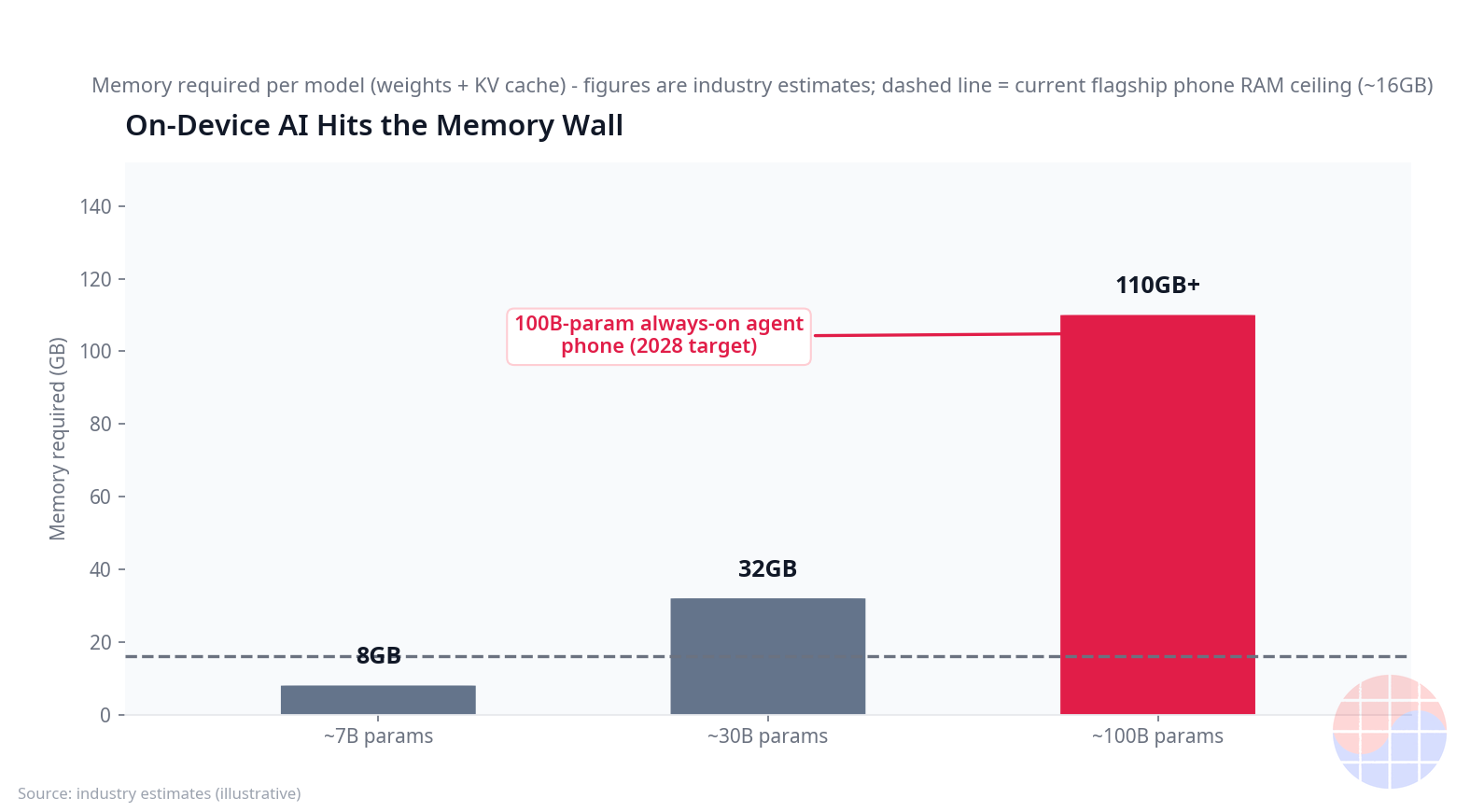
There are mitigants, of course: MoE (Mixture of Experts) architectures that shrink the activated parameter count, quantization more aggressive than INT4, NPU architecture improvements, and the transition to LPDDR6. But these lower the wall; they do not change the physical law that memory bandwidth determines inference speed. That is why the 2028 timeline looks optimistic.
3. The Korean angle — Samsung, SK hynix, and the memory wall
Korea's position in this picture is distinctive. Samsung Electronics is one of the world's only full-stack players spanning devices, memory, and foundry. It is pushing on-device AI as a differentiator through Galaxy AI, and competing with Qualcomm's Snapdragon through an Exynos strategy built around NPU-equipped APs. If the agent era tilts on-device, AP AI performance and the memory subsystem become the product's competitive edge.
The memory side is even more direct. SK hynix's and Samsung's LPDDR sits at the center of the memory wall. An agent's always-on background operation grows demand for memory residency — weights resident, KV cache resident, context resident. That is a new demand axis pulling the LPDDR5X-to-LPDDR6 transition forward. If HBM was the memory of the AI server, LPDDR becomes the memory of the agent-era mobile device.
The competitive map matters too: the rivalry with Apple's 2nm A20 Pro. Apple already owns the playbook of optimizing on-device AI through vertical integration of process, AP, and OS. With Qualcomm declaring the "agentic age" and news of OpenAI building a phone circulating, Samsung's full stack is entering a phase where it commands a premium again. Being able to co-optimize device and memory inside one company is a practical weapon in front of the agent era's memory wall.
4. Verification and counterpoints — between demo and shipping product
For balance, the counterpoints.
First, the gap between agent demos and shipping products. Keynote demos show the best-case scenario in a controlled environment. No shipped product has yet proven the power, thermal, and battery compromises of an always-on background 100B model. The 2028 timeline requires every supply-chain piece to land: TSMC N2P volume production, a custom Dimensity 9600, Luxshare assembly. The pieces are concrete, but schedule risk remains.
Second, the privacy paradox. For an agent to act "on your behalf," it needs access to more personal data — calendar, messages, payments, location. Yet Amon's claim is that "permission is critical and the final decision always rests with the user." The tension between broader data access and stronger user control is real. Permission fatigue sets in, users tap "allow" without thinking, and always-on background execution widens the attack surface for data exposure. Unless this tension is resolved, the agent era's killer features could get tripped up by regulation and trust.
| App era (last 20 years) | Agent era | |
|---|---|---|
| Interaction | Open apps one by one | AI grasps intent and acts on your behalf |
| UI | Touch, app icons | "AI is the new UI" — conversation, context |
| Where compute lives | Per-app, cloud-dependent | Always-on background, on-device-leaning |
| Bottleneck | Network, app optimization | Memory bandwidth, power, thermals |
| Memory demand axis | App runtime memory | Resident weights and KV cache |
| Platform power | OS, app store | Agent orchestration layer |
Chase's Take
Through a VLSI engineer's eyes, this is not a story about NPU TOPS marketing. It is a memory story.
LLM inference is a textbook memory-bound workload. In roofline-model terms, compute throughput (TOPS) is only one side of the roof; achieved performance hangs on the other side — memory bandwidth. Vendors lead with TOPS numbers because peak figures look good, but what determines an agent's felt speed is bandwidth. The calculation showing a 100B INT4 model managing only ~1.4 tokens per second on LPDDR5X is the evidence.
From an STA and tapeout perspective, the PPA (power-performance-area) tradeoff is visible. Agent workloads demand sustained memory bandwidth, which translates directly into power and heat. Servers solve this problem with money — fans and hundred-watt budgets — but phones must solve it within a few watts and a fanless chassis. Solving the same workload under entirely different constraints. That is why "a 100B model running on a phone" is an architecture problem, not a simple scale-down.
From the MBA side, it is the platform playbook repeating. What Qualcomm is after is not chip sales per se but the standard for the agent layer. If the OS was the platform of the app era, the agent orchestration layer becomes the platform of the agent era. The reports of OpenAI building a phone fit the same pattern: AI companies copying Apple's playbook of locking in the software experience with hardware — vertical integration, round two.
The implication for Korea is clear. Memory takes center stage again. Mobile DRAM — LPDDR, long overshadowed by HBM — emerges as the agent era's new demand axis. Samsung's full stack (devices + memory + foundry) becomes a co-optimization weapon in front of the memory wall. While "AI phone" gets consumed as a marketing slogan, the real game is being played in the LPDDR6 capacity-and-bandwidth race.
Implications
For investors. If on-device AI becomes a new axis of memory demand, the beneficiaries sit in the middle of the LPDDR6 transition: the mobile DRAM roadmaps of SK hynix and Samsung Electronics, and the leading-edge foundry allocation race (TSMC N2P-class). Companies building the agent software stack — on-device orchestration, hybrid cloud routing — are also worth watching. But discount the 2028 timeline for optimism. Kuo has pulled his launch forecast forward to early 2027, yet custom silicon and new form factors carry schedule risk that must be priced in.
For management. For handset OEMs, AP selection becomes AI strategy selection. Ride Qualcomm Snapdragon's agent stack, or go independent with an in-house AP like Exynos? How the hybrid on-device/cloud architecture gets designed becomes the core of product differentiation. Privacy regulation is a management issue too: if rules tighten around always-on background AI, the design balance between "permission" and "always-on" will decide product outcomes.
What to watch. (1) Whether the early-2027 first-volume forecast materializes, (2) the LPDDR6 standard freeze and mass-production schedule, (3) how complete the agent features on shipping Snapdragon 8 Elite Gen 6 devices turn out to be, and (4) privacy regulation around always-on background AI. These four will set the pace of the agent era.
FAQ
Q1. What is the "agentic age"? A concept Qualcomm CEO Cristiano Amon laid out in his September 23, 2026 Snapdragon Summit 2026 keynote: smartphones shifting from a phone-centric model to an agentic model, an era in which AI agents understand the user's intent and context, reason, plan, remember, and then act on the user's behalf. "The last 20 years were a model of opening apps one by one" and "AI is the new UI" are the signature lines.
Q2. Can a 100B-parameter model really run on a phone? Not within today's physics. At INT4 quantization, 100B-parameter weights are 400 Gb (50 GB) — more than 3× the 16 GB (128 Gb) of LPDDR5X in a current phone. The bandwidth math gives roughly 1.4 tokens per second, far from usable speed. MoE, more aggressive quantization, and the LPDDR6 transition can lower the wall, but they don't change the law that inference is memory-bound.
Q3. What is the news about AI companies building their own smartphones? It started with Amon's October 10, 2026 interview statement that "some AI companies are developing their own smartphones" — phones designed to run 100B-parameter models continuously in the background, targeting 2028. OpenAI is reportedly furthest along: per Ming-Chi Kuo (TF International Securities), a custom MediaTek Dimensity 9600 on TSMC N2P, Luxshare assembly, Sunny Optical cameras, and a dual AI processor handling vision and language simultaneously, with ~30 million units forecast across 2027–2028.
Q4. What does it mean for the memory industry? The agent era means always-on background operation, which grows demand for memory residency — weights, KV cache, context. Servers accelerate on HBM; phones accelerate through an LPDDR5X-to-LPDDR6 race in capacity and bandwidth. On-device AI becomes a new axis of memory demand, making the mobile DRAM roadmaps of suppliers like SK hynix and Samsung Electronics a key variable.
Q5. What about privacy? Amon drew the line at "permission is critical, and the final decision always rests with the user" (September 23, 2026). But agents acting on your behalf need access to more personal data, creating real tension. Unless permission fatigue and the data risks of always-on background execution are resolved, killer features could get tripped up by regulation and trust.
Sources
- Snapdragon Summit 2026 · Snapdragon 8 Elite Gen 6 · agentic AI bet: https://indianexpress.com/article/technology/tech-news-technology/snapdragon-8-elite-gen-6-qualcomm-bet-on-agentic-ai-new-mobile-chips-10889844/
- "AI is the new UI" · agentic era declaration: https://www.digit.in/news/general/ai-is-the-new-ui-qualcomm-ceo-cristiano-amon-says-smartphones-are-entering-the-agentic-era.html
- AI companies' own smartphones · OpenAI phone supply-chain analysis: https://www.techjuice.pk/why-are-ai-companies-secretly-building-phones/
[^1]: Market outlook figures cited (shipments, schedules) are analysts' forecasts and may differ from actual outcomes. Memory-bandwidth and token-speed calculations are estimates from public specs using a simplified model. Not a basis for investment decisions.