VLSI Korea
ASML's Record Quarter Has a Catch: Chip Tools Will Run Short Through 2028
ASML posted record Q3 results: EUR 11.66B in sales, 57.5% gross margin. But the CEO's message mattered more: planned 2027-2028 supply will not meet customer demand. Customers are already asking about 2029-2030 slots. Beyond the AI bubble debate, a hard supply-side signal.


The 30-Second Summary
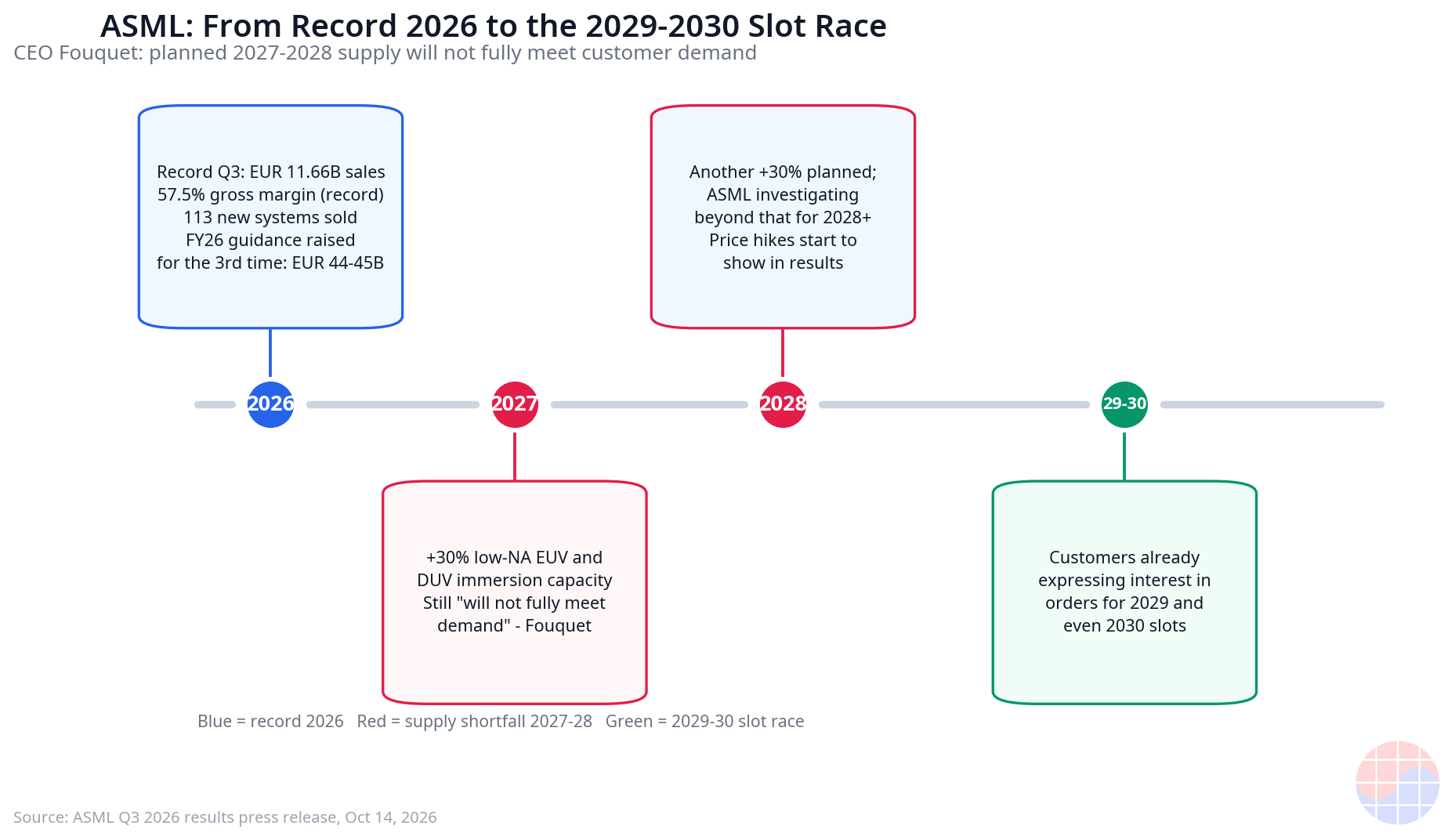
ASML reported its third quarter of 2026 on October 14, and every headline number was a record: EUR 11.66 billion in net sales, EUR 4.96 billion in net income, and a 57.5% gross margin. Full-year guidance was raised for the third time this year, to EUR 44-45 billion. But the numbers were not the real story. CEO Christophe Fouquet told investors that planned supply for 2027 and 2028 "will not fully meet the demand of our customers." Some customers are already asking about equipment slots for 2029 and even 2030. The AI bubble debate is a demand-side argument. On the supply side, there is no debate: the world's only EUV maker just declared a two-year shortage. The game from here is slot-allocation politics.
Background
ASML, headquartered in Veldhoven, the Netherlands, is the sole supplier of extreme ultraviolet (EUV) lithography systems and the leader in deep ultraviolet (DUV) immersion lithography. Advanced logic and memory scaling is effectively impossible without its tools.
The Q3 2026 results, published October 14: Source: ASML official Q3 2026 release
- Net sales of EUR 11.662 billion — up 25% quarter-on-quarter, up 55.2% year-on-year. A quarterly record.
- Net income of EUR 4.96 billion — up 70% QoQ, up 133% YoY.
- Gross margin of 57.5% — an all-time high, above the guided 55-57% range.
- 113 new lithography systems sold (up from 86 in Q2), plus 8 used systems.
- Installed Base Management (service and upgrade revenue) of EUR 3.289 billion — above guidance and the main driver of the margin beat.
- Q4 guidance: net sales of EUR 14.2-15.2 billion at ~57% margin. Q4 will be bigger than the record Q3.
- Full-year 2026 guidance: net sales of EUR 44-45 billion at ~56% margin — the third upward revision this year.
- EUR 4.1 billion in share buybacks during the quarter; interim dividend of EUR 1.88 per share payable November 4.
The stock reaction was paradoxical. Amsterdam-listed shares rose about 1.2%, but the US ADR fell 3.9%. Source: WSJ The macro backdrop did the damage: US September CPI came in hot at 3.7%, and the Philadelphia Semiconductor Index fell for a sixth straight session. A day when rate fears overpowered company fundamentals.
But the real news was in the outlook commentary. Fouquet said customers "continue to increase their short- and medium-term equipment demand forecasts," driven by their views on "the size and duration of AI-related investments," with some expressing interest in orders for 2029 and even 2030. And then the declaration: planned supply for 2027 and 2028 will not fully meet customer demand.
Business Deep Dive
1. The economics of the bottleneck
ASML occupies a unique position in the equipment industry. Memory and foundry are oligopolies with competitors; EUV lithography has no substitute at all. Every EUV layer of every advanced chip on earth passes through an ASML tool. A declared two-year EUV shortfall is therefore a declaration that the ceiling on global advanced-chip capacity is fixed for two years.
ASML already had aggressive expansion plans: +30% low-NA EUV and DUV immersion capacity in 2027, another +30% in 2028. Still not enough. The company is now investigating capacity beyond that for 2028 and beyond, with reports of annual EUV output above 110 systems under review. 2027 EUV capacity is effectively sold out.
The MBA insight: while the market debates whether AI demand is a bubble, supply is physically constrained. If AI capex slows, orders can be deferred or cancelled — ASML flags this risk explicitly in its forward-looking statements. But as long as demand holds, equipment slots harden into a first-come-first-served regime. The foundry that secures slots first owns 2028-2030 advanced capacity. Equipment slot bookings are a leading indicator of foundry capacity.
2. The second engine — Installed Base Management
The real driver of the 57.5% margin was not new tools but the service business. Installed Base Management revenue of EUR 3.289 billion beat guidance, and Fouquet credited "continued strong demand for productivity upgrades" for lifting margins.
Unpack the IBM business model and ASML's strategic shift comes into focus. This is revenue earned by increasing customers' wafer capacity without selling new tools: throughput upgrades measured in wafers per hour, overlay and process-control packages via metrology. For customers, upgrading installed tools beats queueing for machines that cost hundreds of millions of dollars. For ASML, it is high-margin recurring revenue.
The product roadmap points the same way. The NXE:3800F EUV scanner, due in 2027, raises throughput from 230 to 260 wafers per hour. DUV immersion tools delivering in 2027 get upgraded to 330 wph. The first YieldStar 550 metrology system shipped this quarter, offering more than 60% higher productivity than the previous generation and supporting the 14-angstrom logic node and the 1D DRAM node. Source: ASML Q3 earnings call recap
In short, ASML is evolving from a company that sells tools into a company that sells wafer capacity. Tool sales ride the cycle; service and upgrade revenue from the installed base dampens it. This quarter was the proof.
3. Pricing power — the negotiation is over
A little-noticed fact from the earnings call: ASML has completed price-increase negotiations with key customers. CFO Roger Dassen said the effect will not show in 2026 figures, will become partly visible in 2027, and will hit fully in 2028 and beyond. Source: Dow Jones via Morningstar
Note the timing: the monopolist's pricing power lands in full force in 2028 — the exact year supply is declared short. In a market where demand exceeds supply, price is the cleanest margin lever there is. How high ASML's 2028 margin can go is the next thing to watch.
4. The High-NA race — the economics of a USD 400M machine
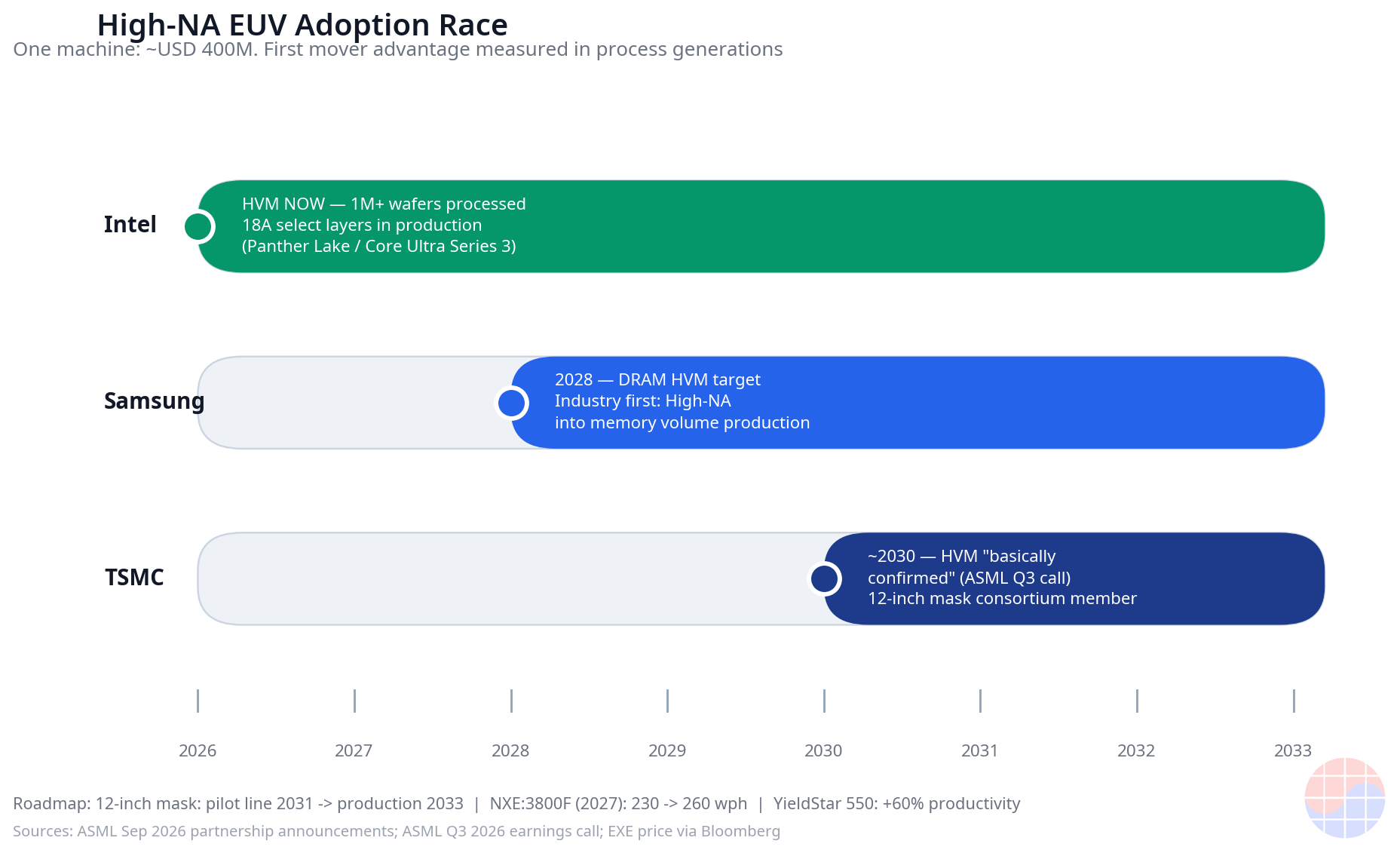
High-NA EUV is ASML's next-generation lithography. Each EXE system costs roughly USD 400 million, about twice a standard EUV tool. Source: Bloomberg via The three key customers are adopting at starkly different speeds:
- Intel: already in high-volume manufacturing. More than one million wafers processed on High-NA, applied to select layers of the 18A process (Panther Lake / Core Ultra Series 3). The CEO called Intel "one of the key leaders of the industry's adoption of High NA."
- Samsung: targeting DRAM high-volume manufacturing in 2028 — the industry's first use of High-NA in memory volume production, confirmed in the expanded September 8 strategic partnership.
- TSMC: high-volume adoption around 2030, described on the Q3 call as "basically confirmed." The most cautious of the three.
Source: High-NA adoption status
The speed gap mirrors each company's capex priorities and margin structure. Intel is paying the early-adopter price to revive its foundry; Samsung is making an aggressive 2028 bet to defend memory leadership; TSMC can afford to wait until 2030 because low-NA multi-patterning economics still work for its nodes.
And the ten-year roadmap behind it: ASML, TSMC, Samsung, and Intel have formed a consortium to move the industry from the 6-inch photomask standard to 12-inch. Target: a pilot line by 2031, production by 2033. High-NA's anamorphic optics halve the exposure field, forcing stitching on large AI dies; a 12-inch mask removes that constraint and lifts scanner productivity. Source: The Register It is the infrastructure investment that makes a USD 400 million machine economical.
One detail to watch: customers promised the machine works. None promised a count. Quarterly High-NA order counts are the next catalyst.
5. Physical expansion — the second Eindhoven campus
Toolmakers expand slower than fabs. On September 8, ASML broke ground on a second major campus at the BIC North site in Eindhoven: roughly 350,000 square meters, room for up to 20,000 jobs, with phase one targeted for 2029. The physical bet on post-2028 capacity has already begun.
Chase's Take
The AI bubble debate is a demand-side argument. On the supply side there is no debate. The world's only EUV maker just declared a two-year shortage — there is no harder signal than that.
The real game from here is slot-allocation politics. Whoever reserves 2029-2030 slots first owns 2030s chip supremacy. The High-NA adoption gap — TSMC cautious, Samsung aggressive, Intel leading — is not a technology preference; it reflects each company's capex priorities and margin structure. Samsung's 2028 DRAM High-NA target is an aggressive bet to defend memory leadership, and its success hinges on securing ASML slots. From a Korea perspective, the fastest way to read Samsung's foundry and memory capacity roadmap is to track ASML's slot and order trends.
Second, watch ASML's business-model shift. IBM revenue of EUR 3.3 billion a quarter is now the core of its margin. The company is evolving from selling tools to selling wafer capacity — and recurring service revenue dampens equipment cyclicality. For investors, that means the quality of ASML's earnings just stepped up.
Finally, pricing power. The negotiations are done; the full effect lands in 2028. Shortage plus price hikes in the same year. ASML's 2028 margin has a real shot at another all-time high.
Implications
For investors. Track three catalysts. First, whether additional 2028 capacity gets announced (reports of 110+ EUV systems a year are the hint). Second, quarterly High-NA EXE order counts — customers committed to the technology, not to a number. Third, the flow-through of price increases into 2027-2028 results. Because equipment slots lead foundry capacity, ASML's order and shipment trends are the shortcut to reading TSMC, Samsung, and Intel capacity guidance. The risk is AI capex slowing and orders being pushed out — a risk ASML itself discloses.
For operators. There is no multi-sourcing EUV capacity. Long-term reservations and productivity-upgrade contracts are the only path to securing capacity. DUV immersion demand is solid too, with 330 wph upgrades on 2027 deliveries. For memory players, Samsung's 2028 High-NA DRAM target carries a big signal: as EUV patterning goes mainstream in memory, the pace of DRAM's EUV transition will decide cost structures.
FAQ
Q1. What were the key Q3 numbers? Net sales of EUR 11.66 billion, net income of EUR 4.96 billion, and a 57.5% gross margin — all quarterly records. ASML sold 113 new lithography systems, and Installed Base Management revenue of EUR 3.3 billion beat guidance and drove the margin. Full-year guidance was raised to EUR 44-45 billion, the third increase this year.
Q2. Why did the US shares fall on record results? Macro overwrite. US September CPI surprised to the upside and the Philadelphia Semiconductor Index fell for a sixth straight day. Amsterdam shares rose 1.2%; the US ADR fell 3.9%. Rate fears, not fundamentals, moved the stock that day.
Q3. What does the 2027-2028 supply shortfall declaration mean? With no EUV substitute, it means the ceiling on global advanced-chip capacity is effectively fixed for two years. The +30% capacity increases planned for 2027 and another +30% for 2028 are still not enough, and ASML is investigating more for 2028+. Customers are already asking about 2029 and 2030 slots.
Q4. Where does High-NA EUV adoption stand? Intel is in volume production on select 18A layers (1M+ wafers processed); Samsung targets DRAM high-volume manufacturing in 2028; TSMC's ~2030 adoption is "basically confirmed." Each EXE system costs about USD 400 million. The 12-inch photomask consortium (pilot 2031, production 2033) underpins the next decade's roadmap.
Further Reading
Chris Miller's Chip War is the best single account of the geopolitics and business that created ASML's monopoly — useful background for understanding how this bottleneck was built. View on Amazon — This link may earn us a commission.
This article is for informational purposes only and is not investment advice. Figures are based on ASML's official release dated October 14, 2026.[^1]
[^1]: Some forward-looking figures (e.g., 2028 capacity under review) cite earnings-call remarks and press reports, and actual results may differ.