VLSI Korea
The Builders Earn First: Samsung E&A's Earnings Surprise in 5 Facts (Cleanroom, Sub-Fab)
Samsung E&A's Q3 operating profit of KRW 500.6 billion was about twice consensus, and order guidance jumped from KRW 12 trillion to KRW 19 trillion. Even after stripping out about KRW 100 billion of one-offs, the structural beat stands. Five facts on the fab buildout's second-order winners.


Before a new fab produces a single wafer, the companies that build it have already been paid. Samsung E&A's third quarter shows where the fab buildout cycle pays out first.
30-Second Summary
- Samsung E&A posted third-quarter revenue of KRW 2.9 trillion and operating profit of KRW 500.6 billion, up 45.8% and 183.6% year on year (reported October 23, 2026). Operating profit came in at roughly twice the market consensus of KRW 252.0 billion.
- Full-year guidance was raised sharply: new orders from KRW 12 trillion to KRW 19 trillion, revenue from KRW 10 trillion to KRW 11 trillion, and operating profit from KRW 0.8 trillion to KRW 1.4 trillion — record territory for orders and profit.
- About KRW 100 billion of the quarter's profit was one-off — settlement gains and a provision reversal tied to the Yanbu power project. The rest reflects a structural driver: rising order volume from affiliates building new fabs.
- The company announced a KRW 780 billion share buyback and cancellation, of which KRW 90 billion is employee compensation and KRW 690 billion is shareholder return.
- 14 of 15 brokerages that published reports raised their target prices. The spillover is already visible one layer down: Hanyang ENG won a KRW 148.1 billion cleanroom piping contract for Samsung's P5 fab, and cleanroom and sub-fab suppliers are heading for record results.
5 Facts
Fact 1 — Third-quarter operating profit landed at about twice the consensus
Samsung E&A reported third-quarter revenue of KRW 2.9 trillion and operating profit of KRW 500.6 billion. Revenue rose 45.8% year on year and operating profit rose 183.6%. Against a market consensus of KRW 252.0 billion for operating profit, the actual result was 1.99 times the estimate — a gap too large to be explained by rounding or a single strong project. An operating margin of about 17.3% (KRW 500.6 billion on KRW 2.9 trillion of revenue) is also far above what plant engineering normally delivers, which is the first clue that the quarter mixes a structural improvement with one-off items. Fact 5 separates the two.
Fact 2 — Guidance was not trimmed upward; it was reset
The company lifted its full-year targets by an unusual margin: new orders from KRW 12 trillion to KRW 19 trillion (+58.3%), revenue from KRW 10 trillion to KRW 11 trillion (+10.0%), and operating profit from KRW 0.8 trillion to KRW 1.4 trillion (+75.0%). Both the order target and the profit target sit at record levels for the company. The shape of the revision matters more than its size. Orders were raised far more than revenue, which means management is signaling a multi-year workload, not a single good year: orders booked in 2026 convert into revenue across 2027 and 2028 as fab projects move from groundbreaking to cleanroom fit-out.
Fact 3 — A KRW 780 billion buyback turns an order story into a shareholder-return story
Alongside the results, Samsung E&A announced a KRW 780 billion share buyback and cancellation. KRW 90 billion of the total is allocated to employee compensation and KRW 690 billion — 88.5% of the program — to shareholder return through cancellation. For an engineering and construction company, committing a sum equal to about 56% of the newly raised full-year operating profit target (KRW 1.4 trillion) to buybacks is a statement about cash conversion: management expects the order backlog to turn into cash, not just revenue. It also changes the shareholder base's math — fewer shares outstanding against a rising profit pool.
Fact 4 — Fourteen of fifteen brokerages raised their target prices
Of the 15 securities firms that published reports on the results, 14 raised their target prices. NH Investment & Securities moved its target from KRW 80,000 to KRW 86,000, and Samsung Securities from KRW 64,000 to KRW 83,000, against a previous close of KRW 55,400. Even the more conservative of the two new targets implies roughly 50% upside from that close, and the higher one about 55%. Near-unanimous upgrades after a single quarter usually mean analysts had modeled the fab buildout as a slower, smaller cycle than the one now showing up in orders. The revision wave is therefore evidence about the cycle, not just about one company.
Fact 5 — The money is already flowing to cleanroom and sub-fab suppliers
The buildout does not stop at the general contractor. Hanyang ENG signed a KRW 148.1 billion contract with Samsung C&T for general piping work on the phase-1 cleanroom of Samsung's P5 fab. Suppliers of fan filter units (FFU) such as Shinsung ENG, and sub-fab equipment makers such as Unisem and GST, are also expected to post record results, according to research commentary from IBK Investment & Securities. This is the classic second-order pattern of a fab cycle: the chipmaker commits capital, the EPC contractor books the plant, and then dozens of cleanroom, piping, and sub-fab specialists book their largest orders in years — each layer with its own backlog and its own visibility.
Background
Why fab construction is a separate cycle from chip sales
A leading-edge fab takes years to build and costs tens of trillions of won before the first wafer ships. That spending is sequenced: site and structure first, then cleanroom construction, then process tools, then sub-fab systems — the vacuum, abatement, chemical supply, and utility equipment that sits below and around the cleanroom floor. Each stage has different suppliers, different margins, and different timing. Chip revenue arrives at the very end of the chain; construction revenue arrives at the beginning.
Three buildout programs anchor the current cycle. Samsung is expanding at Pyeongtaek, including the P5 fab. SK hynix is building its Yongin cluster. Korean chipmakers are also building fabs in the United States. Together they create a multi-year order pipeline for the engineering, procurement, and construction (EPC) layer and for the cleanroom and sub-fab specialists beneath it. Samsung E&A sits at the top of that layer as the affiliate that builds plants for the group and for outside clients — which is why its order book is one of the earliest hard-data reads on how fast the buildout is actually moving.
Business Deep Dive
The quarter in numbers
| Item (Q3 2026) | Actual | Comparison | Change |
|---|---|---|---|
| Revenue | KRW 2.9 trillion | Year-ago quarter | +45.8% |
| Operating profit | KRW 500.6 billion | Year-ago quarter | +183.6% |
| Operating profit | KRW 500.6 billion | Consensus KRW 252.0 billion | About 1.99x |
| Implied operating margin | About 17.3% | Revenue KRW 2.9 trillion | — |
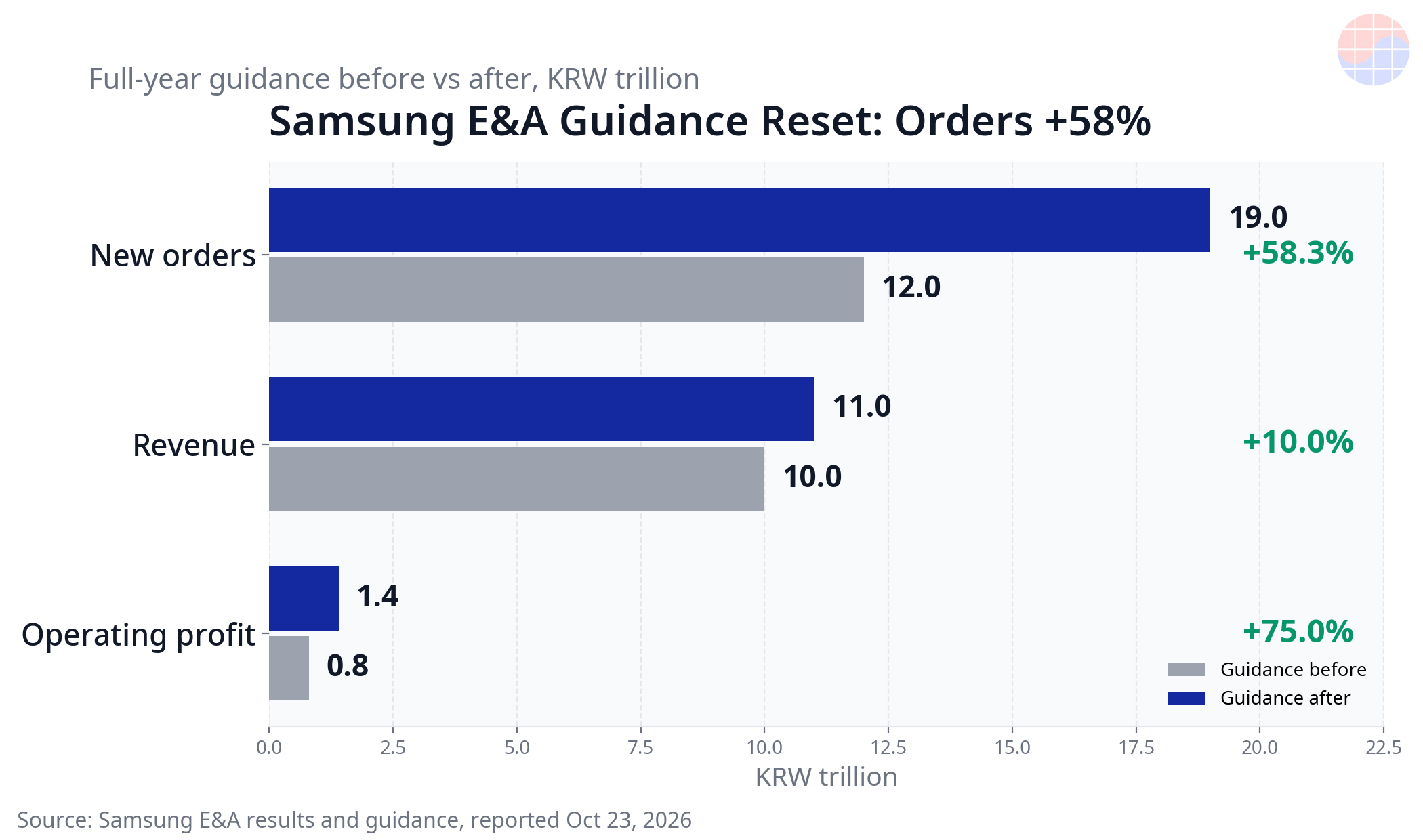
Source: Company results reported on October 23, 2026; consensus as reported the same day. Full source links are listed at the end of this article.
The guidance reset in numbers
| Full-year guidance | Before | After | Change |
|---|---|---|---|
| New orders | KRW 12 trillion | KRW 19 trillion | +58.3% |
| Revenue | KRW 10 trillion | KRW 11 trillion | +10.0% |
| Operating profit | KRW 0.8 trillion | KRW 1.4 trillion | +75.0% |
| Buyback and cancellation | — | KRW 780 billion | KRW 690 billion for cancellation |
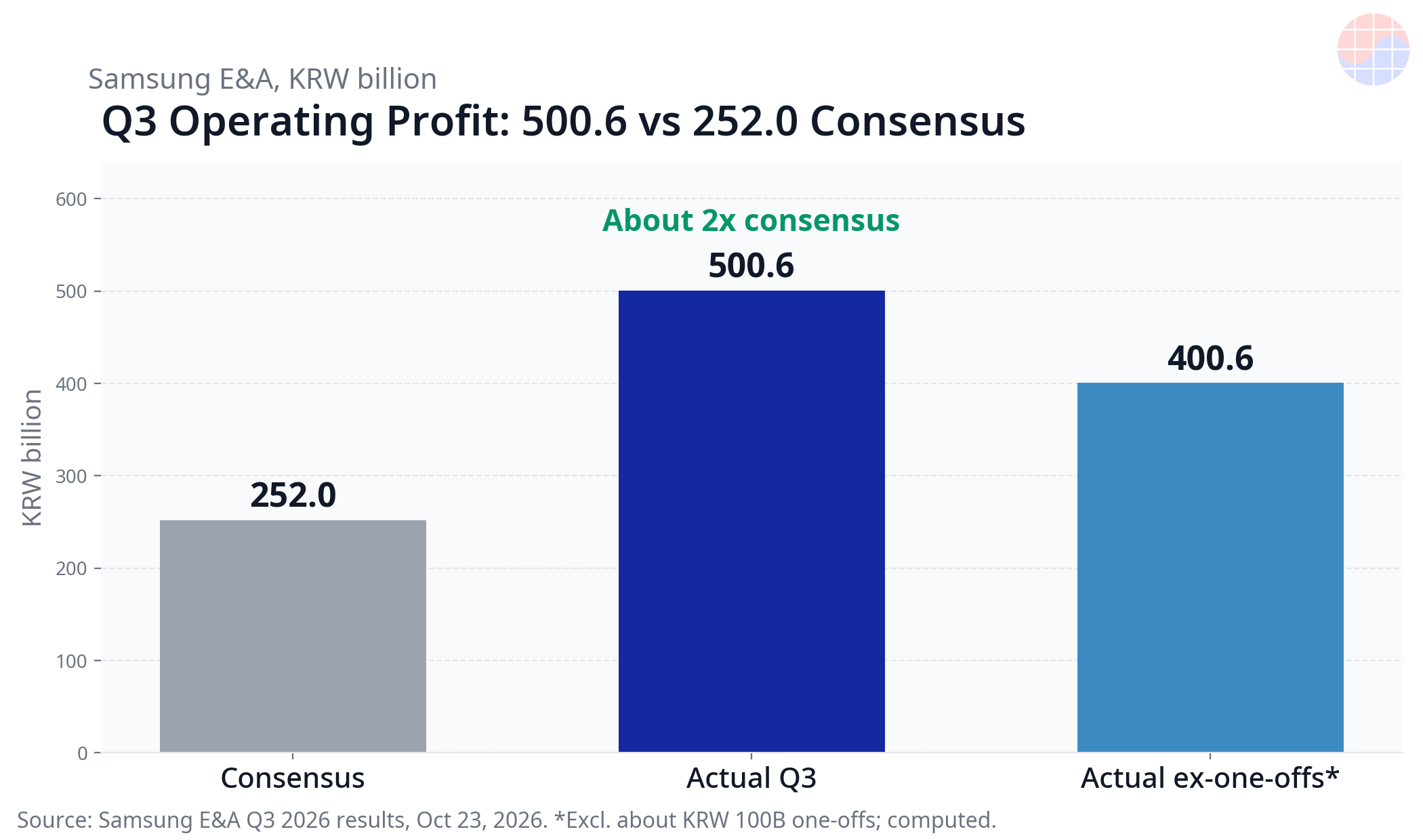
Source: Company guidance reported on October 23, 2026.
The most important line is the first one. A 58.3% increase in the order target, decided with one quarter left in the year, means orders were arriving faster than the plan assumed. Because EPC revenue is recognized over project life, an order surge in 2026 is primarily a 2027–2028 revenue story. The profit target rising 75.0% on a 10.0% revenue increase also implies operating leverage: fixed engineering capacity spread over a larger, richer project mix.
📩 Following this story?
Get the follow-up analysis — earnings, reports and HBM supply — in your inbox daily at 10:30 KST. Subscribe free →
One-off versus structural: separating the two engines
Not all of the third quarter's profit has the same durability, and the distinction decides how much of the surprise should be capitalized.
| Driver | Size | Type | Durability |
|---|---|---|---|
| Yanbu power project settlement and provision reversal | About KRW 100 billion | One-off | Does not repeat by itself |
| Higher volume from affiliates | Main driver of the revenue increase | Structural | Lasts while the fab buildout lasts |
| Order backlog growth (guidance KRW 19 trillion) | Multi-year | Structural | Converts to revenue over 2–3 years |
Source: Company results and same-day reporting, October 23, 2026.
The one-off items are roughly 20% of the quarter's KRW 500.6 billion operating profit. Strip them out and the underlying quarter is still about KRW 400 billion of operating profit — still roughly 59% above the KRW 252.0 billion consensus. That is the cleanest way to read the print: the headline beat is flattered by one-offs, but the structural beat is real. The structural engine is affiliate volume — Samsung group fabs under construction need EPC capacity now — reinforced by non-affiliate plant work. Its durability is tied to the buildout calendar, not to a single settlement.
The second-order map: who gets paid, in what order
| Layer | What they sell | Named evidence this cycle |
|---|---|---|
| EPC and plant engineering | Whole-plant design and construction | Samsung E&A orders guided to KRW 19 trillion |
| Cleanroom construction and piping | Cleanroom fit-out, process piping | Hanyang ENG: KRW 148.1 billion P5 phase-1 piping contract with Samsung C&T |
| Cleanroom components | Fan filter units (FFU) | Shinsung ENG among suppliers expected to post record results |
| Sub-fab equipment | Vacuum, abatement, utility systems | Unisem and GST among suppliers expected to post record results |
Source: Contract and results reporting dated October 23, 2026; supplier outlook per IBK Investment & Securities research commentary.
Three properties make this layer attractive relative to chip equipment. First, visibility: EPC and cleanroom work is contracted before it is performed, so backlog, not spot demand, drives the next several quarters. Second, volatility: construction revenue follows project milestones, which are smoother than wafer-equipment orders that can be pushed out in a single quarter. Third, breadth: a single fab program fans out into hundreds of contracts, so the cycle lifts an ecosystem rather than one winner. The offsetting risks are equally concrete — skilled labor shortages, delivery schedules that slip when several fabs peak at once, and the lumpiness of settlement gains, as the Yanbu item shows in reverse.
What the target-price wave is really saying
Analyst targets moved because the input that matters most for this layer — the order run-rate — moved. When 14 of 15 firms revise in the same direction after one release, the prior consensus had embedded a buildout that was too slow. The two named revisions bracket the new range: KRW 83,000 (Samsung Securities, from KRW 64,000) and KRW 86,000 (NH Investment & Securities, from KRW 80,000), versus a KRW 55,400 previous close. The gap between price and targets is now an execution question: can labor, equipment, and cleanroom capacity be delivered on the schedule the orders assume?
Chase's Take
The chip industry obsesses over who sells the most advanced silicon. This quarter is a reminder that the buildout itself is a business — and right now it may be the more legible one. A chipmaker's next year depends on prices it does not control. A fab builder's next two years sit in a signed backlog. Samsung E&A's guidance reset — orders up 58.3% — is effectively the Samsung group's construction department telling the market, in numbers, how fast P5 and the wider buildout are really moving. Read that way, the print is not just an earnings surprise; it is a speedometer for the entire Korean fab expansion.
The discipline is to refuse the headline number. About a fifth of the quarter's profit is settlement and reversal income that will not repeat on schedule. The honest figure — roughly KRW 400 billion of underlying profit against a KRW 252.0 billion consensus — is still a decisive beat, and it rests on the most durable thing in this industry: concrete, cleanrooms, and piping that must exist before any AI chip can. Investors who only watch wafer and HBM prices are looking at the end of the chain. The beginning of the chain just reported, and it is accelerating.
Implications
- For investors: The fab buildout now has a listed, backlog-driven proxy with rising shareholder returns. The KRW 780 billion buyback — 88.5% of it cancellation — signals management confidence in cash conversion, but position sizing should respect the one-off share of the latest quarter.
- For the supply chain: Cleanroom piping, FFU, and sub-fab equipment suppliers are moving from "expected to benefit" to named contracts and record-result forecasts. Hanyang ENG's KRW 148.1 billion P5 contract is the template: mid-cap specialists can re-rate on a single fab phase.
- For chipmakers: The bottleneck is shifting. When EPC orders rise 58.3% in a year, the constraint on new capacity becomes construction labor and delivery schedules as much as process tools. Fab timelines — and therefore future chip supply — now depend on builder capacity.
- For competitors and customers: A faster Korean buildout (Pyeongtaek P5, the Yongin cluster, US fabs) means future leading-edge and memory supply arrives on the builders' schedule. Customers planning 2027–2028 supply should track EPC backlogs as a leading indicator, not just chipmaker capex headlines.
FAQ
Q: How much of Samsung E&A's third-quarter profit was one-off? A: About KRW 100 billion of the KRW 500.6 billion operating profit — roughly 20% — came from one-off items tied to the Yanbu power project, namely settlement gains and a provision reversal (reported October 23, 2026). Excluding them, underlying operating profit of about KRW 400 billion still beat the KRW 252.0 billion consensus by a wide margin.
Q: What exactly changed in Samsung E&A's full-year guidance? A: New orders were raised from KRW 12 trillion to KRW 19 trillion (+58.3%), revenue from KRW 10 trillion to KRW 11 trillion (+10.0%), and operating profit from KRW 0.8 trillion to KRW 1.4 trillion (+75.0%). The order and profit targets are at record levels, and the order increase points to revenue conversion across 2027 and 2028.
Q: Which companies benefit beyond Samsung E&A? A: The spillover reaches cleanroom and sub-fab layers. Hanyang ENG signed a KRW 148.1 billion contract with Samsung C&T for general piping on phase 1 of the P5 cleanroom. FFU supplier Shinsung ENG and sub-fab equipment makers Unisem and GST are also expected to deliver record results, per IBK Investment & Securities research commentary.
Q: What are the main risks to this story? A: Three stand out. One-off settlement gains may not repeat, so headline growth rates will normalize. Construction labor shortages and overlapping fab schedules can delay delivery and revenue recognition. And the structural driver — affiliate fab volume — depends on chipmakers sustaining their buildout pace at Pyeongtaek, Yongin, and US sites.
Sources
- Samsung E&A third-quarter results and guidance, reported October 23, 2026: https://biz.chosun.com/en/en-finance/2026/10/23/IO6OTX6RJFGJFE7BYV5L7IPRHA/
- Fab supply-chain spillover and supplier contracts, reported October 23, 2026: https://en.edaily.co.kr/news/eda202610235107/
Note: This article is an analysis of publicly reported figures as of October 23, 2026, and is not investment advice. Brokerage target prices and supplier outlooks are third-party estimates that may not materialize.
📩 Missed today's analysis? Get tomorrow's in your inbox
Daily Silicon at 10:30 KST plus earnings and analyst-report breakdowns, first. Samsung Electronics, SK hynix, TSMC and HBM supply, read by practicing engineers. Join 300+ subscribers.
Subscribe free →
Free · No spam · Unsubscribe anytime