VLSI Korea
Banks Are Quietly Dumping the AI Data Center Debt They Just Underwrote
JPMorgan, Goldman and MUFG are offloading AI data center debt they underwrote six months ago — including a $38B Oracle loan stuck in syndication. For chipmakers, the message is concrete: the 2027 constraint on AI demand may be the cost of money, not CoWoS capacity.


The most important signal in the semiconductor market this week is not a chip announcement. It is a banking one: the same banks that raced to underwrite AI data center debt six months ago are now quietly trying to get it off their balance sheets. When the lenders closest to the money start hedging their own bets, the financing layer of the AI boom — the layer that turns chip purchase orders into actual revenue — is flashing yellow.
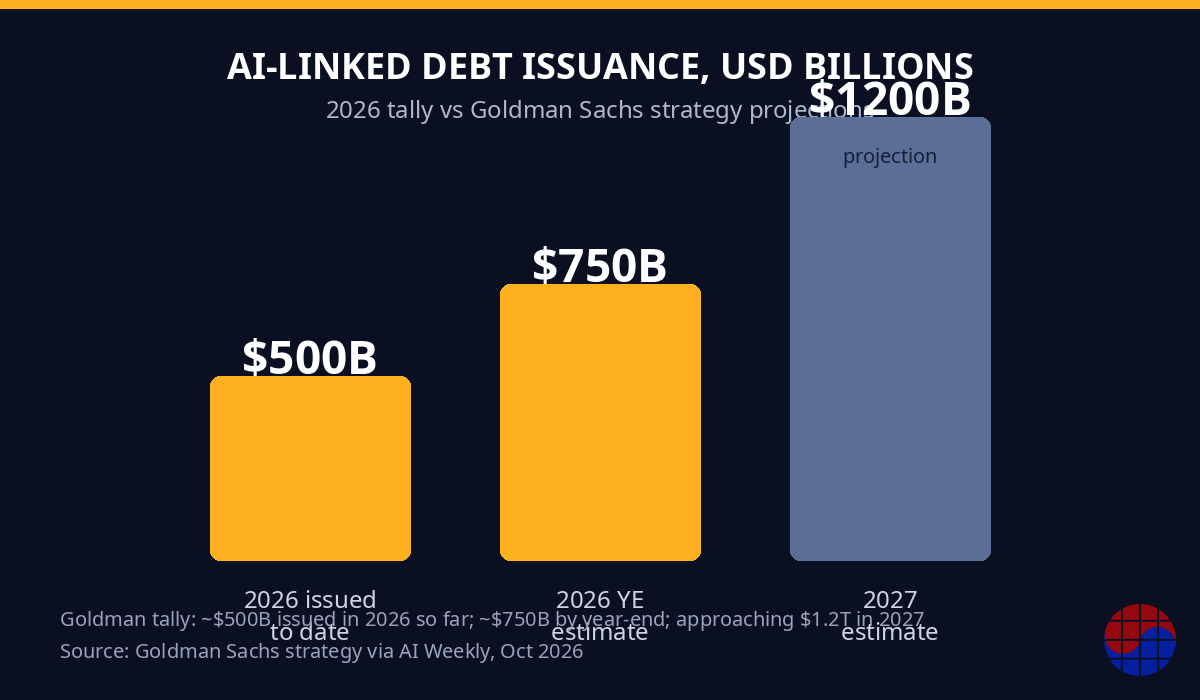
The numbers behind this story are staggering. Goldman Sachs strategy tallied AI-linked debt issuance at roughly $500 billion so far in 2026, projecting it to reach $750 billion by year-end and approach $1.2 trillion in 2027.* The banks' retreat does not mean the AI buildout stops tomorrow. But it means the cost of funding the next wafer, the next rack of GPUs, and the next HBM supply contract is rising fast — and rising funding costs have a way of turning "insatiable AI demand" into canceled orders.
What happened: two deals that tell the whole story
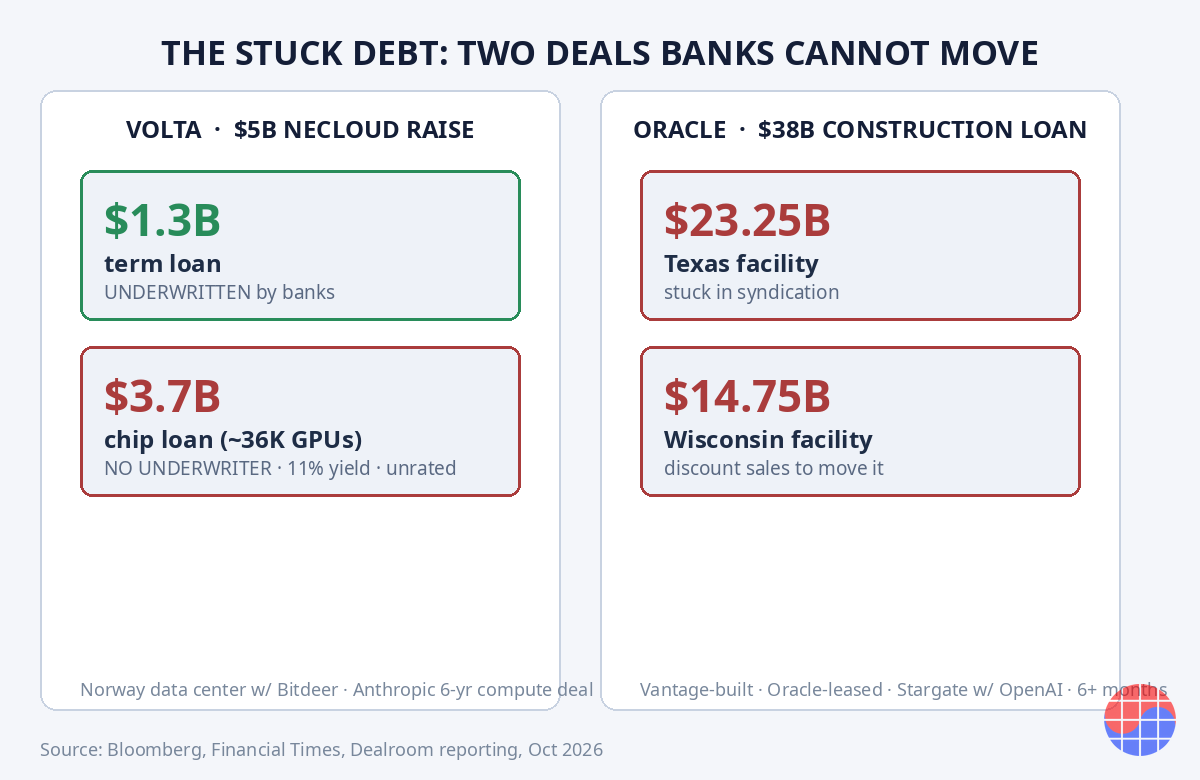
Deal one: the $38 billion loan nobody can move. A bank group led by JPMorgan and MUFG has spent more than six months trying to syndicate a record $38 billion construction loan tied to data centers in Texas and Wisconsin, built by Vantage Data Centers and leased to Oracle as part of its Stargate commitment with OpenAI (reported by Bloomberg, October 2026). After more than two dozen banks and investors joined, the arrangers are still shopping the last slice — and some lenders are now willing to sell pieces to non-bank buyers at a discount, just to move it.
Consider what that means. Banks underwrite debt to sell it, not to hold it; their business model is moving paper. Six months stuck on a deal is an eternity. The loan splits into a $23.25 billion Texas facility and a $14.75 billion Wisconsin facility, priced around 2.5 percentage points over the benchmark with a four-year maturity. Oracle's corporate rating sits one notch above junk after a July 2026 S&P downgrade — which does nothing to speed the sale.
Deal two: the $5 billion neocloud raise with a $3.7 billion hole. Volta Infrastructure Holdings, a UK neocloud founded in 2026 by former Brookfield infrastructure executives, is raising $5 billion in debt — led by JPMorgan and Goldman Sachs — to finance a data center complex in Norway, operated with Bitcoin miner Bitdeer. Here is the detail that matters: the banks underwrote only the $1.3 billion term loan, which is collateralized by the lease payments. The $3.7 billion chip loan — the part that buys roughly 36,000 NVIDIA GPUs — has no underwriter at all. It is being pitched at a yield of about 11 percent, one of the highest of the AI boom, and it is unrated, which keeps out the collateralized loan obligation funds that are normally the biggest buyers of leveraged loans (reported by Dealroom and The Inference, October 2026).
So the chain looks like this: the safest slice gets a bank's name on it, and the GPU-buying slice — the one that actually becomes semiconductor revenue — gets sold to yield-hungry investors at 11 percent, with no bank willing to stand behind it. Goldman, which collects the arranging fees, keeps the debt off its own balance sheet. Meanwhile, Goldman's own strategists are underweight hyperscaler credit.
Why now: rates, and the 2022 memory
The trigger is monetary. The Federal Reserve raised rates in September 2026 — its first hike in three years — and Goldman's economists expect another by December. On the earnings call, Goldman CEO David Solomon said pressure on rates could affect the returns and viability of AI projects, and that the bank remains highly selective about the AI risk it underwrites.
Banks remember 2022. Rapid rate hikes then left lenders holding big losses on leveraged loans they could not sell. Nobody at a money-center bank wants to be the one holding the next pile of unsold AI paper. The Financial Times reported that JPMorgan, Morgan Stanley, SMBC, and MUFG have been exploring significant risk transfers — deals that let a bank keep a loan on paper while shifting its riskiest slice to outside investors — because they are bumping up against internal limits on AI-linked exposure.
Matthew Moniot, co-head of credit risk sharing at Man Group — a firm whose entire business is pricing exactly this kind of bank debt — told the FT that the deal sizes are "out of scale to anything we've thought about, ever." When the professionals who buy bank risk for a living say the numbers no longer fit their models, that is not commentary. That is a market structure problem.
The part chip people should read twice: the real debt is off-balance-sheet
Here is where this story becomes a semiconductor story. Morgan Stanley's analysis of filings (reported by Axios, August 2026) found that the hyperscalers have committed to $1.1 trillion in payments for data center leases that have not even begun — and the seven companies (Google, Meta, Microsoft, Oracle, Amazon, NVIDIA, Broadcom) have also agreed to buy $1.7 trillion of "other stuff": purchase commitments for chips, memory, and networking gear. Google's commitments alone totaled $707 billion in the most recent quarter, versus $72.5 billion in all of 2025.
The structure works like this: a special purpose vehicle, mostly owned by an asset manager, borrows the money, builds the data center, and leases it to the tech company. The tech company books the rent as a lease. The bonds sit with the SPV — not on the hyperscaler's balance sheet. Prices on those bonds have been sliding.
Read that again from a chip vendor's perspective: a meaningful share of the "AI demand" in your order book is purchase commitments backed by lease structures and SPV debt — the very financing layer that banks are now retreating from. Purchase commitments are real until they are renegotiated. And renegotiation is exactly what happens when the funding behind the buyer gets repriced from "cheap bank loan" to "11 percent unrated paper."
The VLSI+MBA read: credit is the throttle on the AI cycle
Strip the finance jargon and this is a classic industrial-cycle story with one new variable: the buyer of last resort for chips is no longer just the hyperscaler with a fortress balance sheet. It is increasingly the neocloud — Volta, CoreWeave-style operators — funding GPU fleets with leveraged debt at double-digit yields.
Three strategic implications follow:
1. Demand quality now matters more than demand quantity. A 36,000-GPU order financed at 11 percent unrated debt is not the same asset as a 36,000-GPU order from a cash-rich hyperscaler. For NVIDIA, SK hynix, and Samsung's memory divisions, the question is shifting from "how many GPUs/HBM stacks will the market absorb" to "whose balance sheet is behind the purchase order." Vendor finance discipline — the boring art of checking customer credit — is about to matter in semiconductors the way it mattered in telecom equipment in 2001.
2. The equipment cycle gets a haircut. ASML, Applied Materials, Lam Research, and Tokyo Electron sell into foundry capex, and foundry capex is funded by the same credit markets that are repricing AI risk. If neocloud GPU demand softens, the second-order effect lands on memory pricing (HBM contracts are negotiated against datacenter build schedules) and then on logic capex. The 2028 equipment shortage narrative and the 2026 credit tightening narrative are now pulling in opposite directions — and credit usually wins the near term.
3. The winners consolidate. Alphabet became the first tech company in decades to issue a 100-year bond, raising $31.5 billion in February 2026. Cash-rich hyperscalers can fund the buildout at investment-grade rates while neoclouds pay 11 percent. That spread is a competitive moat: every point of funding cost is a point of margin the well-funded player can spend on custom silicon, on HBM supply agreements, or simply on outlasting the leveraged buyer. Expect the next twelve months to separate the AI infrastructure players into two tiers — and chip vendors should be tiering their customer forecasts the same way.
The bottom line
Banks dumping AI debt they underwrote six months ago is not proof the AI boom is a bubble. It is proof the boom's financing was priced for a rate environment that no longer exists. For the semiconductor industry, the message is concrete: the constraint on AI chip demand in 2027 may not be CoWoS capacity or HBM supply. It may be the cost of money. Watch the credit, not just the tapeouts — because when the lenders flinch, the purchase orders are never far behind.
FAQ
Why are banks selling AI data center debt they just underwrote?
Banks earn fees by arranging and distributing debt, not by holding it. With the Fed raising rates in September 2026 (the first hike in three years) and internal exposure limits binding, lenders including JPMorgan, Morgan Stanley, SMBC, and MUFG are using risk transfers and discounted sales to reduce AI-linked exposure — a defensive move shaped by 2022, when rapid rate hikes left banks holding losses on unsold leveraged loans.
What is the $38 billion Oracle loan stuck in syndication?
A construction loan backing Vantage-built data centers in Texas ($23.25B) and Wisconsin ($14.75B), leased to Oracle for its Stargate commitment with OpenAI. Led by JPMorgan and MUFG, the syndication has dragged on for more than six months (as of October 2026), with some lenders now willing to sell pieces at a discount to non-bank buyers. Oracle's rating sits one notch above junk after a July 2026 S&P downgrade.
What makes the Volta $5 billion deal unusual?
The banks underwrote only the $1.3 billion collateralized term loan; the $3.7 billion chip loan funding ~36,000 NVIDIA GPUs has no underwriter, is pitched at ~11% yield, and is unrated — blocking CLO buyers. It shows banks will take fees on the safe slice while leaving GPU-buying risk to yield investors.
How does this affect semiconductor demand?
A growing share of AI chip orders comes from neoclouds financed with leveraged debt rather than cash-rich hyperscalers. If refinancing costs stay high, those purchase commitments can be cut — hitting GPU, HBM/memory, and eventually equipment capex. Credit quality of the customer is becoming as important as the size of the order.
Disclosure
This article is analysis based on reporting by the Financial Times, Bloomberg, Axios, Dealroom, and The Inference as of October 15, 2026. Figures cited (deal sizes, yields, issuance projections) come from those reports and Goldman Sachs strategy estimates; they may be revised as deals close. Nothing here is investment advice.
*Issuance figures: Goldman Sachs strategy via AI Weekly, October 2026; deal details: Bloomberg, Financial Times, Dealroom reporting, October 2026.