VLSI Korea
China's EUV Light Source Prototype: What the 90% Localization Claim Really Means
Chinese startup Langdao Silex unveiled an EUV light source prototype. The 90% localization claim is the company's own, and 15W output is 10x+ below the hundreds of watts production EUV needs. A light source ≠ a lithography tool. The company itself says mass production needs 3–5 more years.


The 30-second version: On October 14, 2026, at the China International Industry Fair in Shanghai, Chinese startup Langdao Silex unveiled an EUV light source prototype, the "FlintNano LPP-OXXO." The company claims 90% localization, EUV output above 15W, and 100+ hours of continuous operation. Fact-check: what was shown is a light source — one core component of an EUV lithography tool, not a complete scanner — and it sits more than 10x below the hundreds of watts that production EUV requires. The company itself says mass production is 3–5 years away. A meaningful step, but not "China completes EUV."
Background: Who Showed What
On October 14, 2026, at the 26th China International Industry Fair (CIIF) in Shanghai, Chinese technology company Langdao Silex (朗道燧岩) publicly displayed its self-developed EUV light source system prototype for the first time. According to on-site staff, it is the most advanced domestically developed EUV light source prototype shown in public to date. An EUV light source is a core component — often called the "heart" — of the lithography tools needed to manufacture chips at 7nm and below.
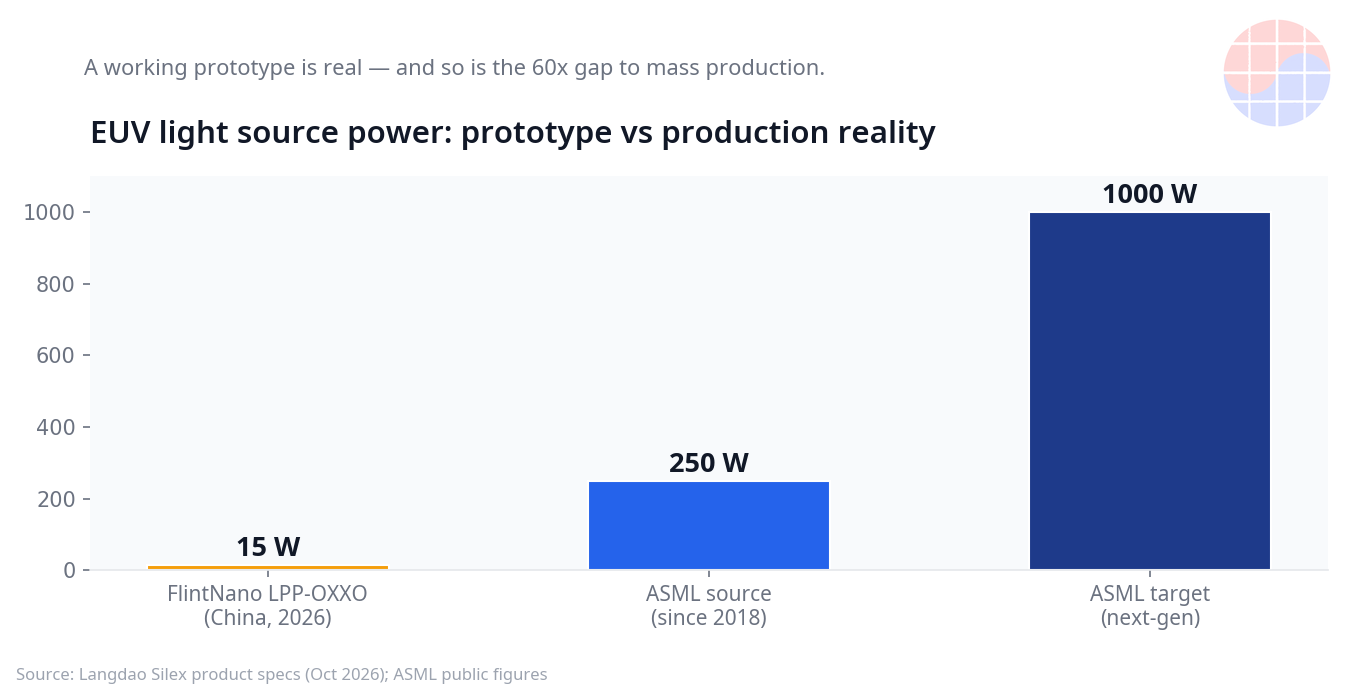
The published specifications (per the company's official website, as of October 16, 2026): the low-power EUV light source "FlintNano LPP-OXXO" runs a 1000W drive laser at 1–20kHz repetition, with conversion efficiency above 2%, EUV output energy above 15W, 100+ hours of continuous operation, a 60μm plasma size, and 3% RMS plasma stability. It uses LPP (Laser-Produced Plasma) — generating plasma with a high-power laser to produce EUV light — the same technical route as the leading international producer. The company says this product has entered the productization stage, while the high-power "FlintMicro-LPP" series has completed principle verification.
The company's claims, for the record: most core components independently developed, localization rate of about 90%, usable for chip exposure testing — and 3–5 years to large-scale commercial production. That last line matters most. Even optimistically, commercialization lands in 2029–2031.
Business Deep Dive: Fact-Check — What Is Confirmed, What Is Not
Confirmed 1: a light source prototype ≠ an EUV lithography tool
Correct the most common misunderstanding first. What was unveiled is an EUV light source, not an EUV lithography tool. Completing a scanner also requires ultra-precision projection optics (mirrors), wafer stages, and system integration. Per publicly available figures, a single EUV tool comprises hundreds of thousands of parts from more than 800 suppliers. The light source is one of three core subsystems. Building the "heart" does not complete the "body."
Confirmed 2: the power gap is more than 10x
Look at the numbers. The prototype's EUV output is just above 15W. Production EUV tools demand sources in the hundreds of watts. Public figures show ASML has used 250W-class EUV sources in volume production since 2018 and is now pushing toward 1000W-class technology. From 15W to hundreds of watts is not a simple "scale-up" problem: plasma stability, source lifetime, and long-run reliability must be secured alongside power — separate engineering challenges. The company itself lists "output improvement, long-term operational stability, and source lifetime" as future work.
Unverified: the basis of the "90% localization" claim
The 90% figure is the company's own on-site claim. No independent third-party verification has been made public. It is also unclear whether the number covers the light source system only, and whether it is counted by part number or by value. Localizing a light source subsystem and localizing a full lithography tool are different orders of problem. Chinese media covering the fair likewise noted that high localization of a prototype does not equal commercialization or manufacturing capability, with technology stability and process validation still ahead.
Context: DUV is moving, EUV is far
China's lithography localization is moving at two speeds. On DUV (deep ultraviolet), progress is concrete. In early 2025, SMEE (Shanghai Micro Electronics Equipment) delivered its 28nm immersion DUV tool (SSA800-10W series) to SMIC for testing, and a July 2026 report said China had begun producing domestically developed immersion DUV tools, with deliveries to major Chinese chipmakers expected this year. With multi-patterning, DUV can serve down to the ~10nm class, so mature-node self-sufficiency is rising fast.
EUV is a different order of problem. Reports of a 100–150W-class LDP (Laser-Induced Discharge Plasma) source developed by Harbin Institute of Technology in mid-2025, observations of an EUV prototype generating light at a Shenzhen lab in early 2025, and news that Tsinghua's SSMB (Steady-State Micro-Bunching) project began building a dedicated facility in Xiong'an in early 2025 are all either early-stage research results or unverified information. Langdao Silex's prototype is meaningful as a "physical unit shown in public," but the distance to a production tool remains years.
CXMT: memory is ahead of logic
Separately from equipment, China's memory catch-up shows up in numbers. Market observations put CXMT (ChangXin Memory Technologies) at roughly 10% of global DRAM revenue in Q2 2026 — the first double-digit quarter — ranking fourth behind Samsung (38%), SK hynix (25%), and Micron (24%). At the 2026 World Manufacturing Convention, the company announced mass production of its fifth-generation DRAM platform (G5) and commercial deployment of its self-developed LPDDR6 chip.
HBM is a different story. CXMT's revenue centers on commodity DDR4 and DDR5, with HBM allocation estimated at under 2% of total wafers. Compared with Samsung, which began HBM4 mass production in February 2026, the HBM gap remains large. Equating "10% DRAM share" with "China catching up in HBM" is an overreach.
Chase's Take
The right posture toward this news is "neither hype nor dismissal." A publicly displayed EUV light source prototype is a genuine milestone — a first step from lab research toward industrialization. Choosing the same LPP route as ASML reads as a signal: "no shortcut, the hard way." Regardless of whether the 90% localization claim holds up, the physical display itself shows China's EUV source capability is not zero.
But strategists and investors need to keep the units straight. Between a 15W source and a hundreds-of-watts production tool lies a 10–60x gap, plus two more mountains: optics and stages plus system integration. The company saying 3–5 years itself is the estimate of the party that best knows what filling that gap takes. Reading it as "about to replace ASML" doesn't do the math.
Through an MBA lens, China's semiconductor self-reliance strategy is an option portfolio: commercializing immersion DUV tools (near-term cash flow), the EUV source prototype (mid-term option), and radical alternatives like SSMB (long-term call option) — all running at once. For Korea, the thing to watch right now is not EUV but DUV. If Chinese-built immersion DUV tools actually start shipping to major Chinese chipmakers in 2026, the pricing structure of the mature-node equipment market shakes first. EUV can be managed as a ~2030 scenario.
Implications
- Equipment supply chain: Progress in EUV source localization affects ASML's long-term bargaining position vis-à-vis China, but it does not change the 2026–2028 equipment revenue structure. The near-term variable is whether immersion DUV tools expand supply inside China.
- Geopolitics: The US export-control regime centers on complete tools. Self-reliance progress in subsystems like sources raises questions about the long-term effectiveness of the control network — though a wide gap remains between subsystem self-reliance and volume tool production.
- Memory market: CXMT's 10% DRAM share is a variable affecting commodity DRAM pricing structure. The China variable in the HBM market is still minimal.
- The Korea angle: Not a direct threat to Samsung and SK hynix's HBM leadership. But the impact of China's DUV self-reliance on mature-node foundry and memory pricing deserves monitoring from H2 2026.
FAQ
Q1. Has China developed an EUV lithography tool?
No. What was unveiled on October 14, 2026, is a prototype of the light source system — a core component of an EUV lithography tool. Building a complete tool additionally requires ultra-precision optics, wafer stages, and system integration, none of which has been publicly demonstrated.
Q2. Is the "90% localization" claim credible?
It is the company's own on-site claim; no independent third-party verification has been made public. The figure is also limited to the light source system — different from the localization rate of a full lithography tool. Chinese media likewise noted that technology stability and process validation remain ahead before commercialization.
Q3. How does it compare with production EUV tools?
The prototype's EUV output is just above 15W, more than 10x below the hundreds of watts production tools require. ASML has used 250W-class sources in volume production since 2018. The company itself says large-scale commercial production needs another 3–5 years.
Q4. How far has CXMT come in HBM?
CXMT reached roughly 10% of global DRAM revenue in Q2 2026, ranking fourth worldwide, and announced G5 platform mass production and LPDDR6 commercialization. But its revenue centers on commodity DDR4/DDR5, with HBM allocation estimated under 2% of total. The HBM gap remains large.
Disclaimer: This article is based on public information as of October 16, 2026, and is not investment advice. Company claims without independent verification are identified as such.