VLSI Korea
Equipment Is the Real Bottleneck: The Execution Test Behind Samsung and SK hynix's Expansion Sprint
ASML says even 30% capacity increases in both 2027 and 2028 will not meet customer demand. SK hynix pulled its Yongin cleanroom opening forward three months and Samsung accelerated P5 Fab 2. In this cycle, expansion schedules are decided by secured EUV slots, not announcements.



30-Second Summary
- On October 14, 2026, ASML CEO Christophe Fouquet said the company's planned capacity increases — roughly 30% in 2027 and another 30% in 2028 for Low-NA EUV and immersion DUV systems — "will not allow us to meet our customer demand."
- Days later, the schedule race in Korea tightened further: SK hynix is opening the first cleanroom at its Yongin Y1 fab in February 2027, three months ahead of the original May target, while Samsung Electronics pulled construction of its P5 Fab 2 in Pyeongtaek into the second half of 2026.
- The binding constraint on both companies' expansion plans is no longer land, permits or even capital. It is equipment — above all EUV lithography systems, which take 18 months to two years to deliver and are effectively sold out years in advance.
- In this cycle, an expansion announcement is only as credible as the equipment slots behind it. Companies that locked in tools early convert schedules into capacity; companies that did not are buying time at rising prices — or waiting.
Background: One Week, Two Signals
The second week of October 2026 produced two signals that belong in the same story.
The first came from Veldhoven. Reporting third-quarter results on October 14 — net sales of €11.7 billion at a 57.5% gross margin, with full-year 2026 guidance raised to €44–45 billion — ASML used the occasion to deliver an unusual message for a supplier: even after expanding, it will not have enough product. The capacity plan ASML laid out in July, raising Low-NA EUV and immersion DUV output by about 30% in 2027 and another 30% in 2028, is already insufficient against the order book. "It is becoming very clear that 30% in 2027, 30% in 2028 will not allow us to meet our customer demand," Fouquet said. "We have to do more." CFO Roger Dassen added a detail that reveals how tight the market has become: ASML is deliberately holding off on accepting orders for 2029 and 2030, because it does not want to tell a customer who has not yet ordered, "Sorry, we're sold out."
The second signal came from Yongin, south of Seoul. SK hynix's first fab there (Y1) will open its first cleanroom in February 2027 — three months earlier than the original May schedule — with production targeted for October 2027. The Yongin cluster is a 600 trillion won project that will eventually house four fabs. SK hynix's board has also approved roughly 54 trillion won for the follow-on Y2 fab in Yongin (35.2 trillion won) and the M17 fab in Cheongju (19.1 trillion won); Y2's first cleanroom is planned for June 2029. In Cheongju, the M15X fab built for HBM began receiving wafers in February 2026.
Samsung Electronics is running the same play. Its P5 Fab 1 in Pyeongtaek targets operation in 2028 as an HBM production hub, and the company has pulled construction of P5 Fab 2 — a twin facility previously scheduled to break ground early next year — into the second half of 2026, with land preparation already under way. Industry estimates put construction cost at roughly 80 trillion won per P5 fab. Samsung's first fab at the Yongin national industrial complex is slated to begin operations in 2029, with groundbreaking this month.
Both Korean makers are accelerating into a market where warnings about a 2029 memory glut are already circulating. The interesting question is not why they are accelerating. It is whether the announced schedules can physically happen — and that question runs through a factory in the Netherlands.
Business Deep Dive
The Physics of a Lead Time
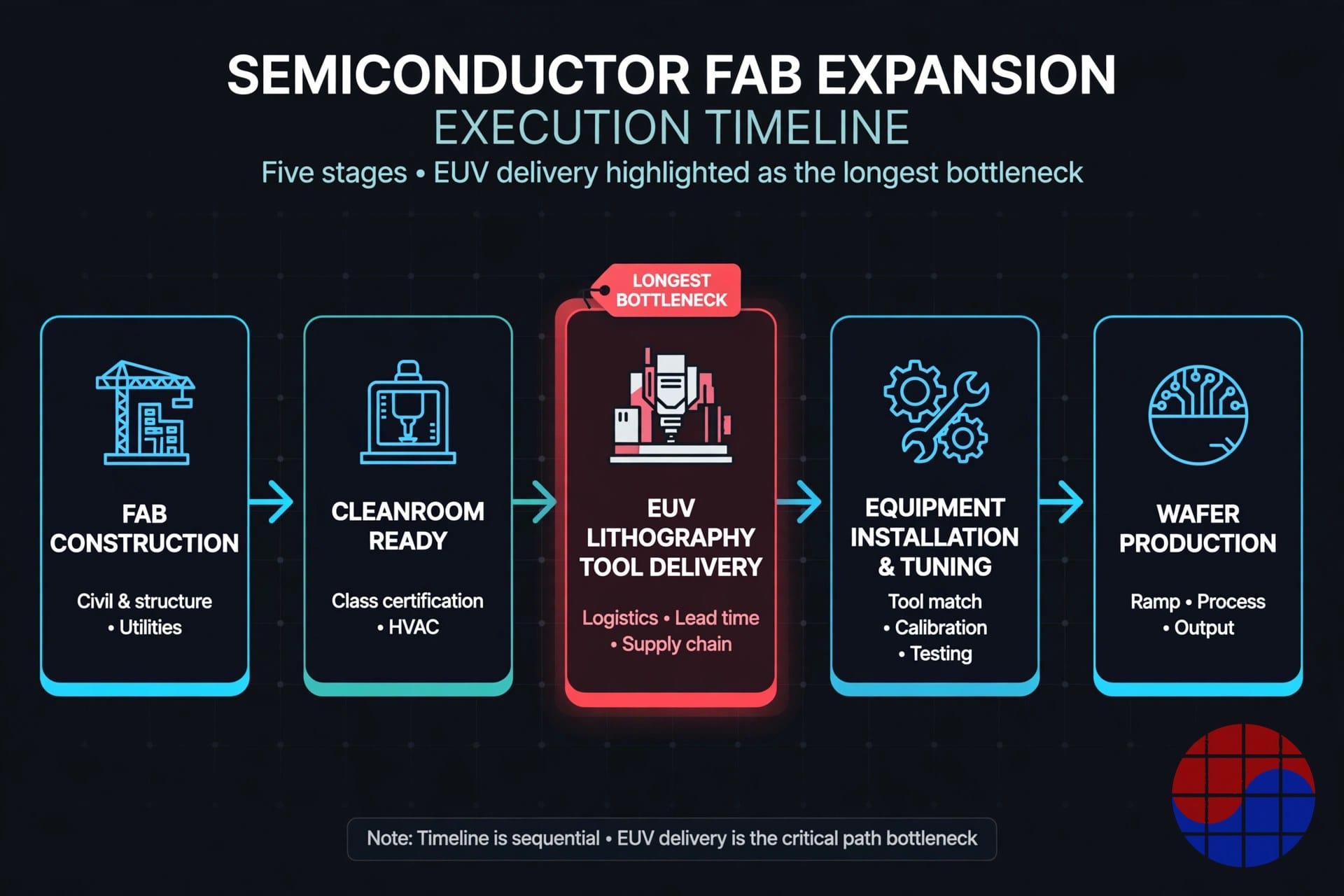
A fab schedule is a chain of dependencies, and the slowest link sets the pace. Construction of a fab shell takes roughly two to three years; Samsung itself told investors on its second-quarter call that more than three and a half years elapse between starting a new fab and producing wafers. Within that chain, one link has stretched the furthest: lithography. Semiconductor equipment typically takes 18 months to two years from order to delivery, and EUV systems sit at the long end of that range. An EUV scanner is not shipped so much as installed — it arrives in pieces, requires weeks of assembly and calibration, and is followed by months of process tuning before yields reach production levels.
This physics reframes what "acceleration" means. When SK hynix opens a cleanroom three months early, it is not producing chips three months early; it is buying three months of equipment-installation and tuning runway. When Samsung starts P5 Fab 2 construction six months early, it is purchasing the option to install tools earlier if — and only if — the tools exist. A cleanroom without equipment is an expensive empty room. An equipment delivery slot without a ready cleanroom is a machine in a warehouse. The schedule is credible only where the two curves intersect.
ASML's numbers show how narrow that intersection has become. Media reports indicate ASML plans to deliver more than 60 EUV systems in 2026 and roughly 80 in 2027. Against that supply, demand is compounding: TSMC, Samsung, SK hynix, Micron and Intel are all expanding advanced capacity simultaneously, and ASML's customers are discussing orders for 2029 and 2030 today. When the sole supplier of a critical input tells the market that a cumulative ~70% capacity increase over two years is insufficient, the input has stopped being a procurement item and become an allocation mechanism.
Cleanrooms First: Buying Time with Concrete
Both Korean companies have converged on the same hedge: build the cleanroom before the equipment decision is final. Samsung has stated the doctrine explicitly — secure cleanrooms through preemptive infrastructure investment, then introduce equipment flexibly as demand evolves. SK hynix's Yongin acceleration is the same logic executed from the other direction: pull the building forward so that equipment, whenever it arrives, lands in a finished room rather than a construction site.
The economics are asymmetric, which is why the strategy makes sense. A cleanroom shell is a small fraction of total fab cost — the building is cheap relative to the tens of trillions of won in process tools that fill it. But the option value is large. Every month of equipment-installation runway preserved is a month of output at AI-cycle memory prices. Conversely, an idle equipment slot cannot be stored: if ASML's delivery window passes while a customer's cleanroom is unfinished, the slot reallocates to a competitor who is ready. In an allocation market, readiness is a competitive weapon.
The cost side is real, though. Pulling construction forward means spending capital earlier, paying rush premiums to contractors, and carrying an empty, depreciating asset if equipment slips. SK hynix will run Yongin's Y1 cleanroom from February 2027 while volume production targets October — an eight-month gap that must be filled with installation, qualification and yield learning. That gap is the price of the option, and both companies have decided it is worth paying. SK Group chairman Chey Tae-won has said the memory shortage is now likely to persist until 2030, with a wafer shortfall of more than 20% expected; against that demand outlook, idle-cleanroom risk looks smaller than missed-slot risk.
Contracts as Schedule Insurance
The most concrete evidence that equipment — not intent — now sets the pace is on SK hynix's disclosure record. The company has filed a purchase of EUV scanners from ASML worth 11.95 trillion won (about $8 billion), with delivery by December 2027. Whatever fab those tools are destined for, the filing converts a plan into a dated, priced claim on ASML's scarcest product. Media reports add that SK hynix plans to install around 20 Low-NA EUV systems over the next two years for HBM and advanced DRAM production.
This is the pattern to watch across the industry. Long-term equipment contracts, prepayments and multi-year slot reservations are becoming the real expansion announcements; the fab groundbreakings are ceremony. An investor comparing two makers' 2028 capacity claims should ask a different question than "who announced more?" The right questions are: whose tools are already contracted, with what delivery dates, and whose cleanrooms will be ready when the tools arrive?
The Second Bottleneck: Power, Water, Roads
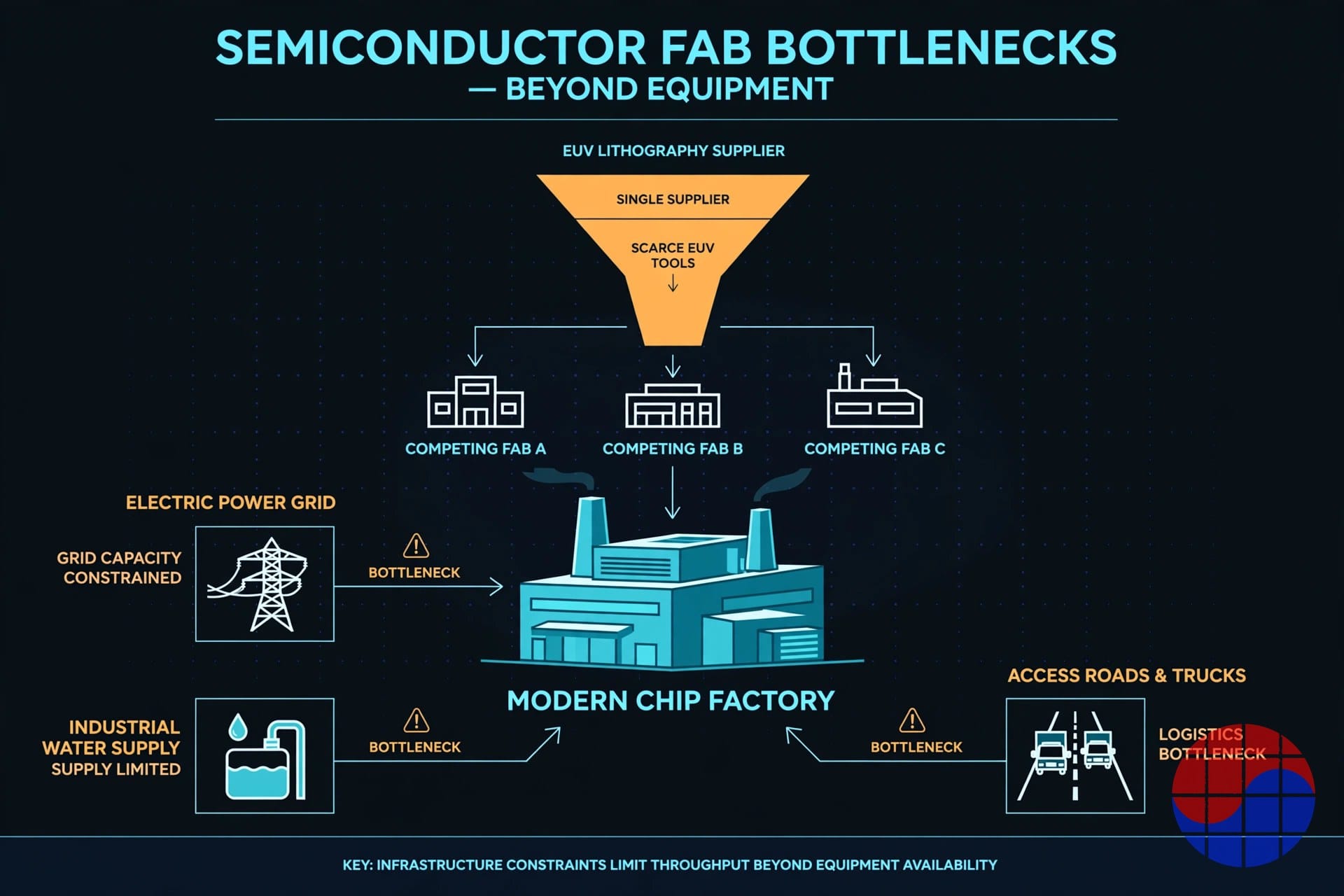
Equipment is the binding constraint, but it is not the only one. Korea's business federation has warned that the Yongin cluster's supporting infrastructure is lagging the fabs themselves: expansion of the main access road is unlikely to finish before Y1's cleanroom opens, and industrial water supply requires additional public support. Samsung's and SK hynix's Yongin projects, plus the planned Jeonnam-Gwangju cluster, all draw on the same pool of construction capacity, utility buildout and — critically — equipment. Policy support so far has concentrated on land and power. The October debate in Korea marks the point where equipment joined that list: officials now describe securing tools as a new variable in how fast the fabs come online.
Chase's Take
The memory industry has run this movie before — announce capacity at the peak, deliver it into the downturn. What is different this time is not discipline; it is physics. In previous cycles, a maker that announced a fab could plausibly build it: equipment vendors had slack, and lead times were measured in quarters. In this cycle the marginal unit of Korean memory capacity must pass through a Dutch bottleneck that is rationing supply into 2029 and 2030.
That changes how to read every headline in this story. SK hynix's three-month cleanroom acceleration looks small until you price it correctly: it is an insurance premium on an 11.95 trillion won equipment claim and on HBM contracts that punish late delivery. Samsung's early start on P5 Fab 2 is likewise not really about 2030 output; it is about being installation-ready whenever its EUV allocation lands. Both companies are behaving as if they believe ASML's warning — that the tools, not the demand, will decide who ships in 2028.
The corollary is uncomfortable for anyone modeling a 2029 glut on announced capacity alone. Announced capacity is a statement of intent; deliverable capacity is a statement about equipment slots, cleanroom readiness and utility hookups, in that order. If ASML cannot expand faster, some portion of the industry's announced 2028–2029 capacity will slip right — which is precisely why the makers with contracted tools are accelerating everything else. They are not racing each other. They are racing the allocation queue.
Implications
For investors. Discount expansion announcements by their equipment backing. A fab schedule supported by filed equipment contracts (SK hynix's December 2027 EUV delivery is the cleanest example) deserves a higher probability weighting than one supported by construction starts alone. ASML's fourth-quarter disclosures — particularly backlog and 2028 order intake — are now leading indicators for Korean memory supply, not just for ASML's own revenue.
For equipment makers. ASML's pricing power and order visibility are extending, but the same physics applies one tier down: etch, deposition, inspection and advanced packaging tools face their own allocation queues as every customer accelerates simultaneously. Watch whether Korean makers extend the long-term-contract pattern beyond lithography.
For Samsung and SK hynix. The execution race has three checkpoints: (1) whether Yongin Y1's equipment installation proceeds on the February 2027 cleanroom schedule without infrastructure delays; (2) whether Samsung's P5 tool orders surface with delivery dates matching its 2028 target; (3) whether ASML's additional capacity measures, promised for 2028 and beyond, arrive in time to matter for the fabs now being accelerated. The winners of this cycle will be decided less by who predicted demand correctly than by who converted predictions into installed tools first.
Note: Figures drawn from company disclosures and earnings statements are cited as reported; industry estimates (such as per-fab construction costs) are labeled as such and actual figures may differ.
| Item | Detail |
|---|---|
| ASML capacity plan | Low-NA EUV and immersion DUV output +~30% in 2027 and +~30% in 2028 — still below customer demand |
| Equipment lead time | 18 months to 2 years from order to delivery; EUV at the long end |
| ASML EUV deliveries (media reports) | More than 60 systems in 2026, ~80 in 2027 |
| SK hynix Yongin Y1 | First cleanroom Feb 2027, 3 months early; production targeted Oct 2027 |
| SK hynix EUV purchase (disclosed) | KRW 11.95 trillion (~USD 8 billion), delivery by Dec 2027 |
| Samsung P5 Fab 2 | Construction pulled into H2 2026; P5 Fab 1 targets operation in 2028 |
FAQ
Q1. Why is equipment — rather than capital or land — the bottleneck for Samsung and SK hynix's expansion? Both companies have secured land and are spending at record levels, but EUV lithography systems come from a single supplier, ASML, which has said its planned ~30% capacity increases in both 2027 and 2028 will not meet customer demand. Equipment lead times of 18 months to two years mean today's fab schedules depend on tool orders placed years in advance.
Q2. What did SK hynix actually accelerate at Yongin? SK hynix moved the first cleanroom opening at its Yongin Y1 fab to February 2027, three months earlier than the original May plan, with production targeted for October 2027. An earlier cleanroom means equipment installation and process tuning can start sooner — it buys execution runway, not instant output.
Q3. How large is SK hynix's EUV purchase from ASML? SK hynix has disclosed an EUV scanner purchase worth 11.95 trillion won (about $8 billion) with delivery by December 2027. It is one of the clearest examples of a chipmaker converting an expansion plan into a contracted claim on scarce equipment.
Q4. Does ASML's shortage mean the announced 2028–2029 capacity will not materialize? Not entirely — but it means announced capacity and deliverable capacity will diverge. Fabs with contracted equipment and ready cleanrooms will ramp close to schedule; fabs still waiting for tool allocations will slip. That divergence, not the headline announcements, will determine actual 2028–2029 memory supply.
📩 Subscribe to VLSI Korea
Get our daily semiconductor deep-dives delivered to your inbox first. Free to subscribe.