VLSI Korea
Chip Stocks Fell 8 Straight Days While Earnings Estimates Rose: The Bottleneck Moved From Silicon to Credit
The SOX fell 8 straight sessions and the KOSPI lost over 20%, yet TSMC raised its outlook and KOSPI forward EPS was revised up. Why prices and earnings diverged — and the five signals that would turn this credit repricing into a real downcycle.


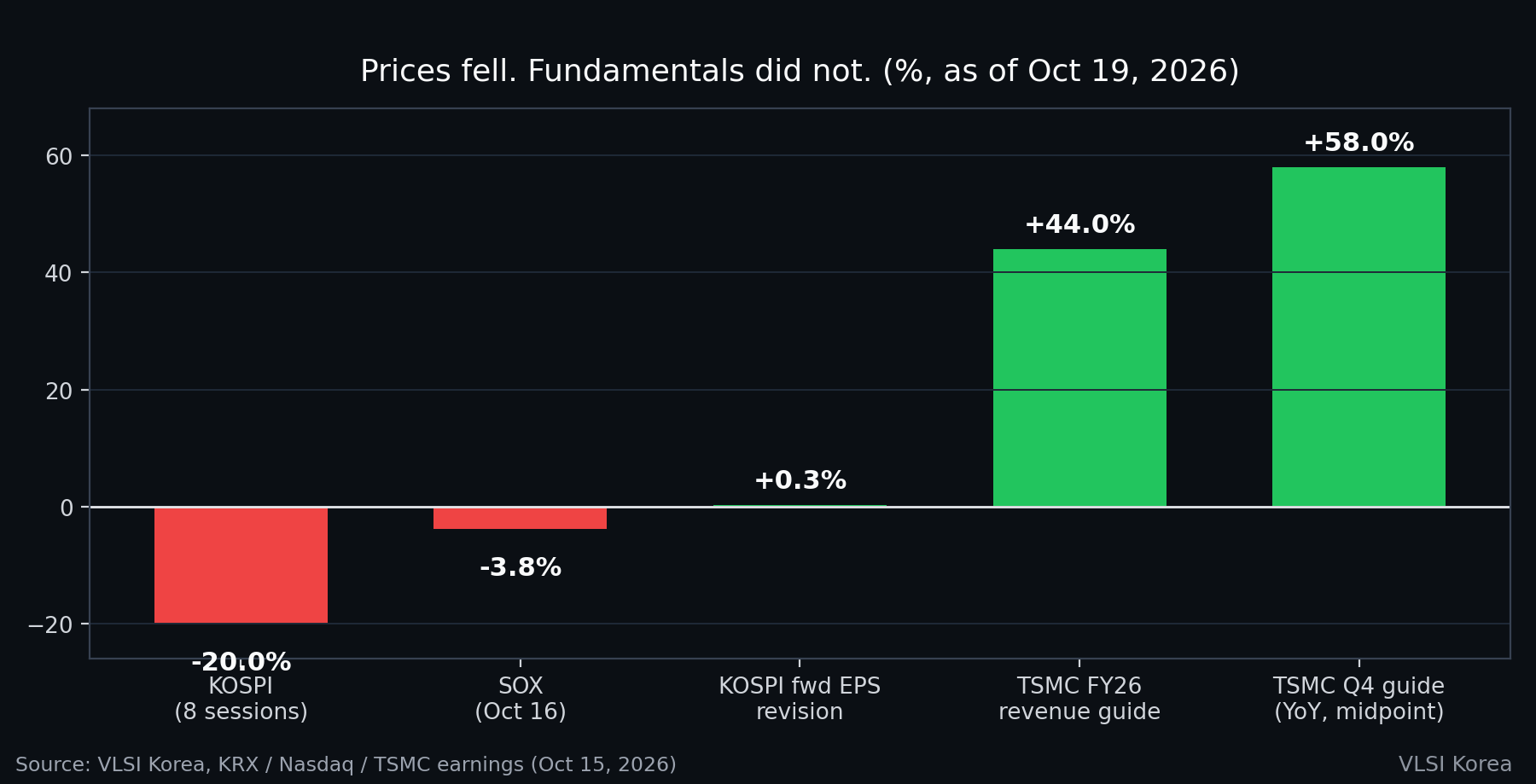
Conclusion first: as of October 19, 2026, the semiconductor selloff is a credit repricing, not a demand break. The Philadelphia Semiconductor Index (SOX) has fallen for eight straight sessions, its longest losing streak since the 2008 financial crisis. The KOSPI has lost more than 20% in eight trading sessions. Yet over the same window, TSMC reported a sixth consecutive record quarterly profit and raised its outlook, and the KOSPI's 12-month forward earnings estimate was revised up, not down. Prices and fundamentals are moving in opposite directions — and the variable that changed is not silicon supply. It is the cost and perceived safety of the debt funding the AI buildout.
That distinction decides what happens next. A demand break cuts orders, tapeouts and capex. A credit repricing cuts multiples first, and only reaches orders if funding stress spreads from marginal borrowers to the hyperscalers who self-fund. This article lays out the verified numbers, the transmission channel, and the five signals that would change the conclusion.
The numbers, as of October 19, 2026
| Signal | Reading | Date |
|---|---|---|
| KOSPI open | 5,488.41, down 179.64 points (-3.17%) | Oct 19, 2026 |
| KOSPI, 8 sessions | More than -20% | Oct 2-19, 2026 |
| SOX losing streak | 8 straight sessions, longest since 2008 | As of Oct 16, 2026 |
| CoreWeave stock, one day | -11.91% | Oct 16, 2026 |
| CoreWeave 5-year CDS | Above 1,100 bp | Week of Oct 12, 2026 |
| KOSPI 12-month forward EPS | Revised up +0.3% | Oct 19, 2026 |
| TSMC Q3 2026 net income | NT$763.06 billion, +68.7% year over year | Oct 15, 2026 |
| TSMC Q4 2026 revenue guidance | US$52.3-54.3 billion, about +58% year over year at midpoint | Oct 15, 2026 |
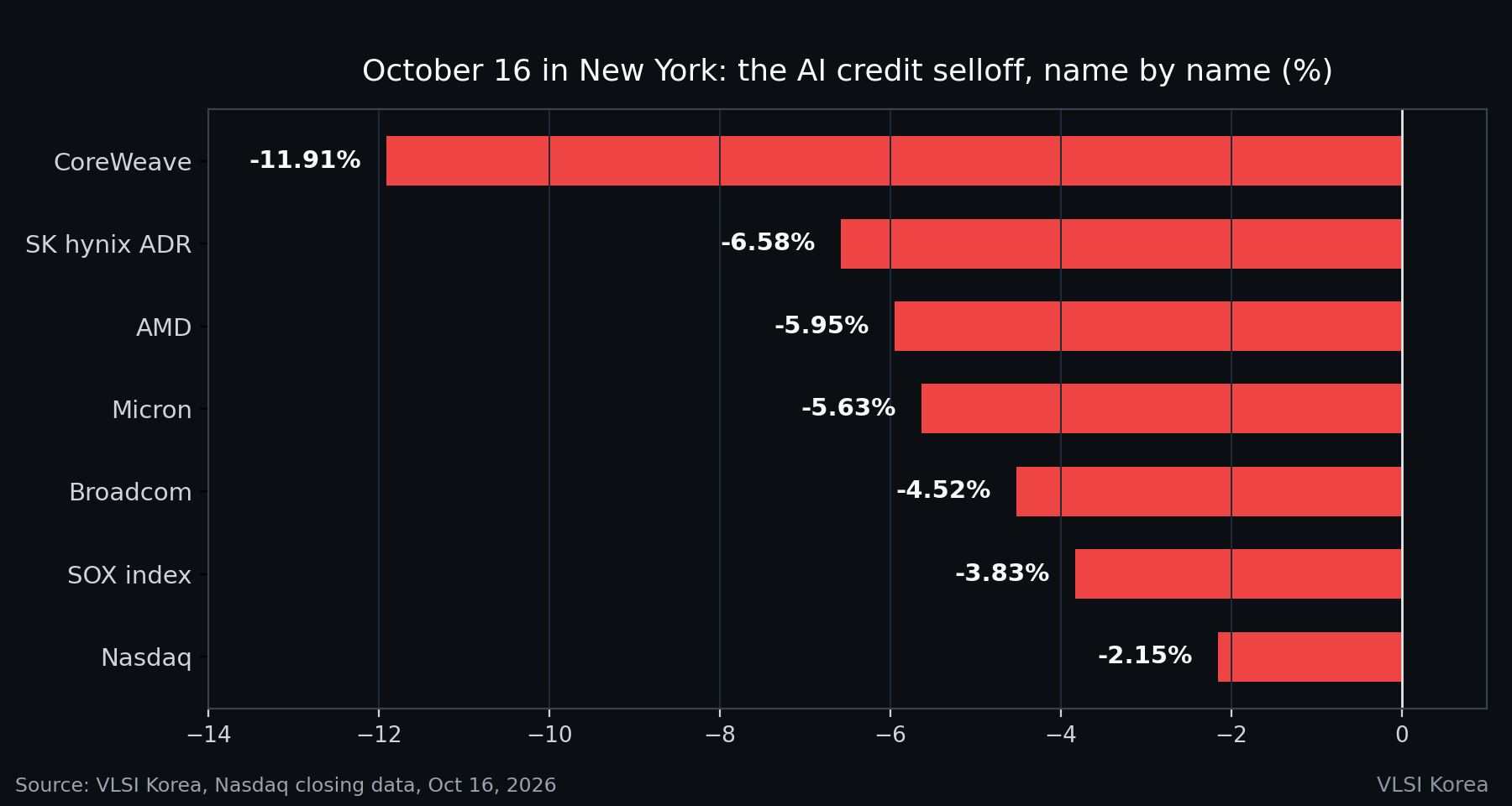
On Friday, October 16 in New York, the Nasdaq fell 2.15% to 26,140.03 and the SOX fell 3.83%. The selling was led by the names closest to AI infrastructure credit: CoreWeave fell 11.91%, the SK hynix ADR fell 6.58%, AMD fell 5.95%, Micron fell 5.63% and Broadcom fell 4.52%. On Monday, October 19 in Seoul, the KOSPI opened down 3.17% at 5,488.41 and the KOSDAQ opened down 2.73% at 773.06. Samsung Electronics and SK hynix fell 5-6% in premarket trading before dip-buying by foreign and institutional investors narrowed the losses; by 9:06 a.m. Samsung Electronics was down 1.16% at 213,000 won and SK hynix was down 1.97% at 1,247,000 won. Japanese names tied to the same chain, including silicon wafer and EUV mask-inspection suppliers, also fell about 6% in the morning session.
What actually changed: the price of AI debt
Three facts explain the violence of the move, and none of them is a cancelled chip order.
First, the market started pricing the borrower, not the chip. CoreWeave, the most leveraged large buyer of AI compute, saw its 5-year credit default swap spread move above 1,100 basis points in the week of October 12, 2026. A CDS spread at that level is the credit market saying a borrower's default risk is no longer theoretical. Equity investors then re-rated every company whose revenue depends on leveraged buyers continuing to borrow — which, in the AI supply chain, is almost everyone.
Second, Korea's index structure amplified a global factor into a national index event. The KOSPI is heavily concentrated in memory semiconductors. When a global credit factor hits chip stocks, the KOSPI does not dilute the shock across sectors; it concentrates it. Goldman Sachs noted in its October 19, 2026 Korea Weekly Kickstart that declines of more than 20% in eight sessions have occurred only in periods of extreme stress — the Asian financial crisis, the global financial crisis and the COVID-19 outbreak — while attributing this episode to above-expectation inflation, AI-linked credit concerns and uncertainty over Chinese DRAM supply, not to collapsing Korean earnings.
Third, macro added fuel. WTI crude above US$100 per barrel and an inflation print above expectations raised the discount rate applied to exactly the long-duration, capex-heavy cash flows that AI infrastructure stocks represent. Yuanta Securities Korea summarized the correction on October 19 as stemming "not from listed companies' earnings but from funding for the AI investment cycle and a re-rating of valuations."
The other side of the ledger: TSMC, four days earlier
On October 15, 2026 — in the middle of the SOX losing streak — TSMC reported third-quarter net income of NT$763.06 billion (about US$23.6 billion), up 68.7% year over year, on revenue of US$46.72 billion, above its own guidance. It guided fourth-quarter revenue to US$52.3-54.3 billion, raised full-year 2026 revenue growth to about 44% in U.S. dollar terms, and held 2026 capex at US$60-64 billion. High-performance computing, which includes AI accelerators, was 68% of revenue; 2nm was already 8% of wafer sales. CEO C.C. Wei said AI accelerator demand growth through 2029 would "probably be higher" than the previously guided mid-to-high-50s percent CAGR, and that demand remains far above TSMC's ability to supply.
TSMC also said it is checking whether customers have the financing and supporting components to deploy AI systems — and that even after those checks, demand exceeds supply. That sentence matters for this selloff: the industry's central supplier is explicitly stress-testing its customers' funding, and still cannot keep up.
This is the pattern of a valuation reset, not a cycle turn — so far. In a true demand break, the sequence runs the other way: orders are cut first, guidance follows, and only then do multiples compress. Here, multiples compressed first while guidance rose.
How this looks from the design floor
From a signoff desk, the physical pipeline does not reprice overnight. Chips being taped out this quarter were started 12-24 months ago; HBM qualification schedules, package substrate bookings and equipment lead times move in quarters, not in trading sessions. A credit event reaches this pipeline through exactly one door: purchase orders and capex approvals at the buyer. That is why the correct monitoring unit is not the share price but the order book of the marginal buyer.
The exposure is also unevenly distributed, and the market knows it. Hyperscalers fund AI capex largely from operating cash flow; their buildout continues even if credit markets close. Neoclouds and second-tier data center operators fund from debt; they are the marginal buyers of GPUs, networking and, indirectly, HBM — and they are the first to pause when spreads blow out. A credit-led slowdown therefore does not hit the chain uniformly. It hits merchant capacity and spot-exposed suppliers first, and contracted HBM and leading-edge foundry capacity last. The October 16 scoreboard — the leveraged buyer down 11.91%, the foundry-anchored names down less — already reflects that ordering.
There is also a timing lesson from past cycles. In the 2000 telecom buildout, the credit break came first and the equipment order collapse followed by roughly two quarters, because carriers kept spending committed capex until refinancing actually failed. The lag is the opportunity: the signals below are observable before orders move.
Five signals that would change this conclusion
Treat the current episode as a credit repricing unless at least two of the following trigger:
- TSMC cuts capex or guidance. The US$60-64 billion 2026 capex plan and the raised 44% growth outlook are the load-bearing facts of the "fundamentals intact" case. A cut breaks it.
- A hyperscaler cuts AI capex guidance in the upcoming Big Tech earnings round. Self-funded buyers pausing would mean the problem is demand or returns, not credit.
- HBM contract pricing is renegotiated down. Contracted HBM pricing for 2027 is the tightest part of the chain; a downward renegotiation would show stress reaching the core order book.
- Credit stress spreads beyond the marginal borrower. Watch whether CDS and bond spreads widen for investment-grade hyperscalers and the broader high-yield market, not only for leveraged AI infrastructure names.
- Equipment orders are pushed out. Backlog pushouts at leading lithography, deposition and test suppliers would confirm the credit channel has reached physical orders.
Until then, the honest summary of October 19, 2026 is uncomfortable but precise: the AI buildout's bottleneck has moved. For three years it was silicon — wafers, HBM stacks, advanced packaging. This month, for the first time, the binding constraint being repriced is the balance sheet that pays for the silicon. Engineers solved the first bottleneck. The second one belongs to the CFO.
FAQ
Did semiconductor demand fall in October 2026?
No, based on data available as of October 19, 2026. TSMC raised its full-year 2026 revenue growth outlook to about 44% and guided fourth-quarter revenue about 58% higher year over year on October 15, 2026, and the KOSPI's 12-month forward EPS estimate was revised up 0.3%. Share prices fell; reported demand did not.
Why did the KOSPI fall more than 20% in eight sessions?
Because a global AI credit shock hit an index concentrated in memory semiconductors. The KOSPI opened October 19, 2026 down 3.17% at 5,488.41 after the SOX fell for eight straight sessions. Analysts attributed the drop to AI credit concerns centered on CoreWeave, above-expectation inflation, oil above US$100 and uncertainty over Chinese DRAM supply.
What is CoreWeave's role in the chip selloff?
CoreWeave is the most leveraged large buyer of AI compute, so its credit is the market's stress gauge for debt-funded AI capex. Its shares fell 11.91% on October 16, 2026 and its 5-year CDS spread rose above 1,100 bp, prompting investors to re-rate suppliers whose revenue depends on leveraged buyers.
What would turn this selloff into a real semiconductor downcycle?
Order-book evidence: a TSMC capex or guidance cut, a hyperscaler AI capex cut, downward HBM contract repricing, credit stress spreading to investment-grade buyers, or equipment order pushouts. Two or more of these would indicate the credit channel has reached physical demand.
Disclosure: This article is an analysis of publicly reported market and company data as of October 19, 2026 (exchange data, TSMC's October 15, 2026 earnings release and call, and brokerage commentary published October 19, 2026). It is not investment advice. Figures are as reported by the cited sources on the stated dates and may be revised.
📩 Subscribe to VLSI Korea
Get our daily semiconductor deep-dives delivered to your inbox first. Free to subscribe.